


More news on this day
Delta Air Lines and JetBlue have climbed to the top of global cancellation tables after a fresh wave of Federal Aviation Administration ground stops disrupted operations for a second consecutive day at multiple major U.S. airports, straining already fragile summer schedules and leaving thousands of travelers scrambling to rebook.
Get the latest news straight to your inbox!
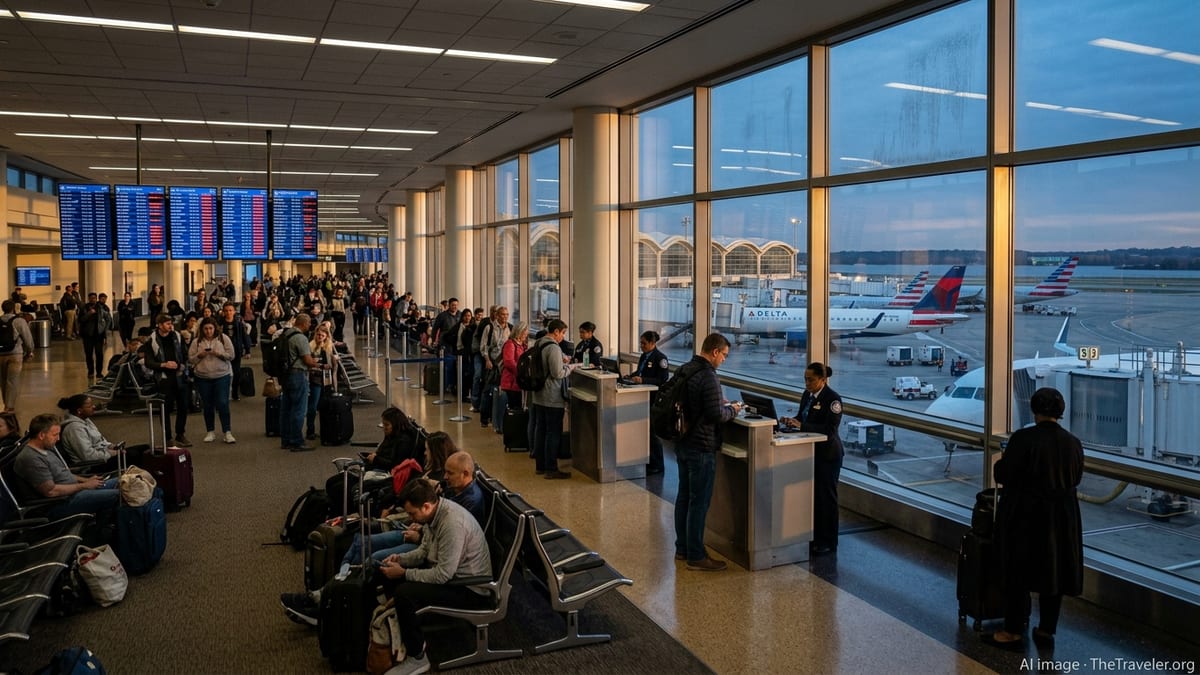
Back-to-back FAA ground stops ripple through U.S. hubs
Publicly available FAA traffic management advisories and daily air traffic reports indicate that a series of ground stops and flow-control programs have been in place for two days in a row at several large U.S. hubs, including New York area airports and Atlanta. These measures, triggered by a combination of convective storms, high congestion and staffing constraints in key airspace sectors, have repeatedly halted or sharply slowed departures bound for the affected airports.
Ground stops are among the most disruptive tools available to air traffic managers because they hold flights at their origin airports until conditions at the destination improve. When imposed on high-volume hubs, they quickly create bottlenecks that ripple across the national network, tying up aircraft and pushing crew members toward duty-time limits. Even after the formal stop is lifted, the resulting imbalance between planes, crews and passengers can take many hours to unwind.
Recent FAA summaries of daily operations point to elevated levels of delays and cancellations linked to severe weather systems and traffic management initiatives in the Northeast and Southeast. Earlier in July, similar measures at Atlanta produced widespread disruption across Delta’s network, and fresh rounds of ground stops this week have again hit the same pressure points during one of the busiest travel periods of the year.
Industry observers note that while all carriers share the same air traffic restrictions, those with dense schedules at a handful of major hubs tend to suffer the most severe knock-on effects when ground stops are issued repeatedly over consecutive days.
Delta among hardest hit as hub-focused model magnifies disruption
Operational data compiled from flight tracking dashboards show Delta near the top of global cancellation rankings during the latest two-day spell of FAA ground stops. The carrier’s reliance on a small number of mega-hubs, particularly Atlanta and New York, leaves it especially vulnerable when those airports face repeated holds and arrival rate reductions.
Earlier this month, coverage on aviation and travel outlets documented how a mid-July ground stop at Atlanta cascaded into network-wide disruption for Delta, with mass cancellations and extended delays spreading far beyond the Southeast. The pattern is now repeating as successive days of air traffic restrictions compress already tight summer schedules, forcing Delta to prune flights and consolidate operations to preserve the remainder of its timetable.
Publicly visible advisories and airline communications also highlight how operational stressors accumulate over multiple days. When thunderstorms, heat-related ramp restrictions and airspace flow constraints overlap, aircraft and crews can quickly become out of position. Once duty-time limits are reached and spare capacity is exhausted, airlines have little choice but to cancel flights preemptively, often at short notice.
Analysts point out that Delta has recent experience managing large-scale disruptions, including the global IT outage of July 2024, and has since emphasized investments in recovery planning. Even so, current cancellation figures suggest that persistent ground stops continue to test the resilience of hub-and-spoke operations during peak demand.
JetBlue tops global cancellation tables amid Northeast constraints
JetBlue is emerging as another focal point of the current disruption. Aviation industry coverage citing FlightAware statistics in late July reports that JetBlue has recorded the highest volume of cancellations worldwide over several recent days, closely linked to repeated program constraints in the congested Northeast corridor.
The carrier’s network is heavily concentrated at New York John F. Kennedy and Boston Logan, both of which have been subject to ground stops and route restrictions during the latest weather systems and traffic management initiatives. When departures to these airports are held or throttled for extended periods, JetBlue has limited alternative hubs or routings it can use to absorb displaced passengers, resulting in a higher proportion of cancellations compared with larger, more diversified competitors.
Passenger accounts shared on public forums describe a pattern of late-night cancellations, rolling delays and tight rebooking options on JetBlue services from New York, Boston and secondary cities such as Buffalo. While some disruptions are clearly tied to storms and FAA programs, online commentary from frequent travelers and self-identified employees points to internal scheduling and crew-positioning challenges that may be compounding the impact of external constraints.
Travel waiver notices circulated by the airline for New York and Boston departures over several consecutive days further underscore the scale of the disruption. These waivers typically allow affected customers to change or cancel trips without fees, a step carriers use when they expect elevated levels of operational difficulty across a region.
Why two days of ground stops cause lasting damage
A key feature of the current situation is the back-to-back nature of FAA ground interventions. Aviation planning guidance shows that even a single afternoon of ground stops at a major hub can generate hundreds of cancellations and thousands of delays. When similar constraints recur the following day, airlines are forced to manage both the new disruption and the unresolved residue of missed connections, stranded aircraft and displaced crews from the previous cycle.
The mechanics are straightforward but unforgiving. Aircraft stuck on the ground at origin cannot operate their onward segments later in the day, shrinking capacity throughout the schedule. Crews timed out by long duty periods cannot immediately be reassigned, particularly when hotels and ground transport are stretched. With spare aircraft and personnel already limited during peak season, carriers have little flexibility to mount recovery flights.
The cumulative effect is most visible in global cancellation tables, where U.S. airlines with large domestic footprints tend to dominate when the national airspace system is under strain. Data highlighted in recent aviation reports show that on several July days, U.S.-based carriers collectively accounted for a significant share of worldwide cancellations, with Delta and JetBlue frequently appearing at or near the top of those rankings.
Regulatory and policy analyses produced after past disruptions, including the nationwide ground stop linked to a notice-system failure in 2023 and the technology outage of 2024, have emphasized the need for both robust federal systems and more resilient airline schedules. The latest episode of repeated ground stops is likely to renew questions about how quickly carriers can restore normal operations once the immediate air traffic restrictions are lifted.
What travelers can expect in the days ahead
For passengers, the two-day sequence of ground stops and cancellations is a reminder that mid-summer flying in the United States remains highly vulnerable to cascading disruption. Even travelers whose flights do not touch the most affected hubs may experience knock-on delays as aircraft and crews are rerouted or substituted to cover higher-priority segments.
Consumer advocates and travel analysts routinely recommend that passengers build additional buffer time into itineraries during peak season, favor early-day departures when possible and monitor flight status closely in the 24 hours before travel. In periods of repeated ground stops, same-day rebooking options can shrink rapidly, particularly on airlines with limited frequencies in certain markets.
Published guidance from the U.S. Department of Transportation also underscores that, regardless of the cause of a disruption, travelers are entitled to refunds when airlines cancel flights or make significant schedule changes that passengers choose not to accept. Recent high-profile meltdowns have prompted greater public awareness of these rights, and the current wave of cancellations at Delta, JetBlue and other carriers is likely to add further scrutiny.
In the immediate term, publicly available operational dashboards suggest that airlines will continue to face an uphill battle to stabilize schedules if storms and airspace constraints persist over key hubs. With Delta and JetBlue already leading global cancellation counts during this latest bout of disruption, any additional FAA ground stops in the coming days could prolong the turbulence for both carriers and their customers.