


More news on this day
Delta Air Lines has restored an automated weight-and-balance calculation system after a technical issue on November 22 led to a brief ground stop and extensive delays for flights into Atlanta, creating knock-on disruption across the carrier’s U.S. network just as the busy Thanksgiving travel period began.
Get the latest news straight to your inbox!
What happened to Delta’s system in Atlanta
The disruption began on Sunday, November 22, when Delta reported problems with an automated system used to calculate the weight and balance of aircraft before departure. The tool, which helps dispatchers and pilots determine safe loading and takeoff parameters, went offline for part of the morning. Because the system is integral to dispatching flights, the outage quickly affected departures and arrivals linked to Delta’s largest hub at Hartsfield-Jackson Atlanta International Airport.
In response, the Federal Aviation Administration first issued a ground stop affecting Delta flights bound for Atlanta from other U.S. airports. During this period, certain Delta-operated flights that were already on the ground at their origin airports were held from taking off for Atlanta while the airline and regulators assessed the issue. Within about an hour, the FAA converted the measure into a ground delay program, allowing flights to depart but spacing them out to manage arrivals more carefully at Hartsfield-Jackson while the system issue was addressed.
Delta said the automation used for its weight and balance calculations was restored later that afternoon. However, the outage had already slowed operations during one of the day’s peak travel windows at what is among the world’s busiest airports. The airline emphasized that there was no indication of a cybersecurity incident and that the problem was confined to its own automation system rather than national air traffic control infrastructure.
Scale of the delays on November 22
While exact figures varied between data providers and over the course of the day, publicly available information points to several hundred Delta and Delta Connection flights delayed systemwide, with the heaviest impact in Atlanta. Flight-tracking service reports indicated that by early afternoon on November 22, a significant share of Delta-operated flights had departed at least 15 minutes late, and more than 1,000 flights associated with Hartsfield-Jackson showed delays. A smaller number of cancellations were also recorded, though weather contributed to some schedule changes alongside the automation outage.
Delta stated that approximately 70 percent of its delays and cancellations that day were linked directly to the automation issue, with the remainder attributed to adverse weather conditions affecting parts of the network. Because Atlanta is the central hub of Delta’s route map and accounts for a large portion of its daily departures, disruptions there tend to radiate outward. Passengers reported late departures or extended waits aboard aircraft at airports including New York, Detroit and others as crews awaited manual weight and balance clearances or slot times assigned under the FAA delay program.
The technical problem did not halt U.S. air traffic systemwide, and flights operated by other airlines into Atlanta largely continued, though congestion and weather meant some knock-on delays. However, because Delta and its regional partners account for the majority of movements at Hartsfield-Jackson, the carrier’s outage had a visible effect on operations at the airport, with longer lines at customer service desks and rebooking counters as travelers tried to adjust plans.
How Delta and the FAA managed operations during the outage
Once the automation system issue emerged, Delta said it began using contingency procedures while working to restore the technology. These measures included manual weight and balance calculations performed by operations staff and flight crews, which are standard backups when automated tools are unavailable. Manual processes are more time-consuming, particularly across a global operation with thousands of daily flights, which contributed to the extended departure queues and longer turnarounds seen at some airports.
The FAA’s initial ground stop for flights bound to Atlanta was designed to prevent congestion at gates and on taxiways while Delta assessed the scope of the problem. After the situation stabilized and manual workarounds were in place, the agency shifted to a ground delay program specific to Delta and its regional affiliates flying into Hartsfield-Jackson from the contiguous United States. Under that program, departure times from origin airports were adjusted to regulate the flow of arrivals into Atlanta so that ramp areas, gate space and air traffic capacity remained manageable.
Throughout the day, Delta issued brief public statements explaining that the problem stemmed from its automated weight and balance system and confirming once the tool was restored. The airline did not immediately provide detailed technical information about the root cause of the outage. However, its communications indicated that systems critical for flight safety, such as pilots’ ability to obtain accurate loading data through alternative methods, remained available through manual processes while the automation was offline.
Impact on travelers at Atlanta and across the network
For passengers, the most visible effects on November 22 were delayed departure times, gate changes and, in some cases, missed connections in Atlanta. As flights into the hub arrived late, aircraft and crews were out of their planned positions, creating ripple effects for later departures even after the automation system came back online. Some travelers reported waiting on board aircraft at origin airports while dispatchers completed manual calculations, leading to departure delays ranging from under an hour to several hours.
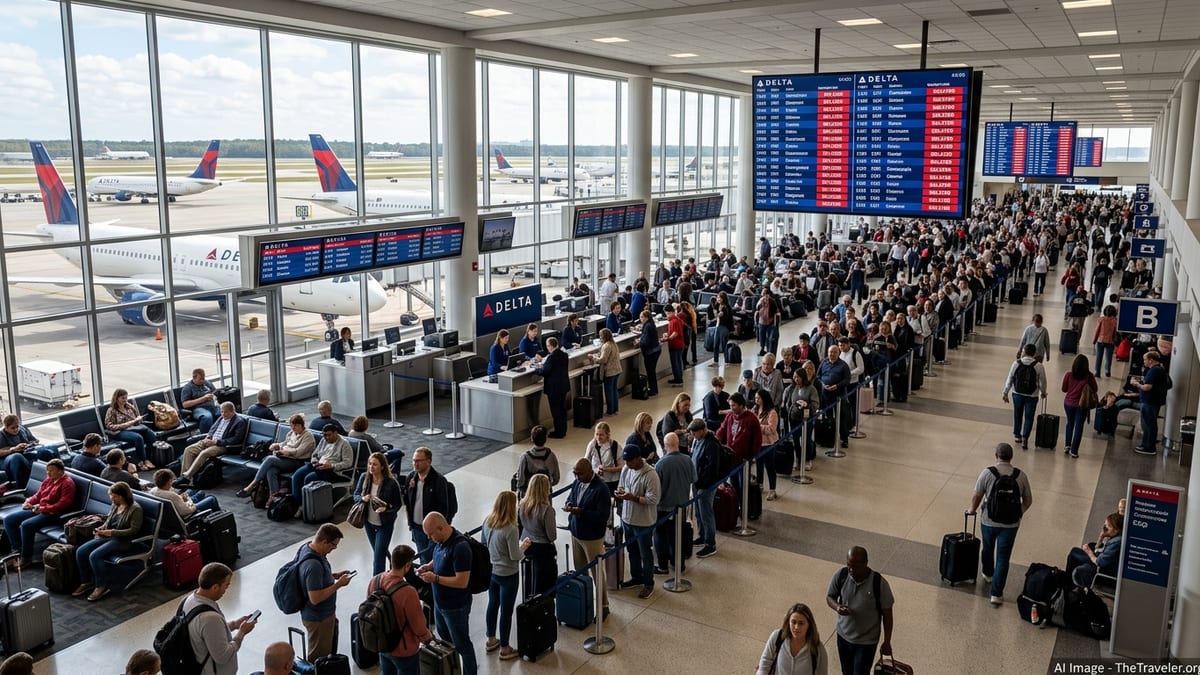
Inside Hartsfield-Jackson, the combination of delayed inbound flights and adjusted departure schedules led to crowded concourses and longer lines at customer service counters as travelers sought rebooking options. Because the outage occurred at the start of the Thanksgiving travel period, when many flights were already close to full, alternative itineraries were at times limited. Hotels around Atlanta became part of the recovery landscape for passengers who were unable to secure same-day onward flights and needed overnight accommodation.
The disruption did not affect only those starting or ending their journeys in Atlanta. Passengers connecting through the hub on multi-leg itineraries also encountered missed onward flights and revised routings. Travelers bound for destinations far from Georgia, including on domestic and some international services operated by Delta, experienced schedule changes as aircraft and crews were reassigned to stabilize the operation. Even after the automation system was restored, residual delays continued into the evening of November 22 as the airline worked through backlogs.
Context: recent airline and aviation tech issues
The Delta outage in Atlanta came shortly after a separate, unrelated technology failure affected the Federal Aviation Administration’s communication systems earlier in November, contributing to a rare nationwide ground stop for U.S. flights. Around the same period, another major U.S. airline experienced its own system outage that forced it to delay certain departures. While these incidents involved different systems and operators, together they reinforced how dependent modern air travel has become on complex digital infrastructure at both airline and government levels.
Unlike the earlier nationwide FAA disruption, the November 22 Delta incident was confined to a single airline’s automation platform for weight and balance calculations, even though its impact spread across the carrier’s network. Regulators and industry observers have periodically highlighted the challenges of maintaining and upgrading aging technology used in aviation, including both internal airline systems and national air traffic management tools. When a critical system falters during a peak travel period, even a relatively brief outage can produce hours of operational knock-on effects as schedules, aircraft rotations and crew duty times have to be recalculated.
For Delta, Sunday’s issue follows previous high-profile technology disruptions in recent years that prompted internal reviews and, in some cases, regulatory scrutiny of contingency planning. U.S. government reports on airline IT outages have noted that while carriers often have backup procedures, including manual processes and redundancy for key systems, the scale of contemporary airline operations means recovery can still take significant time once schedules are widely disrupted. The events of November 22 illustrate how even targeted technical faults can create a challenging operational environment at a large hub.
What travelers should do next and what to expect
By November 23, Delta’s automated weight and balance system was back in regular use and the airline’s public statements indicated that the immediate technical issue had been resolved. However, passengers flying with Delta in the days following the outage, particularly around the peak Thanksgiving period, have been advised by travel and consumer authorities to continue monitoring their flight status closely. When large-scale delays occur, it can take at least a day for aircraft and crew positions to fully realign with schedules, and some flights may still see minor timing adjustments even after core technology is restored.
Travelers with upcoming Delta flights are encouraged to use the airline’s mobile app or website to check for schedule changes before heading to the airport and to ensure that contact details in their bookings are up to date so they can receive rebooking offers or notifications. Those connecting through Atlanta in the immediate aftermath of the incident may wish to allow additional time between flights where possible or be prepared for tighter connections if inbound legs depart late. At airports experiencing poor weather on top of the residual network effects from the outage, delays may be more pronounced.
Passengers affected on November 22 who incurred significant delays or cancellations may be eligible for certain forms of assistance in line with Delta’s policies and applicable regulations. These can include meal vouchers or hotel accommodation when disruptions are primarily within an airline’s control, although eligibility depends on itinerary details and local rules. Travelers seeking redress should retain documentation such as boarding passes, delay notifications and receipts. Looking ahead, while the specific automation problem that impacted Delta on November 22 has been fixed according to the airline, similar events underscore the value of building flexibility into travel plans, especially during peak holiday periods when aircraft are heavily booked and recovery options are more limited.