


More news on this day
A brief equipment-related ground stop at Chicago O’Hare International Airport on Tuesday was lifted by late afternoon, easing delays at one of the nation’s busiest hubs just as forecasters warned that a powerful Thanksgiving week storm could disrupt travel across large parts of the eastern United States.
Get the latest news straight to your inbox!
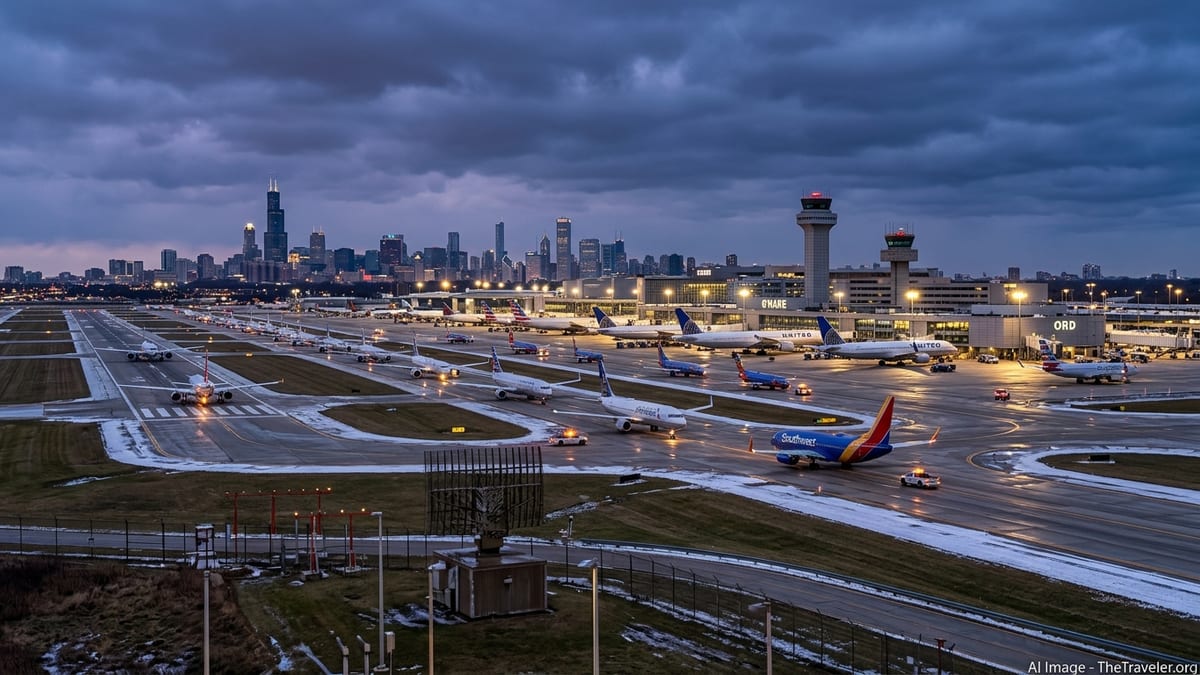
Short-lived equipment outage adds to week of O’Hare disruptions
The Federal Aviation Administration said flights bound for Chicago O’Hare were temporarily halted on Tuesday afternoon after an issue with air traffic control equipment prompted a ground stop for inbound traffic. The agency later confirmed the problem was associated with ground radar serving O’Hare, though it stressed that the outage was localized and did not affect other airports or broader FAA systems.
According to FAA advisories, the ground stop was lifted by 4:07 p.m. local time, and by early evening most operations had returned to near normal, with average delays of under an hour and minimal residual disruption. Departures from O’Hare continued throughout the event, with the greatest impact felt by flights scheduled to depart from other airports in Illinois and the surrounding region that were held on the ground until the restriction was removed.
Chicago’s ABC affiliate, citing FAA information, reported that the outage involved one of the airport’s ground radar systems and that FAA technicians were working on site to repair the equipment while traffic resumed on a managed basis. The FAA said it was spacing some flights and issuing modest delays as a precaution while the work continued, but emphasized that safety systems and procedures remained in place throughout.
Second ground stop in two days raises reliability concerns
Tuesday’s radar-related disruption followed a separate ground stop at O’Hare on Monday, which the FAA attributed to staffing issues at air traffic control. In that earlier incident, flights headed to O’Hare were held at their departure airports for roughly 90 minutes before the restriction was eased, according to FAA statements and local news reports. Chicago television outlets and national wire services both highlighted the incident as a concern for travelers during what is already one of the busiest weeks of the year for aviation.
Local transportation analysts noted that the two interruptions stemmed from different causes, adding to a perception that there is no single, simple fix to recent reliability pressures. A DePaul University aviation expert interviewed by Chicago media pointed out that the recent O’Hare ground stops have involved staffing, equipment and broader regional coordination issues, underlining the importance of both stable technology and adequate controller staffing as traffic volumes rise.
The pair of local events also came less than two weeks after the FAA imposed a rare nationwide ground stop during a separate communications and radar disruption affecting multiple facilities. In that case, investigators traced the instability to legacy network equipment that became overloaded when new hardware sent a surge of data through the system. The FAA has said that, even during the nationwide stop, critical frequencies and radar feeds remained available for controllers to land aircraft safely while departures were paused.
Thanksgiving traffic surges through O’Hare and Midway
The Chicago Department of Aviation expects nearly 1.7 million passengers to pass through O’Hare during the Thanksgiving travel period, with an additional several hundred thousand using Midway International Airport. City officials said that, if these projections are met, O’Hare would log its busiest Thanksgiving week on record, with volumes more than 7 percent higher than last year’s holiday period. Sunday is forecast to be the single busiest day at both airports as travelers return home.
Nationally, AAA estimates that nearly 6 million people will fly over the Thanksgiving holiday, part of more than 80 million Americans expected to travel at least 50 miles from home by air, road or rail between Tuesday and the following Monday. Airlines have scheduled additional flights and upgauged aircraft on popular routes out of major hubs such as Chicago, Atlanta and Dallas, but recent technology and staffing disruptions have underscored how quickly schedules can unravel when even a single major facility experiences difficulties.
At O’Hare, city and airline representatives said they have contingency plans in place to respond to outages and staffing challenges, drawing on recent experience managing both local and nationwide delays. A United Airlines executive based at O’Hare told local media that the carrier maintains a detailed playbook for irregular operations and has had to use it several times in recent weeks as outages at airlines and the FAA have cascaded through the system. Airport officials urged passengers to build extra time into their itineraries for check-in, security and potential delays, particularly during the peak afternoon and early evening hours on Tuesday and Wednesday.
East Coast storm and Midwest snow threaten broader holiday disruptions
While Tuesday’s ground stop at O’Hare was brief, the larger threat to Thanksgiving travel appears to be weather. The National Oceanic and Atmospheric Administration’s Weather Prediction Center and the National Weather Service are tracking a powerful coastal storm expected to intensify along the U.S. East Coast, bringing heavy rain, strong winds and coastal flooding from the Carolinas to New England from Wednesday through Friday.
Forecasts issued on Monday and Tuesday indicate that rain will spread across much of the Southeast on Wednesday, then move into the Mid-Atlantic, Ohio Valley and Northeast on Thanksgiving Day. Meteorologists expect widespread wind gusts over 40 miles per hour along and inland from the Interstate 95 corridor, with 50 mile-per-hour gusts possible along exposed coastal areas. Federal and state emergency managers have warned of moderate to locally major coastal flooding in vulnerable communities from Georgia and the Carolinas northward to Long Island during periods of high tide.
Weather outlets and aviation forecasters say the timing of the storm means travelers could face a combination of low clouds, heavy rain, turbulence and crosswinds at major East Coast hubs just as peak holiday departures and arrivals are under way. Airports from Atlanta and Charlotte to Washington, New York and Boston are all at risk of delays, which could ripple through the national network and affect connections in the Midwest and West, including at hub airports such as Chicago O’Hare and Midway even if local weather remains manageable.
Closer to Chicago, forecasters are also monitoring the potential for accumulating snow and reduced visibility on Wednesday across parts of northern Illinois and southern Wisconsin. Local forecasts suggest that significant snow is possible along and east of the Interstate 39 corridor, including near Rockford, as colder air interacts with a separate disturbance moving through the central United States. Any snow bands that do develop could create slick road conditions on regional highways and may lead to deicing delays at smaller airports feeding O’Hare.
New runway safety rules could add minor delays at busy towers
In parallel with the recent outages, air traffic controllers and pilots are adjusting to more conservative procedures around a key runway operation known as “line up and wait.” The FAA recently tightened its rules governing when controllers may instruct aircraft to move into takeoff position on the runway before issuing takeoff clearance, part of a broader push to reduce runway incursions and near-collisions at busy airports.
Industry safety publications have long highlighted that, while line up and wait procedures can improve efficiency when used correctly, they can also contribute to risk if aircraft are left on the runway for extended periods or if communication breaks down. The refreshed FAA guidance effectively limits when controllers can employ the procedure, especially during periods of staffing strain or complex traffic flows. In practice, this can mean that more aircraft hold short of the runway instead of staging in position, slightly reducing peak departure throughput during rush periods.
Controllers at O’Hare have advised pilots that, on days when staffing does not meet specific thresholds, they may have to suspend line up and wait entirely. In radio traffic reviewed by local media, controllers warned that this could lead to additional delays during the Thanksgiving period, particularly if adverse weather requires greater spacing between departures and arrivals. The FAA has characterized the changes as a safety-first measure and said it is working with airport operators and airlines to minimize knock-on effects for passengers.
What travelers should do as conditions evolve
With a repaired radar system at O’Hare, both of this week’s local ground stops resolved and the airport operating close to normal by Tuesday evening, travelers passing through Chicago face a familiar set of holiday variables rather than an ongoing acute disruption. The greatest risks in the days ahead are likely to arise from the East Coast storm, pockets of Midwest snow and any staffing or equipment constraints that intersect with those weather systems at busy facilities.
Passenger advocates and airport officials are encouraging travelers to take several practical steps as the situation develops. Flyers are advised to monitor their airline’s app or website for real-time updates on gate assignments, departure times and rebooking options if connections are missed. For those driving to or from Chicago’s airports, transportation authorities are urging travelers to avoid stopping on highway shoulders near the terminals, noting that police can issue fines for vehicles parked or idling along expressway ramps instead of using designated cellphone waiting lots.
Given the forecast for coastal flooding and strong winds along the Atlantic seaboard, travelers heading to or connecting through East Coast airports on Wednesday, Thanksgiving Day and Friday may want to review change-fee policies and consider earlier or later departures where possible. Forecasters also stress that conditions could evolve as the storm organizes, so official advisories from the National Weather Service, FAA air traffic bulletins and updates from local airport authorities remain the most reliable sources for current information. For now, Chicago’s brief radar outage appears to have been a contained event, but the combination of high passenger volumes, tighter runway procedures and a potent holiday storm system means that patience and flexibility will be important assets for travelers through the long weekend.