


More news on this day
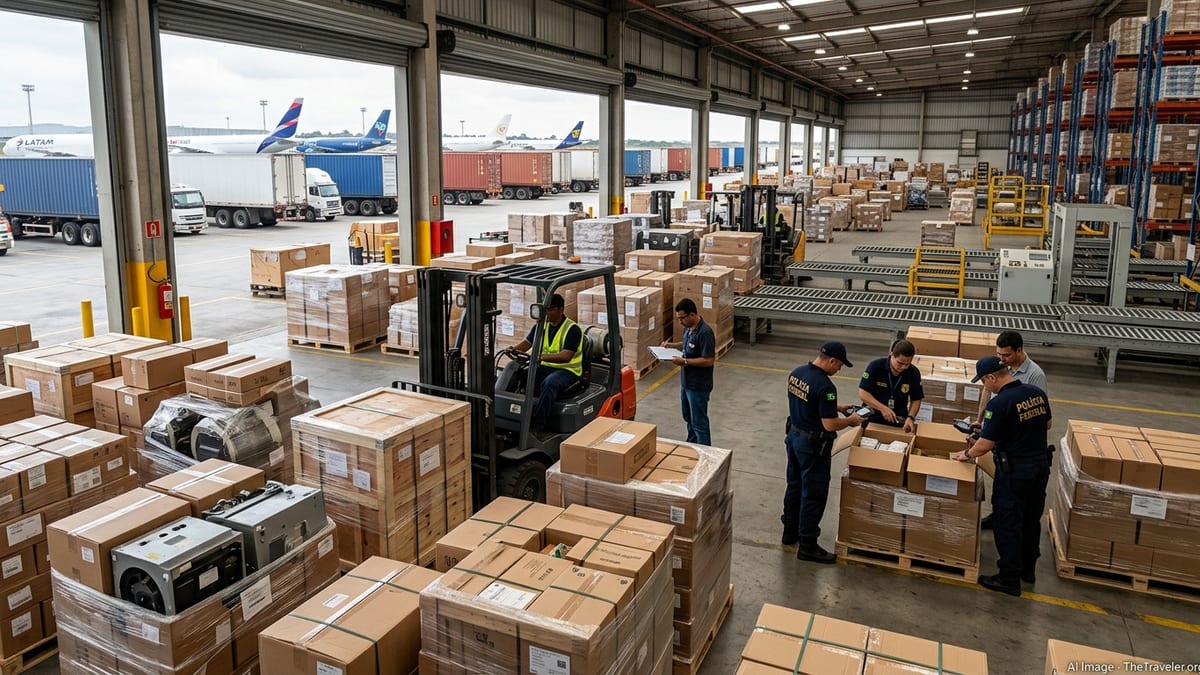
Air cargo movements at São Paulo–Guarulhos International Airport are facing fresh disruption in late November 2026, after intensified Federal Police security inspections sharply reduced processing speeds in the main cargo terminal and prompted GRU Airport to warn shippers of delays for general export freight.
Get the latest news straight to your inbox!
Heightened inspections and what authorities have confirmed
The current disruption follows a Federal Police operation at São Paulo–Guarulhos International Airport between 18 and 22 November 2026, focused on criminal schemes using the airport’s cargo flows. Industry circulars and local media report that officers increased their physical presence in cargo areas, including acceptance docks and airline storage zones, with more frequent documentary checks and physical inspections of shipments. While detailed case information has not been released in full, recent Federal Police communications on operations at Guarulhos highlight investigations into drug trafficking and customs fraud involving air cargo, providing the context for tighter control of access to restricted areas and export screening processes.
A separate Federal Police note in September 2026 described “Operação Carga Falsa,” aimed at dismantling a group suspected of using shipments disguised as diplomatic luggage to move undeclared goods through Guarulhos, underlining official concern about misuse of the airport’s cargo channels well before the latest November action. Taken together, these moves illustrate a broader law‑enforcement effort to close loopholes in how high‑value and sensitive cargo passes through Brazil’s busiest international hub, even if the November operation itself has not been fully detailed in public documents.
Guarulhos has long been Brazil’s largest international airfreight gateway by volume, handling a higher share of cross‑border cargo than any other Brazilian airport. Regional air cargo data and official statistics show that international freight remains heavily concentrated at GRU, especially for manufactured goods and e‑commerce traffic, which means even moderate slowdowns in screening or warehouse flows can quickly translate into truck queues and backlogs. That structural role helps explain why the latest enforcement activity has produced visible effects across supply chains using the São Paulo region.
Official notices from GRU Airport and current terminal conditions
The clearest public indication of operational strain came on 22 November 2026, when GRU Airport Cargo issued a formal notice to users of the TECA GRU cargo terminal. In the communication, the concessionaire stated that intensified inspection of dry export cargo had left the export warehouse with “high volumetry,” and warned that both receipt and delivery of export shipments were being affected, with delays likely while the situation persists. The operator stressed that handling of perishable cargo was continuing normally and that the terminal itself remains open around the clock, but advised exporters, freight forwarders and truckers to confirm appointment availability before sending vehicles to the facility.
Local trade associations and logistics companies have echoed that message in their own advisories to customers. Circulars circulated to customs brokers and forwarders in São Paulo note that export areas at TECA GRU have been close to physical capacity since the week of 18 November, with truck parking and internal roads heavily used at peak times. Some operators report that trucks which arrived toward the end of that week faced extended waits to unload as inspection points and handling teams worked through accumulated cargo under tighter security protocols.
There is, however, an important distinction in where delays are emerging. Market reports suggest that for imports the main bottleneck is inside the terminal rather than at the gate. Trucks delivering inbound freight to the airport are generally not queuing in large numbers, but cargo that has already landed and cleared customs can remain inside the warehouse for longer than usual before it is physically released to consignees or bonded transit operators. By contrast, export congestion is more visible from the landside, with access management and yard capacity now crucial to how quickly new shipments can be received.
How import handling is being adjusted
For importers relying on Guarulhos, the immediate effect of the November enforcement action is an elongated interval between customs clearance and actual collection of goods. Freight forwarders active at the airport say that, in many cases, aircraft continue to arrive and unload as scheduled and customs processes are still running, but Federal Police and Customs checks along the chain, combined with limited warehouse space, mean that cargo can sit longer in storage before it is staged for delivery.
Terminal operators have reacted by consolidating import shipments more aggressively before release, grouping freight by airline, consignee or bonded destination to streamline the movement of pallets and truck loading in a constrained environment. This batching approach is designed to make better use of handling equipment and reduce the number of separate truck movements inside the terminal, but it can extend individual lead times, particularly for smaller consignments that must wait to be combined with other loads.
Industry messages shared with customers indicate that import delays of several additional days are possible compared with typical conditions, although precise timings vary by commodity and the level of inspection required. Goods subject to stricter controls, such as certain chemicals, pharmaceuticals or high‑value electronics, can experience longer dwell times when they fall within the scope of intensified checks. At the same time, there is no indication of a blanket suspension of import operations at Guarulhos. Airlines continue to unload inbound cargo, and there have been no official announcements of a general embargo on import handling at TECA GRU as of 25 November 2026.
Export congestion, priorities by cargo type and alternative routings
Export flows are facing more acute disruption than imports in the current episode. GRU Airport’s 22 November communication explicitly links the high level of export warehouse occupancy to intensified inspection of dry cargo, meaning general freight such as manufactured products and e‑commerce parcels is most exposed to slowdowns. Several logistics companies with operations at Guarulhos have advised clients that parts of the export terminal have been operating at or near full capacity, with restricted room for new bookings and greater use of rescheduling or partial uplift by airlines.
Perishable cargo, including fresh food and other temperature‑sensitive products, is being treated differently. In its official notice, GRU Airport underlined that export handling of perishables continues under normal conditions, and operators at the terminal confirm that these shipments are being prioritised for acceptance and movement through the facility. This reflects a standard contingency approach at cargo hubs where items with strict shelf‑life requirements are moved first when storage and handling resources are under pressure.
The practical impact for shippers of general export cargo is reduced flexibility and longer overall transit times. Forwarders report that some flights are departing with only part of the booked freight on board because not all consignments reached the aircraft build‑up area in time, leaving residual loads in the warehouse. In these cases, remaining cargo may be shifted to later departures or different routings. During a previous congestion episode at Guarulhos in November 2024, some shippers temporarily redirected exports through alternative Brazilian gateways such as Viracopos and Rio de Janeiro, and logistics providers now again recommend evaluating such options for time‑critical traffic where airline schedules and cost structures permit.
Role of regulators and the security systems under scrutiny
The National Civil Aviation Agency of Brazil and the Ministry of Ports and Airports have monitored cargo handling performance at Guarulhos since at least late 2024, when a surge in volumes, physical constraints and security checks produced a widely reported backlog. On that occasion, authorities formally requested an action plan from the concessionaire to reduce cargo accumulation, opened the door to administrative measures if service levels did not improve and supported short‑term steps such as tighter control of export acceptance and encouragement of weekend cargo pick‑ups.
In 2026, trade association circulars have repeatedly referred to the Federal Police security verification system used for export screening at GRU. Communications shared with customs brokers in São Paulo in mid November mention the return to service of the SISCAER security verification platform, which is used to support police checks on air cargo. Industry stakeholders say that previous interruptions or restarts of this system have contributed to fluctuating productivity in the export terminal, because screening processes are highly sequenced and depend on reliable access to security databases and equipment.
The Federal Police have not set a public end date for their intensified checks at Guarulhos and have signalled that investigations into criminal schemes using the airport’s cargo infrastructure will continue beyond the 18 to 22 November operation window. For now, there is no indication that enforcement activity is easing significantly, which suggests that higher scrutiny of cargo movements is likely to remain a feature at GRU in the near term even as the terminal works to clear existing backlogs and adjust its handling patterns.
What shippers and importers using GRU should do next
For companies planning to move goods through São Paulo–Guarulhos in the coming days and weeks, the practical consequences are clear: expect extended lead times, less certainty over booked uplift on particular flights and possible last‑minute routing changes. Logistics providers are advising export customers shipping general dry cargo to allow additional days in their schedules, monitor booking status closely in the run‑up to departure and be prepared for partial uplift if flights depart without all scheduled consignments on board.
GRU Airport’s guidance to confirm appointment availability before dispatching trucks to the terminal means exporters, forwarders and road carriers should coordinate closely to avoid unnecessary waiting times at TECA GRU. Where service options exist, particularly for urgent or high‑value exports, shippers may wish to compare routings via other Brazilian airports that currently show fewer constraints on cargo handling, while taking into account total transit times, connectivity and customs arrangements at those alternative gateways.
Importers using Guarulhos should plan for the possibility that cargo already in Brazil will remain in the terminal for several extra days before pick‑up, even after customs release. Firms with just‑in‑time production models or tight downstream distribution windows are being encouraged to track shipment status frequently and, where possible, to build inventory buffers or flexibility into their supply chains. While prioritisation of perishable and other sensitive cargo is helping limit the worst delays for those segments, shippers are still advised to confirm handling arrangements on a shipment‑by‑shipment basis with their airline or freight forwarder as long as heightened police inspections and warehouse congestion remain in place at GRU.