


More news on this day
Flights bound for Chicago O’Hare International Airport were briefly halted on Tuesday, November 24, 2026, after an equipment outage prompted the Federal Aviation Administration to order a ground stop on inbound traffic, delaying many arrivals during one of the busiest holiday travel weeks of the year.
Get the latest news straight to your inbox!
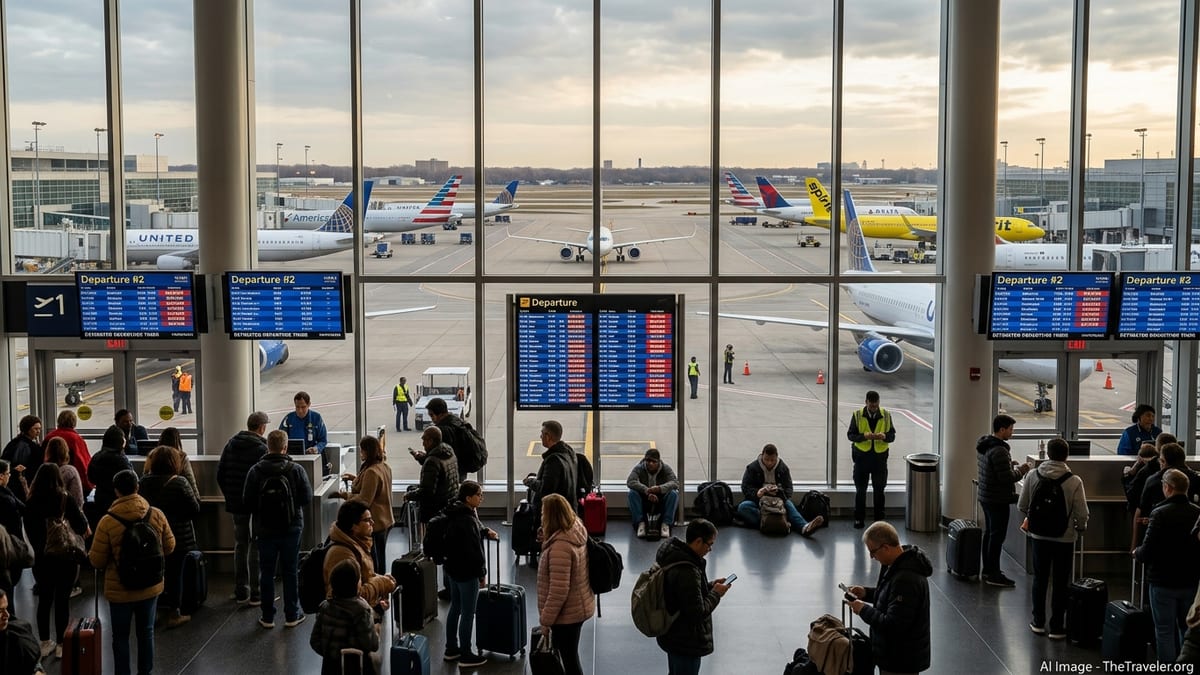
What happened at O’Hare on November 24
According to the FAA’s real-time traffic management logs and multiple airport status services, a ground stop was issued on the afternoon of Tuesday, November 24, affecting flights scheduled to depart for Chicago O’Hare (ORD). The program applied to aircraft bound for O’Hare from other airports, meaning those flights were held at their origin until air traffic control determined it was safe to resume normal operations.
Local broadcaster WLS-TV reported that the restriction was tied to an equipment outage and that, by 4:07 p.m. Central time, the FAA had lifted the ground stop with average delays running about 47 minutes across affected flights. That timing is consistent with federal traffic management advisories and independent trackers that show an interruption of a little under an hour, followed by a transition to a more routine ground delay program as traffic flows were gradually restored.
The FAA did not immediately publish a detailed technical explanation for the outage on November 24, but agency status pages categorized the disruption under equipment-related causes rather than weather or staffing. As of late evening on November 24, O’Hare’s published arrival and departure boards indicated that operations were continuing with residual delays but without an active ground stop order in place.
How the ground stop affected flights and passengers
The November 24 ground stop primarily affected flights heading into Chicago, rather than those already departing from O’Hare. Under FAA procedures, a ground stop instructs departure airports to hold flights that are destined for the impacted airport. Travelers already at O’Hare saw departures continue, although some outbound services were delayed as airlines waited for arriving aircraft and crews caught behind the inbound disruption.
Average delays of roughly three quarters of an hour meant that many passengers arriving into O’Hare on Tuesday afternoon and early evening faced missed or at-risk connections, particularly those with tight layovers of less than an hour. Because the hold occurred during the busy Thanksgiving travel period, even a relatively short disruption had knock-on effects. Some carriers extended connection windows for rebooking and encouraged customers to use airline apps or websites to adjust plans once updated departure and arrival times became available.
Data from independent delay trackers suggest that, although the most acute disruption lasted under an hour, it took several more hours for operations to stabilize. After the ground stop ended, the FAA and Chicago’s air traffic control facilities managed inbound flows using a ground delay program that spaced arrivals more widely to account for the earlier outage. As a result, travelers arriving into O’Hare on Tuesday evening continued to experience delays varying by airline, route and scheduled arrival time.
Context: a second disruption in a busy holiday week
The November 24 equipment-related ground stop came one day after a separate, staffing-related ground stop affecting O’Hare arrivals on Monday, November 23. On that earlier day, the FAA briefly halted flights into Chicago because of staffing constraints at local air traffic control facilities, before lifting the order once staffing levels improved and controllers could safely handle the volume of traffic again. In both cases, flights departing from O’Hare were largely able to continue operating, but inbound passengers and connections were significantly affected.
These local events also followed a much larger nationwide ground stop on November 13, when an outage linked to air traffic control communications equipment led the FAA to pause most U.S. departures for several hours. Federal officials have since said that a malfunction involving new fiber-optic networking equipment caused a flood of data that destabilized older systems, forcing the agency to halt traffic while it restored reliable communications for controllers. That separate national disruption rippled through major hubs including O’Hare, contributing to broader concerns about the resilience of the U.S. air traffic control network.
Despite the proximity of dates, current reporting indicates that the November 24 O’Hare issue is being treated as a localized equipment outage rather than a continuation of the earlier nationwide event. The FAA has not publicly linked Tuesday’s outage to the November 13 incident and, at this stage, has not suggested that collision-avoidance systems or other direct safety-of-flight tools were compromised. Instead, as in other recent events, the agency appears to have used a precautionary ground stop to preserve safe separation and manageable controller workloads while technical issues were resolved.
What travelers experienced on the ground
For travelers already airborne and headed to Chicago when the ground stop was issued, the impact varied by flight. Some aircraft close to O’Hare were able to continue and land with modest additional holding, while departures from more distant airports were held on the ground until the stop was lifted. Passengers posting on social media on Tuesday afternoon described sitting at departure gates or on parked aircraft awaiting updated pushback times, with crew members citing an equipment outage affecting flights to Chicago.
Inside O’Hare’s terminals, the disruption translated into a familiar pattern of congested gate areas, longer lines at airline service counters and increased demand for same-day rebooking. Because the ground stop hit during the Thanksgiving travel rush, many affected flights were already near capacity, leaving fewer open seats for re-accommodating disrupted passengers. Some travelers reported being rebooked onto later same-day services or, in some cases, onto flights departing on Wednesday, November 25, especially on heavily traveled domestic routes.
Airport operations teams, airlines and the Transportation Security Administration continued to process departing passengers, and there were no indications on Tuesday evening that the equipment outage had affected runway conditions, airport power, security screening or baggage systems. The primary pinch points were at the airline and air traffic control interface: gate availability, aircraft rotations and the sequence in which arrivals could be safely accepted once the ground stop ended and the subsequent delay program was in effect.
Operational and planning implications for upcoming travelers
For travelers heading to or through O’Hare over the remainder of Thanksgiving week, the November 24 outage is a reminder that even short-lived disruptions can have meaningful knock-on effects. While the specific ground stop tied to Tuesday’s equipment issue has been lifted, airlines typically need several hours, and sometimes longer, to work through displaced aircraft and crews, especially at a major hub. Late-evening flights on November 24 and early-morning departures on Wednesday, November 25 were therefore at increased risk of residual delays or equipment substitutions as carriers repositioned aircraft.
Because the FAA and the City of Chicago have not yet released a full technical account of the November 24 equipment outage, it is too early to say whether travelers should expect further related disruptions. At this stage, available information supports only that the incident was localized to O’Hare, that it was addressed within roughly an hour from the initial stop order to the lifting of the program, and that normal operations resumed under a controlled delay regime later in the day. Any broader conclusions about systemic risk will depend on the FAA’s ongoing review of both the nationwide November 13 outage and these more recent localized events.
Passengers with upcoming itineraries involving O’Hare are being advised by airlines and airport information services to monitor flight status closely on the day of travel, especially during peak holiday periods. Same-day schedule changes, rolling delays and aircraft swaps are possible as carriers balance demand and operational constraints. Travelers with tight connections through Chicago may wish to allow additional buffer time or be prepared with alternative options in case of misconnection, particularly while the system continues to absorb the cumulative effects of multiple November disruptions. For now, however, the November 24 ground stop is over, and O’Hare remains open and operating with typical seasonal congestion rather than an active emergency program.