


More news on this day
Thanksgiving week air travel in the United States is facing significant disruption after a Delta Air Lines automation outage delayed roughly 2,000 flights on Sunday, November 22, 2026, compounding the effects of a rare nationwide Federal Aviation Administration ground stop imposed nine days earlier and leaving many travelers facing cancellations, lengthy delays and ongoing schedule uncertainty.
Get the latest news straight to your inbox!
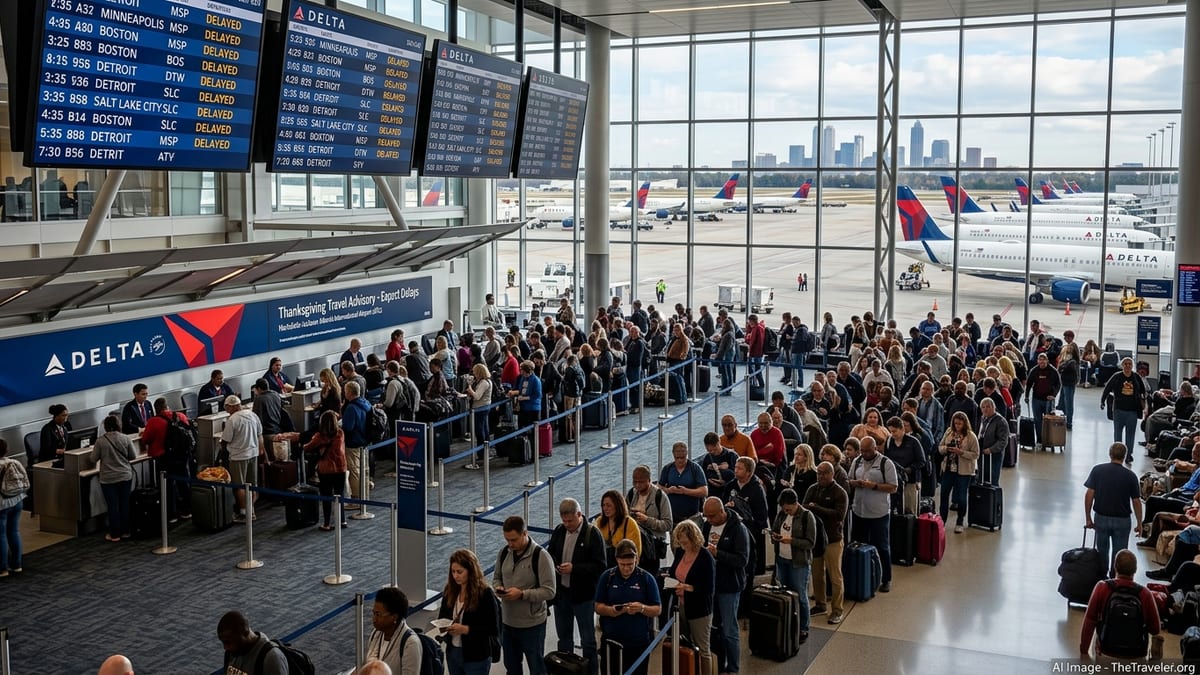
What happened to Delta’s systems and how widespread were the delays?
On Sunday, November 22, Delta Air Lines suffered a failure in an automated system used to calculate aircraft weight and balance before departure, triggering rolling delays across its network at the start of the busy Thanksgiving travel period. The airline has said the outage affected a core tool that helps ensure planes are properly loaded and safe to depart, forcing crews to either pause departures or switch to slower manual processes while engineers worked to restore the software.
Operational data gathered on Sunday indicate that close to 2,000 Delta flights were delayed worldwide, representing roughly half of the carrier’s schedule that day. In its public comments, the airline has not cited a cybersecurity incident or external attack, characterizing the event instead as a technical fault within its own automation systems. By Sunday afternoon, Delta reported that the affected weight and balance system had been restored and that it was gradually resuming more normal operations, although the sheer scale of the disruption meant that delays continued into the evening.
Delta has said it is providing standard support to affected passengers, including rebooking assistance and refunds for those whose flights were cancelled and who chose not to travel. However, as of Tuesday, November 24, the carrier had not posted a special, standalone travel waiver tied specifically to the November 22 outage on its public advisories page, leaving some travelers reliant on individual rebooking and refund provisions associated with their specific disruption.
Temporary ground stop and hub impacts at Atlanta and beyond
The system outage had its most visible impact at Delta’s primary hub at Hartsfield-Jackson Atlanta International Airport, one of the world’s busiest passenger airports and a key connecting point for Thanksgiving travelers. On Sunday morning, Delta requested that the Federal Aviation Administration impose a temporary ground stop on some of its flights bound for Atlanta while it worked through the automation failure. The FAA subsequently issued a time-limited halt and then shifted to a ground delay program that metered arrivals to manage congestion as aircraft slowly began to move again.
Airports across the United States felt knock-on effects. At Minneapolis–Saint Paul International Airport, Boston Logan International Airport and Phoenix Sky Harbor International Airport, local officials and media reported significant numbers of Delta delays linked to the same outage. In Boston, roughly 100 Delta flights were affected in some way, while travelers in Minneapolis and Phoenix described long waits at gates and check-in as the airline’s operations team manually processed weight and balance calculations and worked through out-of-position crews and aircraft.
While the ground stop itself was relatively brief and limited to Delta’s operation, the timing at the start of a peak holiday travel wave meant that delays propagated across the network throughout Sunday and into Monday. Passengers with early-week departures, including those flying on November 23 and 24, have reported overnight stays, rolling departure time changes and missed connections as the airline works to reposition aircraft and crews and to absorb displaced travelers into already busy flights.
How the earlier FAA nationwide ground stop fits into the picture
Sunday’s Delta-specific outage came just nine days after the FAA ordered a separate, nationwide ground stop on Friday, November 13, 2026, following a telecommunications problem that affected communications between air traffic controllers and pilots. According to the agency’s public explanation, an equipment issue tied to an ongoing upgrade from older copper wiring to fiber-optic infrastructure disrupted critical voice circuits, prompting the FAA to halt departures nationwide for several hours until it could verify that systems were stable.
The November 13 event was only the second time since the attacks of September 11, 2001, that the FAA imposed a full nationwide ground stop. The order lasted roughly four to five hours and led to thousands of delays and cancellations across all major U.S. airlines, including Delta. Although flights were able to resume later that day, the agency has acknowledged that the disruption rippled through the network for several subsequent days, as aircraft and crew positioning were restored and airlines cleared backlogs of stranded passengers.
For Delta customers, the combination of the federal ground stop and the carrier’s own automation failure has meant two distinct, unrelated but overlapping episodes of disruption in the space of less than two weeks. Industry analyses note that while the FAA telecommunications fault and Delta’s weight-and-balance outage arose from different systems owned by different organizations, both incidents highlight the sensitivity of large, tightly scheduled air networks to technology failures, particularly in periods when demand is at or near peak levels.
Current situation heading into the Thanksgiving peak
By Monday, November 23, Delta said the technical cause of its November 22 delays had been resolved and that the airline was focusing on restoring its schedule ahead of the busiest travel days. Flight-tracking and airport reports indicate that punctuality improved on Monday compared with Sunday, but that elevated levels of delays and some cancellations persisted across parts of the network as the carrier continued to work through residual imbalances in aircraft and crew availability.
More broadly, federal data and travel forecasts point to a very busy holiday period. The FAA has cited projections of more than 417,000 flights across all carriers in the United States during the nine-day Thanksgiving window from November 23 to December 1, 2026, a level that would represent one of the heaviest schedules in more than a decade. Separate forecasts suggest that over 80 million Americans may travel at least 50 miles from home during the broader Thanksgiving period, with a substantial minority of those journeys taking place by air.
Weather is an additional variable. Meteorological outlooks published on November 23 flag the potential for storms and coastal flooding in some parts of the United States during the holiday week, conditions that could trigger further delays and diversions on top of any residual scheduling challenges from recent technology incidents. For now, however, forecasters and aviation analysts generally expect that the combined effects of the FAA ground stop and the Delta outage will fade in relative impact as airlines move deeper into the week, assuming there are no further significant system failures.
What affected travelers should check now
Passengers booked on Delta in the coming days, particularly those flying through Atlanta, Minneapolis–Saint Paul, Detroit, Salt Lake City, New York or other major hubs, should expect that most flights will operate but that schedules may remain less reliable than during quieter periods. Given the lingering effects of Sunday’s outage, some travelers may see last-minute aircraft swaps, changes to departure times or adjustments to routings as Delta continues to normalize its operation.
Customers whose flights on November 22 or 23 were cancelled or significantly delayed should review their booking details and any messages from the airline regarding rebooking options or refunds. Delta has reiterated through public statements that passengers whose flights were cancelled and who choose not to travel are eligible for refunds. Travelers who incurred additional costs for hotels, meals or alternative transportation may also wish to document their expenses and review the terms of any purchased travel insurance or credit card travel protections, especially in cases where they were rebooked a day or more after their original departure time.
Looking ahead to the remainder of Thanksgiving week, travelers on all U.S. airlines are being advised to build extra time into their journeys, particularly at congested hubs and during peak hours. Checking flight status frequently on airline apps or airport displays, confirming connection times, and monitoring weather advisories for both departure and arrival cities can help mitigate the impact of any remaining disruptions tied to the recent FAA and Delta outages. While schedules are expected to stabilize further if no new issues emerge, the elevated volume of traffic means that even isolated problems can still translate into delays for individual passengers over the coming days.