


More news on this day
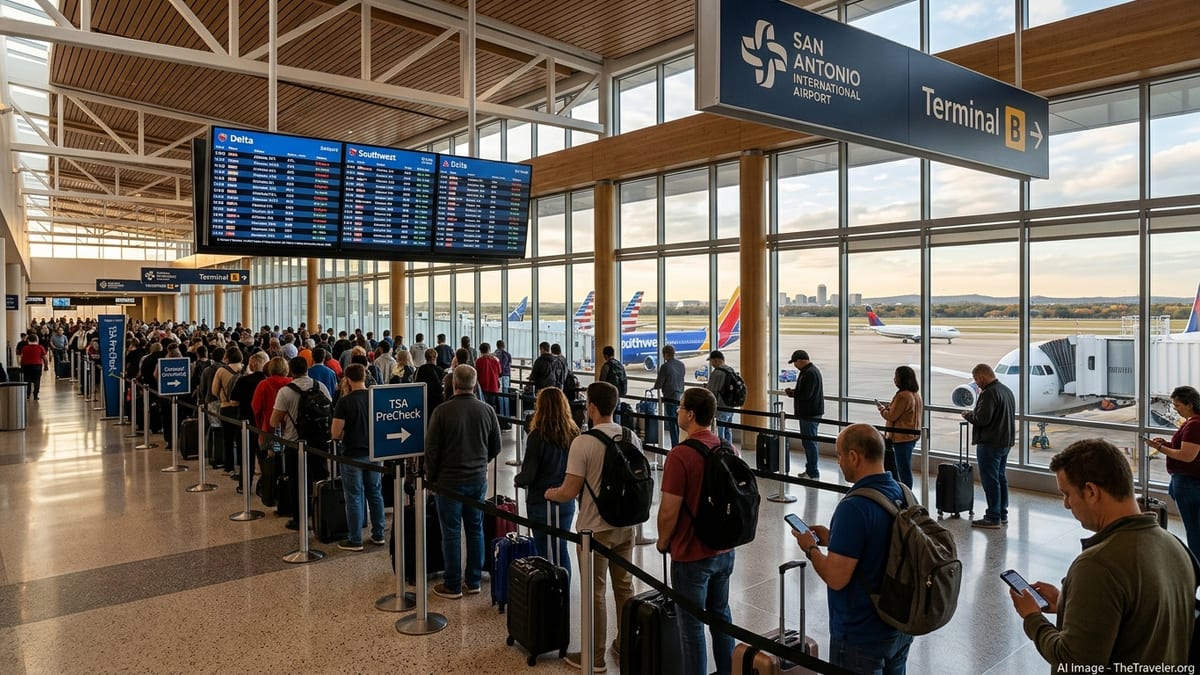
Thanksgiving week is bringing one of the busiest travel periods of the year to San Antonio International Airport, where officials expect more than 130,000 passengers between November 22 and 29 and are urging travelers to leave extra time for parking, check-in and security amid a congested national air network.
Get the latest news straight to your inbox!
Passenger volumes peak on Wednesday and Sunday
San Antonio International Airport projects that more than 130,000 passengers will pass through its terminals over the Thanksgiving travel period, running from Sunday November 22 through Sunday November 29. Local officials say the heaviest days will be the day before Thanksgiving and the Sunday after, which historically see the highest concentration of outbound and returning travelers.
Forecasts shared with local media indicate that around 17,800 passengers are expected on Wednesday November 25, with approximately 20,000 on Sunday November 29, making those the airport’s busiest days of the week. While San Antonio is primarily an origin-and-destination airport rather than a major connecting hub, the compressed nature of Thanksgiving travel means that peak days can still push facilities such as security, baggage handling and road access close to capacity.
The expected 130,000-plus passengers sit against a backdrop of nearly 5.5 million departing travelers screened at San Antonio International in the 12 months to the end of October 2026. That scale helps explain why even a single holiday week can feel markedly more crowded as airlines concentrate flights and residents take advantage of time off work and school to visit family or head to vacation destinations.
National disruptions put local travelers on alert
This year’s Thanksgiving travel period is unfolding just days after a series of national disruptions that have kept many passengers on edge. On Sunday November 22, Delta Air Lines experienced an automation failure in a system that calculates aircraft weight, delaying more than 1,000 flights and prompting the Federal Aviation Administration to briefly halt some traffic into Atlanta, one of the country’s largest hubs. The same incident produced knock-on delays at a number of airports around the United States, including San Antonio, although operations have since largely returned to normal.
Separately, a telecommunications issue earlier in November led the FAA to order a short-lived nationwide ground stop that continued to ripple through airline schedules for days afterwards. While that event had been resolved by the time Thanksgiving week began, it has added to concerns among travelers who remember long lines and canceled flights from previous peak periods and are watching their airline apps closely for schedule changes.
Despite those disruptions, the overall national outlook points to a very busy but broadly manageable holiday period. The FAA expects more than 417,000 domestic and international flights to operate over the nine-day Thanksgiving window, the highest volume for the holiday in 16 years, while the Transportation Security Administration plans to screen around 17.6 million air travelers between Tuesday November 24 and Monday November 30. For San Antonio passengers, those figures help explain why their local airport may feel more crowded even if there are no major weather issues or local technical problems.
Parking, drop-off and security: what SAT is telling travelers
San Antonio International Airport’s main message to Thanksgiving travelers is to plan ahead. Officials recommend that passengers arrive at least two hours before domestic departures and three hours before international flights, in line with national TSA guidance for peak periods. Those estimates are designed to cover check-in, bag drop, security screening and potential congestion on the airport approach roads, particularly at traditional morning and late-afternoon banks of flights.
Parking is expected to be one of the most visible pressure points. The airport is encouraging travelers who intend to drive to reserve spaces in advance through its FlySAT Parking portal, which manages the on-site garages and surface lots. Capacity across the system has been tightened further by construction and improvement projects elsewhere on the campus and by a general increase in local demand, so drive-up availability may be limited at the last minute on the busiest days.
For those collecting family or friends, the airport highlights several options to reduce congestion directly outside the terminals. A short-term lot offers parking for up to three hours, aimed at drivers who want to meet arriving passengers inside the building. For anyone simply waiting for an arrival to appear at the curb, a free cell phone waiting lot is available; motorists can remain there until their traveler has collected baggage and is standing ready for pickup, which helps keep the terminal frontage from backing up into airport roadways.
How San Antonio fits into the wider Thanksgiving travel picture
San Antonio International may not see the tens of millions of passengers that pass through the country’s largest hubs each year, but the airport is firmly embedded in the broader Thanksgiving travel surge. Nationally, motor club AAA expects about 81.5 million Americans to travel at least 50 miles from home between Tuesday November 24 and the following Monday, with nearly 6 million of them flying. Texas accounts for a significant share of that movement, with AAA projecting that nearly 6 million Texans will travel for the holiday by all modes combined.
Within Texas, the busiest aviation flows are centered on Dallas–Fort Worth and Houston, where hubs feed connecting traffic across the country and abroad. By contrast, San Antonio’s traffic is more heavily local, with about 97 percent of passengers originating or ending their journey in the city rather than connecting. That pattern tends to concentrate crowds in ticketing, security and baggage claim areas rather than in the gate concourses, and it means local factors such as school calendars, military leave from Joint Base San Antonio and regional driving conditions have a direct impact on the airport’s busiest hours.
San Antonio’s passenger forecast for Thanksgiving sits alongside a broader softening in traffic compared with last year. Data compiled from security checkpoint counts indicate that departing passenger volumes at the airport are down a few percentage points year on year, and some recent holiday periods, such as Columbus Day 2026, saw fewer travelers than the same weekends in 2025. Even so, Thanksgiving remains one of the most concentrated bursts of demand in the calendar, with Sunday after the holiday typically recording more than 30 percent more departing passengers than a standard early December weekday.
Practical steps for those flying through San Antonio this week
For travelers departing San Antonio International during Thanksgiving week, airport officials and federal agencies are emphasizing a set of practical steps to reduce the chances of disruption. The first is to monitor flight status consistently through airline websites or mobile apps both before leaving home and while en route to the airport. National experience over the past several weeks has shown that schedule changes and minor delays can appear with short notice as carriers respond to aircraft rotation issues, crew availability and weather elsewhere in their networks.
Security screening is the next potential bottleneck. The TSA advises passengers to review current rules on liquids, electronics and prohibited items ahead of time and to pack accordingly, particularly if they are infrequent flyers or traveling with holiday food. Solid items such as pies and baked goods can typically travel in carry-on bags, while liquids and gels need to follow standard size restrictions or be placed in checked baggage. Ensuring that identification documents are readily accessible and that laptops and other large electronics can be removed quickly can help lines move more smoothly.
Finally, those using airport parking or ride-hailing services may want to build additional margin into their plans. Higher passenger volumes translate into more vehicles seeking access to the terminal curbs and garages, and occasional congestion at peak times has been reported. Reserving parking in advance, designating clear meeting points with relatives or drivers and allowing room for unexpected slowdowns on Interstate 410 and nearby arterial roads can provide a buffer if weather, traffic incidents or isolated flight disruptions occur during what is shaping up to be San Antonio’s busiest travel week of the year so far.