


More news on this day
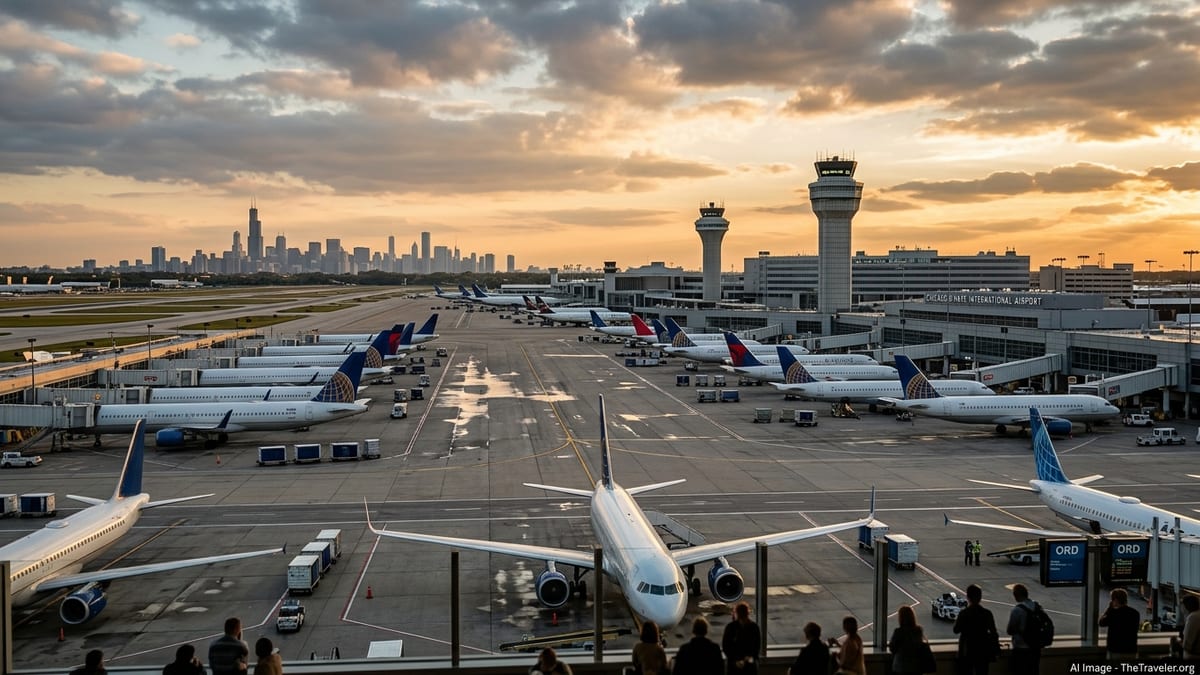
Flights bound for Chicago O’Hare International Airport were temporarily halted on Tuesday, November 24, after the Federal Aviation Administration (FAA) ordered a ground stop citing an “equipment outage,” causing fresh disruption for travelers just two days before the peak Thanksgiving travel period.
Get the latest news straight to your inbox!
What the FAA has confirmed so far
According to live status information from the Federal Aviation Administration and multiple airport operations trackers, a ground stop affecting traffic to Chicago O’Hare International Airport (ORD) was put into effect on the afternoon of Tuesday, November 24, 2026. The advisory cited an “equipment outage” as the impacting condition, indicating that an issue with aviation infrastructure rather than weather or airspace congestion prompted the halt to incoming flights.
Regional media in Chicago reported that the FAA notice referred specifically to an equipment or system outage, without providing further detail on which subsystem was affected. As of the latest publicly available information, officials had not disclosed whether the disruption involved radar, radio communications, data links, or another part of the air traffic control network serving O’Hare. The agency has also not announced any link between this localized outage and the nationwide ground stop that occurred on November 13.
Tracking services that monitor FAA programs showed the ground stop as active in the late afternoon Eastern Time, specifying equipment outage as the cause and indicating that flights to O’Hare from other airports were being held on the ground for a defined period. These advisories typically list an expected end time, but the FAA has cautioned in past disruptions that such times are operational estimates and can change as controllers and technicians work to stabilize systems.
Timing, duration and flight impact on November 24
The ground stop on November 24 began in the mid to late afternoon local time, overlapping with a busy pre-holiday travel window when both inbound and outbound traffic at O’Hare typically increase. FAA-related trackers logged the program as starting around 4:30 p.m. Eastern Time, with an initial expectation that restrictions would remain in place until approximately 4:15 p.m. Central Time. Because the advisory times are rounded and can be updated as conditions evolve, the precise minute-by-minute progression may vary between data sources, but they consistently show a discrete afternoon disruption rather than an all-day shutdown.
Preliminary delay statistics compiled by independent aviation monitoring platforms suggest that the outage translated into departure and arrival delays in the tens of minutes rather than hours for most affected flights, with some services possibly facing cascading knock-on effects as aircraft and crews ended up out of position. At least some departures for later in the day were categorized as “possibly late” as the stop unfolded, reflecting the uncertainty that ground stops create for airline scheduling even once the immediate hold is lifted.
By early evening Eastern Time, some trackers indicated that only one FAA ground stop remained in effect nationwide and associated it with O’Hare, again listing equipment outage as the cause. Ground stops are designed primarily to regulate flights into an affected airport, so the extent to which departures from Chicago were restricted during this period likely varied by airline and route. In past incidents, some carriers have been able to continue limited departures using available runway capacity once air traffic control confirmed that outbound operations could be conducted safely, while arrivals remained more tightly controlled.
How the O’Hare disruption fits into a month of aviation outages
The localized ground stop at O’Hare on November 24 comes less than two weeks after a high-profile nationwide ground stop on November 13, when the FAA temporarily ordered all U.S. departures held because of widespread communication problems traced to its telecommunications network. That earlier event, which officials have linked to instability created during a network upgrade, halted flights across the country for several hours and led to thousands of delays and cancellations as airlines attempted to recover their schedules.
In the days since the nationwide stoppage, federal transportation authorities have acknowledged that key parts of the U.S. air traffic control system still depend on aging equipment that can react unpredictably when new components or software are introduced. A preliminary FAA question-and-answer document about the November 13 incident attributes the disruption to legacy equipment becoming unstable when it was flooded with unusually high volumes of data on the agency’s telecommunications backbone, prompting safety managers to order a system-wide halt to departures while they assessed the impact.
Separate from the nationwide event, O’Hare has also seen at least one other equipment-related disruption this month. FAA program histories and independent delay trackers list an earlier ground stop at the airport on November 13 that was likewise attributed to an equipment outage, and Chicago-area travelers reported localized stoppages and delays on November 23 linked to staffing constraints. Against that backdrop, Tuesday’s fresh outage has drawn particular attention from passengers and local media, even though, as of now, there is no public evidence that the November 24 equipment problem shares a direct technical cause with the earlier nationwide telecommunications failure.
Implications for Thanksgiving week travelers using O’Hare
The timing of the November 24 ground stop is especially significant because it falls just two days before the anticipated peak of the U.S. Thanksgiving travel period. Forecasts from travel organizations and airport operators had already projected some of the busiest passenger volumes since before the pandemic between Tuesday, November 24 and the following Monday, with O’Hare among the country’s most heavily used hubs for both domestic connections and international arrivals.
Even a relatively short ground stop can ripple through airline networks on a day when flights are heavily booked. When inbound aircraft are held at their origin airports, their late arrival in Chicago can delay connecting departures or force airlines to swap aircraft between routes. Travelers already en route may face missed connections, while those still on the ground may see gate changes or rolling departure times as carriers adjust to evolving slot allocations from air traffic control. These secondary effects can persist for several hours after FAA formally lifts a ground stop.
For passengers with itineraries passing through O’Hare during the evening of November 24 and into November 25, airlines are likely to manage the disruption by a mix of short rolling delays and, in some cases, schedule adjustments. Based on similar events earlier this month and in prior years, the majority of flights would be expected to operate, although some may depart or arrive significantly later than planned. As of the latest information, there are no indications that the November 24 equipment outage has prompted airlines to preemptively cancel large blocks of service at O’Hare for the days that follow, but travelers should be prepared for possible residual delays, particularly on tightly banked connecting itineraries.
What is known and still unknown about the cause, and what travelers should check next
At the time of writing, the FAA has not released a detailed technical explanation for the equipment outage behind the O’Hare ground stop on November 24. Publicly available notices simply describe an equipment outage affecting airport operations, consistent with the structured terminology the agency uses for operational advisories. There is also no public confirmation that the issue has been definitively resolved, although the finite timing and evolving status messages suggest that mitigation steps were being taken to allow flights to resume in a controlled manner.
Given the lack of detailed public statements, it remains unclear whether the O’Hare outage stemmed from a failure of on-airport equipment, such as radar or communication systems specific to the Chicago area, or from a problem elsewhere in the air traffic control network that affected the flows of traffic into O’Hare’s airspace. It is also not yet known whether the disruption involved newly installed hardware or software, as was the case in the November 13 nationwide ground stop, or instead reflected a failure of existing systems. Until the FAA publishes a more complete account, any more specific explanation would be speculative.
For travelers, the most practical step is to monitor airline apps, carrier websites and airport information boards for real-time status updates on individual flights into and out of O’Hare over the next several hours. Because ground stops are issued and lifted by the FAA rather than airlines, a flight that appears on time in an airline’s system may still be subject to an air traffic control hold if the advisory remains in force or if downstream capacity is reduced. Passengers with tight connections in Chicago should be especially vigilant, as even modest inbound delays can be enough to jeopardize onward flights during a crowded holiday period. Anyone with flexibility to rebook or adjust their itinerary may wish to consider earlier departures or longer connection times, subject to airline policies and seat availability, until O’Hare’s operations stabilize following the November 24 equipment outage.