


More news on this day
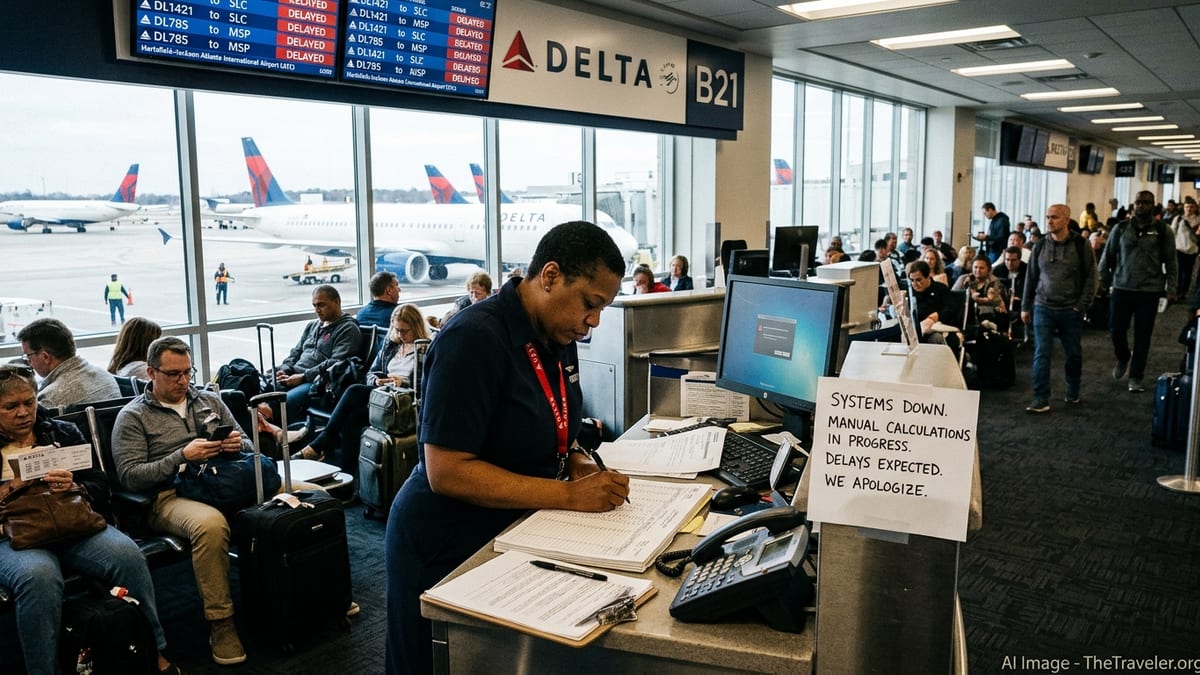
Delta Air Lines has largely restored operations after a failure in its automated weight-and-balance system on Sunday, November 22, 2026, triggered widespread delays at its Atlanta hub and across the United States just as Thanksgiving week travel reached full swing.
Get the latest news straight to your inbox!
What happened to Delta’s weight-and-balance system
Delta began experiencing problems early on Sunday, November 22, with the automated system it uses to calculate aircraft weight and balance for departing flights. The carrier confirmed that the technology, which helps ensure each aircraft is within certified weight limits and has its load safely distributed, had stopped working correctly and that teams were forced to switch to manual procedures while engineers worked to restore automation.
The issue initially manifested at Hartsfield–Jackson Atlanta International Airport, Delta’s largest hub and the world’s busiest passenger airport, before its effects were felt across the network. The Federal Aviation Administration issued a ground stop for some Delta flights bound for Atlanta on Sunday morning, then converted the restriction to a ground delay program that remained in effect for roughly an hour before expiring just before midday, according to FAA advisories.
By Sunday afternoon, Delta said it was using “manual workarounds” to dispatch flights while efforts to restore the system continued. Manual weight-and-balance calculations, which involve cross-checking passenger loads, baggage and cargo weights, fuel levels and seating distribution, are standard aviation procedures but typically take longer than automated solutions, particularly at large hubs handling hundreds of departures per day.
Scale of the disruption for Delta passengers
Flight-tracking data show that the outage caused extensive delays across Delta’s network as the airline worked through backlogs. By Sunday evening, the flight-tracking site FlightAware reported that roughly half or more of all Delta flights had run late at some point during the day, with around 2,000 Delta flights delayed and a smaller share canceled. Other analyses cited more than 1,600 Delta flights delayed during the day and about 6 percent of the airline’s schedule canceled as operations struggled to recover.
At Atlanta specifically, where Delta accounts for the vast majority of traffic, delays were particularly acute. Data compiled from FlightAware indicated that more than 800 flights into and out of Atlanta were delayed on Sunday. Local outlets reported that by early evening around 1,250 flights at the airport in total were running late, with Delta responsible for most of the disruption as it processed departures using manual weight-and-balance methods.
Delta said about 70 percent of the delays and cancellations recorded on Sunday were directly linked to the weight-and-balance automation issue, while the remainder were attributed to weather-related factors. The airline emphasized that, despite the impact on schedules, the system problem did not create any immediate safety hazard, because flights continued to depart only after their weight and balance had been verified under established safety procedures.
System restored but knock-on effects into Thanksgiving week
By mid- to late afternoon on Sunday, Delta said that its automated departing-flight weight-and-balance system had been restored. The airline confirmed the same in statements carried by local Atlanta media and national outlets, noting that there was no indication of a cyberattack and that the incident appeared to be confined to the specific automation platform used for weight and balance calculations.
Even after restoration, congestion across the network persisted into the evening as aircraft and crews remained out of position. Travel industry analysts reported that, by the end of Sunday, Delta’s delays and cancellations represented a significant share of overall U.S. disruptions. On Monday, November 23, data indicated that Delta’s operation had largely returned to normal, although some flights were still experiencing residual delays linked to the previous day’s outages and aircraft being in the wrong locations.
Passengers reported extended wait times and missed connections on Sunday, particularly at Atlanta, Boston, New York and several West Coast airports with heavy Delta schedules. Social media posts and online forums described pilots informing travelers that weight-and-balance calculations were being performed manually and that departures would be held at the gate until those processes were complete. Some travelers whose flights were heavily delayed on Sunday did not reach their destinations until Monday or Tuesday after being rebooked.
Safety significance of weight-and-balance calculations
Weight-and-balance calculations are a critical part of commercial flight safety. Before each departure, U.S. airlines must determine an aircraft’s total weight, including the airframe, fuel, passengers, baggage and cargo, and verify that it stays within certified structural limits. They must also ensure the aircraft’s center of gravity falls within an approved range, which affects how the aircraft will handle on takeoff, landing and in flight. These requirements are laid out in Federal Aviation Administration regulations and advisory material.
Automation has significantly streamlined this process over the past two decades, allowing airlines to take real-time data feeds from passenger check-in systems, baggage handling and cargo loading. Specialized software generates a load manifest, computes weight-and-balance figures and transmits them to flight crews and dispatchers. If that software becomes unavailable, airlines revert to manual or semi-manual methods, which can involve recalculating loads using standard weight tables and confirming distribution with ground and ramp staff.
On Sunday, Delta stressed that it would not dispatch any aircraft until all weight-and-balance checks had been completed using these fallback procedures. Aviation safety specialists speaking to U.S. media noted that such redundancy is a standard requirement and that the main impact of the outage was on efficiency and punctuality, not on the underlying safety of flight operations, provided the manual checks were correctly completed.
Delta’s response and assistance for affected travelers
Throughout Sunday, Delta issued statements apologizing for the disruption and promising support for passengers whose travel plans were affected at the start of the busy Thanksgiving week. The airline said it was rebooking travelers onto later flights where seats were available and providing meal vouchers and hotel accommodations for eligible customers, particularly those facing overnight delays or missed connections at hub airports.
Where flights were canceled entirely, Delta indicated that passengers were entitled to refunds if they chose not to travel. Travelers with nonrefundable tickets could also request rebooking within a limited date range without change fees, subject to availability. Specific waiver details varied by fare type and itinerary and were published in advisories on the airline’s website and communicated to customers via email and text alerts.
The airline did not immediately provide a detailed technical explanation of what had caused the automated system to malfunction but confirmed that an internal review was underway. Delta also reiterated that the outage was unrelated to the Federal Aviation Administration’s own network problems earlier in the month, which had led to a nationwide ground stop on November 13, or to a separate system issue that affected United Airlines in mid-November.
Context: a fragile travel system heading into a peak holiday
The Delta outage came during an already tense period for U.S. air travel. On November 13, an instability in an FAA telecommunications network used for air traffic control led to the longest nationwide ground stop in more than two decades, disrupting thousands of flights and affecting about a million passengers. Within days, United Airlines suffered its own technology problem involving internal systems, which temporarily delayed departures across that carrier’s network.
Together, the incidents have highlighted the degree to which both regulators and airlines now rely on complex, interconnected digital systems to manage everything from air traffic flows to aircraft loading. Although each problem has had a different root cause, passengers have experienced them in a similar way: unexpected ground stops, long lines at airports, missed connections and limited real-time information as airlines and the FAA work to stabilize systems.
The timing is particularly challenging because Thanksgiving is traditionally the busiest travel period of the year in the United States. The FAA and the Department of Transportation have forecast that 2026 will see the heaviest Thanksgiving air traffic in at least 16 years, with more flights scheduled than in 2025. AAA has projected that more than 5.9 million people will travel by air for the holiday, and tens of millions more will journey by road and rail between Tuesday, November 24 and the following Monday.
What Thanksgiving travelers should expect and check now
For travelers booked on Delta during Thanksgiving week, most schedules are now operating close to normal levels. Data from flight-tracking services on Monday and Tuesday show punctuality improving sharply compared with Sunday, though some residual delays and occasional aircraft swaps remain as the airline fully rebalances its fleet and crew rotations.
Industry forecasts suggest that the busiest days at major U.S. airports will be Wednesday, November 25, and the Sunday after Thanksgiving, when passenger volumes and security lines are expected to be highest. At Atlanta, where more than 4 million passengers are forecast to pass through between November 19 and December 1, both airport authorities and Delta are advising travelers to arrive well ahead of departure times, particularly for early morning and late afternoon peak banks of flights.
Delta customers are being encouraged to monitor the airline’s app or website for the latest status of their flights and any remaining rebooking options. Travelers whose Sunday flights were canceled or significantly delayed and who have not yet requested compensation or a change are advised to review the relevant travel waiver and refund rules, which set deadlines for making changes without additional fees.
Passengers connecting through Atlanta and other Delta hubs over Thanksgiving should allow extra time between flights where possible and be prepared for occasional gate changes as the airline continues fine-tuning its schedules. While there is no current indication of ongoing technical issues with Delta’s weight-and-balance system, the events of November 22 underline how quickly a single point of failure in airline technology can ripple through the broader travel network, particularly during peak holiday periods.