


More news on this day
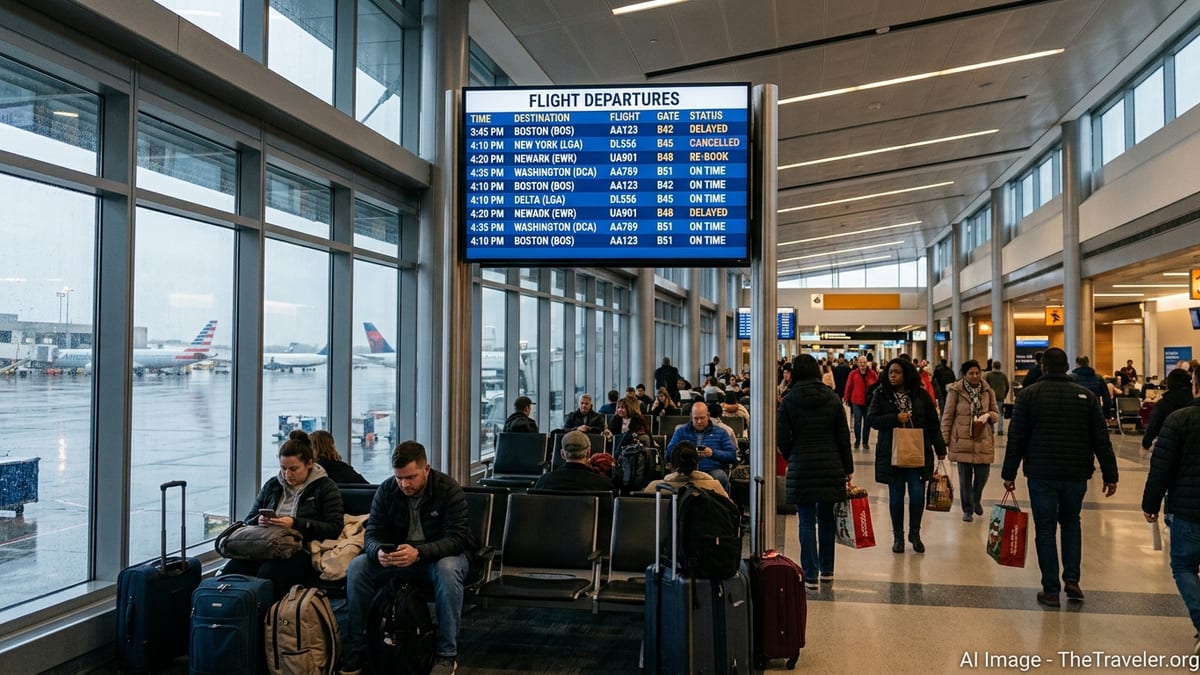
A powerful Thanksgiving nor’easter that drenched the U.S. East Coast and disrupted one of the busiest travel periods of the year is now moving away, but airline operations have not fully recovered: by Friday afternoon, November 27, 2026, flight‑tracking data still showed thousands of delays nationwide as carriers worked to realign aircraft and crews ahead of the packed return‑travel surge on Sunday, November 29.
Get the latest news straight to your inbox!
National delays fall from Thursday’s peak, but recovery is uneven
Real‑time figures from flight‑tracking service FlightAware on Friday, November 27, indicated a sharp improvement compared with Thanksgiving Day, but not a complete return to normal. By mid‑afternoon Eastern time, the site was reporting roughly 2,200 delays and more than 130 cancellations on flights within, into or out of the United States, after a similar tally earlier in the day, reflecting rolling disruption rather than a single concentrated peak.
Those numbers were lower than on Thursday, November 26, when the nor’easter’s heaviest rain and strongest winds coincided with the holiday itself. Data cited by several outlets and local airport tallies show that more than 460 U.S. flights were cancelled and many thousands delayed on Thanksgiving, making it one of the most disrupted days of the 2026 Thanksgiving travel period even though overall passenger volumes were lower than on the main departure and return days.
Federal Aviation Administration status boards on Friday did not show any nationwide ground stop, a rare measure reserved for major system outages or security events. Instead, the agency relied on targeted ground delay and ground stop programs at individual airports to manage the reduced capacity caused by low cloud, strong crosswinds and saturated runways. Independent disruption dashboards that track FAA initiatives in real time listed Boston Logan International Airport under a ground delay program on Friday morning, with other East Coast hubs experiencing shorter‑lived arrival and departure metering at various points in the day.
The unsettled picture comes during what the U.S. Department of Transportation and FAA had already projected as the busiest Thanksgiving flying period in 16 years, with more than 417,000 flights scheduled over the broader November 23 to December 1 window and peak daily activity above 50,000 flights. Airlines for America and major carriers including American Airlines had also flagged record Thanksgiving operations, with American alone planning more than 8 million customers across nearly 85,000 flights and 7,021 flights on Sunday, November 29, its largest single operating day since the pandemic.
New York, Boston and Washington among the hardest‑hit hubs
The nor’easter’s track up the Eastern Seaboard placed some of the country’s most constrained airports directly in its path. In New York, wind gusts on Thursday reached 54 miles per hour in Central Park and up to 66 miles per hour at LaGuardia Airport, according to National Weather Service data, conditions that significantly limited arrival and departure rates on the airport’s short, tightly configured runways. Local media images showed crowded departure halls and long security queues at LaGuardia as airlines trimmed schedules and extended spacing between aircraft.
John F. Kennedy International Airport and Newark Liberty International Airport also saw elevated disruption as the storm’s low cloud and heavy rain moved north. Flight‑tracking snapshots through Thursday evening and early Friday captured several dozen cancellations and many more delays at each field. Because New York‑area airports operate near capacity even in good weather, relatively modest schedule cuts can quickly translate into gate congestion, longer taxi times and missed connections for passengers relying on these hubs to reach other parts of the country or onward international flights.
Farther south, Washington’s Reagan National Airport, with its river‑hugging approach paths and strict operational limits, reported a noticeable share of its compact schedule delayed or cancelled on Thursday as rain bands and low ceilings moved across the Mid‑Atlantic. Baltimore/Washington International Thurgood Marshall Airport and Philadelphia International Airport also experienced periods of arrival and departure metering tied to wind and visibility restrictions. By Friday, conditions at these airports had generally improved, but residual late‑running aircraft meant that some flights continued to depart behind schedule even after the worst of the weather had passed.
In New England, Boston Logan International Airport remained one of the focal points of Friday’s disruption. Statewide reporting in Massachusetts cited 80 delays and 49 cancellations at Logan on Thanksgiving itself, while FlightAware data on Friday morning showed continuing cancellations and late operations as the airport worked through the aftermath of the storm. The FAA’s formal ground delay program for Boston added further knock‑on effects as inbound flights from across the country were held at origin or assigned later slots to avoid excessive airborne holding near the constrained hub.
How the Thanksgiving nor’easter disrupted air and ground travel
The travel problems trace back to a large, slow‑moving coastal storm that developed over the Southeast in the days before Thanksgiving and then tracked north along the Atlantic shoreline. Forecast discussions from the National Weather Service and the National Oceanic and Atmospheric Administration’s Ocean Prediction Center on November 24 and 25 warned of a strengthening low‑pressure system bringing heavy rain, coastal flooding and gale to storm‑force winds from the Carolinas to New England, with the most significant impacts expected on Thursday, November 26.
As the system intensified near the Mid‑Atlantic coast, widespread wind gusts of 50 to 60 miles per hour were recorded inland, with even stronger gusts along exposed coastal locations. Governors in several states, including New Jersey, issued formal warnings ahead of expected tidal flooding and high winds from Wednesday, November 25, through Friday, November 27, with coastal flood warnings in effect for numerous shoreline counties. These conditions led to multiple rounds of moderate to major coastal flooding at high tide, localized road closures and scattered power outages across the region.
For aviation, the combination of strong crosswinds, low ceilings and heavy precipitation reduced effective runway capacity at many East Coast airports. FAA traffic management initiatives required controllers to increase separation between arrivals, adjust approach patterns and in some cases hold departures at origin airports through ground delay programs. This approach is designed to keep airborne holding to a minimum for safety and fuel efficiency, but it means that disruption propagates hundreds or even thousands of miles away from the weather itself, as flights from unaffected regions are held on the ground to match the reduced acceptance rate at the storm‑affected hubs.
The storm’s reach extended beyond aviation. Situation reports compiled by emergency‑management agencies and the Federal Emergency Management Agency highlight flooded coastal highways, temporary closures on parts of the Northeast rail corridor and lingering debris from downed trees and power lines. In New England and the Mid‑Atlantic, several hundred thousand customers experienced at least brief power outages on Thursday and Friday, affecting not only homes but also traffic lights, tunnel systems and some transport‑adjacent infrastructure. While core airport facilities generally remained open, difficulties reaching them by road or public transport added to door‑to‑door travel times for many holiday travelers.
Why disruption persists after the storm and what is different this year
From a passenger perspective, the most confusing aspect of weather‑related disruption is often its persistence after the skies start to clear. Airlines build their networks on tightly choreographed rotations of aircraft and crews, especially during peak periods like Thanksgiving when spare capacity is limited. When a major storm forces extended delays, diversions or cancellations over one or two days, it leaves aircraft overnighting at non‑standard locations and pushes many crew members up against or beyond their legal duty limits.
Industry data from previous holiday periods, summarized in U.S. Department of Transportation on‑time performance reports, show that late‑arriving aircraft and crew availability together typically account for more delay minutes than weather alone in a normal month. However, when a slow‑moving storm aligns with peak holiday travel, the share of delays directly attributed to weather jumps sharply, and its indirect effects can take several days to wash out of the system. This dynamic appears to be playing out again in 2026, with airlines working through residual imbalances on Friday and into the weekend while operating close to their planned maximum schedules.
This year’s Thanksgiving period has also been shaped by earlier strains on airline operations. In the week before the holiday, Delta Air Lines experienced a problem with an automated system that calculates aircraft weight and balance, delaying more than a thousand flights on Sunday, November 22. Separately, a FedEx MD‑11 freighter overran a runway at Miami International Airport late on Wednesday, November 25, prompting the temporary closure of all but one runway and contributing to hours‑long delays at the busy South Florida hub on the day before Thanksgiving. While both incidents were resolved, they highlight how little margin for error exists when carriers are already running near capacity.
For travelers, one practical consequence is reduced flexibility when something goes wrong. With many flights over the holiday period booked close to full, passengers who misconnect due to a delayed inbound sector may find that same‑day rebooking options are limited or unavailable. Airlines sometimes add extra sections or upgauge aircraft during recovery, but such measures are constrained by crew availability and airport gate space. The result is that relatively modest disruptions on Thursday and Friday can still translate into long waits for available seats, particularly on popular trunk routes along the East Coast and transcontinental flights feeding the New York, Boston and Washington hubs.
What travelers should expect through Sunday and how to prepare
Short‑range forecasts from the National Weather Service indicate that the core of the Thanksgiving nor’easter will continue to pull away from the most heavily traveled East Coast corridors into the weekend of November 28 and 29. Flying weather across much of the eastern United States is expected to improve, with rain tapering off and winds gradually moderating, although smaller pockets of unsettled conditions may develop over the Great Lakes and interior Northeast. At this stage, no new large‑scale coastal storm is forecast to coincide with the main return‑travel days.
Even with better weather, however, Sunday, November 29, remains a focal point for potential congestion. Travel companies and aviation data firms consistently identify the Sunday after Thanksgiving as one of the most delay‑prone days of the year, a pattern echoed in multi‑year analyses of on‑time performance that show a lower share of flights arriving on schedule on that date compared with a typical Sunday. For 2026, American Airlines and other major carriers have scheduled their largest single operating days on November 29, and TSA screening forecasts, as summarized by travel and automotive associations, point to record numbers of passengers passing through security checkpoints.
Given that backdrop, passengers returning home over the weekend are advised to build in more margin than usual. Transport authorities and airlines recommend leaving extra time for journeys to the airport, particularly in regions where coastal flooding or lingering power outages may still affect key roadways. Travelers should also monitor their flight status frequently through airline mobile apps and official airport channels, since day‑of‑travel adjustments to schedules and routings are more common when the network is still in recovery mode.
Connection management will be especially important for those changing planes at constrained hubs such as New York LaGuardia, Newark, Boston and Washington Reagan National. Longer minimum connection times may be advisable on Sunday, when even minor delays can cascade through tightly timed banks of departures and arrivals. Where possible, passengers still finalizing plans might consider earlier return dates, early‑morning or late‑evening departures on Sunday, or nonstop services that avoid connection risk altogether, though the availability and cost of such options vary by route and may already be limited for this year.
The broader lesson for travelers planning future Thanksgiving trips is that severe weather need not fall on the single busiest travel day to have a significant impact. As 2026 illustrates, a powerful nor’easter arriving on Thanksgiving Day itself can continue to shape flight operations for several days afterward, even as skies brighten. For those yet to travel home, staying informed, allowing generous buffers and understanding how airlines handle weather‑related disruption remain the most effective tools for navigating the final days of this holiday weekend.