

More news on this day
A train driver has died and dozens of passengers have been seriously injured after two East Midlands Railway services collided near Bedford, prompting a major incident response and severe disruption on a key route into London.
Get the latest news straight to your inbox!
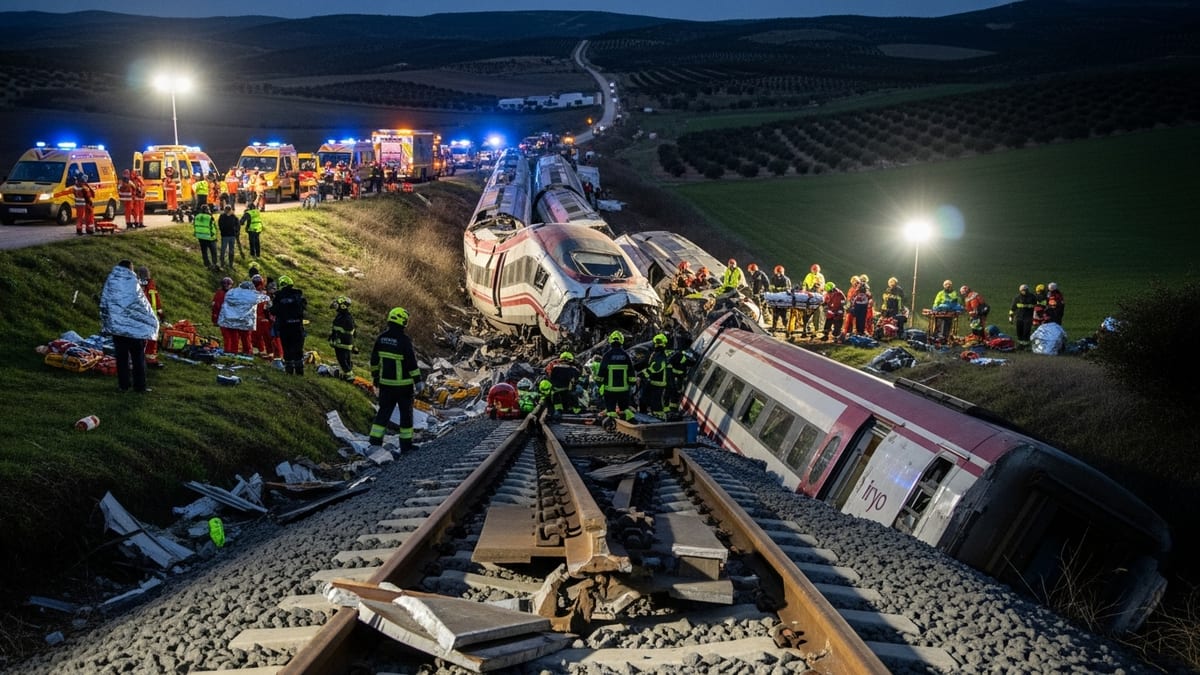
Evening collision on busy London commuter route
The collision took place on Friday 19 June in the late afternoon on the main line between Bedford and London St Pancras, one of Britain’s busiest intercity and commuter corridors. Reports indicate that both services were travelling southbound when one train struck the rear of another outside Bedford, leaving carriages badly damaged and passengers trapped in crowded car interiors.
Rail tracking data cited in early coverage shows the trains involved were East Midlands Railway services heading toward the capital during the evening peak. Images and video from the scene shared on social media show the crumpled front cab of a Class 360 unit and a damaged bi-mode intercity train ahead of it, with emergency workers moving between the two formations in fading daylight.
According to figures reported by local media and rail community channels, the driver of the rear train died at the scene. The East of England Ambulance Service has been cited as reporting 11 people with very serious injuries, 22 with serious injuries and a further 56 with minor injuries, bringing the total number of casualties to 89. A significant number of those hurt were treated at the scene before being taken to hospitals around the region.
The scale of the response led police and health services to declare a major incident as additional resources were drafted in from nearby counties. Bedford Hospital asked the public to avoid the emergency department unless absolutely necessary so that staff could focus on incoming casualties linked to the crash.
Emergency response and rail disruption
Publicly available information indicates that dozens of ambulances, rapid response vehicles and specialist hazardous area teams were deployed to the line south of Bedford soon after the alarm was raised. An air ambulance was seen landing in nearby fields, while fire crews used ladders and cutting equipment to reach passengers in damaged coaches and assess structural stability before evacuations.
Passengers posting online shortly after the collision described being thrown from their seats and seeing travellers with broken bones, head injuries and deep lacerations. Photographs from inside the carriages show windows shattered, ceiling panels dislodged and luggage strewn across aisles, with floor spaces used as makeshift treatment areas while medics moved through the train.
Train movement on the Midland Main Line was effectively halted around Bedford on Friday evening as emergency teams secured the area and began work to remove the injured. East Midlands Railway and other operators warned travellers of severe disruption, with long-distance services to and from London St Pancras cancelled or diverted and replacement road transport constrained by ongoing road closures near the scene.
Industry observers say that clearing the line is likely to take some time, given the extent of damage to rolling stock and potential harm to trackside infrastructure and signalling equipment. Once recovery and repairs are complete, specialist engineers will need to confirm the integrity of the route before normal operations can resume, potentially prolonging disruption into the weekend.
Early focus on signalling and train protection systems
While the precise sequence of events has not yet been confirmed, discussions among rail professionals and enthusiasts have quickly focused on signalling and train protection systems in the Bedford area. Contributors referencing preliminary information suggest that the rear train may have passed a signal at danger, a type of incident commonly referred to in the industry as a SPAD, before colliding with the train ahead.
Online commentary has also highlighted the role of the Train Protection and Warning System, a safety technology designed to reduce the risk and consequence of trains passing signals at danger or approaching hazards too quickly. Some posts referencing the layout around Bedford question whether the full suite of train protection measures was active on all relevant signals at the time of the crash, although there is currently no official confirmation of any technical failure.
Specialist accident investigators are expected to examine data from on-board event recorders, signalling logs and closed-circuit television to build a detailed picture of the trains’ movements in the minutes before impact. Investigators typically also review driver training records, rostering and fatigue management, as well as recent infrastructure work, to determine whether a combination of human, technical and systemic factors contributed to the incident.
Rail safety analysts note that rear-end collisions between passenger trains on busy main lines in the United Kingdom are rare, reflecting decades of investment in signalling upgrades, better crashworthiness and layered safety systems. The circumstances at Bedford are therefore likely to receive close scrutiny, with particular attention on whether existing protections operated as intended and, if so, why they were not sufficient to prevent the collision or reduce its severity.
Passenger accounts and local impact
First-hand accounts shared across social media platforms describe scenes of shock and confusion in the moments after the crash. Several passengers wrote that the force of the impact threw them forward without warning, while others described a sudden, violent jolt followed by darkness as lighting failed and dust and debris filled the air.
People on board have described working their way through narrow, crowded aisles to check on fellow passengers, applying improvised bandages and offering reassurance while waiting for paramedics to arrive. Others recounted clambering down from carriages to track level under the guidance of emergency workers, then being escorted across uneven ground to makeshift triage areas set up in nearby fields.
For communities around Bedford, the crash has brought ambulance sirens, helicopter activity and road closures to an otherwise routine Friday evening. Local transport networks have been placed under pressure as diverted rail passengers seek alternative routes by car and bus, while hotels and guest houses along the corridor between Bedford and London are likely to see an influx of stranded travellers.
Publicly available information from health services indicates that hospitals across Bedfordshire and neighboring counties rapidly activated surge plans to accommodate the influx of patients. Staff have been redeployed, elective appointments postponed and clinical teams reconfigured to prioritize trauma care as the full extent of injuries becomes clearer.
Questions for the future of rail safety
The Bedford collision has reignited debate about rail safety on key intercity routes at a time when passenger numbers are steadily recovering and operators are introducing new fleets to modernize services. Commentators have pointed out that the crash involved both a newer high-speed train and an older electric unit, raising questions about how differences in design standards and crashworthiness might have influenced outcomes for those in the leading cabs and front carriages.
Online discussion has also turned to the implementation of more advanced European train control systems across the British network, which are intended to provide continuous speed supervision and greater protection against human error. The pace of these upgrades, and how they are prioritized across busy passenger corridors, is likely to feature in future policy conversations once the initial investigation yields clearer findings.
Rail users’ groups and safety advocates are expected to follow developments closely, particularly around any interim recommendations that may be issued to reduce the risk of a similar event on comparable sections of track. These could include changes to signalling layouts, adjustments to operating rules in congested areas, or renewed emphasis on driver training and route familiarization for services converging on major hubs.
For now, published coverage indicates that the priority remains caring for the injured, supporting families affected by the death of the driver and other serious casualties, and restoring a sense of normality to a crucial transport artery serving Bedfordshire and the wider region. The findings of the formal investigation, likely months away, will determine whether this tragic crash leads to further changes in how Britain manages and safeguards its increasingly busy rail network.