


I expected my drive through the Chianti region of Tuscany to be a pretty way of getting from Florence to Siena. What I did not expect was how often I would pull over just to stare. The Chiantigiana road, the SR222 that threads through the heart of Chianti Classico, turned a simple point-to-point transfer into one of the most quietly magical days I have had in Italy.
Get the latest updates straight to your inbox!
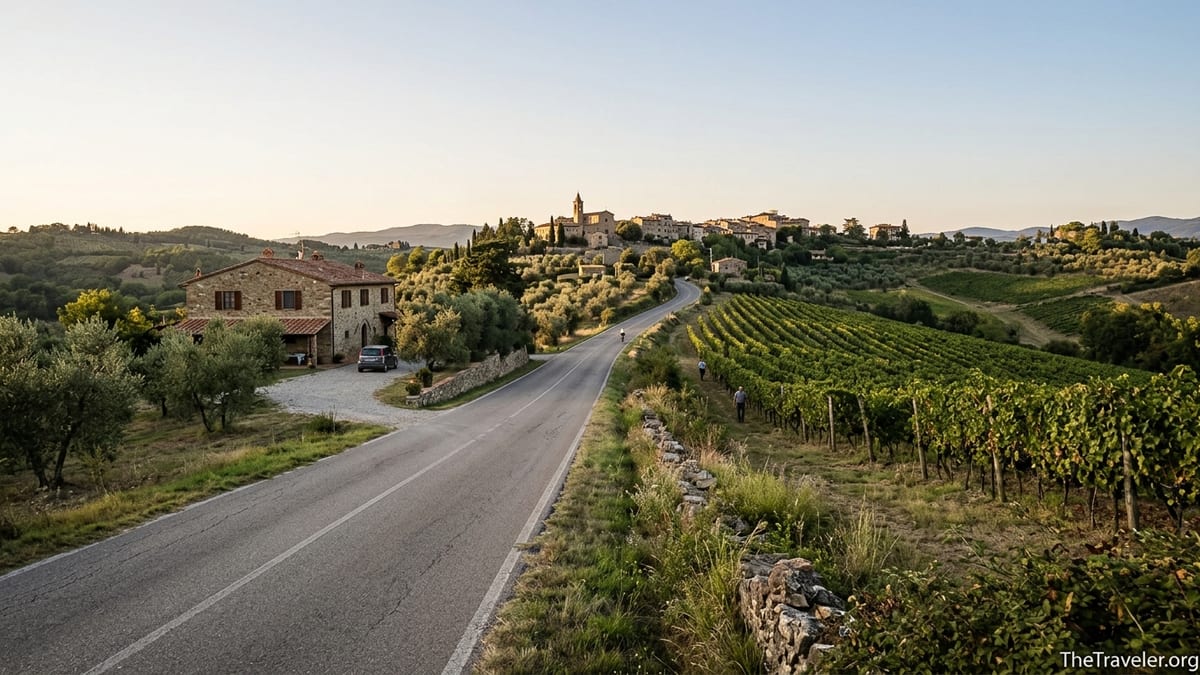
Setting Off From Florence on the Chiantigiana
I picked up a compact rental car near Florence’s Santa Maria Novella station just after 9 a.m. The clerk handed over the keys and a few words of advice: avoid the historic center’s ZTL restricted zones, follow the signs for Siena, then peel off onto the SR222, the Chiantigiana. Within 20 minutes I had left the city’s ocher facades behind and was climbing into low green hills, olive groves starting to outnumber apartment buildings.
The Chiantigiana is not a fast road. It meanders for around 70 kilometers between Florence and Siena, passing through Strada in Chianti, Greve, Panzano, Castellina and a patchwork of side roads that lead to smaller villages like Radda and Gaiole. Many travelers blast down the A1 highway in about an hour, but driving the Chiantigiana comfortably takes most of the day once you factor in photo stops, a winery visit and lunch.
Costs are manageable if you plan ahead. A one-day compact rental from a mainstream agency in Florence often runs somewhere between 40 and 80 euros before fuel and insurance, depending on season and demand. Fuel itself in rural Tuscany is usually a little pricier than in cities, but a full day’s loop between Florence, Chianti and Siena will typically burn less than half a tank in a small car. There are no tolls on the Chiantigiana itself, which quietly keeps the focus on the landscapes rather than the cost.
As the road eased past the last suburban roundabout and into proper countryside, the mood in the car shifted. Vineyards appeared in tidy rows, cypress trees framed old stone farmhouses on distant ridges, and the air coming through the half-open window began to smell faintly of cut grass and warm earth. The idea of the drive as a mere transfer slipped away; it started to feel like the real point of the day.
Greve in Chianti: The First Tasting of the Region
My first meaningful stop was Greve in Chianti, about 45 minutes from Florence if you resist the urge to pull over constantly for photos. Greve is the principal town of the Chianti wine district, sitting in the Val di Greve, and its triangular main piazza has hosted markets for centuries. I parked in a blue-striped paid parking area just off the square and fed a few euros into the ticket machine for a couple of hours of freedom.
Mid-morning, the square was a gentle bustle of locals and visitors. Under the porticoes, butchers, cheese shops and wine bars opened onto the cobbles. At a traditional norcineria I bought a small paper cone of finocchiona, the local fennel salami, for a few euros, and carried it across the piazza to a café table for an espresso. Typical bar prices in a place like this are modest: around 1.50 to 2 euros for a coffee at the counter, a little more if you sit, and 3 to 4 euros for a glass of simple local wine later in the day.
Greve makes it easy for first-time visitors to get a sense of Chianti Classico without committing to a full winery visit. In and around the square, several enotecas offer tastings from self-service machines or at the counter. A common format is to buy a tasting card for around 10 to 15 euros and use it to sample several different producers in small pours, often alongside shelves of bottles you can ship or carry out. It is an efficient, low-pressure way to understand the difference between a basic Chianti and a Chianti Classico Riserva before you head deeper into the vineyards.
Before leaving, I walked up a short side street towards a viewpoint where the town quickly dissolved into countryside. That is one of the charms of Chianti: settlements tend to be compact, and the transition from stone houses to vines and woodland happens in a matter of steps. From that vantage point, with the Franciscan monastery still visible in the old part of town and the faint grid of vineyards beyond, the day’s route suddenly felt more tangible. Each line of vines pointed south, where the road would soon carry me.
Panzano in Chianti and an Unforgettable Lunch
Back on the SR222, the road narrowed and began to twist more assertively, curling around hillsides and dipping into small wooded valleys. After another half-hour, the village of Panzano in Chianti appeared ahead, perched on a ridge about halfway between Florence and Siena. Many locals and repeat visitors describe the stretch between Greve and Panzano as one of the most beautiful parts of the Chiantigiana, where the landscape opens into a classic patchwork of vineyards, olive groves and stone farmhouses.
Panzano is small, but it punches well above its weight in reputation, largely thanks to its most famous resident, butcher Dario Cecchini. His historic Antica Macelleria Cecchini sits right on the main street, with three different dining concepts attached. The atmosphere spills onto the pavement: on busy days you may hear classic rock or metal tracks drifting out onto Via XX Luglio, locals greeting staff by name and travelers easing in with equal parts curiosity and appetite.
I had reserved lunch at one of Cecchini’s fixed-menu restaurants, where communal tables and a nose-to-tail philosophy set the tone. Fixed menus here tend to cost in the region of 35 to 60 euros per person, depending on the specific concept and whether you visit at lunch or dinner. In my case, plates of lesser-known beef cuts arrived in steady succession, accompanied by simple sides: white beans with olive oil, seasonal vegetables, bread that demanded liberal dipping in the meat juices, and house wine poured without fuss. The experience felt robust and convivial rather than formal, and the staff handled both first-time visitors and returning regulars with the same easy charm.
For travelers on a tighter schedule or budget, the butcher shop itself is also worth a short stop, even without sitting down for a full meal. You can buy a grilled sausage in a roll, pick up a small wedge of lardo or a packet of Tuscan sausages for a self-catered dinner, or simply stand at the counter and talk about meat and life with whoever happens to be carving that day. It is one of those places where the region’s reputation for food, wine and hospitality suddenly becomes very concrete and very human.
Side Roads, Hilltop Castles and Winery Detours
Leaving Panzano, I had to choose between sticking closely to the SR222 or letting the smaller side roads tempt me away. The truth in Chianti is that there is no single correct route. The main road passes through or near towns like Castellina in Chianti before bending eventually towards Siena, but a network of provincial roads branches off towards Radda, Gaiole and a series of castles and vineyards that feel almost suspended in time.
I turned towards Radda in Chianti, following a road that narrowed again and began to climb. Radda is less busy than Greve but loved by those who stay in the area for a few days. Stone houses cluster around a small central area, with views opening in two directions over vine-covered hills. Parking is usually in lots just outside the historic center, with modest hourly fees. From one viewpoint I could trace the road I had just taken, a thin grey ribbon between fields, and for the first time that day I had the sense of distance as something almost tangible.
From Radda, I continued towards Gaiole and on to Castello di Brolio, a fortified estate that rises from an isolated hill a short drive away. The castle has been linked for centuries to the Ricasoli family, major figures in the history of Chianti Classico. Today visitors can book walks through the gardens, guided estate tours and tastings of the estate’s wines. Ticket options vary, but a typical self-guided garden visit with a glass of wine might fall in the range of 12 to 20 euros per person, with more in-depth tastings or tours priced higher.
What struck me at Brolio was not only the story of wine and politics but the physical sensation of standing on its terraces. To one side, the neat geometry of vineyards descended in ordered stripes; to the other, wooded hills dissolved into blue distance. Late afternoon light picked out the textures in the castle’s stone walls and the silvery undersides of olive leaves. The magic of the day was less about any single photograph and more about the cumulative effect of continuous, quiet beauty.
Practical Realities: Driving, Timing and Safety
It is easy to romanticize a day on the Chiantigiana, but the road also demands attention and a bit of planning. It is narrow in places, with tight bends, and you share it with tractors, cyclists and local drivers who know every curve. Distances on the map are deceptive: Florence to Siena via the SR222 might look short, but with stops in Greve, Panzano and one or two detours, the day fills itself. Setting out by mid-morning and planning to reach your final stop before dark is a sensible approach, especially if it is your first time driving in Italy.
Speed limits change frequently as the road passes through small villages and open countryside. Fixed speed cameras and occasional police checks make it wise to obey the signs, not only for safety but to avoid unwelcome fines appearing months after your trip. Many of the viewpoints that tempt you to stop are just informal gravel pull-offs; it is important to use those rather than the narrow shoulders, both to stay safe and to avoid blocking local traffic on blind bends.
From a cost perspective, the Chiantigiana is a flexible canvas. You can structure the day around one substantial paid experience, like a fixed-menu lunch at a notable restaurant or a guided winery tour, and keep the rest of the stops to low-cost or free pleasures: coffee in a village bar, a stroll through a medieval lane, a simple glass of house wine at the end of the afternoon. Many wineries now require reservations for tastings, especially in peak season from late spring through early autumn, and tasting fees of 15 to 30 euros per person are common for a small flight of wines and a cellar tour.
One non-negotiable element is a designated driver. The region’s identity is built around wine, but Italy’s drink-driving laws are strict, and enforcement does not vanish in pretty countryside. Sharing winery visits with a professional driver or small-group tour is a good alternative if everyone in your party wants to taste freely. For self-drivers, limiting yourself to small pours and spacing them out over the day, along with substantial food, is essential. The magic of Chianti’s landscapes lasts longer than any single glass of wine; there is no reason to rush.
Arriving in Siena and Letting the Day Settle
By the time I rejoined the main road towards Siena, the sun was low, and the hills had shifted from fresh green to gold. The transition from rural Chianti to the outskirts of a major city is surprisingly gentle here. Vineyards give way to patches of woodland, then to the first suburban buildings, and finally to the view of Siena’s skyline, with the Torre del Mangia and the striped cathedral appearing like a painted backdrop on the horizon.
I parked in one of the signed car parks outside the historic center, where hourly rates are higher than in the villages but still reasonable for an evening visit. From there, an escalator and a short walk delivered me into the tight medieval streets. After a day of wide landscapes and empty stretches of road, Siena felt almost theatrical: flags hanging from windows, voices echoing off stone, the sudden revelation of the Piazza del Campo as the alleys opened.
Sitting at an outdoor table on the shell-shaped piazza, I ordered a simple glass of local red and a plate of pici all’aglione, the thick hand-rolled pasta typical of the region, dressed in a garlicky tomato sauce. Prices here reflect the city’s popularity, but a basic pasta and wine combination can still be found for around 15 to 25 euros if you avoid the most touristed menus. I found myself less interested in comparing this glass of wine to the ones I had sipped earlier than in quietly replaying the day’s small moments: the first glimpse of vineyards, the music spilling from a Panzano butcher shop, the view from Brolio’s walls.
What surprised me most about the drive was how it worked on the senses in a slow, cumulative way. There were no single, jaw-dropping landmarks demanding a tick on a checklist, but rather an ongoing conversation between road and landscape. By the time twilight settled over Siena, the Chiantigiana felt less like a route on a map and more like a thread that had stitched together a series of impressions into one coherent memory.
The Takeaway
Going into the day, I had treated the drive through Chianti as the practical part of my itinerary, an efficient way to relocate myself between two famous cities. Leaving Siena that evening, it was clear that the journey had overtaken the destinations. The Chiantigiana had turned out to be less about chasing postcards and more about noticing what unfolds when you give a landscape the time it quietly deserves.
For travelers considering a visit to Tuscany, the lesson is simple. If your schedule allows, let at least one day stretch out along the SR222 between Florence and Siena. Put a small village like Greve, Panzano or Radda at the center of your plans rather than as an afterthought. Reserve a lunch or winery visit that genuinely interests you, leave generous gaps between appointments, and be prepared to change your mind when a side road or unexpected view tempts you.
Magic in travel is often a matter of attention rather than spectacle, and Chianti rewards that attention more generously than many places twice as famous. What begins as a straightforward drive soon becomes something else entirely: a slow, sensory introduction to a region that has spent centuries perfecting the art of living well in a beautiful landscape.
FAQ
Q1. Is it realistic to drive the Chianti region between Florence and Siena in one day?
Yes, it is realistic to drive the SR222 between Florence and Siena in a single day, but you should plan for it to take most of the day once you include stops in towns like Greve, Panzano and perhaps one or two winery or castle visits. Leaving Florence in the morning and arriving in Siena by early evening allows time to enjoy the scenery without rushing.
Q2. Do I need to reserve winery visits in Chianti in advance?
Many wineries in Chianti now prefer or require advance reservations for tastings and cellar tours, especially in high season from late spring through early autumn and on weekends. Smaller family-run estates in particular may not have staff available for walk-in visits, so it is wise to contact them at least a few days ahead when possible.
Q3. How expensive are wine tastings in the Chianti region?
Tasting fees vary between wineries, but a common range is roughly 15 to 30 euros per person for a guided tasting of several wines, often combined with a short tour. Some estates deduct part of the fee if you purchase bottles, while others treat it as a fixed charge. In town enotecas, you can often build your own tasting by the glass or through prepaid cards that let you sample multiple producers.
Q4. Is the Chiantigiana road difficult or dangerous to drive?
The SR222 is a well-maintained regional road, but it is narrow and winding in places, with frequent curves, changing speed limits and occasional tight village sections. It is not technically difficult for confident drivers, but it does require attention, sensible speeds and patience. Driving in daylight, avoiding distractions and using designated lay-bys for photo stops all help keep the experience enjoyable and safe.
Q5. Can I visit Chianti without renting a car?
It is possible to visit Chianti without a car by joining organized wine tours, hiring a private driver or using the limited regional bus services that connect Florence with towns such as Greve and Panzano. However, public transport does not serve smaller villages and wineries well, and timetables are often infrequent, so travelers who want maximum flexibility and access to rural areas usually find a car or a driver the most practical option.
Q6. What is the best time of year to drive through the Chianti region?
Spring and autumn are often considered ideal times to drive through Chianti, with milder temperatures, greener landscapes in spring and warm colors during harvest season in early autumn. Summer offers long days and lively village atmospheres but can be hot and busier, while winter is quieter, with bare vines and fewer tourists, which some travelers appreciate for a more contemplative experience.
Q7. How much should I budget for a full day driving in Chianti?
Budgets vary with travel style, but a reasonable estimate for a couple might include 40 to 80 euros for a day’s car rental, fuel for a modest loop, 40 to 60 euros per person for a sit-down lunch if you choose a well-known restaurant, and 15 to 30 euros per person for a winery tasting. Adding small expenses for coffees, parking and a simple dinner or aperitivo can bring the total into the low to mid hundreds of euros for two people.
Q8. Are there tolls on the main scenic route through Chianti?
The main scenic route through Chianti, the SR222 Chiantigiana between Florence and Siena, does not have tolls. However, if you combine it with segments of the A1 highway or other major toll roads on the same day, you will encounter toll booths there. Many travelers choose to take the Chiantigiana in one direction and a faster toll road in the other to balance scenery and efficiency.
Q9. Where should I base myself if I want to explore Chianti over several days?
Good bases for exploring Chianti over multiple days include Greve, Panzano, Radda, Castellina and Gaiole, as well as rural agriturismi scattered between them. These towns offer a mix of accommodation, restaurants and access to nearby wineries, while still feeling small and atmospheric. Choosing a central village and making day trips in different directions works well for travelers who prefer not to change hotels frequently.
Q10. Is it safe to drink wine during tastings if I am driving?
Italy’s legal blood alcohol limits for drivers are strict, and rural roads require full attention, so the safest approach for drivers is to spit during tastings, limit themselves to very small pours or designate one person in the group who does not drink at all during the day. Alternatively, you can arrange a private driver or join an organized tour so that everyone is free to taste without worrying about driving responsibilities.