


More news on this day
Geopolitical tensions and rolling airspace closures are disrupting Eid holiday travel across the Middle East, with Dubai International Airport facing renewed delays and cancellations that are rippling through the region’s busiest routes.
Get the latest news straight to your inbox!
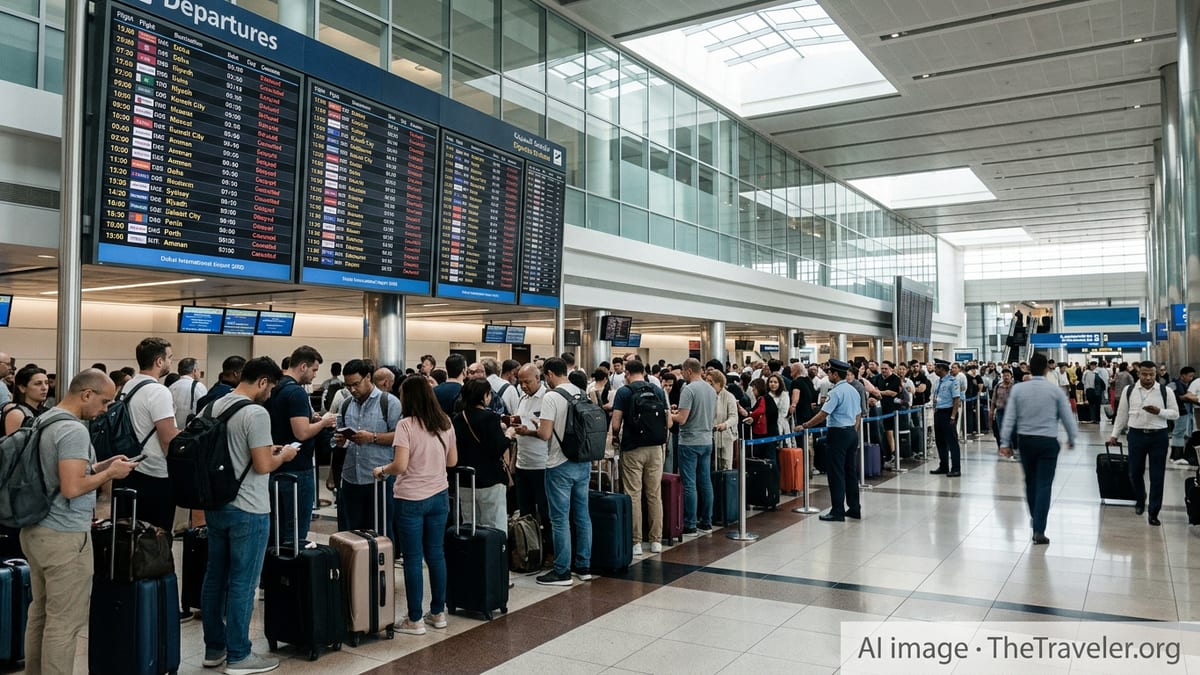
Fresh disruption at Dubai during peak Eid rush
Dubai International Airport, one of the world’s largest long-haul hubs, is again contending with significant disruption just as Eid travel demand surges across the Gulf. Flight-tracking snapshots and aviation data cited in recent industry coverage indicate that on several days in May 2026, scores of services touching Dubai have been delayed or cancelled as airlines rework schedules around fragile airspace access.
Reports from specialist aviation outlets describe clusters of operational disruption on May 5 to 7 and again around May 18, with Emirates, flydubai, Etihad and Air Arabia among carriers adjusting or grounding flights as airspace bottlenecks intensified over parts of Iran, Iraq and the Gulf. One analysis of May 6 activity pointed to hundreds of delays and several dozen cancellations across the wider Middle East network, with Dubai among the hardest-hit hubs.
While Dubai’s terminals remain open and passenger volumes are recovering compared with the immediate crisis months of February and March, publicly available advisories still describe a more fragile operation than in previous years. Travel alerts reviewed by TheTraveler.org warn that schedules remain volatile and that even minor security scares or routing constraints can quickly cascade into extensive disruption for transit passengers using Dubai as a bridge between Asia, Europe and Africa.
For Eid travellers, the timing is particularly challenging. The holiday traditionally brings a sharp spike in family visits, religious trips and leisure breaks, concentrating demand into a narrow window that leaves limited slack when flights are rescheduled or grounded.
From February strikes to a protracted aviation crisis
The latest wave of Eid disruption is unfolding against the backdrop of a broader aviation crisis triggered in late February by escalating conflict involving Iran, the United States and Israel. According to published media coverage and aviation data providers, coordinated strikes on Iran on 28 February were followed within hours by missile and drone attacks across parts of the Gulf, prompting multiple Middle East states to close or severely restrict their airspace.
Dubai International and Al Maktoum International briefly suspended all flights during the initial shock, with radar images and airline advisories showing near-empty corridors over Iran, Iraq and sections of the Gulf. Subsequent Iranian strikes on the United Arab Emirates in late February and again on 16 March forced further temporary closures and diversions, damaging infrastructure at some airports and reinforcing perceptions of vulnerability around key hubs.
Regional flight data compiled in March and April shows thousands of cancellations in the first weeks of the conflict and an ongoing pattern of volatility since then. Analysts cited in industry reports estimate that airports in the Middle East, which typically handle a significant share of global long-haul traffic, have operated well below capacity throughout the spring, with the greatest turbulence focused on Dubai, Abu Dhabi, Doha, Kuwait City and Tel Aviv.
In parallel, several major international airlines extended their suspension of services to Dubai, Doha and Tel Aviv into late May, effectively cutting many of the traditional Asia–Europe connecting options that rely on Gulf stopovers. Even as some airspace corridors reopened in April, the network has remained patchy, complicating efforts to restore stable holiday schedules.
Airspace closures, rerouting and the knock-on effect for Eid
At the core of the current disruption are fluctuating airspace restrictions and the operational burden of rerouting around conflict zones. Notices to airmen, government advisories and airline bulletins reviewed in recent weeks describe partial or total closures at various times over Iran, Iraq and parts of Syria and the Gulf, forcing carriers to lengthen flight paths or suspend routes entirely.
Aviation analysts note that rerouting long-haul flights away from the most sensitive areas typically adds flying time, fuel costs and crew-duty complications. For hub-and-spoke systems built around tight connection windows in Dubai and other Gulf airports, these changes can destabilise carefully sequenced timetables, especially during peak Eid travel when spare aircraft and crews are scarce.
Industry-focused sites tracking Middle East disruption on 5 to 7 May and 18 May point to several hundred delays in a single day across regional airports, with many of the affected flights either originating in or transiting through Dubai. When a morning service from South Asia arrives late into Dubai, the effect can cascade across onward departures to Europe and North America, leaving Eid travellers facing missed connections and unplanned overnight stays.
The impact extends beyond passengers starting or ending their journeys in the Gulf. Dubai’s position as a connecting hub means that disruptions there quickly spill into schedules at secondary airports across the Middle East, North Africa and even parts of Europe and Central Asia, where aircraft and crews depend on punctual arrivals from the United Arab Emirates.
Uneven recovery and a fragile regional network
Two months after the first major airspace shutdowns, the Middle East aviation network is showing signs of gradual recovery, but progress has been uneven and remains susceptible to fresh geopolitical shocks. Recent travel advisories from corporate mobility providers and consultancies describe a system operating on a thinner margin of resilience, with many airports open but still handling reduced schedules or temporary route suspensions.
In the United Arab Emirates, Dubai International has progressively reopened more slots since late March, yet several foreign carriers continue to operate limited or no service to the city, following earlier directives that prioritised UAE-based airlines. Neighbouring hubs such as Abu Dhabi and Sharjah face similar constraints, meaning that disruptions at one airport are harder to mitigate by rerouting through another.
Beyond the UAE, airports in Kuwait, Bahrain, Saudi Arabia, Jordan and Egypt have each reported waves of disruption tied to the same regional tensions. In some cases, drone or missile incidents near airport infrastructure have prompted temporary ground stops; in others, airlines have preemptively pulled back frequencies to reduce exposure to rapidly changing risk assessments.
For Eid travellers, the picture is one of partial normalisation layered over persistent uncertainty. While many scheduled flights are operating, the risk of sudden timetable changes remains higher than before the conflict, encouraging travellers and travel managers to build in greater buffers between connections and to monitor airline communication channels closely.
What passengers can expect in the weeks ahead
Looking beyond the immediate Eid period, publicly available planning documents from airlines and route announcements suggest that the rebuilding of Middle East connectivity will extend into the second half of 2026. Several carriers have signalled only gradual increases in capacity to Dubai and other Gulf hubs, contingent on a sustained easing of regional tensions and the continued reopening of overflight corridors.
Travel industry analysts note that even if ceasefires hold, high insurance premiums, crew safety concerns and complex rerouting patterns could keep costs elevated and schedules less predictable than before the conflict. For passengers, this may translate into fewer nonstop options, longer journey times and higher fares on some of the most popular Europe–Asia and South Asia routes that typically rely on Dubai transfers.
In the near term, those planning Eid or summer travel through Dubai are being encouraged, in widely circulated advisories, to confirm flight status frequently, leave additional time for connections and consider flexible tickets where possible. Airport operation updates indicate that check-in areas and security queues can swell rapidly when multiple delayed flights converge, particularly during busy evening departure banks.
Despite the headwinds, Dubai and its regional peers remain intent on restoring their role as global connectors. Official statements and airport traffic data point to a steady climb from the deepest lows of February and March, even as the network adjusts to a new reality in which geopolitical risk is a more central factor in day-to-day travel planning.