


More news on this day
Rapidly shifting airspace closures over Iran, Israel and the Gulf are rewriting the Middle East’s role as a global transit crossroads, piling operational pressure on Qatar Airways just as the carrier freezes staff bonuses despite posting another multibillion‑dollar profit.
Get the latest news straight to your inbox!
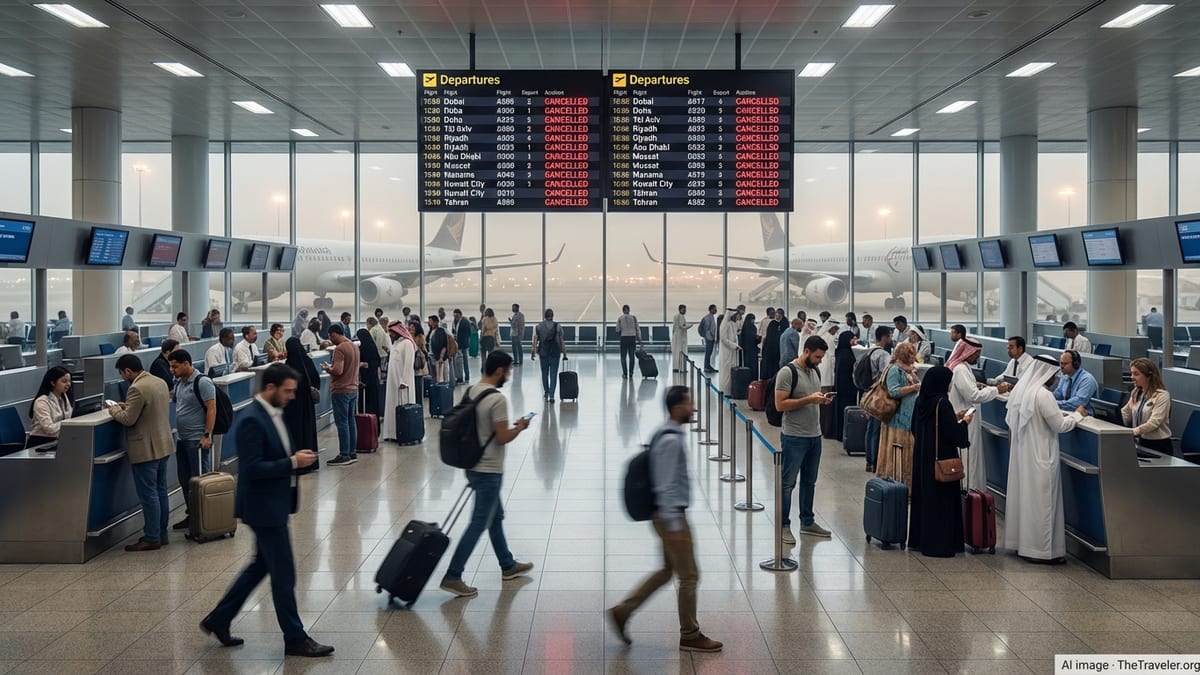
War Disruptions Redraw the Middle East Air Map
Since late February 2026, the conflict involving Iran, Israel, the United States and regional allies has triggered an unprecedented patchwork of airspace closures across the Middle East. Publicly available flight tracking data and industry briefings show corridors over Iran, Iraq, Israel, Qatar, Bahrain and parts of the United Arab Emirates intermittently closed or tightly restricted, draining once‑busy skies of long haul traffic that previously linked Europe, Asia, Africa and Australia through Gulf hubs.
Reports from aviation analytics firms indicate that at the height of the crisis in early March, several thousand flights were cancelled across the region within days, with key hubs in Doha, Dubai and Abu Dhabi operating on highly reduced schedules or suspended for regular commercial traffic. Airlines have been forced into extended detours via the Caucasus, Central Asia, Egypt and Saudi Arabia, absorbing longer flight times, higher fuel burn and complex crew rotations.
Risk assessments by international regulators continue to flag Iran’s Tehran flight information region as high‑risk airspace, even during lulls in active hostilities. Many non‑regional carriers now treat most of the northern Middle East as a no‑fly zone at cruising altitudes, routing around it even when national authorities technically reopen portions of their skies. This shift has turned what was once the shortest path between Europe and much of Asia into an avoidance zone, pushing traffic onto narrower alternatives.
Israel’s Ben Gurion Airport has remained operational for essential traffic, but capacity limits, heightened security measures and intermittent missile alerts have curbed regular schedules in and out of Tel Aviv. Flights to and from Israel are now routinely subject to last minute changes, with several foreign airlines focusing on point‑to‑point services via Europe rather than deeper connections through the wider region.
Qatar’s Hub Strategy Under Strain
For Qatar, which has spent two decades building Doha’s Hamad International into a global super‑hub, the new airspace reality is especially acute. Qatari airspace sat near the center of the initial closure ring following the late February escalation, leaving Qatar Airways facing sudden suspensions of many east‑west connections and complicating access even for evacuation and cargo operations.
Travel industry advisories describe Hamad International’s status through March and April as oscillating between limited emergency operations and controlled resumptions, with capacity constrained by the need to rely on contingency routing, enhanced safety margins and alignment with neighboring flight information regions. This has sharply reduced the predictability that once defined connections through Doha, where short minimum transfer times had been a core selling point.
Alternative hubs, particularly Istanbul, European gateways such as Helsinki, and southern routes via Cairo or Jeddah, have emerged as beneficiaries of the disruption. Analysts note that carriers based outside the Gulf, including European and Asian airlines with non‑Middle East polar or trans‑Siberian options, have been able to recapture some connecting traffic from travelers actively avoiding Gulf routings.
For Qatar Airways, the challenge is twofold: maintaining a viable long haul network in an unstable airspace environment while defending its position against competitors capitalizing on the detours. Industry forecasts suggest that even if ceasefires hold, insurers and safety regulators may be slow to relax overflight guidance, leaving the carrier operating on thinner margins for its traditional role as a bridge between continents.
Qatar Airways Freezes Bonuses Despite Strong Profit
Against this backdrop, Qatar Airways has reported another year of robust profitability but opted to suspend staff bonuses for the 2025–2026 financial year. According to financial results summarized in European business media, the airline generated a net profit in the range of 1.7 to 1.9 billion dollars for the year ending 31 March 2026, with an even higher operating profit reflecting solid passenger demand and high yields earlier in the fiscal period.
Yet internal communications cited in publicly visible employee forums and specialist aviation outlets indicate that the company has informed staff that no performance bonuses will be paid this year. Management has pointed to forward revenue pressures linked to the ongoing regional airspace crisis, rising operating costs and uncertainty over how long detours and reduced hub utilization will depress future cash flow.
The decision has fueled debate within the Gulf aviation sector, particularly in contrast to rival Emirates, which regional press coverage reports as planning a substantial profit‑sharing payout for its workforce following a year of record earnings. Commentaries in aviation trade publications suggest Qatar Airways is choosing to retain cash to preserve balance sheet resilience while it navigates a prolonged period of geopolitical volatility and potential network restructuring.
For global travelers, the bonus freeze is a signal that even financially strong Gulf carriers are bracing for a more turbulent earnings outlook. If revenue headwinds intensify, airlines could turn to tighter capacity management, more conservative expansion plans or delayed fleet investments, outcomes that may ultimately narrow choice and keep fares elevated on key long haul corridors.
Ripple Effects for Global Travelers
The most visible immediate impact for passengers has been widespread cancellations and unscheduled overnight stays as flights relying on Middle Eastern hubs are rerouted or grounded. Reports from travel management companies describe business travelers stranded in cities such as Singapore, Kuala Lumpur and Bangkok when onward flights via Doha, Dubai or Abu Dhabi were abruptly removed from schedules during the first weeks of the crisis.
On surviving routes, fare dynamics have shifted sharply. Travel data providers estimate that economy class prices on some Europe to Southeast Asia itineraries routed via non‑Gulf hubs spiked well above historical norms during March, with limited seats available as airlines consolidated demand onto detour corridors. Premium cabins have also tightened, as corporate travel shifts away from conflict‑adjacent routings and concentrates demand on a smaller set of perceived safe options.
Schedule reliability has become more volatile. Even when tickets are sold and flights appear confirmed, airlines continue to warn that departures may be retimed, rerouted or consolidated at short notice, depending on developments in the region and on the status of overflight permissions. Travelers connecting to or from Israel face additional layers of uncertainty, given that Tel Aviv services are closely tied to the evolving security picture.
Experts in airline network planning quoted in industry analyses argue that the crisis is accelerating a pre‑existing trend toward diversification of long haul flows. Carriers in Europe, Asia and North America are looking more closely at point‑to‑point ultralong‑haul services or connections through secondary hubs that are less exposed to Middle Eastern flashpoints, potentially diluting the dominance of Gulf super‑connectors in the medium term.
What Passengers Should Watch Next
For global travelers considering itineraries touching the Middle East over the coming months, several factors will shape the experience. First, the stability of ceasefires and any formal relaxation of airspace restrictions will determine whether airlines feel confident restoring pre‑crisis frequencies through the region. Even partial reopenings may not immediately translate into normal schedules if insurers and regulators maintain strict risk thresholds.
Second, the strategic responses of key carriers such as Qatar Airways, Emirates, Etihad and major European and Asian airlines will influence pricing and availability. If Gulf hubs remain constrained, airlines may continue to funnel more capacity through alternative routes via Turkey, southern Europe or North Africa. That could lock in longer average flight times between Europe and Asia and sustain higher fare levels on many city pairs.
Third, travelers will need to pay closer attention to ticket flexibility. Travel management advisories consistently recommend booking itineraries that allow date or routing changes at reasonable cost, favoring airlines that have published clear disruption policies tied to the Middle East situation. Passengers booking journeys that involve Qatar, Iran, Israel or neighboring airspace zones are being urged to monitor airline notifications daily in the week before departure.
Finally, observers note that the combination of sustained geopolitical risk and financial caution, illustrated by moves such as Qatar Airways’ bonus suspension, could herald a more conservative era for capacity growth across the region. For frequent flyers accustomed to abundant seat supply, aggressive competition and generous loyalty benefits on Gulf carriers, the reshaped landscape may feel markedly tighter, with fewer routing options and less margin for last minute change.