


More news on this day
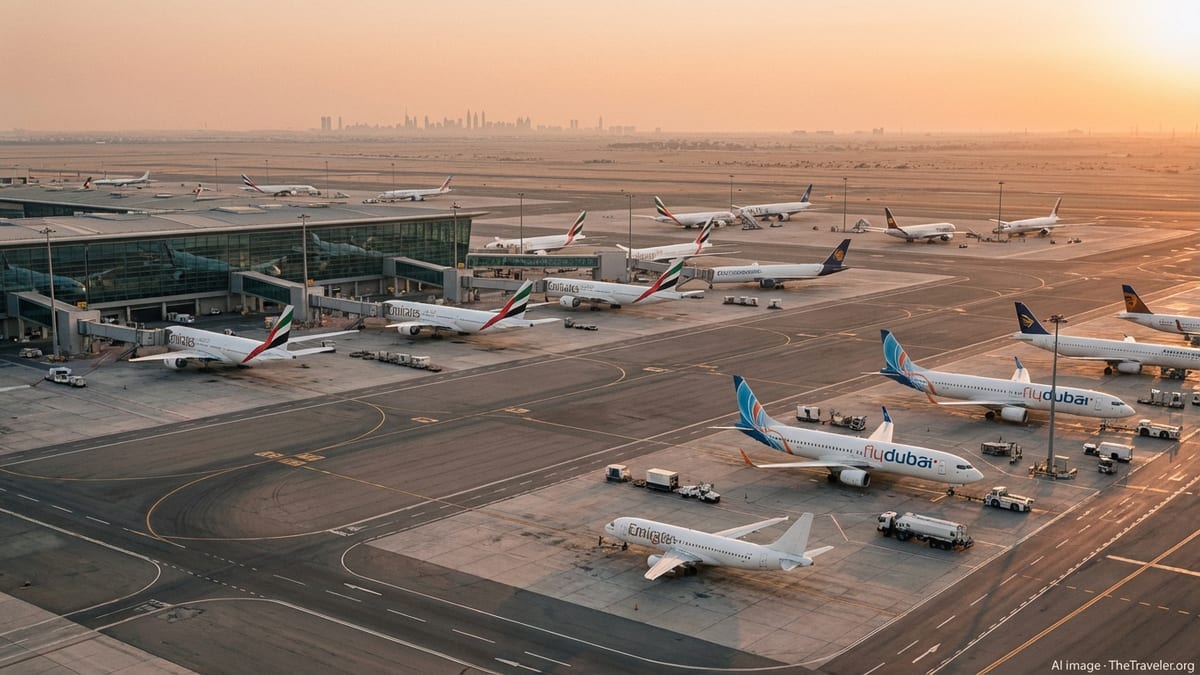
Travelers across the Gulf, South Asia, Europe and North America are facing fresh disruption as operational constraints at Dubai International Airport trigger 257 flight delays and 21 cancellations, disrupting major carriers on routes linking the United Arab Emirates to Saudi Arabia, India, the United Kingdom, Bangladesh, the United States, Singapore and other key markets.
Get the latest news straight to your inbox!
Widespread Knock-on Effects for Major Carriers
Publicly available flight-tracking data and airline travel alerts indicate that the latest disruption at Dubai International Airport is rippling well beyond the United Arab Emirates, affecting departures and arrivals on multiple continents. Network carriers that use Dubai as a primary hub are managing rolling delays, trimmed schedules and selective route suspensions as they adjust to constrained airport operations and congested airspace.
The disruption has translated into at least 257 delayed flights and 21 outright cancellations in a concentrated window, hitting services not only within the Gulf but also on long-haul links to Europe, North America and Asia. Passengers transiting through Dubai are experiencing extended ground times, tighter connection margins and, in some cases, enforced overnight stays when onward connections are missed.
According to published coverage and industry advisories, the impact is not limited to any single airline. Large Gulf carriers are re-timing departures, operating aircraft substitutions and consolidating lightly booked services, while international partners in Europe, South Asia and East Asia are rerouting or temporarily suspending certain Dubai-bound rotations. This has created an uneven pattern in which some flights operate close to schedule while others are delayed by several hours.
Travel agents and corporate travel managers report a surge in itinerary changes as passengers seek to bypass the most heavily affected waves of traffic through Dubai. Alternate routings via Abu Dhabi, Doha and other regional hubs are becoming increasingly common, although these airports are also contending with higher-than-normal volumes driven by the same airspace and scheduling constraints.
Routes to Riyadh, Mumbai, Singapore and Beyond Disrupted
The disruption has been particularly visible on high-demand regional and long-haul city pairs that depend on Dubai as a connective node. Routes linking Dubai with Riyadh, Mumbai and Singapore feature prominently among those affected, with delays and cancellations rippling down the line to secondary destinations in Saudi Arabia, India and Southeast Asia.
On the Saudi corridor, schedule data and traveler reports suggest that frequencies between Dubai and Riyadh have been repeatedly adjusted in recent days. Morning and late-evening departures have been especially vulnerable to changes, as carriers compress operations into narrower windows of available slots. This has had a knock-on effect for passengers relying on Riyadh as a springboard to other domestic Saudi cities.
Traffic between Dubai and Mumbai, one of the region’s busiest short-haul international markets, has likewise seen a mix of delays and aircraft swaps. Airlines operating this route have responded by advising travelers to arrive early, monitor flight-status tools closely and prepare for potential rebooking if minimum connection times cannot be maintained during peak periods. The disruption coincides with robust summer travel demand between the Gulf and India, amplifying crowding at check-in, security and transfer points.
Longer-haul services linking Dubai with Singapore have recorded selective cancellations and extended ground holds as carriers recalibrate their Asia networks. When these flights are pulled or significantly delayed, passengers bound for onward destinations across Southeast Asia and Australasia are pushed onto alternative connections, in some cases lengthening total journey times by half a day or more.
Passengers from the UK, US, Bangladesh and Other Markets Caught Up
Because Dubai functions as a global super-hub, disruption there quickly cascades into passenger experiences far from the Gulf. Travelers originating in the United Kingdom and the United States have reported last-minute schedule changes, missed onward connections and rebookings through alternative hubs when Dubai-bound legs or connecting flights onward to South Asia and the Far East are affected.
Published reports highlight that routes linking Dubai with London, Manchester and several major US gateways remain operational but are subject to day-of-travel schedule adjustments. When Dubai arrivals land later than planned, transit passengers heading to destinations such as Riyadh, Mumbai, Dhaka or Singapore may find that their originally booked connections have already departed, prompting lengthy re-accommodation processes at the transfer desks.
Bangladesh-facing routes, including services between Dubai and Dhaka, have also been drawn into the disruption. These flights are key links for migrant workers and visiting families, who often travel on tightly budgeted itineraries with limited flexibility. Any cancellation or forced rerouting can introduce additional financial strain in the form of added accommodation, meals and local transport costs.
Secondary markets in Europe, Africa and Central Asia that rely heavily on onward connections via Dubai are feeling indirect pressure as well. Even when their direct flights operate close to schedule, seat availability onward to the Gulf, South Asia or East Asia can be constrained if earlier cancellations and delays have created backlogs of rebooked passengers.
Operational Constraints, Airspace Issues and Summer Demand
A combination of factors appears to be driving the current wave of disruption. Aviation bulletins and risk advisories for the Middle East highlight the lingering effects of regional airspace restrictions that have been in place since earlier in the year, forcing airlines to fly longer, more circuitous routings around closed or high-risk corridors. These detours increase block times, narrow turnarounds and reduce the buffer that carriers normally rely on to keep their schedules on track.
Operational constraints at Dubai International Airport itself, including tight runway and gate capacity, further limit the ability of airlines to absorb knock-on delays once they occur. When arriving flights are pushed back by airspace issues, downstream departures can quickly stack up, leaving carriers with few options other than to delay or cancel selected services in order to stabilize the overall schedule.
The disruption is coinciding with the summer peak travel season, a period when Dubai usually handles some of its highest passenger volumes of the year. Strong demand from leisure travelers, expatriate workers and visitors transiting between Europe, Asia and Oceania means that many flights are already operating near capacity, leaving little spare inventory for rebooking displaced passengers. This intensifies crowding at customer-service counters and increases pressure on airlines’ call centers and digital channels.
Industry analysis suggests that carriers are also balancing operational resilience with cost control. Running additional backup aircraft and crews can mitigate disruption but is increasingly expensive in the current environment of high fuel prices and complex geopolitics. As a result, some airlines are opting for targeted cancellations and schedule thinning on specific city pairs to protect the reliability of their core networks.
What Travelers Can Do if Their Flight Is Affected
For travelers scheduled to pass through Dubai in the coming days, publicly available guidance from airlines and travel advisories converges around a few key points. Passengers are urged to monitor their flight status frequently using airline apps or official departure boards and to expect that day-of-travel changes may occur even if tickets were issued weeks or months in advance.
Airlines are generally offering no-fee date or routing changes in cases where flights are significantly delayed or cancelled, though the specific options vary by carrier and fare type. Some travelers may be able to reroute through alternative hubs in Abu Dhabi, Doha, Muscat or European gateways, while others may prefer to shift their trips by several days until schedules show greater stability.
Experts recommend allowing additional connection time when booking itineraries that involve a transfer in Dubai, particularly on routes to Riyadh, Mumbai, Singapore and other heavily affected destinations. Where possible, choosing slightly longer layovers can provide a buffer if inbound flights encounter delays due to airspace detours or congestion at the airport.
Travelers facing involuntary cancellations are encouraged to retain all receipts for meals, accommodation and ground transport incurred while waiting for replacement flights, as some airlines and travel insurance policies may reimburse these expenses under disruption provisions. With conditions around the Gulf still fluid, observers expect airlines and airports to continue adjusting their operations in the short term as they work to restore more predictable connectivity through Dubai’s key hub.