


More news on this day
Dubai’s airports are operating close to full capacity and maintaining their role as a key global transit hub, even as renewed US-Iran tensions continue to disrupt airspace and flight paths across the wider Middle East.
Get the latest news straight to your inbox!
Passenger traffic rebounds as airspace stabilises
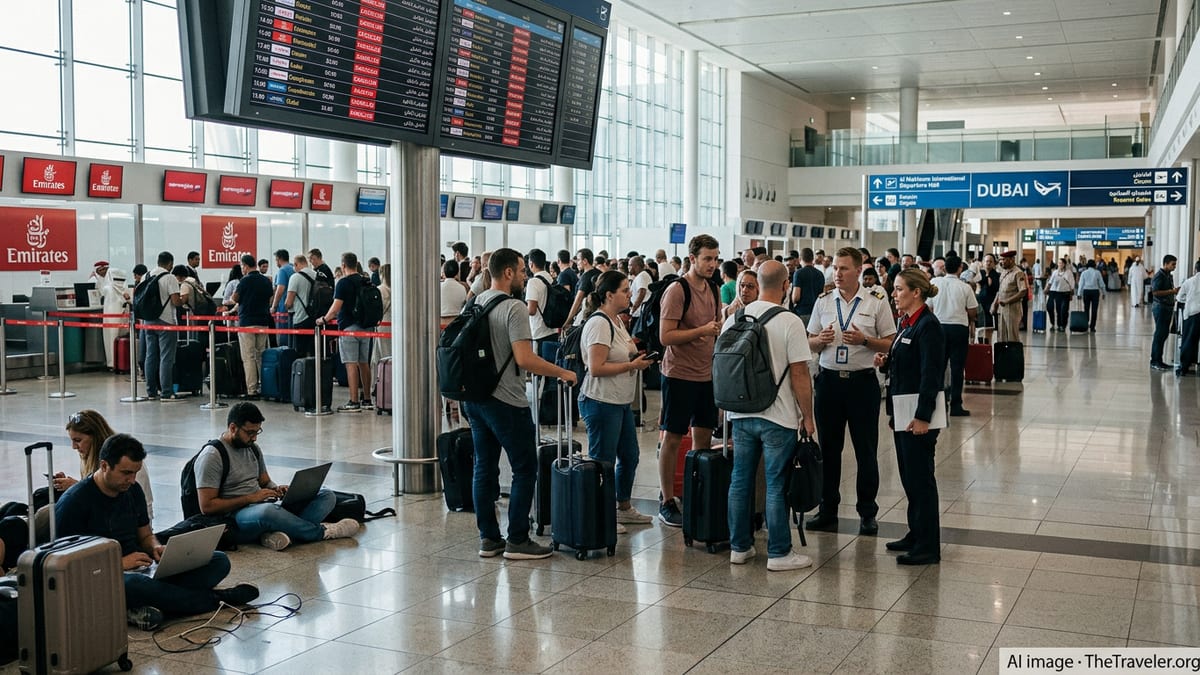
Publicly available information from Dubai Airports and regional aviation coverage indicates that operations at Dubai International Airport have recovered strongly from the steep disruption that followed the escalation of conflict involving the United States and Iran earlier this year. As regional airspace restrictions within the United Arab Emirates have eased, the hub has progressively restored movements to its pre-crisis levels, with schedules now described as operating at or near declared capacity.
Earlier updates from Dubai Airports showed that during the height of the Iran-related disruptions in March and April, daily flight movements dropped to well below half of normal activity. Recent briefings and industry data now point to a return to almost full capacity on most days, supported by reconfigured routes that avoid conflict zones while preserving the volume of services into and out of the emirate.
Passenger volumes have followed a similar trajectory. Coverage in regional business outlets has highlighted that Dubai International handled millions of travelers during the crisis period despite repeated missile alerts and temporary shutdowns. With airspace within the UAE now fully restored and regional routings more predictable, the airport is once again processing passenger numbers broadly in line with its pre-war forecasts for 2026.
Industry analysts cited in Middle East aviation reports suggest that, provided no new large-scale airspace closures occur, Dubai Airports remains positioned to meet or approach earlier annual traffic projections, even after a weaker first quarter.
Rerouted corridors keep connectivity intact
While tensions between Washington and Tehran continue to shape the security environment over parts of the Gulf and wider region, airlines serving Dubai have largely preserved connectivity by shifting to alternative routings. According to published coverage, many carriers reoriented flights south of Iranian and Iraqi airspace, making greater use of corridors over Oman and the Arabian Sea to maintain long-haul links to Europe, Asia and the Americas.
These detours have generally added flight time and fuel costs but have not fundamentally altered Dubai’s role as a connecting hub. Data shared in regional media show that during some days of the crisis, Dubai International operated at more than 90 percent of its typical daily schedule, even when neighboring airspace remained heavily restricted.
Reports from aviation tracking platforms referenced by news outlets indicate that Emirates, flydubai and other carriers based in the UAE have concentrated on optimizing schedules within the available corridors rather than significantly cutting capacity. Aircraft rotations have been adjusted and some frequencies consolidated, but overall seat supply through Dubai remains robust compared to the early weeks of the conflict.
For travelers, the main impact has been longer flight times on certain routes and the possibility of last-minute adjustments, rather than large-scale cancellations. Travel-industry commentary notes that Dubai’s ability to keep a high percentage of flights operating helped prevent broader global network disruption, especially for Europe–Asia and Africa–Asia connections.
Mixed picture for foreign carriers and insurance-driven decisions
Despite the strong performance of Dubai-based operators, the recovery has been uneven among foreign airlines. Coverage in Gulf-focused business media points out that some major European carriers have been slower to restore full schedules into Dubai, citing government travel advisories and aviation insurance conditions related to overflight of nearby conflict areas.
Several long-haul airlines have gradually resumed services but remain on reduced frequencies compared with pre-conflict timetables. Analysts note that these decisions often reflect corporate risk assessments and insurance requirements rather than any operational constraints at Dubai’s airports themselves, which are described as functioning normally.
Industry commentary suggests that as regulatory guidance evolves, more international carriers may restore capacity through Dubai to meet resurgent demand. In the meantime, local and regional airlines have redeployed aircraft to partially fill gaps, particularly on high-demand routes to South Asia, Europe and North America.
Travel trade publications highlight that for tour operators and corporate travel planners, the main uncertainties now relate to the evolution of geopolitical risk assessments rather than airport throughput. As long as Dubai’s hubs remain open and operating near full capacity, itinerary planning continues to pivot around airline-specific policies instead of infrastructure limitations.
Al Maktoum Airport expansion advances despite conflict
The resilience shown at Dubai International has been mirrored by steady progress at Al Maktoum International Airport in Dubai South. According to recent regional news reports, Dubai Airports’ chief executive has reiterated that expansion plans at the newer airport remain on track, even in the context of heightened US-Iran tensions and temporary war-related disruptions.
Al Maktoum International, envisioned as a future mega-hub for the emirate, continues to see investment in terminal capacity and airfield infrastructure. While its current traffic remains a fraction of Dubai International’s volume, the airport has provided additional operational flexibility during periods of regional instability, including the ability to accommodate diversions and cargo operations when routings were under strain.
Aviation analysts quoted in trade coverage argue that maintaining momentum on Al Maktoum’s long-term development sends a signal of confidence to airlines and investors that Dubai intends to preserve and expand its role as a global aviation center regardless of geopolitical headwinds. The project is seen as a hedge against future shocks, enabling the emirate to spread risk and capacity across two major hubs.
For the travel industry, the continued build-out of Al Maktoum International suggests that even as airspace remains politically sensitive, infrastructure planning in Dubai is proceeding on the assumption of sustained, and eventually growing, international demand.
Travel demand and booking trends remain resilient
Despite recurring headlines about missile alerts, airspace advisories and regional security concerns, the underlying appetite for travel through Dubai appears strong. Travel and aviation publications report that passenger flows rebounded quickly once the most stringent airspace closures were lifted, helped by Dubai’s existing reputation as a reliable connecting hub and destination.
Forward-booking data cited in industry commentary indicate that demand for connecting itineraries via Dubai has remained firm for the peak summer season, even as some governments maintain cautions about non-essential travel to parts of the Gulf. Price-sensitive leisure travelers and connecting passengers, in particular, continue to route through the emirate when schedules and fares remain competitive.
Regional economists note that Dubai’s wider economy, including tourism and retail, has so far weathered the US-Iran tensions better than many feared at the outset of the conflict. Spending indicators and hotel performance data reported by local media suggest only marginal declines relative to pre-conflict expectations, reinforcing the view that the aviation sector’s ability to operate near full capacity has cushioned the broader impact.
For travelers and industry professionals watching the situation, the message from publicly available information is that Dubai’s airports, while operating within a complex geopolitical environment, remain open, busy and central to global air networks, with operations that are described as close to full capacity even as regional tensions persist.