


More news on this day
Flights to Dubai and across the Middle East are slowly returning after months of war-related disruption, yet a fresh spike in tensions between the United States and Iran is keeping airlines cautious and passengers facing delays, detours and last-minute changes.
Get the latest news straight to your inbox!
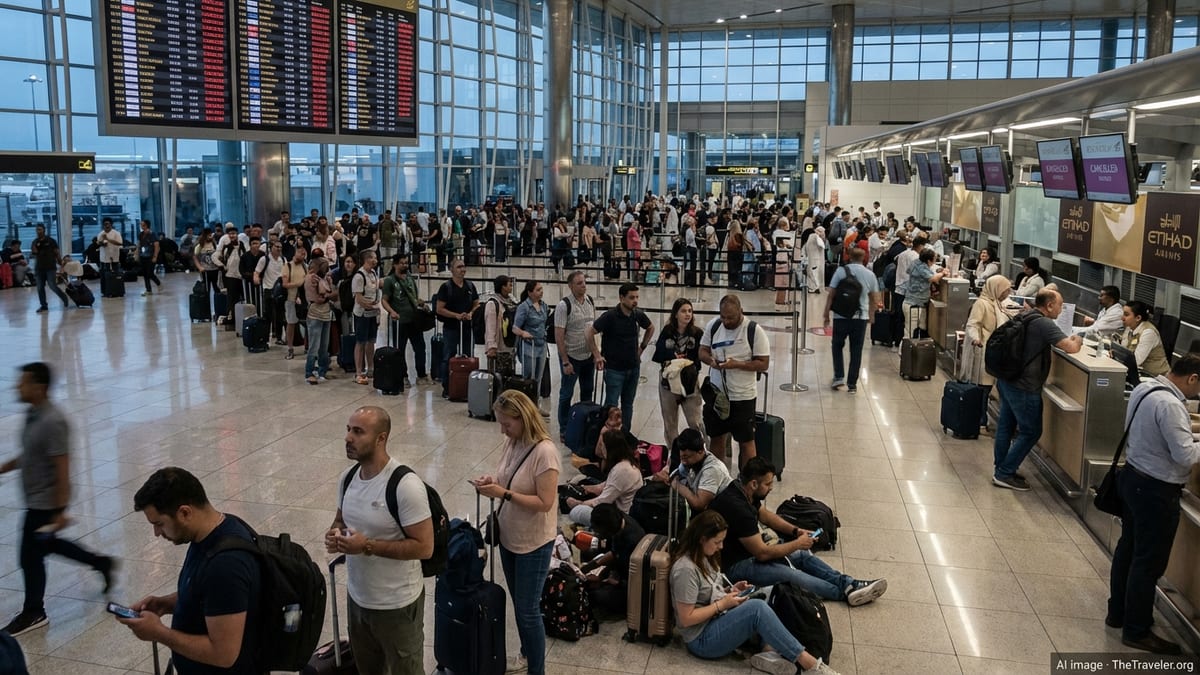
Traffic returns to Dubai, but with thinner schedules
Dubai International Airport remains open and operating, but traffic is still below normal as carriers balance resuming key routes with managing security and airspace risks. Publicly available airport and airline data indicate that the hub has rebuilt much of the capacity lost when Iranian strikes and missile alerts repeatedly halted operations earlier in the year, including a closure after the February 28 attacks and further interruptions during subsequent barrages.
In recent weeks, more long-haul and regional services have come back onto the board. Reporting from business and aviation outlets describes how British Airways, for example, restored flights to Dubai at a reduced frequency, while other European and Asian carriers have cautiously followed, often with fewer weekly rotations than before the conflict. Gulf-based airlines such as Emirates and flydubai have also rebuilt large portions of their networks, though schedules remain more flexible than usual to accommodate sudden changes in airspace conditions.
Despite the rebound, travelers passing through Dubai on July 13 and July 14 have encountered fresh delays and diversions as United States airstrikes on Iran and Iran’s retaliatory attacks on Gulf states renewed fears of missile or drone activity near major airports. Local media reports and airport advisories highlight that operations can shift quickly from largely normal to heavily disrupted when regional alert levels rise, a pattern that has become familiar during the conflict.
As a result, airlines appear to be maintaining higher buffers in their schedules, building in additional turnaround time and holding spare aircraft and crews where possible. The aim is to preserve connectivity to one of the world’s busiest international hubs while avoiding the cascading chaos that accompanied the first wave of closures earlier in 2026.
Regional airspace remains a complex patchwork
While Dubai itself is open, the skies around it are still far from normal. Flight-planning advisories and operational briefings for commercial and business aviation show that airspace over Iran remains heavily restricted, with closures or severe limitations on key high-altitude corridors used by east–west traffic. Parts of Iraqi and Lebanese airspace are similarly flagged as high risk, and several Gulf flight information regions have imposed temporary flow controls or altitude caps at times of heightened tension.
European and international aviation safety bodies continue to warn against routine overflights of Iranian, Iraqi and some neighboring airspace, keeping many carriers on longer detours via the Caucasus, Central Asia or southern routes over Egypt and Saudi Arabia. Industry analysis indicates that these diversions add significant flight time and fuel burn for services linking Europe and North America with the Indian subcontinent, Southeast Asia and Australia, many of which traditionally rely on Dubai and other Gulf hubs as transfer points.
This compressed airspace has knock-on effects for Dubai-bound flights. When multiple flows are squeezed into fewer corridors, delays can build as air traffic controllers manage congestion and maintain separation standards. Airlines also have to account for potential holding patterns or tactical reroutes in flight, particularly during periods when military operations intensify near the Strait of Hormuz or along the Gulf coast.
Operators therefore remain wary of announcing a full return to pre-war routings even as demand for travel to and through Dubai climbs. The prevailing strategy is to keep contingency plans active, including pre-cleared alternate routings and additional fuel uplift, so that services can continue even if certain flight paths are abruptly closed.
US-Iran tensions inject new uncertainty into recovery
The latest round of US strikes on Iranian targets and Iran’s retaliatory attacks on Gulf states has added a fresh layer of uncertainty to what had been a slow but steady aviation recovery. News coverage from international and regional outlets describes how missile alerts in the United Arab Emirates, maritime incidents in the Strait of Hormuz and renewed threats to shipping lanes have all contributed to a more fragile operating environment for airlines.
Announcements from Washington that a naval blockade of Iranian ports would be reinstated, combined with Tehran’s warnings around the narrow waterway, have fueled concerns over potential escalation. While the primary focus of these moves is maritime traffic, aviation analysts note that any perceived risk to critical infrastructure in the Gulf, including airports and fuel facilities, tends to be quickly priced into airline risk assessments and insurance costs.
Market commentary from industry bodies and consultancies suggests that the war and its latest flare-up have already dented regional aviation’s financial outlook for 2026. Forecasts for global airline profitability have been revised downward, with the Middle East highlighted as one of the most exposed regions because of its reliance on long-haul connecting traffic and overflight revenue. Even if direct attacks on airports remain rare, the mere possibility requires carriers to maintain contingency planning that weighs on efficiency.
For Dubai, this means its role as a resilient global hub is again being tested. The city’s airports have shown they can resume operations quickly after security incidents, but the persistence of geopolitical risk means that planners cannot yet assume a straightforward return to business as usual.
Airlines walk a line between demand and risk
Passenger demand into Dubai and other Gulf cities has proven surprisingly robust, particularly for leisure and visiting-friends-and-relatives travel from Europe, South Asia and Africa. Tourism authorities report that hotel bookings and events calendars remain busy for the second half of 2026, suggesting that many travelers are still willing to fly despite the headlines, provided flights are operating and airports are open.
Airlines, however, are calibrating capacity carefully. Factbox-style reporting and schedule data show that several major carriers have resumed services to Middle Eastern destinations but with thinner timetables, reduced frequencies or upgauged aircraft on a smaller number of daily rotations. In some cases, airlines have dropped secondary Gulf destinations altogether to focus resources on core hubs like Dubai, Doha and Riyadh where demand is deepest and operational support strongest.
At the same time, risk management remains a central consideration. Many carriers continue to avoid overflying Iran and neighboring high-risk areas even when such routes are technically available, preferring longer paths that keep aircraft and passengers farther from potential military activity. This cautious stance helps explain why some flights are operating with extended block times and why connections that once fit neatly within a one- or two-hour layover in Dubai can now require more generous buffers.
Travelers booking or transiting through Dubai are being encouraged by airlines and travel agents, according to public advisories, to monitor flight-status tools closely, allow more time between connections and remain flexible about routing options. The overarching message is that while flying to and through the Gulf is possible and increasingly common again, conditions remain dynamic and subject to rapid change.
What travelers can expect in the weeks ahead
With tensions between the United States and Iran still high and diplomatic efforts ongoing, aviation experts expect a prolonged period of elevated but manageable disruption rather than a swift return to pre-conflict normalcy. Airspace restrictions, missile alerts and shifting risk assessments are likely to persist, even if ceasefire talks gain momentum.
For passengers using Dubai and other Middle Eastern hubs, this translates into a travel environment where flights are operating, but schedules can be adjusted at short notice. Same-day reroutes, longer flight times and altered connection patterns may remain common features of itineraries linking Europe and North America with Asia and Africa.
Industry analyses point out that airlines and airports in the region have become more adept at handling these shocks, drawing on experience from earlier phases of the conflict. Operational playbooks for rapid shutdowns and restarts, passenger sheltering, and mass rebooking are now well developed, improving resilience even as geopolitical risks persist.
Ultimately, the pace at which Dubai and the wider Middle East can restore full flight connectivity will hinge on developments far beyond the airport perimeter. Until the trajectory of the US-Iran confrontation becomes clearer, airlines are likely to keep flying, but with contingency planning built into almost every leg that crosses the still-tense skies of the Gulf.