


For many long haul travelers, the United Arab Emirates is not the final destination but the place where two big journeys connect. That usually means choosing between flying through Dubai International Airport (DXB), the world’s busiest hub for international passengers, or Abu Dhabi’s newly rebranded Zayed International Airport (AUH), centered on its gleaming Terminal A. Both promise smooth transfers, striking architecture and easy access to the Gulf. Yet they offer very different experiences once you look at routes, airlines, airport layout and what you can realistically do on a layover. This guide breaks down Dubai versus Abu Dhabi airport so you can decide which is better for your specific trip.
Get the latest updates straight to your inbox!
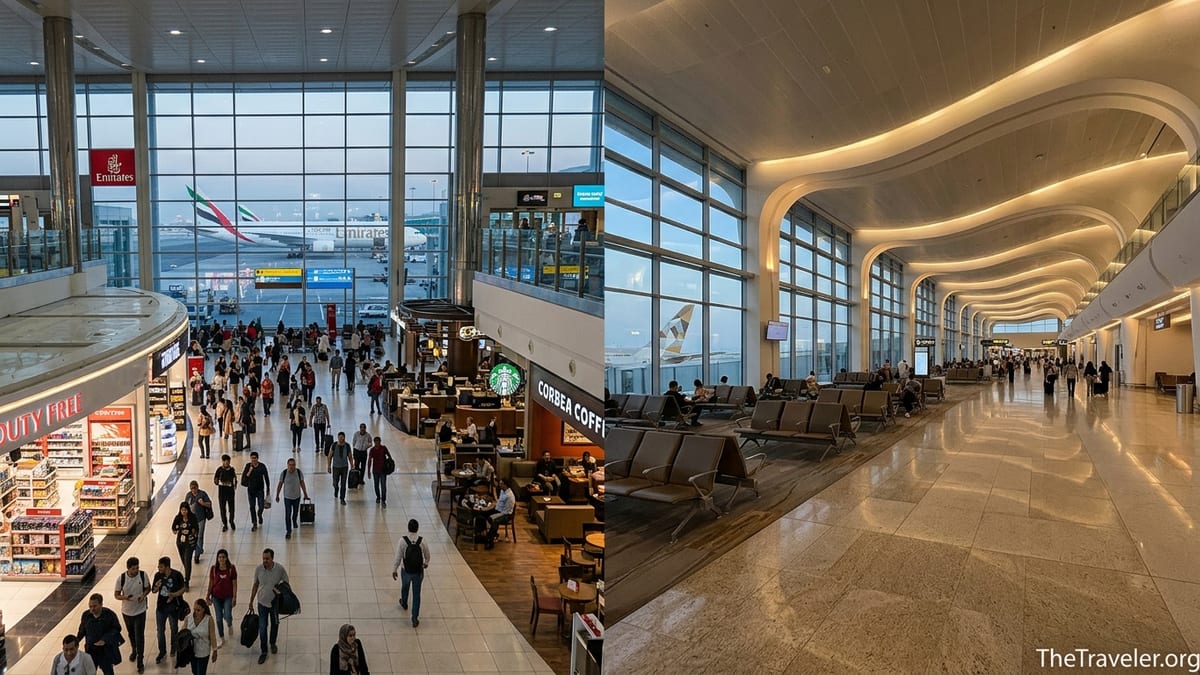
Overview: Two Very Different Gulf Mega Hubs
Dubai International Airport is one of the most traffic heavy hubs on the planet, handling more than 90 million passengers a year and consistently ranking as the world’s busiest airport by international traffic. It functions as the main hub of Emirates and a major base for flydubai, which together operate thousands of weekly flights across Europe, Asia, Africa and the Americas. In practice, that means enormous choice in schedules and routes, particularly if you are flying from secondary European cities to Asia or Australia and need a one stop option.
Abu Dhabi’s Zayed International Airport, by contrast, is smaller but newly built for growth. In late 2023, all flights shifted into the vast new Terminal A, and in February 2024 the airport was officially renamed after Sheikh Zayed. Terminal A was designed for about 45 million passengers a year, so you still get a big hub feel, but with a more manageable scale. It is the home of Etihad Airways and also serves a growing list of other carriers, including low cost airlines that connect Central and Eastern Europe with the Indian subcontinent.
The choice between the two often comes down to which airline and alliance you prefer and how sensitive you are to connection times, walking distances and crowds. Dubai delivers huge capacity and frequency, which suits travelers who want maximum flexibility. Abu Dhabi focuses on a newer terminal, shorter connection times and a more controlled environment, which can appeal if you value calm and clarity over sheer size.
There is also a geographic angle. DXB sits within Dubai itself, close to older districts like Deira and Bur Dubai, and on the Dubai Metro’s Red Line. AUH is farther from the city center, roughly a 30 to 40 minute drive to downtown Abu Dhabi in typical traffic. If you aim to spend time in one city rather than just transit, that location can influence which hub works better.
Airlines, Routes and When Each Hub Shines
For most travelers, the first deciding factor is the airline. If you are booked with Emirates, you will automatically use Dubai International, almost always through Emirates dedicated Terminal 3. Emirates runs an especially dense network from Europe and North America to Dubai and onward to Asia, Australia and Africa. For example, a traveler flying from Dallas to Bangkok can often find a single ticket with convenient overnight connections in Dubai and multiple daily frequencies on both legs. That redundancy can be valuable if one flight is delayed and you need to be rebooked.
If you choose Etihad, you will connect through Abu Dhabi’s Zayed International. Etihad has historically specialized in Europe to Asia and Australia routes via Abu Dhabi as well, but generally with fewer daily frequencies than Emirates on the same city pairs. For instance, you might see one or two daily Etihad flights between a European capital and Abu Dhabi, compared with several Emirates flights from the same region into Dubai. On the other hand, Etihad can sometimes price aggressively on certain markets, such as Milan to Jakarta or Manchester to Manila, making AUH the more economical hub even if the schedule is less dense.
Regional connections also differ. Dubai acts as the primary hub for flydubai, a low cost carrier that reaches dozens of smaller cities in the Middle East, Central Asia and East Africa. This matters if you are heading to places like Bishkek, Zanzibar or small regional airports in Saudi Arabia that Etihad may not serve as frequently. Abu Dhabi, meanwhile, is developing its own low cost ecosystem with Wizz Air Abu Dhabi and Air Arabia Abu Dhabi, which primarily link Central and Eastern Europe and the Indian subcontinent with the UAE. If you are flying from Budapest or Katowice to Kochi, you might find a competitive Wizz or Air Arabia connection through AUH.
Long haul travelers from North America face another trade off. Emirates offers nonstop flights from several US gateways such as New York JFK, Los Angeles and Houston to Dubai. Etihad also serves key US cities like Chicago and Washington via Abu Dhabi but with a smaller route map and fewer daily departures. If you want multiple departure time options in a single day, Dubai usually wins. If you find a particularly good fare or prefer Etihad’s onboard product or frequent flyer partnership, Abu Dhabi can still make excellent sense.
Transit Experience: Layout, Distances and Ease of Connection
Dubai International’s scale is both its strength and its challenge. Terminals 1 and 3 are enormous linear halls with multiple concourses. If you are flying Emirates to Emirates within Terminal 3, the system is generally well tuned: you disembark, follow purple transfer signs, clear security and walk or ride automated trains to your next gate. Connection windows as low as 1 hour 30 minutes are often considered feasible when both flights are with Emirates, and airline agents are accustomed to tightly choreographed transfers.
However, that size can backfire if you land at a remote gate or need to switch between different parts of the complex, especially at peak times around midnight when many long haul flights bank into DXB. You may easily walk 15 to 20 minutes between some gates, and if you are traveling with small children or heavy carry on bags, that distance becomes part of your real transit cost. Travelers connecting from an Emirates flight in Terminal 3 to a low cost carrier in Terminal 2 should allow extra time, because this involves a bus or taxi transfer between terminals, new check in and security checks.
Abu Dhabi’s Zayed International, with all airlines consolidated into Terminal A, is designed to minimize this complexity. The building is large but more compact than DXB’s spread out concourses, and the airside layout intentionally keeps transfer distances reasonable. Etihad often sells connections as short as about 1 hour 15 minutes between many flights, and recent traveler reports suggest that typical connections under two hours are comfortable when both legs are on Etihad. Wayfinding signs are prominent, and because all flights now operate from the same terminal, you avoid terminal hopping.
The trade off is that Abu Dhabi has fewer alternative flights if something goes wrong. If a late inbound flight causes you to miss your onward connection, Etihad can rebook you, but there may be only one next flight that day to your final destination. In Dubai, the combination of Emirates multiple daily flights and the presence of many other carriers sometimes gives agents more rebooking flexibility, whether that means a later Emirates flight or, occasionally, a partner airline.
Lounges, Comfort and What It Feels Like on the Ground
Dubai International has spent years refining its airside ecosystem, particularly for Emirates passengers. In Terminal 3, premium travelers find multiple Emirates lounges, including dedicated Business and First Class spaces with showers, buffet dining and quiet areas. Economy passengers who are willing to pay for comfort can access pay per use lounges from brands such as Marhaba or Plaza Premium, which commonly charge a fixed fee for a few hours of access with snacks, simple hot dishes and Wi Fi. This is especially useful on overnight connections when you want to nap on a recliner instead of trying to sleep in the main public seating areas.
Beyond lounges, DXB offers a sprawling mix of duty free shops, high street fashion brands and global F&B chains. You can pick up everything from a quick burger and coffee to more substantial meals like Lebanese mezze or Indian thali plates. Prices are similar to those in an upscale mall. A sit down meal with a main course and drink in a mid range restaurant might easily cost the equivalent of 20 to 30 US dollars, while a coffee and pastry from a chain café could land around 8 to 10 dollars depending on size and brand.
Abu Dhabi’s Terminal A was designed from the outset as a flagship space that combines design and retail. The architecture features high ceilings, plenty of natural light and a central atrium that has drawn praise from aviation and design publications. In late 2024, the airport was recognized by an international architecture prize as one of the world’s most beautiful airports, which gives a sense of the design ambitions. Inside, Etihad operates new lounges with modern décor, barista coffee, a la carte dining in some sections and dedicated family areas. Pay per use lounges have also appeared, though the overall number of lounge brands is still smaller than at DXB.
On the practical side, AUH’s seating, charging points and rest areas feel more recently built. Travelers report that even at busy times, the new terminal absorbs crowds relatively well, and that lines for restrooms and security are shorter than they often experience in Dubai. Food and retail options are growing, with a mix of international coffee chains, fast food outlets and sit down restaurants. Prices are broadly comparable to Dubai, though the range of ultra luxury boutiques is currently less extensive than DXB’s, which will not matter to most transit passengers.
Stopovers and City Access: Turning a Layover Into a Mini Trip
One major selling point of both hubs is the ability to turn a simple connection into a short stay. Emirates and Etihad have each developed stopover programs that, at various times, include discounted or even free hotel nights when you book long haul itineraries via their home airports. For example, Etihad’s current Abu Dhabi stopover offers packages where eligible passengers receive one or more complimentary nights in selected hotels, often 3 or 4 star properties in the city, when they book a multi day stopover through the airline. Availability and conditions can change, and travelers, especially in recent years, have reported mixed experiences with blackout dates and booking complexity, so it is wise to read the fine print and verify current terms directly with the airline before relying on it.
Emirates, too, frequently promotes Dubai stopover deals that bundle hotel nights and transfers with your airfare. While these programs are not always free, they can represent good value compared with booking a hotel separately in high season, particularly in areas like Downtown Dubai or near Dubai Marina where rates can climb. For instance, a mid range hotel that might cost 130 to 180 dollars per night when booked independently could be bundled more cheaply in a promotional package, especially outside peak months such as December and January.
Getting from airport to city is another factor. Dubai International sits close to the urban core and is connected directly to the Dubai Metro Red Line, with stops at Terminals 1 and 3. A visitor on a long daytime layover can tap a transit card, ride roughly 20 to 30 minutes into the city and be strolling around the Dubai Mall or Burj Khalifa area without needing a taxi. Metered taxis are also plentiful at DXB, with typical fares into central Dubai often starting around the equivalent of 15 to 25 dollars depending on distance and traffic.
Abu Dhabi’s Zayed International, by contrast, does not yet have a metro link, so most visitors rely on taxis, ride hailing apps or hotel shuttles. A taxi into central Abu Dhabi might cost in the region of 25 to 40 dollars, depending on your exact destination and time of day. Once in the city, you have access to attractions like the Louvre Abu Dhabi, the Sheikh Zayed Grand Mosque and the Corniche waterfront. For travelers who build in a 24 or 48 hour stopover, Etihad sometimes partners with local tourism bodies to highlight curated experiences such as museum visits or desert excursions.
Ground Transport, Regional Links and Multi City Itineraries
Another angle worth considering is how Dubai and Abu Dhabi fit into broader itineraries that involve more than one city in the UAE. The two airports lie about 120 kilometers apart, linked by modern highways. In normal traffic, a taxi or private transfer between DXB and central Abu Dhabi takes around 1 hour 30 minutes. Several coach operators also run buses between the cities, departing from central bus stations rather than directly from the airport terminals. This means you can, for example, land in Dubai, spend three days there, then travel overland to Abu Dhabi for a few days before flying out of AUH with Etihad.
If you are planning this type of open jaw trip, think about your arrival and departure times in relation to road travel. Landing into DXB at midnight and then trying to continue directly by road to Abu Dhabi after a 14 hour flight from North America is technically possible but exhausting. A more comfortable pattern might be to spend at least one night in your arrival city, adjust to the time zone, and then move on by bus or taxi the next day. Sample bus fares between Dubai and Abu Dhabi are relatively modest compared with city transport in Europe or North America, making this a budget friendly way to see both cities.
For business travelers attending conferences or meetings in both emirates, the choice of hub may depend on where your first appointment falls. If your initial meeting is in Abu Dhabi’s financial district early in the morning, landing in AUH simplifies your arrival even if the flight schedule is not quite as flexible as Dubai’s. Conversely, if you are heading straight to a trade show at the Dubai World Trade Centre, DXB drops you significantly closer, and the metro can be used to avoid traffic at peak times.
Some travelers also use these hubs as springboards into Oman, Bahrain or Saudi Arabia. Dubai often has the edge in terms of low cost connectivity to secondary cities in the region, via flydubai and other carriers. Abu Dhabi, however, increasingly features in long haul plus regional combinations, such as an Etihad flight from Europe connecting to a regional service on Wizz Air Abu Dhabi or Air Arabia Abu Dhabi. In both cases, make sure you understand baggage rules, visa requirements and minimum connecting times, particularly when combining separate tickets across different airlines.
Visas, Formalities and Family Friendliness
For most visitors from Europe, North America and several parts of Asia, the UAE offers visa on arrival for short stays, whether you land in Dubai or Abu Dhabi. The rules and durations depend on nationality, and it is important to confirm current requirements with official government or airline sources before travel. If you are only transiting airside without leaving the airport and your tickets are on a single itinerary, you generally will not need to clear immigration, but if you intend to use a stopover program that includes hotel nights in the city, you must ensure that your passport allows you to enter the UAE.
Both airports provide electronic gates for eligible passport holders, which can speed up entry and exit. In Abu Dhabi, travelers on a stopover often clear manual immigration on arrival to get their passport stamped, then can use smart gates on departure back to their onward flight, reducing time in queues. Dubai’s passport control has earned a reputation for efficiency as well, with official data in recent years citing very high percentages of passengers cleared in under ten minutes at peak periods. That said, at the busiest times, such as overnight banks or major holidays, travelers should still expect occasional queues and plan connection windows accordingly.
Families find child friendly features at both hubs. Dubai International has dedicated play areas, strollers on request and family rooms near restrooms in several concourses. Many parents also appreciate the wide range of kid friendly food outlets, from familiar fast food chains to casual restaurants where it is easy to share dishes. Abu Dhabi’s new Terminal A was built with family facilities in mind as well, offering children’s play zones, nursing rooms and clear signage. Because AUH currently experiences less footfall than DXB, some families report that navigating the terminal with strollers and young children feels calmer and less overwhelming.
For travelers with reduced mobility or special assistance needs, both airports and their hub airlines provide assistance services that should be requested in advance during booking. The newer infrastructure at Zayed International can be an advantage, with more modern lifts, ramps and restrooms designed to current accessibility standards. Dubai, on the other hand, has had time to refine its processes and coordination between airline and ground staff, and its hub model means that wheelchair assistance and buggy transfers are familiar operations for the teams handling Emirates transit passengers.
The Takeaway: Which Airport Is Better for You?
There is no universal winner in the Dubai versus Abu Dhabi airport debate because the better hub depends heavily on your route, priorities and travel style. If you value maximum flight choice, dense long haul schedules and direct metro access into a globally known city, Dubai International with Emirates and flydubai is often the more pragmatic option. Its Terminal 3 ecosystem is built for mass transfer traffic, with extensive lounges and retail. The trade off is dealing with one of the busiest airports in the world, with long walks and heavy crowds during peak hours.
Abu Dhabi’s Zayed International is compelling if you prefer a calmer, newer terminal and you are happy with Etihad’s route network. Terminal A’s unified layout keeps transfers straightforward, and its architecture and interiors offer a more polished, almost museum like quality in some areas, without losing practicality. The expanding Abu Dhabi stopover offerings, including promotional hotel nights, make it an attractive choice if you want to explore the UAE capital’s cultural scene around the Louvre Abu Dhabi, Saadiyat Island and the Grand Mosque for a night or two.
For many travelers, real world considerations like fare differences, loyalty program benefits and specific flight times will seal the decision. If Etihad is several hundred dollars cheaper on your preferred dates, or you collect miles in a frequent flyer program partnered with Etihad, then connecting through AUH makes sense even if Dubai is slightly better known. Conversely, if you seek flexible schedules, or you need to rebook easily in case of disruptions, the sheer scale of Emirates operations via DXB may be worth any added airport stress.
The best approach is to start with your itinerary and budget, then layer on what kind of experience you want during your hours on the ground. When you do that, the choice between Dubai International and Abu Dhabi’s Zayed International usually becomes clear rather than theoretical.
FAQ
Q1. Is Dubai International Airport or Abu Dhabi’s Zayed International better for a short layover? For short connections of around two hours, Abu Dhabi’s newer Terminal A often feels easier to navigate, while Dubai can work just as well if both flights are on Emirates and you stay within Terminal 3.
Q2. Which airport is closer to the main city attractions? Dubai International sits right on the edge of the city with a direct metro link, so it is quicker to reach central Dubai. Abu Dhabi’s airport is farther from downtown, usually requiring a 30 to 40 minute taxi ride.
Q3. Where will I have more flight options and departure times? Dubai generally offers more frequencies and city pairs, especially with Emirates and flydubai, so you are more likely to find multiple daily departures on popular long haul routes.
Q4. Which hub is better for budget travelers? Both can work for budget travelers, but Dubai currently has a wider mix of low cost connections through flydubai. Abu Dhabi is catching up with Wizz Air Abu Dhabi and Air Arabia Abu Dhabi serving several value focused routes.
Q5. Are the stopover hotel programs in Dubai and Abu Dhabi really free? Sometimes. Etihad and Emirates periodically offer free or heavily discounted hotel nights, but eligibility, blackout dates and booking steps can be complex, so always check the latest terms directly with the airline.
Q6. Which airport has better lounges and facilities? Dubai has more lounges overall, especially in Emirates Terminal 3, while Abu Dhabi’s Terminal A offers newer, design focused spaces with a slightly calmer atmosphere and modern amenities.
Q7. Is it easy to transfer between airlines at these airports? Transferring between flights on the same airline is straightforward at both hubs. Changing between different airlines, especially across terminals in Dubai, can require extra time and sometimes reclaiming and rechecking bags.
Q8. Can I visit both Dubai and Abu Dhabi in one trip using different airports? Yes. Many travelers fly into Dubai and out of Abu Dhabi, or the reverse, using buses, taxis or private transfers between the two cities as part of a multi city itinerary.
Q9. Which airport is better for families traveling with children? Both are family friendly, but some parents find Abu Dhabi’s less crowded Terminal A easier with strollers, while others prefer Dubai’s broader choice of kid friendly dining and play areas.
Q10. How should I choose between Dubai and Abu Dhabi if prices and schedules are similar? If all else is equal, choose Dubai if you want faster access to a big city and a busier, more energetic hub, and choose Abu Dhabi if you prefer a newer, quieter terminal and plan to explore the UAE capital.