


Dublin Airport has grown into one of Europe’s busier hubs, and that means parking can feel almost as complex as your flight plans. Whether you are dropping someone off for an early-morning departure, leaving your car for a two-week holiday, or weighing up a taxi versus parking, understanding how Dublin Airport’s short term, long term, and hotel or off-site options work in 2026 can save you time, stress, and a meaningful amount of money.
Get the latest updates straight to your inbox!
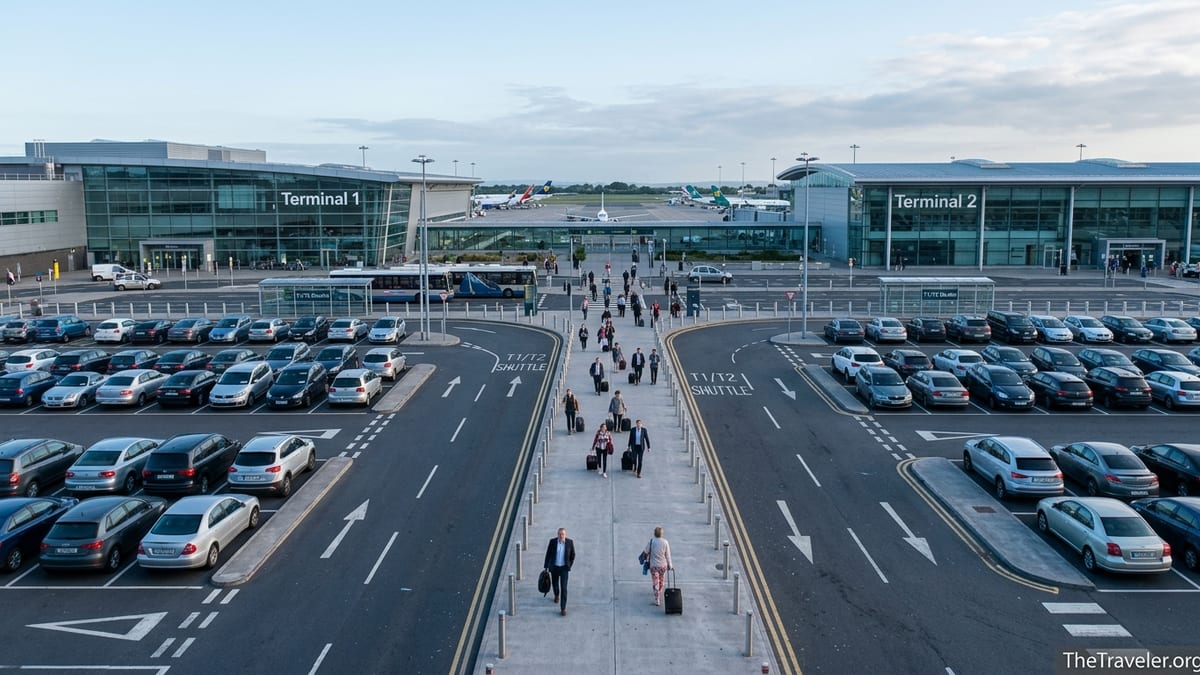
How Dublin Airport Parking Is Laid Out
Dublin Airport serves both Terminal 1 and Terminal 2 with a mix of on-campus multi-storey short term car parks and larger long term car parks on and just beyond the main campus. Right in front of the terminals, you will find Short Term Car Park A and Short Term Car Park C at Terminal 1, and the main Short Term car park at Terminal 2, all of them multi-storey facilities within a few minutes’ walk of check in. A little further away are the Express Red and Holiday Blue long term car parks, which are connected to both terminals by 24-hour shuttle buses running roughly every 10 to 15 minutes.
The basic trade-off at Dublin Airport is straightforward. The short term car parks cost more but put you as close as possible to departures and arrivals, which is ideal for quick trips, business travel, or passengers with reduced mobility who do not want to rely on a shuttle. The long term car parks are designed for multi-day or multi-week trips. They are cheaper per day and better suited for holidaymakers heading off for a week in Spain or a fortnight in the United States, provided you account for the extra shuttle time.
On top of the official airport-operated car parks, there are park-and-ride options with nearby hotels and independent operators, for example the Clayton Hotel Dublin Airport or Park2Travel. These typically run their own shuttles to the terminals, operate on pre-booked reservations, and can undercut the on-the-day airport prices, especially for a week or more of parking. Many regular travelers mix and match these options depending on the season, length of stay, and how much they value a simple, on-campus experience versus a lower headline rate.
Before you decide which car park fits your needs, it helps to know not just the names but also how access works in practice. Dublin Airport offers an interactive map showing both terminals and all car parks, so if you are unsure whether, for example, Short Term Car Park C is closer to your airline’s check-in desks, you can preview your walk in advance. In real terms, however, most drivers simply follow clear roadside signs for either T1 Short Term, T2 Short Term, Express Red, or Holiday Blue as they approach the airport on the M1 or R132.
Short Term Parking at Terminals 1 and 2
The short term car parks at Dublin Airport are the closest parking options to the terminal doors and are aimed at short stays, business trips, and convenient pickups. At Terminal 1, the main options are Short Term Car Park A and Short Term Car Park C, both multi-storey structures just a few minutes’ walk from departures and arrivals. At Terminal 2, a similar multi-storey short term car park sits directly in front of the terminal, linked to check in via covered walkways and lifts.
Short term parking is charged by the hour, with a flat first hour rate and then an additional hourly rate up to a daily maximum. In mid 2026, official guidance suggests drive-up rates around a few euro for the first hour, rising by several euro for each additional hour, with a capped daily maximum that makes it viable for an overnight or single-day trip but expensive for multi-day stays. For example, someone parking for a three-hour pickup window might pay under 20 euro at current rates, whereas leaving the car for a full calendar day can quickly approach the 50 euro range. These figures change periodically, so it is worth checking current tariffs before you travel, but they illustrate why locals describe short term as a premium, convenience-focused product.
Short term car parks at Dublin Airport have height restrictions that are important for drivers of vans, people carriers, or vehicles with roof boxes. Maximum heights are typically just under 2.1 metres, with some blocks at Terminal 1 limited to around 1.85 metres. That means a standard family hatchback, estate, or SUV will be fine, but a high-roof van or camper may not clear the barrier. Travelers with taller vehicles often either use long term surface parking, arrange off-site parking with a hotel that accepts vans, or choose a different mode of transport altogether.
In practice, short term works best for situations like a midweek day trip to London, where you are in and out within 24 hours, or for meeting an arriving relative when you are unsure how long immigration and baggage will take. For instance, if you plan to park in the T2 Short Term car park while waiting for a transatlantic flight that might be delayed, you have the flexibility to stay in the car, monitor the arrivals board, and walk across to meet passengers the moment they clear customs, without fretting about shuttle timings or off-site transfers.
Long Term Parking: Express Red and Holiday Blue
For longer trips, Dublin Airport’s long term car parks provide significantly better value per day. The main on-campus facility is the Express Red Long Term car park, which typically offers around five to ten minutes shuttle time to the terminals. Buses run around the clock, circulating every 10 to 15 minutes, and drop passengers at clearly signed bus stops serving both Terminal 1 and Terminal 2. For many travelers, Express Red strikes a balance between price and convenience, particularly for trips of three to seven days.
Further from the terminals but often cheaper is the Holiday Blue Long Term car park, located off the main airport campus but still integrated into the airport’s shuttle network. Transfer times here are usually closer to 15 minutes, and frequent users note that while buses are scheduled for approximately every quarter-hour, it is sensible to allow extra margin during peak summer mornings in case full buses or traffic cause delays. That is one reason regular users of Holiday Blue recommend arriving at least 45 minutes earlier than you otherwise would to give yourself room for shuttle waiting and boarding.
Official daily rates for long term parking are set at a headline figure, with on-the-day prices generally higher than pre-booked online rates. As a rough guide in 2026, public information suggests drive-up daily rates in the 20 to 25 euro range for the long term car parks, with the cheaper of the two usually being Holiday Blue. Real-world examples from travelers illustrate this difference. It is not uncommon to see a week’s pre-booked stay at Holiday Blue work out to around 8 to 12 euro per day, while the same week booked late at Express Red can be substantially more, sometimes doubling the overall bill if you leave it until the last minute in peak season.
These car parks are entirely suitable for longer holidays, such as a 10-day family trip to the Algarve or a two-week visit to Australia. On arrival, you follow clear signs from the M1 or surrounding roads to either Express Red or Holiday Blue, park in a marked zone, and walk to the nearest shuttle stop. Buses are branded and equipped with luggage areas, which makes boarding with suitcases straightforward. On your return, you simply follow signs in the arrivals hall to the long term car park buses, board the one serving your chosen car park, and note the zone where you parked via the car park signage or a quick photo on your phone.
Drop Off and Pickup: Quick Options Without a Full Stay
Travelers picking up or dropping off passengers at Dublin Airport have several options that range from free or low-cost quick stops to paid short term parking. Each terminal features a dedicated forecourt area directly outside departures for drop offs. These zones are designed for very short stays only: you pull up, unload luggage, say goodbye, and move on. Staying longer than the permitted free window, idling in the lane, or leaving your car unattended can lead to penalties or requests from staff to move along, particularly at busy times.
For pickups, the same forecourt areas can sometimes be used if you coordinate arrival times carefully. A typical local strategy is to wait in a nearby holding area such as a petrol station or fast-food car park off airport grounds while monitoring the flight and a live message from the arriving passenger. When they clear customs, they send a message, and the driver then swings into the departures forecourt to collect them at the kerb, spending only a few minutes in the official pickup area. This minimizes parking charges and avoids the uncertainty of how long baggage reclaim and passport control will actually take.
Another option for pickups is to use the official short term car parks and walk into arrivals. This is usually the more relaxed choice if the arriving passenger is elderly, traveling with children, or unfamiliar with the airport. For example, if you are meeting grandparents arriving from Canada into Terminal 2, parking in the T2 Short Term multi-storey allows you to reach the arrivals hall in a couple of minutes, help with luggage, and take your time walking back to the car, without worrying about blocking a busy kerbside.
Dublin Airport also has designated set-down and pick-up arrangements aligned with its long term shuttle car parks. For instance, some travelers collecting friends who have used the long term car parks will meet them at the shuttle bus stop rather than at the terminal doors, especially if they are continuing on a longer drive north or west. The key is to agree a precise meeting point: the T1 arrivals forecourt, the T2 bus stop, or a specific level of a short term car park. With two terminals and multiple parking zones, clarity in your plan can save a great deal of circling in traffic.
Online Booking, Off-Site Options and Cost-Saving Strategies
The single most important way to save money on parking at Dublin Airport is to book online in advance. The airport’s own website typically offers lower pre-booked prices than the drive-up rate, especially for long term stays. Independent comparison sites and brokers can add further discounts or package deals. Travelers regularly report that pre-booking a week in the Holiday Blue car park can cost less than half of what you would pay by simply driving up without a reservation, particularly in busy holiday periods such as late July or over Christmas.
Off-site and hotel-based park-and-ride services add another layer of savings. Hotels like the Clayton Hotel Dublin Airport and the Crowne Plaza near Santry frequently offer “park, stay and fly” packages where you can leave your car in their car park for a week or more and take a dedicated shuttle bus to the terminals. For instance, a traveler staying one night at the Clayton before an early flight might pay a combined rate that includes up to 15 days of parking, with the average daily cost for the parking portion coming in well below the long term drive-up rate at the airport itself. Independent operators such as Park2Travel provide similar off-site parking with frequent shuttles, competing both on price and on shuttle convenience.
There are also pricing quirks worth knowing. Long term bookings are usually priced per calendar day rather than per 24-hour block. That means if you arrive at 11 p.m. and leave at 1 a.m. seven days later, you can be charged for eight days instead of seven. Short term, by contrast, is billed by the hour up to a daily cap. Savvy travelers sometimes adjust their flight choices or driving times slightly to avoid tipping into an extra calendar day of long term charges. Similarly, last-minute changes to your flights can often be accommodated by amending your parking booking online up to a few hours before arrival, although terms vary by provider.
Real-world comparisons show how costs stack up against alternatives like taxis. A return taxi from central Dublin to the airport can easily reach 60 to 80 euro depending on distance and time of day. If you can secure a week of pre-booked long term parking for under 70 euro in Holiday Blue or with an off-site operator, and you value having your car ready on your return, parking can make financial sense. On the other hand, if you live in the city centre or are taking only a two-day trip, a taxi or bus may be cheaper and certainly avoids the hassle of navigating car parks and shuttles.
Terminal Access, Walking Times and Special Considerations
In practice, one of the biggest differences between parking options at Dublin Airport is how quickly and comfortably you can reach your terminal with luggage. From T1 Short Term Car Park A or C, you can usually walk to the terminal doors in under five minutes along covered walkways and pavements. The T2 Short Term multi-storey is similarly close, with lifts and escalators linking each level to a pedestrian bridge that leads directly into the departures hall. These routes are well signed and lit, making them practical even for late-night or early-morning flights.
From the long term car parks, the shuttle bus is your lifeline. Express Red typically involves around five minutes on the bus once you are on board, while Holiday Blue usually takes closer to 15 minutes. During peak times, you may need to wait a bit longer for a bus with available space, especially at Holiday Blue, so it is wise to build at least 30 minutes of buffer into your journey schedule on top of the standard check-in and security recommendations. Families with young children often prefer Express Red over Holiday Blue precisely because it shortens the shuttle phase, even if it costs a little more per day.
Travelers with reduced mobility can request assistance through their airline and coordinate this with their parking choice. If you or someone in your party has difficulty walking longer distances, short term parking at the terminal or a drop off directly at the departures forecourt is usually the most comfortable option. You can, for example, drop the passenger and luggage at T2 departures, request special assistance through the airline, and then drive to Express Red or Holiday Blue to park the car before returning alone on the shuttle. That way, only the more mobile driver needs to deal with the bus and car park.
Vehicle size and security are further practical considerations. As noted earlier, multi-storey short term car parks have height limits, so drivers of vans, minibuses, or cars with roof boxes may be better off using long term surface parking or an off-site hotel with open-air spaces. As for security, Dublin Airport’s official car parks are monitored and gated, and travelers frequently report leaving vehicles for multi-week periods without issues, though normal common sense applies. Taking photos of your parking area, locking valuables out of sight, and noting your car’s location remain good habits, whether you park in T1 Short Term or Holiday Blue.
The Takeaway
Planning how you will park at Dublin Airport is almost as important as checking your passport and boarding pass. The airport offers a clear structure: premium-priced but ultra-convenient short term multi-storey car parks right at Terminals 1 and 2, long term options like Express Red and Holiday Blue that trade a shuttle ride for far cheaper daily rates, and a growing ecosystem of off-site hotel and independent park-and-ride services. Knowing how these pieces fit together is the key to avoiding nasty surprises on your return.
As a rule of thumb, short term is best for stays under 24 hours, for passengers with mobility needs, or for relaxed pickups where you want to meet someone in the arrivals hall without rushing. Long term suits almost everything else, especially if you pre-book online and are willing to factor a shuttle trip into your timetable. Off-site hotel and independent car parks can undercut official rates, sometimes dramatically, but you should always balance the savings against slightly longer transfers and the need to follow specific instructions from the operator.
Before your next trip, take ten minutes to compare options: look up the current drive-up and pre-booked prices for short term versus long term, check whether a hotel park-and-ride makes sense for your dates, and consider whether a taxi might be simpler for very short journeys. By making that decision early, you can lock in a better rate, build realistic travel time into your schedule, and arrive at Dublin Airport knowing exactly where to go, whether that is Short Term Car Park A, the Express Red shuttle stop, or a quiet hotel car park five minutes down the road.
FAQ
Q1. Which Dublin Airport car park is closest to the terminals?
The closest options are the official short term multi-storey car parks: Car Park A and Car Park C at Terminal 1 and the Short Term car park directly in front of Terminal 2, all within a few minutes’ walk of check in.
Q2. How far in advance should I book parking at Dublin Airport?
For busy periods such as school holidays, Christmas, and major events, it is wise to book several weeks in advance, especially for long term stays. Outside peak dates, booking a few days ahead is usually enough to secure better prices than the on-the-day rate.
Q3. Is it cheaper to park long term at the airport or use a taxi from Dublin city?
For trips of four days or more, pre-booked long term parking, particularly in Holiday Blue or with an off-site hotel park-and-ride, can often work out cheaper than a return taxi from many parts of Dublin, while also giving you the convenience of your own car on your return.
Q4. How long does the shuttle from the long term car parks take?
Typical transfer times are around five minutes from Express Red and about 15 minutes from Holiday Blue, not including waiting time. During peak hours, allow extra time in case buses are busy or slightly delayed.
Q5. Can I park a van or high vehicle in the short term car parks?
Many short term multi-storey car parks at Dublin Airport have height limits of around 1.85 to 2.1 metres. Standard cars and most SUVs are fine, but higher vans, minibuses, or cars with tall roof boxes may not fit and are usually better suited to surface long term or off-site parking.
Q6. What is the best option for a same-day business trip?
For a same-day return, the terminal short term car parks are generally the most convenient. You can walk straight from your car to security in a few minutes, and although the daily cost is higher than long term, the premium is often worth it for the time saved and flexibility.
Q7. Are Dublin Airport car parks open 24 hours?
Yes, the official airport car parks and their shuttle services operate 24 hours a day. This makes them suitable for very early morning departures and late-night arrivals, provided you build in time for shuttle transfers where needed.
Q8. Can I change or cancel a parking booking?
Most official and many off-site providers allow changes or cancellations up to a set time before your arrival, often without a fee. The exact rules vary, so always check the terms when you book and keep your confirmation email handy in case your flight plans change.
Q9. Is it safe to leave my car long term at Dublin Airport?
Dublin Airport’s official car parks are gated and monitored, and many travelers regularly leave cars for one or two weeks without issues. As with any car park, it is sensible to remove valuables from view, lock your vehicle, and note the exact area where you are parked.
Q10. What is the most budget-friendly way to park for a week or more?
The most affordable options are usually pre-booked long term parking in Holiday Blue or an off-site hotel or independent park-and-ride with regular shuttles. These can bring the daily cost down substantially compared with drive-up short term or long term rates, especially if you reserve early.