


Dublin Airport is the main international gateway to Ireland and a growing transatlantic hub, especially for Aer Lingus and major U.S. carriers. Whether you are flying to London for the weekend or connecting to New York via U.S. preclearance, knowing how departures work at Dublin can save you time, stress and sometimes money. This guide walks through each stage of departure, with concrete examples from both Terminal 1 and Terminal 2 so you can plan your journey with realistic expectations.
Get the latest updates straight to your inbox!
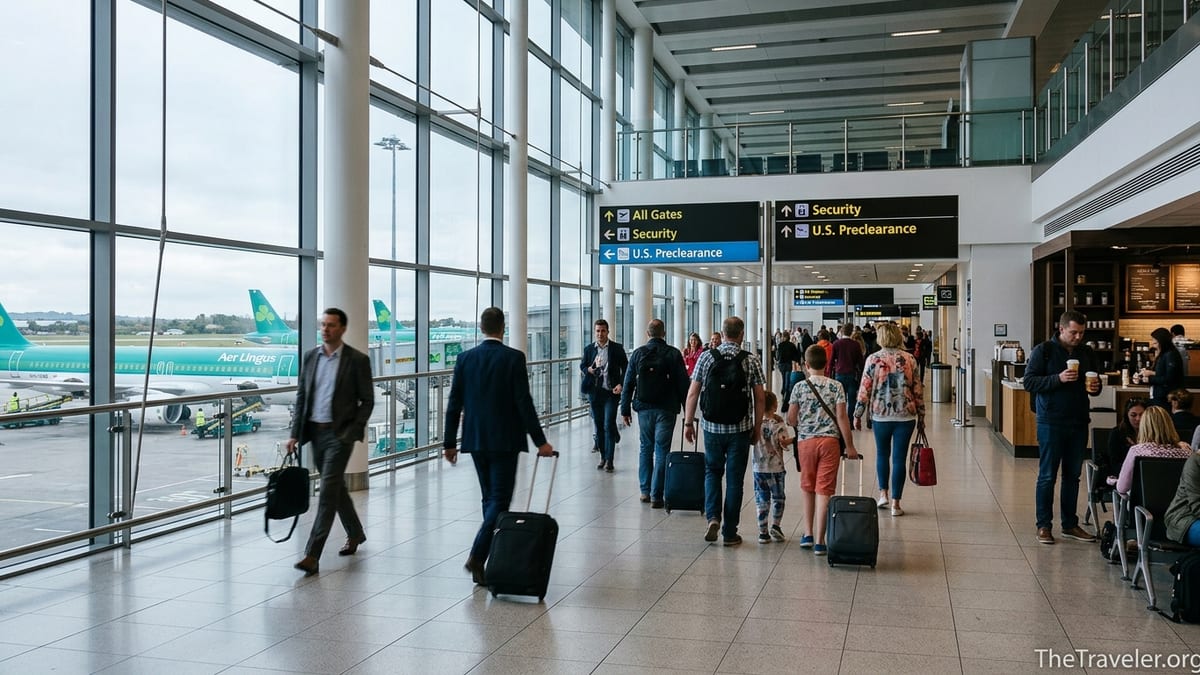
Understanding Terminals, Airlines and When to Arrive
Dublin Airport has two passenger terminals. Terminal 1 handles most short haul and low cost airlines such as Ryanair, while Terminal 2 is home to Aer Lingus and most long haul and transatlantic services including Aer Lingus, Delta, United and American Airlines. When you book, your confirmation and boarding pass will show “T1” or “T2” and it is worth double checking this before you travel, especially if you are connecting through Dublin from elsewhere in Europe.
As a broad rule of thumb, Dublin Airport suggests arriving about 2 hours before scheduled departure for short haul flights within Europe and around 3 hours for long haul flights, including to North America. In peak summer mornings, airlines may advise earlier times. For example, Aer Lingus has at times asked U.S. bound passengers to be at the airport 3 hours before departure to allow for both regular security and U.S. preclearance. Always check the specific advice in the email or app notification from your airline the day before you travel.
Realistically, many frequent European travelers flying hand luggage only on a 10:00 flight to London or Amsterdam will arrive at Dublin Airport around 07:45 to 08:00, confident that security in Terminal 1 is usually manageable outside the early morning rush. By contrast, a family flying from Dublin to Chicago at 11:00 from Terminal 2 with checked bags would be far better off arriving shortly after 08:00, as both the airline bag drop and U.S. preclearance can build queues, especially in school holiday periods.
If you have a separate ticket connection into Dublin, be conservative with your timings. For instance, landing from Paris into Dublin at 10:30 on one airline and departing to Boston at 12:30 on another leaves only 2 hours to change terminals, check bags, clear security and complete U.S. preclearance. That is possible if everything runs smoothly, but a more comfortable layover would be closer to 3 hours.
Check In, Bag Drop and Security: What to Expect
In both terminals you will find a mix of staffed check in desks and self service kiosks with automated bag drops. Airlines like Aer Lingus encourage online check in and mobile boarding passes, which work well at Dublin. For example, on an early morning Aer Lingus flight to London Heathrow, you can often use a self service kiosk in Terminal 2 to print your bag tag in under a minute, then join a relatively fast bag drop line, rather than queuing for a full service desk.
Check in and bag drop opening times vary by airline and flight, so it is important not to arrive hours and hours before your airline is ready. As a guide, short haul desks often open about 2 hours before departure, while long haul desks may open around 3 hours in advance. If you arrive very early on a 15:00 departure you might find your airline’s desks still closed and will need to wait landside in the check in hall.
Terminal 1 security operates around the clock, which is useful if you are on the first wave of flights around 05:30 to 06:30. Terminal 2 security typically opens in the early hours of the morning, with the busiest period between 05:00 and 09:00 as transatlantic and European departures ramp up. For example, passengers on a 06:00 flight to Frankfurt from Terminal 2 will often join a substantial security queue shortly after opening, but once past that early bank of departures the lines tend to shorten.
Dublin Airport sells a Fast Track security product in both terminals, giving access to a dedicated lane and often a shorter queue. This can be worthwhile on busy Monday mornings if you are traveling on business with only cabin baggage and value a more predictable transit through security. For instance, paying for Fast Track on a 07:30 Brussels flight from Terminal 1 can mean the difference between a 10 minute wait and a 30 minute one. That said, Fast Track does not bypass U.S. preclearance queues, so its benefit is primarily in the first standard security checkpoint.
Navigating Security and Liquids Rules
Security screening at Dublin follows standard European aviation rules on liquids, electronics and cabin baggage. Each passenger is generally allowed one cabin bag of limited dimensions, and liquids must typically be in containers of 100 ml or less, carried together in a transparent one litre plastic bag. While security procedures across Europe are slowly modernising, you should still arrive prepared to remove laptops and large electronics from your bag and to place your liquids bag separately in the tray unless signage states otherwise on the day.
In practice, the most common delay for Dublin passengers at security remains liquids that exceed the allowed quantity. A typical example is a traveler who has bought a 250 ml bottle of face cream in the city, forgotten to pack it into checked baggage, and then has it removed at the checkpoint. To avoid both delays and disappointment, pack any full size toiletries into checked luggage or buy travel sized products in the city or airside. Dublin’s airside pharmacies and duty free stores stock small deodorants, toothpaste and skincare products priced similarly to city pharmacies, which can be a convenient fallback if you keep your cabin luggage light.
Families with young children are usually allowed to carry baby food, milk and certain medications in larger quantities, but these may be screened separately. A parent flying from Dublin to Malaga with a six month old baby can expect security staff to test bottled milk or liquid baby food using specialised equipment. Allow a little extra time for this, especially during peak departures to family holiday destinations in summer.
Footwear screening can vary depending on security conditions on the day. It is a good idea to wear shoes that are easy to remove and put back on, especially if you are connecting and already a little tired. Multiple travelers report that slip on trainers or flat shoes speed things up through Dublin security far more than heavy lace up boots.
U.S. Preclearance in Terminal 2: How It Works
One of Dublin Airport’s distinctive features is U.S. Customs and Border Protection preclearance, located in Terminal 2. If you are flying non stop from Dublin to cities such as New York, Boston, Chicago, Washington, Orlando or Los Angeles on Aer Lingus or a major U.S. carrier, you will usually complete U.S. immigration and customs in Dublin rather than on arrival. This means you land in the United States as a domestic passenger, which can significantly reduce connection times at your U.S. gateway.
The process happens in stages. First you clear standard Dublin Airport security in Terminal 2 and enter the main departures area. For U.S. flights, signage and departure boards will typically instruct you to proceed to U.S. preclearance a set time before your flight, commonly around 2 to 3 hours before departure. For example, on an 11:30 Aer Lingus flight to JFK, preclearance might begin processing passengers from around 08:30 or 09:00. You go through an additional security check that uses U.S. standards and then join the queue for immigration inspection conducted by U.S. officers.
The time needed can vary widely. On a quiet winter weekday, a solo traveler with Global Entry may clear the whole process in under 20 minutes. In contrast, during busy summer weekends or around major holidays, families without trusted traveler status can wait 45 minutes or more for immigration, particularly when several large aircraft to multiple U.S. cities are scheduled in the same mid morning wave. Dublin Airport and airlines often recommend that you allow at least 3 hours between landing in Dublin and departing to the U.S. if you are connecting from another European city.
Once you clear immigration, your checked bag is usually already in the system and you are waved through customs electronically. You then enter a segregated U.S. departures area with its own gates, limited shops and a small selection of food and drink options. This area feels more like a compact domestic U.S. concourse than the main Dublin departures hall. A traveler connecting from Dublin to Washington might, for example, have time for a quick coffee and sandwich at one of the few cafes after preclearance, but choice is more limited than before you enter the facility, so many regulars prefer to eat or shop earlier in the main Terminal 2 area.
Lounges, Food and Shopping Before Departure
Dublin Airport has several pay in and airline lounges, primarily on the airside departures levels. In Terminal 1, the main T1 Lounge is located above the security lanes and offers soft drinks, a small buffet of snacks, Wi Fi and quieter seating compared to the main concourse. Many travelers access it through lounge programs such as Priority Pass or DragonPass, while others pay at the door subject to capacity, typically for a stay of up to 3 hours before departure.
Terminal 2 has additional lounges, including facilities used by Aer Lingus and partner airlines, and the 51st & Green lounge located in the U.S. preclearance zone. This lounge is geared towards U.S. bound passengers and is used by premium cabin travelers on carriers like Aer Lingus, American, Delta and United. Pay in access for economy passengers is sometimes sold in advance or on the day when space permits. Inside, you can expect a more substantial food offering than in some other airport lounges, along with showers and runway views overlooking the pier where transatlantic flights depart.
When it comes to dining, Dublin’s terminals offer the typical range of coffee chains, Irish and international casual dining, and grab and go stands. In Terminal 1 after security you will find Irish brands serving burgers and chicken, large coffee outlets for breakfast pastries, and pubs offering a full Irish breakfast before early flights to Manchester or Edinburgh. Prices are comparable to other European capitals: a cappuccino might cost around 3 to 4 euro, while a sit down burger and soft drink could be in the 12 to 18 euro range depending on venue and toppings.
Terminal 2’s food and beverage options include international coffee brands, an Italian style sit down restaurant concept, bars and sandwich counters. If you are flying to the U.S., it often makes sense to have your main meal before entering preclearance, as the choice afterwards narrows to a couple of smaller outlets and vending style options. Shoppers will find duty free cosmetics, Irish whiskey and gin, chocolate, fashion and electronics in both terminals. For example, passengers frequently stock up on local brands of whiskey or Irish cream liqueur before flights to Boston or Toronto, taking advantage of duty free pricing and gift packaging.
Duty Free, Last Minute Essentials and Money Matters
Dublin Airport’s main duty free stores in both terminals are operated by a large international travel retailer and feature familiar brands across fragrance, skincare, makeup and liquor. You can usually find major fragrance houses, as well as Irish specialties such as locally produced gin and whiskey. Promotional offers such as multi buy deals on chocolate or discounts on a second bottle of spirits are common, especially in the run up to Christmas or during peak summer.
Beyond duty free, there are newsagents, pharmacies and travel shops where you can pick up last minute essentials. A typical purchase might be a universal travel adapter for around 15 to 25 euro, a lightweight neck pillow for a transatlantic flight, or over the counter pain relief from the airside pharmacy. Travelers often appreciate that these shops stay open from early morning until late evening to support late night departures and red eye flights, though exact opening hours can vary by season and day of the week.
ATMs are available in both terminals before and after security, dispensing euro. For passengers heading to the United States, it is usually more cost effective to use an ATM on arrival in the U.S. than to exchange large sums of cash in Dublin, as currency exchange counters can have less favorable rates and additional fees. Many travelers now rely almost entirely on cards and mobile payments in both Ireland and the destinations they are visiting, and Dublin Airport’s shops and food outlets are well set up for contactless transactions.
If you intend to claim VAT refund on qualifying purchases made in Ireland, look for the tax refund desks or self service machines in the departures halls. These services are usually available after security. It is wise to bring your receipts and allow a few extra minutes, particularly on a busy Friday afternoon when queues of shoppers may form at the machines as they finalise refund forms before boarding flights home.
Boarding, Gate Changes and Handling Delays
Once you have eaten, shopped and perhaps visited a lounge, it is important to keep monitoring your departure gate. Dublin Airport’s screens and public announcements are clear, but gates can and do change, especially in Terminal 1 where short haul aircraft are turned around quickly. A flight that was originally set to depart from Gate 108 might move to Gate 112, so it is good practice to check the screens again when boarding time approaches instead of relying solely on what was printed on an earlier boarding pass.
Boarding usually begins around 30 to 40 minutes before departure for European flights and a little earlier for long haul and U.S. services. Airlines typically board by groups or rows. For instance, on an Aer Lingus flight to New York, you might see Group 1 for business class and elite frequent flyers called first, followed by economy boarding in numbered groups. If you prefer to avoid queueing, wait until your group is called and watch how quickly the line is moving rather than rushing to stand at the gate for 20 minutes.
In the dedicated U.S. preclearance departures zone, remember that you cannot leave this secure area and re enter easily. Once there, stay close to your gate, particularly during the last hour before departure. U.S. bound flights sometimes board earlier than European flights because the aircraft need additional checks and boarding processes. If there are delays, airlines often keep passengers updated through the Dublin Airport app and via gate announcements, so it is sensible to have your phone charged and notifications enabled.
Weather in Ireland can be variable, and on occasion strong winds or low visibility can cause knock on delays across the schedule. If your departure is significantly delayed, you may be given meal vouchers to use in terminal restaurants, or you might choose to spend time in a pay in lounge if space is available. For example, during a winter storm a flight to Toronto might depart several hours late; in that case, many passengers will relocate from crowded gate seating to a lounge where they can work, rest and access snacks while they wait.
The Takeaway
Departing from Dublin Airport is generally straightforward, especially when you understand the distinction between Terminal 1’s largely European operations and Terminal 2’s long haul and U.S. focused traffic. Arrive with sensible margins, use online check in where possible, and give yourself enough buffer if you need to connect from another flight or pass through U.S. preclearance. Realistic expectations on timing can make the difference between a calm coffee before your flight and a stressful sprint to the gate.
Make strategic use of Dublin’s facilities. Eat and shop in the main terminal before entering the more limited U.S. preclearance zone, consider Fast Track when traveling at peak times, and only pay for lounge access if you know you will have at least an hour to enjoy it. For many travelers, a simple routine of clearing security, grabbing breakfast, browsing duty free and then moving to the gate 30 minutes before boarding is all that is needed for a smooth start to their journey.
Above all, remember that airport staff and signage are there to help. If you are unsure about walking times between areas, how U.S. preclearance fits into your schedule or whether you have enough time to visit a lounge, ask a staff member in the terminal. With a little preparation and awareness of how Dublin operates today, your departure can be one of the easier parts of your trip.
FAQ
Q1. How early should I arrive at Dublin Airport before my flight?
For most short haul European flights, arriving around 2 hours before departure is usually sufficient. For long haul and U.S. flights, aim for at least 3 hours, and if you are connecting into Dublin on a separate ticket consider a longer buffer.
Q2. Which airlines use Terminal 1 and which use Terminal 2?
Terminal 1 is used mainly by short haul and low cost carriers such as Ryanair and several European airlines. Terminal 2 is the base for Aer Lingus and most long haul operations, including the majority of flights to North America.
Q3. Is there Fast Track security at Dublin Airport and is it worth it?
Fast Track security is available in both terminals and provides access to a dedicated lane that often moves more quickly than the standard queue. It can be worthwhile during peak morning or evening periods, especially if you are traveling with only cabin baggage and value a predictable transit through security.
Q4. How does U.S. preclearance at Dublin Airport work?
U.S. preclearance is located in Terminal 2 for non stop flights to the United States. After standard security, you follow signs to preclearance, complete an additional security check and then clear U.S. immigration and customs with American officers before boarding. You land in the U.S. as a domestic passenger, which usually shortens connection times.
Q5. How much time do I need for U.S. preclearance if I am connecting from another flight?
If you are arriving from another European city into Dublin and then flying on to the U.S., a minimum of 3 hours between flights is advisable. This allows for a short walk between terminals if needed, any delays on your first flight, bag recheck, security and the preclearance process itself.
Q6. Are there lounges I can pay to use at Dublin Airport?
Yes, there are pay in lounges in both terminals, including the T1 Lounge and several options in Terminal 2, with some lounges also accessible via membership programs. Access is generally limited to around 3 hours before departure, and capacity controls mean access may be refused at very busy times.
Q7. What food options are available after security?
After security in both terminals you will find coffee chains, pubs, casual dining restaurants and grab and go counters. Terminal 1 is strong on quick service Irish and international brands, while Terminal 2 includes sit down restaurants, bars and cafes. Choices are more limited once you enter the U.S. preclearance zone, so many travelers prefer to eat before going through.
Q8. Can I shop duty free when departing from Dublin?
Yes, duty free shops in both terminals sell fragrances, cosmetics, liquor, confectionery and other travel retail items, with a range of Irish and international brands. Eligibility for duty free allowances depends on your destination, so check limits for alcohol and tobacco products for your arrival country.
Q9. What happens if my flight from Dublin is delayed?
If your flight is delayed, you should stay close to your gate and monitor screens and announcements for updates. Airlines may provide meal vouchers for significant delays, and you can also choose to spend time in a pay in lounge if space is available. If you miss a connection due to a delay on a through ticket, speak directly with your airline for rebooking options.
Q10. Is Dublin Airport easy to navigate for first time visitors?
Yes, Dublin Airport is compact compared with many major hubs, and walking times between areas inside each terminal are relatively short. Clear signage, frequent flight information screens and staff on the concourse make it manageable for first time visitors, even during busy travel periods.