


Landing at Dublin Airport and wondering whether to jump in a taxi to the city centre? With regulated fares, 24 hour ranks and mandatory card payments, taxis are one of the most straightforward ways to start or end your Dublin trip. Still, it helps to know what the ride should cost, how long it usually takes, and what to expect if you land in the middle of the night.
Get the latest updates straight to your inbox!
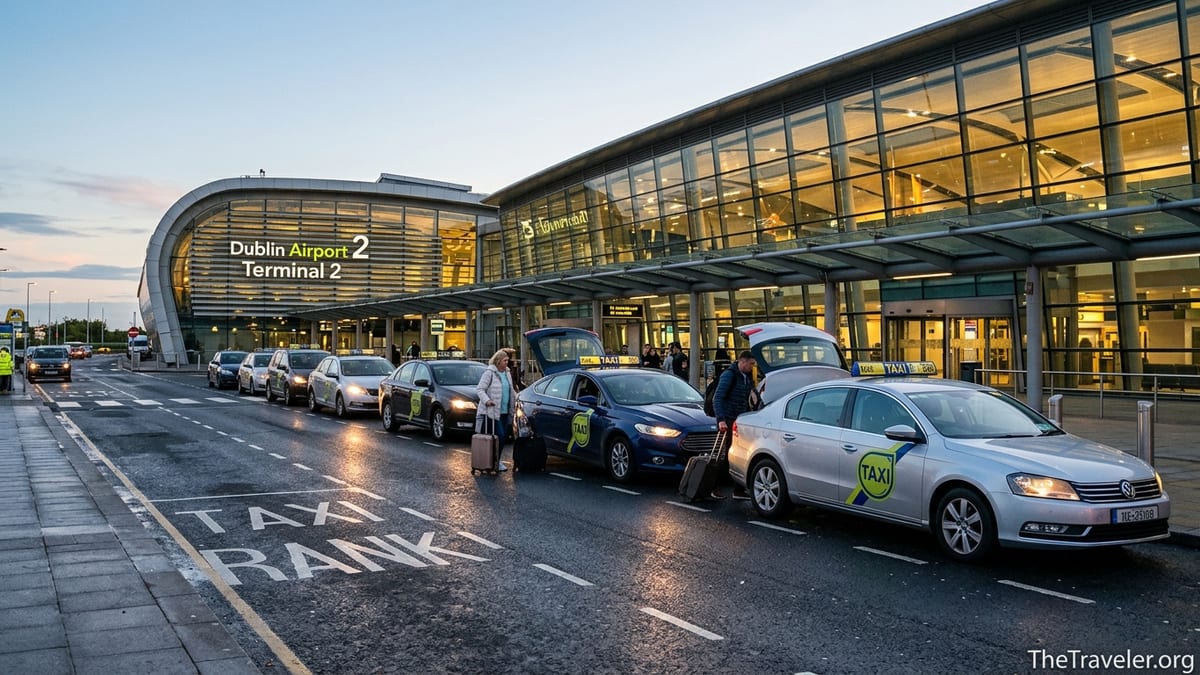
Where to Find Official Taxis at Dublin Airport
Both terminals at Dublin Airport have clearly signposted official taxi ranks right outside the arrivals halls. After you collect your luggage in Terminal 1, you follow the overhead "Taxis" signs through the arrivals area and out the main doors. The rank is directly opposite the exit, with a covered queuing lane, digital signage and airport staff on duty during busier hours. From Terminal 2, you exit arrivals, stay on the same level and walk straight out to a similar rank area in front of the building.
These ranks are operated in partnership with airport management, and only licensed taxis with permits for the airport stands are allowed to pick up there. Every vehicle should display a roof sign, a yellow and blue door sticker with the taxi license number, and a driver ID card on the dashboard or partition. You line up, and staff or a marshal usually direct you to the next free car in the queue. There is no need to prebook for standard journeys into the city centre.
The ranks operate 24 hours a day, seven days a week, although queue lengths vary widely. At 08:00 on a weekday you might find a short line of taxis waiting. At 23:30 on a busy Friday, there can be a queue of passengers, but the line tends to move steadily as incoming flights arrive in waves. In the early hours, around 02:00 or 03:00, there are fewer flights but usually still a supply of taxis serving late arrivals and shift workers.
While some off airport companies advertise “airport taxis” online, most visitors will find it simplest to use the official ranks when they are heading to a central hotel, hostel or guesthouse. Pre booked cars can be useful for special needs, large groups or early morning returns to the airport, but you should arrange those in advance with a reputable operator rather than accepting unsolicited offers in the terminal.
Typical Fares From Dublin Airport to the City Centre
Taxi fares in Dublin are regulated nationally by the National Transport Authority. There is a standard starting charge plus a per kilometre and per minute rate, with different tariffs for daytime and night or Sunday travel. On top of this, taxis that use the official Dublin Airport stands pay a permit fee to operate there, which is built into what you pay as a passenger. The current maximum taxi fare schedule took effect in December 2024, and drivers must have a printed fare card inside the car.
For a typical journey from Dublin Airport to the central city areas around O’Connell Street, Temple Bar, Trinity College or Grafton Street, most passengers report paying in the region of 30 to 40 euro under normal traffic conditions. For example, a solo traveler arriving mid afternoon and going from Terminal 1 to a hotel on Dame Street might see a fare around 32 to 36 euro including the airport charge. A couple with two suitcases arriving on a Sunday evening and heading to a guesthouse near St Stephen’s Green might pay closer to 38 euro if traffic is heavier.
Travel time and congestion have a real impact on the meter. During light traffic, such as early morning on a weekday outside the school run, the 10 to 12 kilometre run to the city centre can take about 20 to 25 minutes. In that case you are more likely to be at the lower end of the 30 to 40 euro range. During the evening peak, especially in wet weather when traffic slows on the M50 and through the tunnel approaches, the same trip might take 35 to 45 minutes and push the fare higher, sometimes into the low 40s for central locations.
For areas slightly beyond the core centre, such as the Docklands around Grand Canal, the Liberties, or the train stations at Heuston and Connolly, expect the fare to increase marginally, often by 5 to 10 euro depending on distance and the time spent in traffic. A realistic working budget for most visitors in 2026 is 30 to 45 euro from the airport to a city centre or inner suburb hotel for up to four passengers sharing one taxi.
How Long the Journey Takes in Real Conditions
On paper, the distance from Dublin Airport to the heart of the city is modest, and under ideal road conditions the drive can feel very quick. Many university and language school guides suggest a typical taxi journey time of 15 to 25 minutes from the airport into the north or central parts of the city, and that is certainly possible when roads are clear and your driver takes the Port Tunnel route into town.
In practice, visitors should plan for a broader range. In the early morning off peak periods, say a 06:30 arrival on a Tuesday, you might clear the terminal, reach the rank and be at your hotel on O’Connell Street within 20 minutes if traffic through the tunnel and along the quays is flowing smoothly. Around midday, that can stretch to 25 or 30 minutes as deliveries, commuters and tourists all share the road network.
Afternoon and early evening are where delays are most common. Flights landing between roughly 15:30 and 18:30 coincide with Dublin’s rush hour, and congestion near tunnel exits, the inner ring roads and river bridges can slow the final kilometres into town. In these cases, a 35 to 45 minute travel time is not unusual, particularly if your hotel is on the south side near Grafton Street, Camden Street or Portobello and you need to cross the Liffey in busy traffic.
At night, journey times become more predictable again. A taxi leaving the airport at 22:30 can often reach most city centre hotels in under 25 minutes, and very late rides, such as 02:00 or 03:00, may be even quicker if roadworks or incidents do not intervene. For planning connections, it is sensible to assume around 30 minutes from airport to central Dublin and allow additional margin for collecting luggage and possible queues at the rank.
Card Payments, Receipts and What to Check Inside the Taxi
All licensed taxis in Ireland are required to accept electronic payments. Since late 2022, drivers must offer at least one of the main card or contactless options such as Visa, Mastercard or a widely used mobile wallet. At Dublin Airport, most passengers now pay by tapping a card or phone at the end of the ride. Cash in euro is still widely accepted, but you should not be told that “card is not working” as a routine excuse. If you prefer card, mention it when you get in so there are no surprises at the destination.
Before the car moves off, you should see a meter in clear view of the rear seats. When you state your destination, the driver should start the meter from the standard initial charge. The fare structure, including the different tariffs and any surcharges, must be displayed on a laminated or printed card, usually on the partition behind the driver or on a side window. You do not need to calculate the journey price yourself, but if you are curious you can compare the final figure with the official Transport for Ireland online taxi fare estimator before or after your trip, using your hotel address as a reference.
At the end of the ride you are entitled to a printed or written receipt. This should show the fare, any extras such as a toll if the M50 has been used, the date and time, the driver’s license or identification number and the vehicle registration. Many modern payment terminals in Dublin taxis can print a receipt on the spot or send one to your email address if you wish. Asking for a receipt is especially worthwhile if you are on business travel and need to claim expenses or if you think there may have been an overcharge and want to follow up with the National Transport Authority later.
If something does not look right, such as a meter that is not switched on, a demand for a fixed cash price that seems significantly higher than expected, or refusal to provide a receipt, you are within your rights to insist politely that the meter be used and that a receipt be issued. Make a note of the taxi registration and the roof sign number, which are both clearly displayed. Problems are not the norm at Dublin Airport, but recording basic details gives you options if you need to lodge a complaint after your trip.
Late Night Arrivals: Safety, Availability and Alternatives
Many transatlantic and European flights land in Dublin well after dark, and travelers often worry whether taxis will still be available. In practice, the airport serves night flights and staff shifts around the clock, so taxis are present through the night, though numbers do dip in the early hours. Travelers landing around midnight typically still find a functioning rank with a line of cars and only short waits, especially on weekends when late flights are common.
Between roughly 01:00 and 04:00, supply can feel patchier. You may find only a handful of taxis waiting, and if several flights land close together you might wait 10 to 20 minutes for a car rather than walking straight into the first one. Drivers sometimes prefer to operate earlier in the evening rather than deep into the night, and local discussions in early 2026 have mentioned that fewer taxis choose to work after 23:00. That said, there is usually at least a trickle of vehicles serving the airport at all times because of demand from aviation staff, long haul flights and early morning departures.
From a safety point of view, using the official ranks is the recommended choice at night, especially for solo travelers. The pick up areas are lit, covered and monitored by airport security and CCTV. You will be getting into a registered vehicle whose driver and license can be traced. Walking off into surrounding roads to hail a car informally is neither necessary nor wise. If for some reason the rank is overwhelmed or temporarily short of taxis, the staff on duty can usually advise on the next arrivals or alternative options.
Night buses operate between Dublin city centre and the suburbs, including routes that pass near the airport corridor, but these services are aimed more at residents and shift workers than visitors. Timetables can be infrequent in the small hours, and services may not drop you close to your accommodation. For example, a backpacker arriving at 00:45 might be able to piece together a combination of routes to reach a hostel on the south side for just a few euro, but at the cost of waiting at bus stops and walking several city blocks in the dark with luggage. For most short stay visitors, a taxi is the more comfortable and secure choice late at night, provided the fare fits the travel budget.
When Taking a Taxi Is Worth It (and When It Is Not)
Whether a taxi from Dublin Airport is worth the money depends on your priorities: budget, comfort and time. For a solo traveler on a tight budget arriving in daylight hours, airport buses can be significantly cheaper. For example, a student landing at 11:00 might take a standard city bus towards the centre for just a few euro, or use one of the express coach services that stop near major hotels on O’Connell Street, Temple Bar and Heuston Station for a modest fare. The trade off is a longer journey, potential standing room and a short walk from the bus stop to the final destination.
If you are arriving after a long overnight flight, carrying heavy luggage or travelling as a couple or family, a taxi quickly becomes more attractive. Two adults paying for individual express bus tickets each way may end up spending only slightly less than the 35 to 40 euro cost of splitting a taxi door to door. Add children, elderly relatives or someone with mobility issues, and the extra comfort of avoiding steps, crowded aisles and late night walks from bus stops can easily justify the incremental expense.
Time sensitivity is another factor. A business traveler with a meeting at a company office near Grand Canal Dock at 09:30 is likely to value the directness of a taxi. Leaving the airport rank at 08:15 should normally see them at the office by 08:45 or 09:00 with minimal stress. By contrast, stitching together bus routes, waiting at stops and navigating an unfamiliar city may eat into preparation time and increase the risk of delays.
There are also situations where combining modes makes sense. A budget conscious visitor might take an express bus from the airport to a central hub like O’Connell Street in the early evening, then jump in a short taxi ride for the final kilometre to a small guesthouse tucked away on a residential street. Conversely, someone staying in a northside suburb close to the airport might prefer a taxi for the entire journey, as the meter cost can be modest compared to the time saved versus indirect bus routes.
Practical Tips to Avoid Problems and Overpaying
Even though Dublin taxi fares are regulated, there is always room for misunderstandings or the occasional bad experience. One of the simplest safeguards is to have a rough idea of what your ride should cost before you travel. Using the official taxi fare estimator from Transport for Ireland, you can plug in "Dublin Airport" and the address of your hotel and note the approximate price range for the time of day you expect to arrive. Keep that figure in mind so that nothing on the meter feels wildly out of line unless traffic conditions are clearly exceptional.
When you reach the taxi at the head of the rank, greet the driver and confirm the destination clearly. If it is a small hotel or guesthouse, having the full address written down or on your phone can prevent confusion. It is perfectly reasonable to ask "About how much do you expect it to be into the city centre at this time of day?" A professional driver will usually give you a ballpark figure consistent with the official estimator. If someone offers a fixed cash price that is much higher than that, it is acceptable to decline politely and wait for the next car.
During the journey, you may notice the driver choosing between the tunnel route and surface roads. Using the Dublin Port Tunnel can add a toll, but it often cuts journey time into the city, especially at busy times. Some drivers ask in advance if you are happy to take the tunnel and pay the toll. If you are watching your budget and traffic is light, you can ask whether surface roads would be similar in time. If you are tired and eager to reach your hotel, you might decide that saving 10 or 15 minutes is worth the small extra cost.
Finally, always take a receipt at the end of the ride and check it briefly. If you feel you have been overcharged, you can later contact the National Transport Authority with the taxi license details and receipt information. While rare, there have been reports from visitors who felt they paid far above the norm for journeys from the airport to the suburbs. Having documentation allows the regulator to investigate. For most visitors, however, a little preparation and awareness is enough to ensure the taxi ride is uneventful and fairly priced.
FAQ
Q1. How much does a taxi from Dublin Airport to the city centre usually cost?
The fare for a standard taxi from Dublin Airport to central areas like O’Connell Street or Temple Bar typically falls in the range of about 30 to 40 euro in 2026 under normal traffic conditions, with slightly higher prices at busy times or for destinations beyond the core centre.
Q2. How long does the taxi journey from the airport to central Dublin take?
In light traffic, the journey often takes around 20 to 25 minutes using the main routes into town, while in peak rush hour or during heavy congestion it can stretch to 35 to 45 minutes.
Q3. Are taxis available all night at Dublin Airport?
Yes, the official taxi ranks operate 24 hours a day. Numbers are highest during daytime and evening hours, but even between 01:00 and 04:00 there is usually a flow of taxis serving late arrivals, airport staff and early morning departures, though waits may be a little longer.
Q4. Do Dublin Airport taxis accept credit and debit cards?
All licensed taxis in Ireland are required to accept electronic payments, so you can expect to pay with major credit and debit cards or contactless methods at Dublin Airport. Cash in euro is still accepted, but you should not be refused a card payment for normal journeys.
Q5. Is it safe to take a taxi from Dublin Airport if I arrive late at night?
Using the official ranks immediately outside Terminals 1 and 2 is considered a safe option, even late at night. The areas are well lit, monitored and used by many travelers, and the taxis are registered and regulated by the National Transport Authority.
Q6. Should I book a taxi in advance or just use the rank?
For most visitors heading to city centre hotels, using the airport rank on arrival is sufficient and avoids the need to match with a specific driver. Prebooking can make sense for very early morning departures, for large groups needing a minivan, or when you require special assistance and want written confirmation in advance.
Q7. Are there extra charges for luggage or airport pick ups?
The maximum taxi fare system allows for certain regulated extras, and drivers who use the airport stands pay a permit fee that is effectively built into what you pay. Normal suitcases and hand luggage are not usually charged per item, but tolls such as the Port Tunnel, if used, can be added to the fare along with the standard meter total.
Q8. Is a taxi worth it compared with the bus from Dublin Airport?
It depends on your situation. A solo traveler on a tight budget can save money by using city or express buses, while couples, families or tired long haul passengers often find that splitting a 30 to 40 euro taxi fare for a direct, door to door ride offers better comfort and time savings.
Q9. How can I estimate the taxi fare before I arrive?
You can use the official taxi fare estimator provided by Transport for Ireland by entering “Dublin Airport” and your hotel address, then noting the approximate price range for your arrival time so you have a realistic expectation before getting in a taxi.
Q10. What should I do if I think I have been overcharged by a taxi from the airport?
Ask for and keep the receipt, which should show the fare, date, time, taxi license number and vehicle registration. Using those details, you can submit a complaint to the National Transport Authority, which regulates taxi fares and can investigate potential overcharging or misconduct.