


Nicholas Air has carved out a niche in private aviation by focusing on a tightly curated, company-owned fleet. For travelers used to chartering whatever aircraft happens to be available on a given day, the Nicholas Air model feels very different. Members are not just buying hours in the air; they are choosing from a specific set of aircraft types, each with its own strengths, cabin feel, and ideal mission profile. Understanding those options is key to getting full value from a Nicholas Air membership, whether you are hopping between Southeastern business hubs or planning a nonstop winter escape to Jackson Hole.
Get the latest updates straight to your inbox!
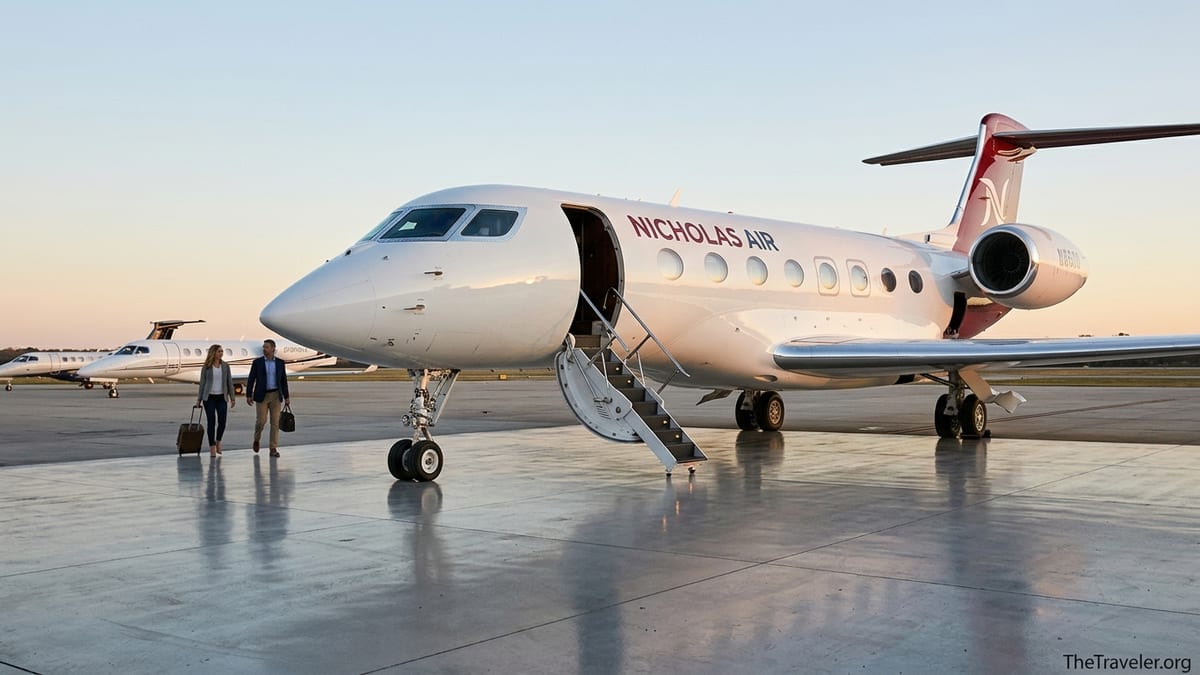
How Nicholas Air Structures Its Fleet and Membership
Nicholas Air operates as a membership-based private jet company that owns and manages its aircraft instead of relying on a loose network of third-party operators. The core fleet centers on modern business jets including the Embraer Phenom 100 and Phenom 300E, the Cessna Citation CJ3+, the Cessna Citation Latitude, the Bombardier Challenger 350, and the long-range Gulfstream G600. The company highlights an average fleet age of roughly five years or less, which is younger than what many on-demand charter flyers will encounter. For members, that typically translates into cabins that feel contemporary, with current-generation avionics, quieter interiors, and more consistent amenities from aircraft to aircraft.
Membership is offered primarily through jet cards, leases, and fractional-style programs. In practice, that means travelers either pre-purchase a set number of hours on a specific aircraft type or deposit funds into a program that lets them choose among multiple types. A business owner who flies mostly regional day trips might lock in hours on a Phenom 100 or CJ3+, while a family that takes longer seasonal journeys could favor a program centered on the Phenom 300E, Latitude, or Challenger 350. For those who occasionally need coast-to-coast or transatlantic range, the Gulfstream G600 sits at the top of the lineup as the flagship option.
Unlike some card providers that use a broad “open fleet” model and source aircraft on the wider charter market, Nicholas Air’s emphasis on “our planes, our pilots” means members know they are flying on aircraft the company itself owns and dispatches. Pilots are assigned by aircraft type and receive training on that specific model, which tends to appeal to frequent flyers who value standardization and familiarity. For a traveler who spends a significant amount of time in the air each month, knowing the cabin layout, baggage configuration, and cockpit team’s experience with that exact jet can be a meaningful comfort factor.
For travelers comparing Nicholas Air with larger providers, it is helpful to view the company’s fleet as intentionally selective rather than all-encompassing. There are no very light turboprops or ultra-large long-haul jets beyond the Gulfstream G600, and there is no separate fleet of older, discounted aircraft. Instead, the focus is on a small set of versatile types that cover the most common private aviation missions: sub-1,000 nautical mile hops, 2,000 to 3,000 nautical mile cross-country flights, and long-range trips up to roughly 6,600 nautical miles.
Entry-Level Option: Embraer Phenom 100
The Phenom 100 is Nicholas Air’s smallest pure jet and often acts as the on-ramp for members transitioning from turboprops or commercial premium cabins into private aviation. The aircraft typically seats up to five passengers in a compact cabin with a private lavatory and a small refreshment center. For business travelers shuttling between cities such as Atlanta, Birmingham, Nashville, and Charlotte, the Phenom 100 offers a strong balance of speed and efficiency without the higher hourly cost of larger jets.
With a published range in the neighborhood of 1,100 to 1,200 nautical miles under ideal conditions, the Phenom 100 is most at home on segments of one to two hours. In real life that might look like a law firm partner flying a morning leg from Atlanta to New Orleans for client meetings, then returning the same afternoon, or a small real estate team visiting multiple Southeastern development sites in a single day. Because of its relatively light weight and efficient engines, the aircraft can operate from many shorter runways, opening up options at smaller regional airports closer to final destinations.
Cabin-wise, travelers can expect club-style seating with swiveling chairs, fold-out tables, and large oval windows that make the space feel slightly larger than the numbers suggest. While you will not find a full galley or stand-up cabin height here, most flights on the Phenom 100 are short enough that passengers are more focused on speed and convenience than elaborate in-flight dining. It is also a practical choice for solo executives or couples who would rather pay for a right-sized jet instead of flying two or three people on a nine-seat aircraft.
From a budgeting perspective, hourly rates for light jets like the Phenom 100 are generally lower than midsize or super-midsize options, which can be important for companies that need frequent private lift but remain sensitive to cost per flight hour. In Nicholas Air’s structure, members who primarily fly within this mission profile can select Phenom 100-focused hours and still retain the ability to upgrade to larger types when an itinerary demands more seats or range.
Stepping Up: Cessna Citation CJ3+ and Embraer Phenom 300E
For many members, the real day-to-day workhorse sits in the light to light-midsize category, and at Nicholas Air that means the Citation CJ3+ and the Embraer Phenom 300E. Both are designed around missions that stretch beyond the Phenom 100’s comfort zone: longer legs, larger passenger loads, and more baggage. The Citation CJ3+ typically seats up to eight passengers, while the Phenom 300E is often outfitted for eight or nine, depending on interior configuration. Both add significant range, with the CJ3+ capable of roughly 2,000 nautical miles and the Phenom 300E published around 2,000 nautical miles as well.
On practical itineraries, this opens up nonstop options such as New York to Miami, Dallas to Cabo San Lucas under favorable conditions, or Chicago to Aspen with room for ski gear. A small family in Charlotte might use the Phenom 300E to fly directly to Vail for a winter holiday, enjoying a higher cruise speed and bigger baggage hold than they would get on a very light jet. The CJ3+, by contrast, can be a sweet spot for companies that regularly move four to six team members on two- to three-hour segments, such as a medical device firm visiting hospitals across the Midwest and Southeast.
Cabin comfort is a differentiator in this tier. The Phenom 300E in particular has earned a reputation in the industry for having one of the more refined cabins in its class, with a flat floor, larger windows, and seating designed around long legs and modern ergonomics. While you will not stand fully upright unless you are under average height, most passengers find the environment comfortable for flights in the three-hour range. The CJ3+ offers a more traditional light jet cabin with club seating and a belted lavatory, and remains attractive for its combination of efficiency and reliability.
In Nicholas Air’s membership world, many travelers find themselves alternating between these two aircraft depending on trip details. A couple plus young children heading from Atlanta to Nassau with beach gear may choose the Phenom 300E for its slightly more generous baggage capacity and cabin feel, while a quick out-and-back meeting run with three colleagues might be more economic on the CJ3+. Because members can often interchange between types within the fleet, the choice becomes an optimization question rather than a rigid commitment to a single model.
Midsize Comfort: Citation Latitude and Challenger 350
For travelers who value a true stand-up cabin and coast-to-coast capability, Nicholas Air’s midsize and super-midsize options become especially compelling. The Cessna Citation Latitude is a midsize jet with a cabin height of about six feet and a range around 2,700 nautical miles. In practice that supports missions like New York to Denver, Toronto to Palm Beach, or Houston to San Jose on a typical business itinerary. The Latitude’s flat floor and generous width give it a feel closer to some larger super-midsize jets, which is why many members gravitate toward it for family trips or longer business journeys.
The Bombardier Challenger 350, categorized as a super-midsize jet, steps up the equation further with published range around 3,200 to 3,400 nautical miles. That makes nonstop flights such as Los Angeles to Honolulu or New York to Jackson Hole far more realistic under favorable conditions. The Challenger’s cabin height is over six feet, and its cabin cross-section is closer to that of large-cabin jets, which many passengers notice immediately: wider aisle, broader seats, and a more substantial galley. For Nicholas Air members, this means the ability to seat up to nine passengers comfortably on longer legs without moving into the pricing tier associated with ultra-long-range aircraft.
Real-world use cases abound in this segment. A private equity firm with portfolio companies across the West Coast might anchor its Nicholas Air usage around a Challenger 350 card, sending partners from Teterboro to San Francisco or Seattle on a regular basis. A multi-generational family traveling from Dallas to Deer Valley for ski season could choose a Latitude or Challenger 350 to balance cabin comfort and ski equipment space. Both aircraft also benefit from better performance out of high-altitude airports compared with smaller jets, which is a meaningful advantage for destinations such as Aspen, Telluride, or Jackson Hole.
Inside the cabin, amenities are in line with what many travelers picture when they think of “true” private jet travel: full galley setups suitable for catered hot meals on three- to five-hour legs, fully enclosed lavatories with more space to move around, and seating arrangements that make conversation easy for eight or nine passengers. Connectivity options vary based on individual tail numbers and upgrades, but in general members can expect Wi‑Fi suitable for email, messaging, and light VPN work, which is essential for those treating the aircraft as an airborne office between cities.
Flagship Range: Gulfstream G600
At the top of the Nicholas Air fleet sits the Gulfstream G600, a large-cabin, long-range jet that serves as the company’s flagship. With a published range in the area of 6,600 nautical miles under ideal conditions, the G600 is engineered for nonstop missions such as New York to London, Miami to São Paulo, or Los Angeles to Honolulu with ample reserves. For Nicholas Air members, this opens up itineraries that go well beyond North American point-to-point flying, including transatlantic business travel and long-haul leisure trips to destinations in Europe, Hawaii, and parts of South America.
The G600’s cabin is a different experience entirely compared with light and midsize jets. With a height of more than six feet and a cabin layout that can seat around thirteen passengers in typical private configurations, it feels closer to a boutique first-class cabin than a business aircraft. Passengers can expect multiple seating zones, such as a forward club section for meetings, a mid-cabin dining or conference area, and an aft lounge or divan that can convert to sleeping arrangements on overnight flights. Large, panoramic windows and a low cabin altitude relative to cruising altitude help reduce fatigue, which frequent long-range flyers often notice when arriving more refreshed after overnight sectors.
In real-world terms, this means a family based in Miami could board in the late afternoon and fly straight to London or Paris for a ten-day summer holiday, avoiding the stopovers and schedule limitations of commercial routes. A global executive team headquartered in New York might use the G600 to visit manufacturing operations in Western Europe, conduct strategy sessions en route in the conference-style seating layout, and return within a tight timeframe that would be difficult to achieve on scheduled airlines. Because Nicholas Air operates the aircraft within a membership structure, availability for such missions is typically planned further in advance than for short-notice regional flights, especially during peak holiday periods.
The tradeoff, as with any large-cabin jet, is cost. Hourly rates for aircraft in the Gulfstream G600 class sit notably higher than for midsize and super-midsize types. Many Nicholas Air members address this by primarily flying Latitudes or Challenger 350s for domestic or shorter missions and reserving the Gulfstream only for a handful of long-range trips each year. For travelers who place a premium on cabin space, privacy, and schedule control on intercontinental routes, however, the G600’s capabilities can more than justify its role at the top of the fleet.
Matching Your Trip to the Right Nicholas Air Aircraft
Choosing which Nicholas Air aircraft to fly is ultimately an exercise in aligning range, passenger count, baggage, and budget. The company’s own materials stress that any given mission can be flown on multiple types; it is a question of efficiency and comfort. For example, a two-person trip from Atlanta to New York for a single meeting could be flown on a Phenom 100, CJ3+, or Phenom 300E. The Phenom 100 might be the most economical, the CJ3+ a balance between price and flexibility, and the Phenom 300E the more luxurious option with additional baggage capacity if shopping or extended stays are on the agenda.
On the other end of the spectrum, consider an eight-person ski trip from Houston to Jackson Hole in February, with checked ski bags, helmets, and winter gear. While a Phenom 300E might handle the passenger count, the combination of altitude, weather, and baggage would likely make a Citation Latitude or Challenger 350 a more practical choice, both for performance and cabin comfort. Members planning this type of itinerary with Nicholas Air would typically consult their account representative weeks or months in advance to reserve the appropriate aircraft and confirm that the specific runway and elevation constraints at Jackson Hole or alternative airports are well within performance limits.
Budget-sensitive members often adopt a blended strategy. A midsize corporate travel program might bank most of its hours on Phenom 300Es for routine domestic travel, then request upgrades to a Challenger 350 for quarterly cross-country board meetings. A family that spends part of the year in the Caribbean might favor the CJ3+ or Phenom 300E for flights from the U.S. Southeast to islands such as the Bahamas or Turks and Caicos, with the understanding that a larger jet could be reserved for once-a-year long-haul trips to Europe or Hawaii.
Equally important is understanding airport access. Smaller aircraft like the Phenom 100 and CJ3+ can often operate into shorter runways and smaller regional fields, such as Hilton Head Island or smaller suburban reliever airports around major cities. That can put members significantly closer to their final destination. Larger jets like the Challenger 350 and Gulfstream G600 may require longer runways and are more likely to operate into major business aviation hubs like Teterboro near New York, Van Nuys in the Los Angeles area, or West Palm Beach in South Florida. When evaluating which Nicholas Air aircraft to request, travelers should weigh whether door-to-door time savings from using a smaller airport outweigh the cabin and range benefits of stepping up in size.
The Takeaway
Inside the Nicholas Air fleet, the common thread is a focus on a modern, owned, and managed set of jets that cover a wide range of private travel missions without sprawling into dozens of aircraft types. From the efficient Phenom 100 for short regional hops to the intercontinental Gulfstream G600, members can select the right tool for each trip rather than forcing a one-size-fits-all solution. For frequent travelers, that means greater control over how each journey feels, how long it takes, and how much it costs.
For prospective members comparing Nicholas Air to other private aviation providers, the key questions revolve around your typical mission profile. If your travel is primarily one- to two-hour domestic hops with just a couple of passengers, the lighter end of the fleet may be ideal. If you regularly move eight or nine people cross-country or occasionally need to cross the Atlantic on your own schedule, the Latitude, Challenger 350, and Gulfstream G600 open up a different tier of possibilities. Working closely with Nicholas Air’s membership team, travelers can map a year’s worth of flights against the capabilities of each aircraft type and design a program that delivers both comfort and value.
Ultimately, what sets Nicholas Air apart is not just which aircraft are on the ramp, but how intentionally those aircraft are used. By aligning fleet composition with member demand and keeping the average aircraft age low, the company aims to offer a consistent, high-touch experience that feels more like a tailored travel service than a generic charter. For travelers ready to move beyond ad-hoc bookings and into a more curated form of private flying, understanding the Nicholas Air fleet is the first step toward making the skies feel both more personal and more predictable.
FAQ
Q1. Which aircraft types are currently part of the Nicholas Air fleet?
Nicholas Air focuses on a core fleet that includes the Embraer Phenom 100 and Phenom 300E, Cessna Citation CJ3+, Cessna Citation Latitude, Bombardier Challenger 350, and the Gulfstream G600 as its flagship long-range jet.
Q2. How many passengers can Nicholas Air aircraft typically accommodate?
Passenger capacity varies by type. The Phenom 100 usually seats up to five, the CJ3+ around eight, the Phenom 300E, Latitude, and Challenger 350 generally up to nine, and the Gulfstream G600 about thirteen in typical private configurations.
Q3. Can members choose different aircraft types for different trips?
Yes. Many Nicholas Air membership structures allow members to select the aircraft that best fits each mission, such as using a smaller jet for short business hops and a larger jet for longer or heavily loaded leisure trips.
Q4. What is the main advantage of Nicholas Air owning and operating its fleet?
Because Nicholas Air owns and manages its aircraft, members benefit from consistent cabin standards, dedicated pilots trained on specific aircraft types, and clearer expectations about the aircraft they will actually fly, as opposed to the variability that can come with third-party charter sourcing.
Q5. Are Nicholas Air jets suitable for international travel?
Yes. While light jets in the fleet are best for regional missions, jets like the Challenger 350 and especially the Gulfstream G600 are capable of longer international routes, including transatlantic and Hawaii flights under suitable conditions.
Q6. How does Nicholas Air handle luggage and sports equipment on its aircraft?
Luggage capacity depends on the aircraft type, with larger jets like the Latitude, Challenger 350, and Gulfstream G600 offering more generous baggage holds suitable for golf clubs, ski equipment, or multiple large suitcases. Members are encouraged to discuss specific luggage needs with the company when booking.
Q7. What kind of in-flight amenities can members expect on Nicholas Air flights?
All jets offer comfortable leather seating, climate control, and refreshments, with larger aircraft adding features such as full galleys, more spacious lavatories, and enhanced seating configurations. Wi‑Fi and entertainment options vary by aircraft but are generally available on midsize and larger jets.
Q8. How new are the aircraft in the Nicholas Air fleet?
Nicholas Air emphasizes a modern fleet with an average aircraft age of roughly five years or less, which helps keep cabins current and reduces the likelihood of members encountering dated interiors or older-generation avionics.
Q9. Do Nicholas Air pilots fly multiple aircraft types?
Nicholas Air typically assigns pilots to a specific aircraft type and provides ongoing, type-specific training. For members, this means the cockpit crews are deeply familiar with the exact jet they are flying.
Q10. How do I decide which Nicholas Air aircraft is right for my trip?
The ideal choice depends on distance, passenger count, baggage, and budget. A Nicholas Air representative will usually review your itinerary and recommend options, such as a Phenom 100 or CJ3+ for short regional hops, a Phenom 300E or Latitude for longer domestic flights, and a Challenger 350 or Gulfstream G600 for cross-country or international missions.