


Landing at Tocumen International Airport is the start of almost every trip to Panama City. What happens next can shape your first impressions of the country: a smooth 30 minute ride to your hotel, or a confusing hour juggling luggage in the tropical heat. This guide walks you through every realistic way to get from Tocumen (PTY) into the city in 2026, with concrete examples of what each option costs, how long it takes, how safe it feels, and which works best for the main hotel areas.
Get the latest updates straight to your inbox!
Understanding the Route: From PTY to the City
Tocumen International Airport sits roughly 20 to 30 minutes east of central Panama City by car in normal traffic. In rush hour, that can stretch to 45 minutes or more, especially if there are accidents on the Corredor Sur toll highway. Most visitors aim for one of three general areas: the modern downtown districts of Obarrio, El Cangrejo and Marbella; the waterfront skyscraper strip along Avenida Balboa and Punta Pacifica; or the historic district of Casco Viejo on the peninsula just west of downtown.
The most direct road route from the airport uses the Corredor Sur expressway. Taxis, private transfers and Uber drivers almost always use this highway and add the toll to your fare or bundle it into a flat rate. The Metro and Metrobus follow a different axis, connecting the airport’s Aeropuerto station on the Line 2 branch to Corredor Sur station and then onward to San Miguelito and Line 1 into the city’s core. In practice, you choose between a door to door car, which is faster but more expensive, and the rail and bus network, which is very cheap but requires at least one transfer with your bags.
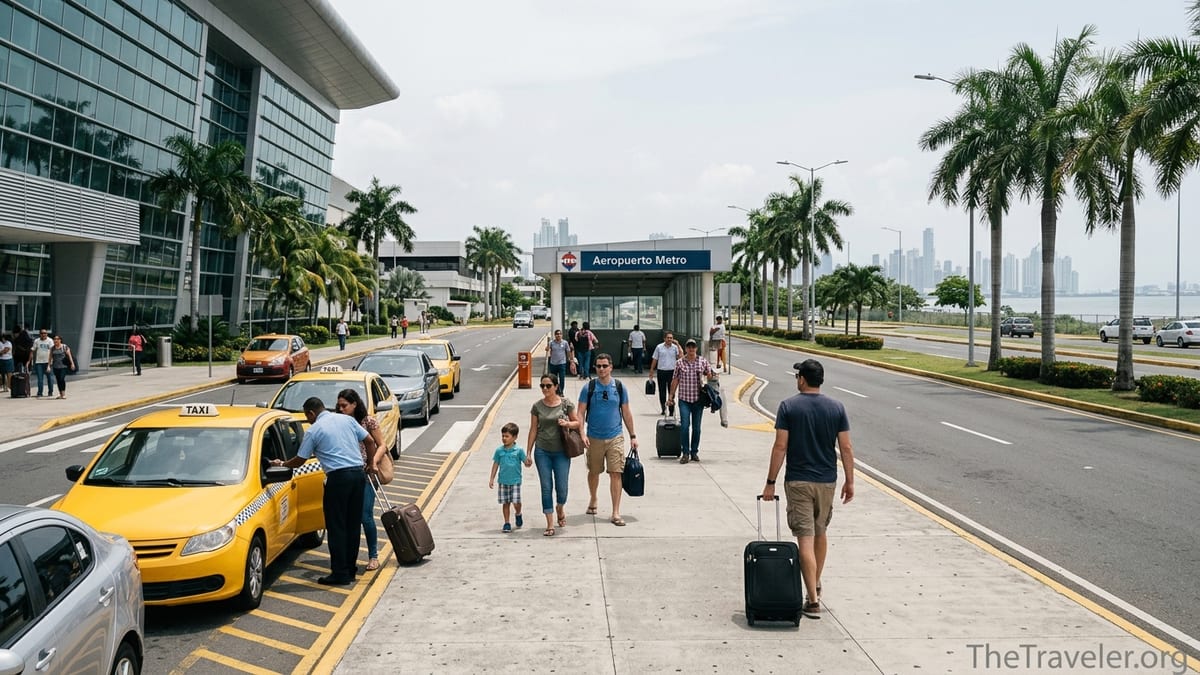
As of mid 2026, the airport is linked directly to the Panama Metro network through the Aeropuerto station, a short walk or shuttle ride from the terminals. Single rides on Line 2 cost about 0.50 dollars, with Line 1 segments around 0.35 dollars, paid by rechargeable transport card or contactless bank card. That means a full journey from the airport to central stations like Iglesia del Carmen or Via Argentina usually costs under 1 dollar, compared with 20 to 35 dollars by road.
Before choosing your option, check the time you land, your hotel’s location and how much luggage you will realistically be willing to move through stations. A solo backpacker arriving at 11:00 on a Tuesday will have very different priorities from a family of four with three suitcases landing at midnight.
Official Airport Taxis: Simple and Predictable
Official airport taxis remain the most straightforward choice for many visitors. At Tocumen, these taxis operate on published zone based fares. In 2026, an individual seat in a shared taxi from the airport to central Panama City typically runs in the low teens per person, while a private taxi for up to four passengers into downtown is usually around 30 to 40 dollars, depending on the exact area and whether tolls are included. The ride into areas like El Cangrejo, Obarrio or Avenida Balboa normally takes 25 to 40 minutes, with traffic being the biggest variable.
To use an official taxi, follow the signs from the arrivals hall toward the taxi counters before exiting the terminal. You pay or at least receive a printed quote inside, rather than negotiating outside on the curb. This protects you from inflated prices and ensures you are dealing with an authorized driver. For example, a couple heading to a mid range hotel near Via Argentina station might be quoted about 35 dollars for a private taxi, which often includes the Corredor Sur tolls, allowing a quick ride that avoids most city traffic lights.
Airport taxis are particularly good for travelers arriving late at night, those with heavy or multiple bags, or anyone unfamiliar with Spanish who prefers to settle everything at a staffed desk. Cars range from older sedans to newer minivans. Seat belts are standard, but child seats are not guaranteed unless you arrange a private transfer company in advance. It is a good idea to confirm before departure whether the fare is per car or per person and whether tolls are included so there are no surprises when you arrive at your hotel.
For safety, stick to the official counter or clearly signed taxi rank instead of accepting unsolicited offers from individuals inside the terminal. The airport and local authorities regularly advise visitors to use authorized taxis, as this minimizes the risk of overcharging and ensures basic insurance and vehicle standards.
Uber and App Based Rides: Flexible but Variable
Rideshare services such as Uber operate in Panama City, including at Tocumen International Airport. As of 2026, you can request an Uber pickup from designated areas outside the arrivals level. Fares fluctuate with demand, but a typical UberX ride from the airport to downtown hotel areas commonly falls between 15 and 25 dollars, sometimes less in off peak times. You see the estimated price in the app before confirming, which many travelers prefer to bargaining with individual drivers.
The main trade off with Uber is availability and pickup logistics. At busy times such as weekday evenings, cars are usually plentiful, and a couple landing at 17:00 might be able to meet their driver at the rideshare pickup area within 10 minutes. Late at night or in heavy rain, wait times can lengthen, and dynamic pricing can push fares closer to or even above official taxis. If you are landing around midnight with tired children, this uncertainty might outweigh the potential savings.
On the safety side, app based rides give you a digital record of your trip, route tracking, and a driver profile, which many visitors find reassuring. In practical terms, a solo traveler heading to a hotel in El Cangrejo or near Iglesia del Carmen station will likely find Uber a comfortable balance of cost and convenience, especially if they already use the app at home. Drivers frequently use Corredor Sur for airport runs, and the toll is either built into the app fare or added as a small extra amount.
One important local detail is that the airport has different curbside zones for private cars, taxis and app pickups, and the rules can change. After landing, check the latest instructions in your Uber app, which will usually specify whether to meet your driver on the departures level, at a specific door number or at a rideshare sign. Sending a quick message to the driver in the app with your terminal and what you are wearing often speeds up the meetup.
Private Transfers and Hotel Cars: Comfort and Certainty
Private transfer companies and some hotels offer pre booked car services from Tocumen into the city. These are more expensive than taxis and Uber but deliver predictability, which can be valuable after a long international flight. As a general guide, an advance booked sedan for two passengers to downtown neighborhoods often starts around 40 to 50 dollars, with larger SUVs or vans for families or groups rising to 60 dollars or more. Prices are usually per vehicle, not per person.
Many mid range and upscale hotels in areas like Punta Pacifica, Costa del Este and Casco Viejo work with preferred transfer providers. For example, a business traveler staying in a tower near Multiplaza mall may receive an email from their hotel offering a private airport pickup for 45 dollars, with the driver waiting in the arrivals hall holding a sign. For someone arriving close to midnight or carrying work equipment, paying extra for that seamless experience can make sense.
Private transfers are also useful for travelers with special needs: families requiring guaranteed child seats, visitors with limited mobility who want help with luggage door to door, or those carrying oversized sports equipment. Unlike street taxis, these services will confirm in writing what vehicle you will get, the exact price, and what happens if your flight is delayed. Many monitor incoming flights and adjust pickup times accordingly, so you are not left stranded if immigration lines are long.
In terms of traffic and routing, private drivers will use the same roads as taxis and Uber, typically Corredor Sur, but they tend to factor in real time traffic information and may adjust departure times if they are picking you up for an outbound flight. For inbound travelers, the biggest benefit is peace of mind rather than time savings, since the drive duration is similar to an ordinary taxi.
Panama Metro: The Cheapest Way into Town
The opening of the Aeropuerto station on a short branch of Metro Line 2 has transformed budget friendly access between Tocumen and the city. From the airport, trains on the Line 2 branch run to Corredor Sur station, where they join the main Line 2 corridor toward San Miguelito. You then connect to Line 1 for central destinations like Iglesia del Carmen, Via Argentina and El Carmen, which are close to many popular hotels, restaurants and offices.
Fares on the Metro remain very low. A typical journey from Aeropuerto station to a Line 1 stop in the city center costs under 1 dollar in total, with Line 2 segments priced around 0.50 dollars and Line 1 around 0.35 dollars. You pay using a rechargeable Metro card, which costs a few dollars to purchase and can then be topped up, or by tapping an accepted contactless bank card at the gates. This means that a solo traveler can cover the entire distance from the terminal to downtown for roughly the price of a bottle of water at the airport.
Using the Metro does require some physical effort. You must reach the Aeropuerto station from your arrival terminal, which can involve a short outdoor walk or an internal shuttle bus, depending on which terminal you land at and the latest airport arrangements. Once on the network, you may need to change trains at Corredor Sur and again at San Miguelito. Platforms at major stations are generally well signed, and uniformed security staff are visible. At busy times, trains can be crowded, so large suitcases are inconvenient even though technically permitted.
The Metro is best for travelers arriving in daylight or early evening with manageable luggage who feel comfortable navigating a foreign transit system. For instance, a backpacker landing at 14:00 and heading to a guesthouse near Via Argentina station can ride from Aeropuerto to Corredor Sur, continue on Line 2 to San Miguelito and then transfer to Line 1, exiting just a few minutes’ walk from their accommodation, all for less than a dollar. In contrast, a couple with two 23 kilogram suitcases landing at 23:30 might prefer a taxi for convenience and safety late at night.
Metrobus and Local Buses: Ultra Cheap, Less Practical with Luggage
Panama’s public bus system, known locally as MiBus or Metrobus, also serves the airport area and connects to the Metro. Certain routes, such as those linking the terminals with Corredor Sur or nearby neighborhoods, are used by locals as an even cheaper alternative to taxis. A single bus ride typically costs a fraction of a dollar, paid with the same transport card used on the Metro. For daily commuters, this is attractive, but for visitors with luggage it can be challenging.
The most practical use of the bus for travelers is often as a short feeder to the Metro, for example from a terminal curbside stop to Corredor Sur station if you prefer not to walk or if the weather is poor. In that case, you tap your card once on the bus and again at the Metro gate, with your total outlay remaining well under 2 dollars for the combined trip. However, buses can be crowded at peak hours, and boarding with large suitcases is awkward, especially if seats are limited.
Longer bus routes between the airport and central areas exist, but they are designed for residents and involve frequent stops, standing passengers and route numbers that change over time. Unless you read Spanish comfortably and are traveling very light, relying solely on a Metrobus from the airport into downtown after a long flight is rarely worth the savings compared with the Metro or a shared taxi seat.
For many visitors, the bus network becomes more useful later in the trip when moving around the city for sightseeing or reaching shopping centers from a Metro station. On arrival day, the extra mental load of figuring out route codes next to baggage carousels often makes other modes more appealing.
Cost, Safety and Luggage: Side by Side Comparison
When you compare Tocumen airport transfer options side by side, a few patterns emerge. The Metro is by far the cheapest, with a typical airport to downtown ride costing under 1 dollar and taking roughly 45 to 60 minutes including transfers. Metrobus segments are even cheaper per ride, but they often add complexity rather than value for visitors. Taxis, Uber and private transfers sit on a higher price tier, usually between 15 and 50 dollars per car depending on brand and level of service, but they cut your door to door time to somewhere between 25 and 45 minutes.
From a safety perspective, authorized airport taxis, reputable private transfers and app based rides like Uber are the most straightforward. You leave the controlled environment of the terminal, step into a marked vehicle or one matched in your app, and head directly to your hotel. The Metro is generally considered safe in the daytime, with security staff and CCTV, but like any urban rail system, pickpocketing can occur in crowded cars, so keeping bags closed and in sight is important. Metrobus routes vary more; they are safe for ordinary commuters, but language barriers and crowding make them less comfortable with large luggage.
Luggage is often the deciding factor. With only a backpack or small roll aboard, the Metro can be a pleasant way to start your time in Panama, giving you a quick introduction to local life. With two big suitcases per person, escalators, packed trains and transfers at San Miguelito and other stations become tiring fast. In that situation, a 30 to 35 dollar taxi or 20 to 25 dollar Uber between the airport and a downtown hotel quickly justifies itself.
Traffic is the final variable. Early mornings, late evenings and weekends often mean a fast run on Corredor Sur with city views over the Bay of Panama as you approach Punta Pacifica and Avenida Balboa. Weekday late afternoons can be slower, particularly approaching major interchanges. If you are landing at 17:30 on a weekday and staying close to a Metro station such as Iglesia del Carmen, the Metro may match or even beat road transport in total time, despite the transfers, while saving you a significant amount of money.
Best Options by Hotel Area
In downtown areas such as El Cangrejo, Obarrio, Bella Vista and Marbella, you generally have two good choices. The first is a direct road transfer by taxi, Uber or private car to your hotel, which is easiest with heavy luggage or late arrivals. The second is the Metro, since many hotels in these neighborhoods sit within a 5 to 10 minute walk of Line 1 stations like Via Argentina, Iglesia del Carmen or Santo Tomas. A budget conscious solo traveler staying near Via Argentina might reasonably choose the Metro, while a couple arriving close to midnight may choose a taxi to avoid a late night walk from the station.
For the skyscraper district around Punta Pacifica and the Multiplaza mall, road transfers typically work better. While you can reach nearby Metro stations and then walk or take a short taxi ride, the area’s big roads and overpasses make walking with luggage feel less comfortable. Business travelers staying in branded towers near the mall often opt for private transfers or taxis, absorbing a 30 to 45 dollar fare in exchange for a quick run on Corredor Sur directly to the hotel entrance.
Casco Viejo, the atmospheric historic quarter, has narrower streets and some traffic restrictions, but taxis, private transfers and Uber can still deliver you to hotel doors or designated drop off points. From the Metro, you would typically exit at Cinco de Mayo or Santo Tomas and use a short taxi ride or a longer walk, which is not ideal with suitcases on cobblestones. For most visitors staying in Casco, especially first timers, arranging a direct car transfer from the airport is usually the most comfortable way to arrive.
In newer residential and business areas east of downtown, such as Costa del Este, your options depend on exact location. Some complexes sit a short taxi ride from Line 2 stations, making a mix of Metro and car feasible. Others are more car dependent, with visitors typically taking a taxi or Uber straight from Tocumen. If your hotel or rental apartment is in a gated community or on a private road, door to door private transfers become especially attractive, removing any uncertainty about explaining directions to a driver in Spanish.
The Takeaway
Choosing the best transfer from Tocumen International Airport to Panama City comes down to a balance of cost, comfort, timing and hotel location. The Metro now provides a remarkably cheap and often efficient route into the heart of the city, especially in daytime and for travelers with light luggage who are staying near Line 1 stations. For them, paying less than 1 dollar to cover the journey is hard to beat, and the experience offers an early glimpse of everyday life in the capital.
For many visitors, though, a road transfer remains the most practical choice. Official airport taxis, Uber and pre arranged private cars will all carry you along Corredor Sur and into downtown in 25 to 45 minutes in normal traffic. Expect to pay somewhere in the 20 to 40 dollar range per car depending on the service and destination. The reassurance of a direct, air conditioned ride to your hotel door, especially late at night or after a long intercontinental flight, is often worth the added expense.
Think through your own priorities before you land. If saving money is key and you are comfortable navigating transit, plan your Metro route in advance, including where you will change lines and which station is closest to your hotel. If convenience and safety with luggage matter more, screenshot your hotel address in Spanish, decide whether you prefer a taxi queue, an Uber pickup or a pre booked driver, and head straight there after customs.
Whichever option you choose, knowing what to expect will make that first ride from Tocumen to Panama City less stressful and more enjoyable, allowing you to arrive at your hotel ready to explore the capital’s waterfront skyline, historic streets and vibrant neighborhoods.
FAQ
Q1. How long does it take to get from Tocumen Airport to Panama City?
The drive usually takes 20 to 30 minutes in light traffic and up to 45 minutes or a bit more at rush hour. Using the Metro, including transfers and walking, most travelers should allow 45 to 60 minutes.
Q2. How much is a taxi from Tocumen Airport to downtown Panama City?
Official airport taxis typically charge in the region of 30 to 40 dollars for a private ride into central areas, depending on the exact neighborhood and whether highway tolls are included.
Q3. Is Uber available at Tocumen International Airport?
Yes. Uber operates in Panama City and serves Tocumen. You can request a ride through the app and meet your driver at the designated pickup area shown in the app instructions.
Q4. What is the cheapest way to get from the airport to Panama City?
The Panama Metro via Aeropuerto station on the Line 2 branch is the cheapest option. A full journey to a central Line 1 station usually costs under 1 dollar, plus the cost of a reusable transport card if you do not already have one.
Q5. Is the Metro safe for travelers with luggage?
The Metro is generally considered safe, especially in daytime, and many visitors use it. However, it can be crowded at peak hours, and you should keep bags zipped, in sight and close to you like on any busy urban rail system.
Q6. Can I pay for the Metro or buses from the airport with cash?
You do not pay cash directly at the Metro turnstiles or on buses. Instead, you use a rechargeable transport card or, on many gates, a compatible contactless bank card. Budget a few dollars to purchase and load the card if you are new to the system.
Q7. What is the best option if my hotel is in Casco Viejo?
For Casco Viejo, most travelers prefer a direct taxi, Uber or private transfer from the airport. While you can use the Metro part of the way, it usually requires at least one transfer and a taxi or walk from the nearest station, which is less convenient with suitcases.
Q8. Are late night arrivals at Tocumen a safety concern?
The airport itself is busy and well policed, and authorized taxis and pre booked transfers are considered safe at night. Travelers arriving very late generally avoid unfamiliar buses and prefer direct car services rather than navigating stations with luggage.
Q9. Do hotels in Panama City offer airport shuttle services?
Some mid range and higher end hotels, especially in business districts and Casco Viejo, partner with transfer companies to offer paid airport pickups. It is less common to find free shared shuttles than at some resort destinations, so check directly with your hotel before arrival.
Q10. Which option is best for a family with small children and multiple bags?
For families with young children and several pieces of luggage, a pre booked private transfer or an official taxi is usually the most comfortable choice. You get door to door service, no transfers with strollers or car seats, and a predictable trip time after a long flight.