


More news on this day
The European Union Aviation Safety Agency has ordered significantly more frequent checks of key de‑icing valves on all ATR 42 and ATR 72 turboprops from 30 November 2026, a binding move that tightens winter safety requirements for regional airlines operating in France and across Europe after investigators linked valve failures and icing to a recent fatal ATR crash.
Get the latest news straight to your inbox!
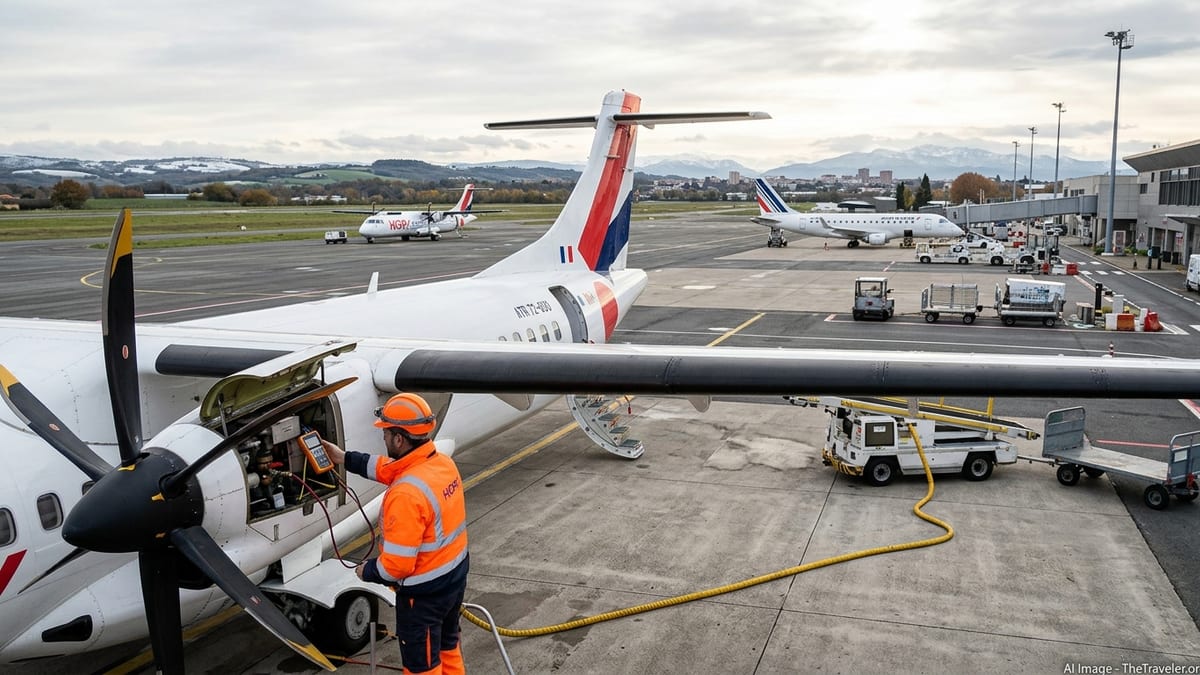
What EASA has ordered and when it takes effect
The core development is EASA Airworthiness Directive 2026-0219, issued on 16 November 2026 and effective from 30 November. The final directive mandates shorter intervals for functional checks of the pressure regulator and shut-off valve in the pneumatic de‑icing system of all ATR 42 and ATR 72 variants, covering the entire in-service fleet. Regulators describe the requirement as necessary to control a risk that a dormant valve failure could remain hidden until the aircraft encounters icing, at which point loss of control could become unrecoverable.
The directive replaces an earlier measure, EASA AD 2025-0011, which had already reduced check intervals but was judged insufficient after further analysis and accident findings. Under the new rule, many operators must perform the functional check as often as every 160 flight hours, a substantial tightening compared with the previous maintenance schedule published in ATR’s instructions. The directive is directly applicable across the European Union and is adopted by the French Civil Aviation Authority for aircraft on the French register and ATRs operated by French carriers.
EASA characterises AD 2026-0219 as a standard airworthiness directive rather than an emergency directive, but it notes that the underlying failure mode is critical because it affects ice protection on essential lifting surfaces. Authorities emphasise that there is no grounding of the ATR fleet and that aircraft can continue flying provided operators comply with the new, accelerated maintenance tasks by the effective date.
Which aircraft and airlines are affected, and why France is in focus
The directive applies to ATR 42-200, -300, -320, -400, -500 and ATR 72-101, -102, -201, -202, -211, -212 and -212A aircraft, covering both older and newer generations. ATR 42 and ATR 72 types are short-haul regional turboprops developed and assembled in Toulouse, France, and they remain widely used by European and global regional airlines for routes typically under 90 minutes. As of late 2025, industry fleet data indicated several hundred ATR 72s and dozens of ATR 42s in active airline service worldwide, with a significant concentration based in or regularly serving European and French regional airports.
France is particularly visible in this development for two reasons. First, ATR is based in Toulouse, and a large share of European ATR maintenance and engineering activity is clustered in France. Second, multiple French and France-linked operators, including carriers serving mainland regional routes and French overseas territories, rely on ATR turboprops for winter services where icing conditions are routine. For these airlines, the new EASA directive translates directly into more frequent technical checks at French maintenance bases.
Beyond French carriers, the directive binds all operators of ATR 42 and 72 aircraft in EASA member states and associated countries. Non-European airlines flying ATRs registered in EASA jurisdictions must also comply. For ATRs registered outside EASA states, national aviation authorities typically review and either mirror EASA directives or issue their own compatible measures, so the European action is expected to influence maintenance practices in other regions even where it does not automatically apply.
Technical issue: how a de‑icing valve can create a hidden risk
ATR 42 and 72 aircraft use pneumatic de‑icing boots along the leading edges of the wings and horizontal stabiliser. In icing conditions, these rubber boots periodically inflate and deflate, cracking and shedding accumulated ice. The pressure regulator and shut-off valve at the heart of EASA’s directive controls bleed air that inflates the boots and isolates sections of the system as required. If this valve fails in certain positions, parts of the ice protection system may stop functioning even though cockpit indications appear normal.
EASA’s earlier analysis, reflected in the superseded AD 2025-0011, concluded that the functional check interval specified in ATR maintenance documentation did not adequately mitigate the risk of a so‑called dormant failure of this valve. A dormant failure is a defect that remains latent and undetected until a specific set of conditions exposes it. In this case, the defect might only become critical when the aircraft encounters significant icing, at which point pilots could find that parts of the wing or tail are no longer being properly de‑iced.
The new directive is based on updated safety analysis and operational experience indicating that a shorter interval is needed to meet design safety objectives. EASA notes that, in combination with icing conditions, an undetected malfunction of the pressure regulator and shut-off valve could ultimately lead to loss of control of the aircraft. The directive therefore orders operators to perform repetitive functional tests at the new, reduced intervals and to correct any discrepancies before further flight in icing conditions.
Link to recent accidents and why regulators are acting before winter
Although EASA’s directive does not name specific accidents, its timing follows a fatal accident involving a Voepass Linhas Aéreas ATR 72-500 in Brazil on 9 August 2024. Brazilian investigators reported substantial ice accretion and multiple anomalies in the aircraft’s de‑icing systems among the factors under investigation. While the final report for that accident has not yet been published, EASA highlights that combination of icing and system failures as an example of the kind of scenario it aims to guard against.
Historically, ATR operations in icing have drawn regulatory scrutiny before. The 1994 crash of American Eagle Flight 4184, an ATR 72 that entered an unrecoverable roll after ice built up beyond the reach of its boots, led to substantial changes to ATR de‑icing procedures and certification standards. Subsequent modifications enlarged boot coverage and changed activation procedures, and regulators on both sides of the Atlantic tightened rules on flying turboprops in severe icing conditions. The new valve‑inspection directive builds on that legacy by addressing a different part of the system that can undermine protection even when crews follow procedures.
The directive’s 30 November 2026 effective date is deliberately set just as the core European winter icing season begins. EASA expects operators to adjust maintenance planning immediately so that the new interval is embedded in work packages for aircraft likely to spend much of December through March flying in icing-prone environments, including French mountain and Atlantic coastal routes. Regulators emphasise that acting ahead of the season reduces the risk that a dormant valve failure could only be discovered during real-world icing encounters.
Operational impact on regional winter schedules and on travelers
For travelers, the most immediate consequence is not a new restriction on flying but the possibility of schedule adjustments if airlines temporarily withdraw ATR aircraft for the required checks. Each functional test adds maintenance workload that must be slotted into hangar capacity which is already busy during winter. Airlines that operate intensive daily schedules on short regional sectors may need to rotate spare aircraft into service more often or reassign flights to jets or other turboprops where available.
In France, where ATRs serve many short domestic links and routes to Corsica and overseas territories, the higher inspection frequency could be felt in tightened turnaround times and more frequent overnight maintenance. However, industry reaction so far indicates that airlines view the directive as manageable, provided they can plan ahead of the 30 November deadline. No carrier has announced large-scale cancellations or route suspensions specifically attributed to AD 2026-0219, and regulators underline that aircraft that complete the new checks remain fully cleared for flight in known icing conditions within existing limitations.
For passengers booked on ATR-operated services this winter, the more likely practical effects are behind the scenes: slightly earlier aircraft withdrawals for scheduled maintenance and occasional substitutions of aircraft types. Ticketed itineraries and fares do not automatically change because of the directive. Where airlines do swap aircraft types, standard passenger rights rules continue to apply, and travelers should check pre-departure notifications for any aircraft or schedule changes rather than expecting systemic disruption solely due to the new inspections.
What travelers and airlines should watch next
The next firm milestone is 30 November 2026, when compliance with the shorter inspection interval becomes mandatory for ATR 42 and 72 aircraft covered by the directive in EASA jurisdictions. Airlines must by then have integrated the new functional checks into their approved maintenance programs and performed initial checks on aircraft that are approaching or beyond the revised hour thresholds. Authorities will monitor compliance through routine oversight and may issue further guidance if recurrent findings suggest that additional design or procedural changes are needed.
For travelers, there is currently no new action required beyond normal winter travel precautions, such as allowing extra time for airport de‑icing on days with freezing conditions. If regulators or investigators later determine that additional technical modifications are necessary in response to accident findings, those steps would be communicated through separate directives and airline announcements. Until then, the key change is the higher inspection frequency, a safety margin that should remain largely invisible to passengers.
Anyone booking regional flights on ATR aircraft operated by French or other European carriers over the coming winter who has concerns about icing can check whether their airline has issued public statements or FAQs on the EASA directive. However, with the aircraft not grounded and no new operational limitations placed on passengers themselves, the development is primarily one for maintenance planners and safety managers to manage in the background rather than a change that alters how travelers plan or experience their journeys.