


Seoul Incheon International Airport is one of Asia’s best connected hubs, yet after a long flight the maze of trains, buses and taxis can feel overwhelming. The good news is that getting between Incheon and central Seoul is usually straightforward once you understand a few core options. This guide walks you through the easiest ways in and out of the airport, with realistic journey times, typical fares and concrete examples for popular areas like Myeongdong, Hongdae and Gangnam.
Get the latest updates straight to your inbox!
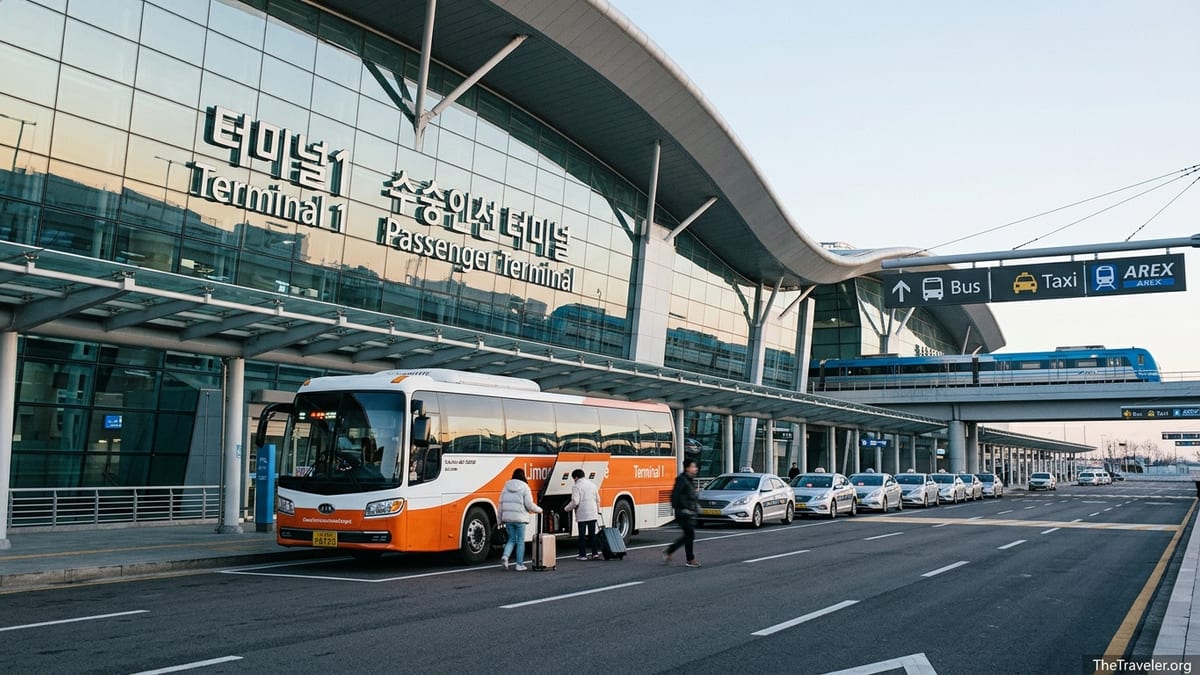
Understanding Incheon Airport and Where Transport Starts
Incheon International Airport has two main passenger terminals, Terminal 1 and Terminal 2, plus a smaller Concourse. Most international airlines use Terminal 1, while Korean Air and several partners operate primarily from Terminal 2. The layout is similar in both: arrivals halls on the first floor, departures above, and most public transport connections either on the basement level or directly outside on the ground floor. After you exit customs, simply follow large overhead signs marked “Railroad” for trains, “Bus” or “Limousine Bus” for coaches into the city, and “Taxi” for metered cabs.
The airport’s transport center at Terminal 1 sits just across from the main building and is linked by indoor walkways and escalators. This is where you will find the AREX airport train platforms on level B1, airport limousine bus ticket counters near the exits on the first floor, and a large taxi rank outside. Terminal 2 has a similar setup with the AREX station directly beneath the arrivals hall in the basement. Give yourself about 10 to 15 minutes from baggage claim to reach any of the main transport options, a bit more if you are traveling with children or large suitcases.
Most services operate from early morning until close to midnight, with night buses and taxis filling the gap in the small hours. If your flight lands around 23:00 or later, it is worth checking the last AREX and bus times in advance and having a backup plan such as a taxi or prebooked car. During the day however, frequencies are high and you rarely need to worry about missing the next train or bus.
To pay for almost all public transport options, many travelers use a rechargeable T-money or Cashbee card that works on trains, subways and buses across Seoul. You can buy one from convenience stores inside the arrival halls and load it with cash. While single-journey tickets and contactless bank cards are also increasingly accepted, a local transport card keeps transfers simple and helps you benefit from automatic transfer discounts inside the city.
AREX Airport Train: Fastest Route to Central Seoul
The AREX airport train is usually the fastest and most predictable way to travel between Incheon and downtown Seoul. The line runs from Incheon Terminal 2 through Terminal 1, Gimpo Airport and several western Seoul districts before terminating at Seoul Station, the main national rail hub. Travel time from Terminal 1 to Seoul Station is around 40 to 60 minutes depending on whether you take the Express service or the All Stop commuter train, and you avoid any risk of highway traffic jams.
The AREX Express train runs non-stop between Incheon and Seoul Station with reserved seats and luggage racks. As of mid 2026, a typical one-way adult fare is under 15,000 won and the journey takes about 40 minutes from Terminal 1 to Seoul Station. This train is popular with first-time visitors staying anywhere near Seoul Station, Namdaemun or Myeongdong, because you can roll your suitcase directly from the platform into the main station hall and connect to subway Line 4 or a short metered taxi ride. For example, a traveler landing on a weekday morning can be off the plane at 08:00, clear immigration, board the 09:00 Express and be at a Myeongdong hotel before 10:30.
The AREX All Stop train functions more like a regular metro service and stops at intermediate stations such as Hongik University (for Hongdae), Digital Media City and Gimpo Airport before reaching Seoul Station. The ride from Incheon Terminal 1 to Hongik University Station takes roughly 55 minutes and costs around 5,000 won with a transport card, making it excellent value if your accommodation is near one of these stops. A backpacker staying in Hongdae might pay under 5,000 won for the train and walk five to ten minutes to a guesthouse, instead of taking a longer and more expensive bus or taxi.
Tickets for both AREX services are easy to buy from vending machines on the station concourse or from staffed counters. Machines offer English and several other languages and accept cash, many foreign bank cards and local transport cards. Once at Seoul Station, you can connect not only to the city subway but also to KTX high-speed trains for other regions. Some airlines also support early baggage check-in at the City Airport Terminal inside Seoul Station for passengers taking the AREX Express, which can be useful if you want to explore the city unencumbered before heading to the airport.
Airport Limousine Buses: Easiest for Hotels and Tourists
Airport limousine buses are one of the simplest options for travelers who prefer to avoid transfers with heavy luggage. These long-distance buses run from designated bays outside each terminal directly to major hotel zones and transit hubs across Seoul, including Myeongdong, City Hall, Gangnam, Jamsil and others. Typical journey times range from 60 to 90 minutes depending on traffic and distance, with fares usually between about 10,000 and 18,000 won per adult one way.
At Terminal 1 the bus stops are numbered bays along the curb outside the arrivals hall; for example, services toward central Seoul often leave from areas such as 4B, 5A, 6A or similar, with prominent route numbers like 6001, 6015 or 6701 displayed on signs and bus fronts. You purchase tickets from orange or blue airport limousine counters inside the arrivals hall or from small ticket kiosks near the stops. Staff normally speak basic English and can advise the correct route if you show your hotel name or neighborhood on your phone. Many buses allow direct payment with a T-money card when boarding from the city toward the airport, although from the airport side travelers are usually guided to buy a paper ticket first.
For example, a family staying in Myeongdong might choose bus 6015, which travels from Incheon via Seoul Station into the Myeongdong area, stopping near several mid-range hotels and guesthouses. With two adults and two children each carrying a suitcase, the family can place large bags in the underfloor luggage hold where the driver tags them, sit comfortably in reclining seats and listen for their stop as it is announced in Korean and English on overhead screens. A one-way adult ticket on such routes usually falls in the mid-teens in thousands of won, making the total cost competitive with a taxi while avoiding transfer stress.
Night services are available on a small number of lines for late arrivals and very early departures. For instance, a night bus variant of the daytime 6002 route links central eastern districts like Dongdaemun with the airport and typically charges a slightly higher fare than daytime buses. These night routes can be a lifeline for passengers landing after midnight when trains have finished for the day but who still prefer a fixed-price option over a long taxi ride.
Taxis and Ride-Hailing: Door-to-Door Convenience
Taxis are the most straightforward door-to-door option between Incheon and anywhere in Seoul, particularly if you are arriving late, traveling with tired children or carrying bulky sports equipment. Official taxis line up at clearly marked ranks outside the arrivals floors at both terminals, separated into standard, deluxe and jumbo (van) categories. Standard cabs offer the lowest fares, while deluxe and jumbo vehicles charge higher rates but provide more space or a more comfortable interior.
The total fare from Incheon Airport to central Seoul varies with traffic and destination but many travelers report paying the equivalent of roughly 40 to 70 US dollars in 2025 and 2026 for a daytime ride in a standard taxi to areas such as Myeongdong, Hongdae or Gangnam. Late-night surcharges, expressway tolls and heavy congestion can all increase the final meter reading, so it is wise to confirm the approximate expected fare with the dispatcher or by checking a navigation app before you join the line. For example, a couple arriving around 21:00 with two suitcases might spend around 60,000 to 80,000 won reaching a Gangnam hotel in about an hour, while the same trip at 03:00 with little traffic could be both faster and slightly cheaper.
Ride-hailing apps are also widely used in Korea. Kakao T is the most common among locals and allows you to request standard taxis, premium sedans and larger vehicles from your phone. Some travelers find that Kakao T bookings can slightly undercut the cost of immediately available airport taxis, especially when demand is low. However, creating an account and registering a foreign bank card can be tricky for short-term visitors, and in many cases it remains easier to simply use the regular taxi queue after you walk out of customs.
One scenario where taxis make particular sense is when you are staying in a residential neighborhood far from a limousine bus stop or subway station, such as a hillside guesthouse or a serviced apartment deep in a local district. In that case, you might still take the AREX train or airport bus into the city and then transfer to a short ten-minute taxi ride, keeping the overall cost down while avoiding complex subway interchanges with luggage. Conversely, if you are a group of four adults splitting a single taxi directly from the airport to an Airbnb in Itaewon, the per-person cost can end up very close to that of the limousine bus while saving 20 to 30 minutes of walking and waiting.
Connecting via KTX and Regional Buses for Other Cities
Not all passengers heading out of Incheon are bound for central Seoul. Many continue onward to other regions of South Korea such as Busan, Daegu, Daejeon or Gwangju. In practice, the most common strategy is to use AREX or an airport limousine bus to reach a major rail hub and then board a KTX high-speed train or an intercity bus from there. Seoul Station serves as the primary KTX terminal for north-south lines, while stations like Gwangmyeong and Yongsan also play a role for certain routes.
A typical example is a traveler flying into Incheon and needing to reach Busan on the same day. One efficient itinerary is to take the AREX Express from Terminal 1 to Seoul Station in around 40 minutes, then catch a KTX train to Busan which takes roughly two and a half to three hours depending on the service. Another option used by some travelers is to ride an airport limousine bus directly from Incheon to Gwangmyeong Station, a major KTX stop south of Seoul, which can save time for those whose final destination is in the southern half of the country. In both cases, buying tickets in advance during busy weekends is advisable because KTX seats can sell out.
For regional travel by bus rather than train, Incheon Airport is linked by long-distance coaches to notable locations such as Daejeon, Gangneung, and various coastal or provincial cities. These buses usually depart from separate platforms signposted for intercity or express buses rather than the airport limousine stands that focus on Seoul neighborhoods. A traveler going straight to a conference in Daejeon, for instance, might choose a direct airport limousine coach that reaches the city in roughly three hours without the need to transfer via central Seoul at all.
If you are simply using Incheon as your departure point for a domestic leg, the airport is also well connected with Gimpo Airport, Seoul’s domestic hub. The AREX All Stop train offers a straightforward ride of around 40 minutes between Incheon and Gimpo, and several airport limousine bus routes also serve both airports. These options are particularly useful for itineraries involving Jeju Island or other domestic destinations served mainly from Gimpo rather than Incheon.
Choosing the Right Option for Your Neighborhood and Schedule
Deciding which transport mode is “easiest” depends heavily on where in Seoul you are staying, what time you land or depart, and how much luggage you carry. For most first-time visitors staying in popular tourist zones like Myeongdong, Hongdae or near Seoul Station, the choice is usually between the AREX train and an airport limousine bus, with taxis as a backup when convenience matters more than cost. Thinking through a few real-world scenarios helps clarify which option suits different types of trips.
If you are staying in Hongdae, the AREX All Stop train is often the simplest and cheapest, since it drops you at Hongik University Station in about an hour from Incheon Terminal 1 and avoids surface traffic. A budget-conscious solo traveler arriving midday might buy a T-money card, ride AREX straight to Hongik University, and then walk ten minutes to a guesthouse for a total outlay of around 5,000 won. On the other hand, a family of four with strollers heading to Myeongdong may prefer the 6015 or 6001 limousine bus, avoiding escalators and station transfers entirely and being dropped within a block or two of major hotels.
For business travelers based in Gangnam or COEX, airport limousine buses that head directly to Gangnam Station, Samsung Station or nearby hotels often beat the train in terms of convenience, especially during off-peak hours when highway traffic flows smoothly. A morning arrival at 06:30 may see you on a bus by 07:15 and at a Gangnam office by around 08:30 with time to spare for a coffee. Conversely, if you are arriving on a weekday between 17:00 and 19:30 when roads into Gangnam routinely clog, the combination of AREX to Seoul Station and then subway Line 2 may be both faster and more predictable than sitting in congestion.
Departure timing matters too. If your flight out of Incheon leaves early in the morning, staying near a hotel that lies on a direct airport bus route can help you avoid very early subway connections. Myeongdong, for instance, has several stops served by first departures of key limousine bus lines that reach the airport before 06:30, suitable for 09:00 international flights. Late-night arrivals after the last AREX departures might lean toward a night bus into the city or a taxi share with other travelers headed to similar districts to keep the price manageable.
Practical Tips for a Smooth Arrival and Departure
A few simple habits make it much easier to navigate between Incheon and Seoul without stress. First, keep your hotel address and Korean-language version of the name saved on your phone, either as a screenshot from a map app or as text you can show to drivers and ticket staff. Even though many workers at Incheon speak at least basic English, having the Korean script handy reduces misunderstandings, especially when there are multiple hotels with similar names in the same neighborhood.
Second, consider buying or reloading a transport card like T-money as soon as you enter the arrivals hall. Convenience stores such as CU or 7-Eleven sell the cards and allow you to add cash credit at the counter. Using one card for AREX, subways and buses means you do not have to queue for individual tickets at every transfer, and Seoul’s integrated fare system automatically applies small discounts when you change from train to bus within a set time window. If you are traveling as a couple or group, each person needs their own card but you can top them up together in a single transaction.
Third, always leave extra time for transfers on your return to the airport. While AREX and most limousine buses are punctual, delays can occur due to heavy traffic, unexpected rail issues or simple confusion in finding platforms. As a rule of thumb, aim to arrive at the airport at least three hours before an international departure, and add another 30 to 60 minutes if you are relying on road transport during rush hour. For example, a traveler flying to Europe at 12:00 from Terminal 1 and staying in Gangnam might board an airport limousine bus around 08:00, allowing generous time for check-in and security even if the roads are busier than usual.
Finally, be mindful of luggage when choosing your route. AREX trains include luggage racks but narrow aisles can still feel crowded at peak commuter times, particularly on the All Stop services used by local residents. Airport buses offer more predictable suitcase storage with tagged holds, but you will still need to lift bags on and off the curb. If you have mobility challenges or are traveling with very large or numerous bags, it can be worth paying extra for a jumbo taxi or private van transfer that meets you in the arrivals hall and drops you directly at your accommodation doorstep.
FAQ
Q1. What is the fastest way to get from Incheon Airport to central Seoul?
The fastest option for most travelers is the AREX Express train from Incheon Airport to Seoul Station, which usually takes around 40 minutes from Terminal 1 and runs on a reliable timetable that is not affected by road traffic.
Q2. How much does it cost to travel from Incheon Airport to Seoul by train?
As of 2026, the AREX Express fare to Seoul Station is typically under 15,000 won one way for adults, while the slower AREX All Stop commuter train usually costs around 5,000 won depending on the exact distance traveled.
Q3. When is an airport limousine bus better than the AREX train?
An airport limousine bus is often better if your hotel is near one of the bus stops in areas like Myeongdong, Gangnam or Jamsil, if you have large or multiple suitcases, or if you prefer a single ride without changing lines or climbing station stairs.
Q4. How much should I expect to pay for a taxi from Incheon to Seoul?
Typical reports in 2025 and 2026 suggest that a standard taxi from Incheon Airport to central areas like Myeongdong, Hongdae or Gangnam costs roughly the equivalent of 40 to 70 US dollars, depending on traffic, tolls and late-night surcharges.
Q5. Are there late-night transport options after the last train?
Yes. A small number of night airport buses serve major districts, and regular taxis are available around the clock at the airport. If your flight lands after midnight, checking current night bus routes in advance or planning to share a taxi can be helpful.
Q6. Which option is best for getting to Hongdae from Incheon Airport?
For Hongdae, the AREX All Stop train is usually the most straightforward choice, since it runs directly from Incheon Terminal 1 and Terminal 2 to Hongik University Station in about an hour and avoids any road congestion.
Q7. Can I pay for airport buses and trains with a foreign credit card?
Many ticket machines for AREX and some airport bus counters now accept major international credit cards, but it is not guaranteed everywhere. Buying and loading a T-money card with cash at a convenience store in the arrivals hall is a reliable alternative.
Q8. How early should I leave Seoul for an international flight from Incheon?
Most travelers aim to arrive at Incheon at least three hours before an international departure. This usually means leaving central Seoul about four hours before your flight time, and even earlier if you are traveling during weekday rush hours or from distant neighborhoods.
Q9. Is it easy to transfer from Incheon Airport to KTX high-speed trains?
Yes. A common route is to take the AREX Express or All Stop train to Seoul Station and then transfer to a KTX service. Some airport buses also go directly to KTX stations like Gwangmyeong, which can be convenient if you are heading to southern cities.
Q10. What is the simplest choice for a first-time visitor who feels nervous about transfers?
For a first-time visitor, booking an airport limousine bus that stops near your hotel or using a standard taxi from the official airport rank are usually the simplest options, since you only need to sit back and get off when you reach your stop or your hotel entrance.