


More news on this day
Germany’s Wendlingen–Ulm high-speed railway, already carrying trains across the Swabian Jura, is moving toward fuller integration with Stuttgart’s future underground hub just as fresh cost increases push the wider Stuttgart 21 project to a new financial peak.
Get the latest news straight to your inbox!
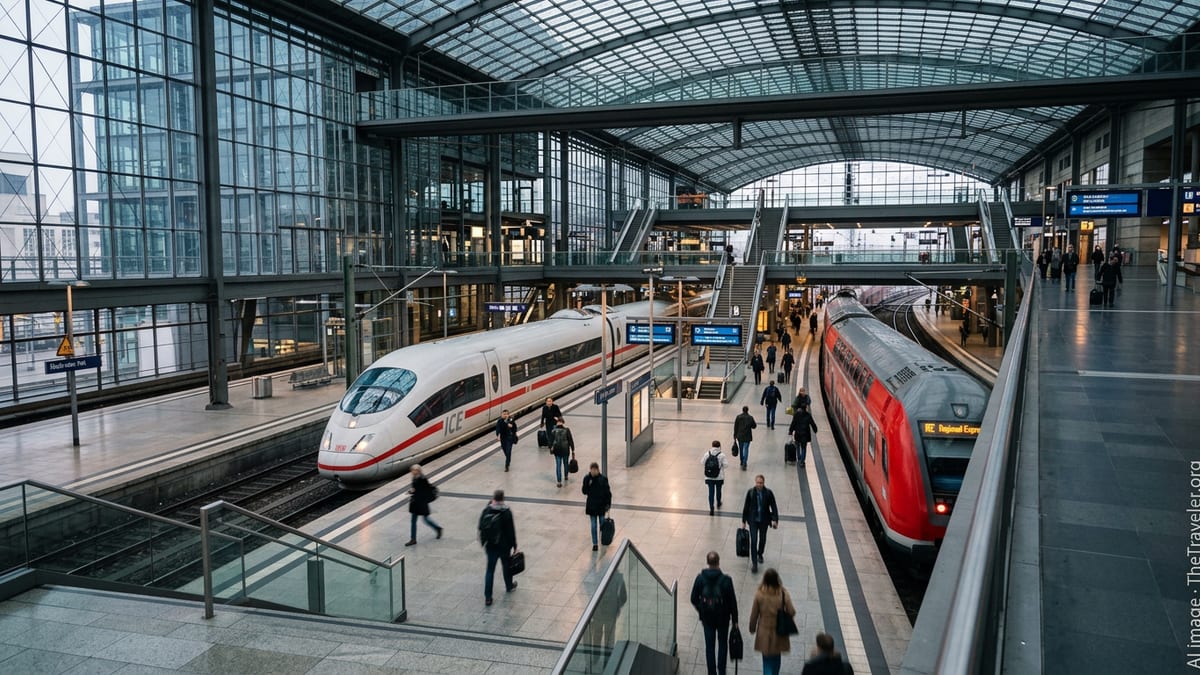
High-speed spine between Wendlingen and Ulm already in service
The Wendlingen–Ulm line forms the new high-speed backbone across Baden-Württemberg, cutting journey times between Ulm and the Stuttgart region and easing pressure on the historic, winding route through the Fils Valley. Publicly available information describes the 60-kilometre corridor as a dual-track, electrified railway designed for speeds up to 250 kilometres per hour, with major engineering works including long tunnels and one of Germany’s highest rail bridges.
The line opened to passenger traffic in December 2022, initially as a stand-alone section feeding into existing infrastructure at Wendlingen and Ulm. Regional and long-distance services have since been adjusted to use the new corridor, bringing time savings of around a quarter of an hour on key Stuttgart–Ulm and Stuttgart–Munich journeys, according to transport ministry and rail operator documentation.
A single intermediate stop at Merklingen on the Swabian Alb has given a previously car-dependent rural region direct access to fast rail services. State and local authorities describe the new station as a catalyst for development on the plateau, with park-and-ride facilities and feeder buses aimed at drawing commuters away from the A8 motorway.
Technical material from Deutsche Bahn and project partners highlights how the line has been built with the future Stuttgart 21 node in mind. Track geometry, power supply and signalling have been specified to allow a substantial increase in long-distance and regional services once direct links into Stuttgart’s new underground station are commissioned.
Stuttgart 21 delays reshape timetable for full integration
While Wendlingen–Ulm is operational, its ultimate function depends on the completion of Stuttgart 21, the controversial plan to convert Stuttgart’s terminus station into an underground through-station and reconfigure surrounding approaches. City and project websites now describe a staged commissioning, replacing earlier expectations of a single switchover.
Recent planning documents outline that the new Stuttgart main station for long-distance and regional rail is no longer expected to open in the mid-2020s but has been pushed back to the turn of the next decade. Municipal information from Stuttgart points to a target date of December 2031 for full operation of the underground station and removal of the current surface tracks.
In the interim, the Wendlingen–Ulm line functions as a high-speed bypass for part of the Stuttgart–Ulm corridor, but without the direct, fully grade-separated connection into central Stuttgart originally envisaged for the mid-2020s. Capacity on the new infrastructure is therefore being introduced gradually, with some fast services still routed via legacy approaches and temporary freight and diversionary patterns in place.
Technical integration is further complicated by the rollout of digital signalling. Stuttgart 21 has been designated a pilot area for extensive use of the European Train Control System, and reports indicate that adapting designs and on-site works to evolving digital standards has added complexity to the commissioning sequence for both the underground node and its Wendlingen–Ulm feeder.
Cost estimates for Stuttgart 21 rise again
As the high-speed section beds in, the financial picture for the overarching Stuttgart 21 project has shifted once more. Coverage from German public broadcasters and local authorities in late June 2026 reports that Deutsche Bahn now estimates total costs at around 14.5 billion euros, roughly three billion euros more than the previous official figure.
This latest revision continues a long trend of cost escalation. When political decisions were taken in the late 2000s to proceed with Stuttgart 21, projected expenditures were significantly lower, and subsequent revisions have repeatedly stirred public debate. Chronologies compiled by regional media show multiple rounds of upward adjustments linked to planning changes, legal disputes, construction challenges and inflation in building costs.
The newest increase has been attributed in part to technical complications and to the expanded digitalisation package, which adds extensive new signalling and control technology in the Stuttgart node. Commentators have also pointed to broader market pressures in the construction sector, including higher material and labour costs than those assumed in earlier estimates.
The state of Baden-Württemberg, the federal government, the city of Stuttgart and Deutsche Bahn share the complex financing structure for Stuttgart 21. Publicly available financing agreements set out caps for some local contributions, meaning that a substantial share of additional costs is expected to fall on the federal level and the rail operator, a point that continues to fuel political discussion.
Travel-time gains and network effects for passengers
For passengers, the most visible benefit so far is faster travel between Ulm and the Stuttgart area via the new high-speed alignment. Deutsche Bahn timetables and promotional material emphasise reduced journey times of around 15 minutes between Stuttgart and Ulm thanks to the 2022 opening of Wendlingen–Ulm, with a further reduction expected once the underground station and new approaches are in full use.
Plans presented by the federal transport ministry frame Wendlingen–Ulm and Stuttgart 21 as central building blocks of a Germany-wide regular-interval timetable. By shortening the east–west axis from Paris and Karlsruhe through Stuttgart and Ulm to Munich and onward to Vienna and Bratislava, the corridor is intended to support more frequent and better-connected long-distance services.
Regional rail is also set to benefit as long-distance traffic migrates to the new high-speed infrastructure. With express services shifting away from the steep and curving Geislingen ramp on the old Fils Valley route, capacity there can increasingly be reallocated to regional and freight trains. Planning documents suggest that, over time, this could improve service frequency for intermediate towns that are bypassed by the new line.
The Merklingen stop exemplifies how the project is reshaping regional mobility patterns. Early usage figures cited in state communications indicate strong demand for park-and-ride access, and local authorities have promoted the station as a tool to reduce car dependency for commuters into Ulm and the wider region.
Political scrutiny and what comes next
The contrast between the timely opening of Wendlingen–Ulm and the prolonged, more costly delivery of Stuttgart 21 has sharpened political and public scrutiny. Commentaries in national and regional media now frequently cite the project in broader debates about how Germany plans, procures and oversees major infrastructure.
Opponents, who have long criticised Stuttgart 21 on environmental, financial and operational grounds, argue that each fresh cost increase confirms earlier warnings. Supporters counter that the combination of the high-speed link and a through-station will deliver long-term capacity and connectivity gains that justify the investment, particularly in the context of climate targets and efforts to shift travel from road and air to rail.
For travellers, the next milestones will come in phases. Service concepts published by rail planners foresee incremental timetable improvements on the Stuttgart–Ulm–Munich axis as rolling stock is upgraded and capacity on Wendlingen–Ulm is further utilised. More transformative changes, including fully reworked long-distance patterns through Stuttgart and direct high-speed services from the new underground platforms, depend on the revised 2031 completion horizon.
Until then, Wendlingen–Ulm stands as both an operational success and a reminder of the unfinished larger project of which it is a part. Trains already speed across the Swabian Jura, but the full promise of the corridor for domestic and international rail travel will not be realised until the Stuttgart node finally catches up.