


More news on this day
Powerful summer thunderstorms sweeping across the U.S. East Coast triggered another day of aviation turmoil on Tuesday, with around 5,600 flights nationwide delayed or canceled as storm cells slowed traffic into major hubs from Washington to Boston.
Get the latest news straight to your inbox!
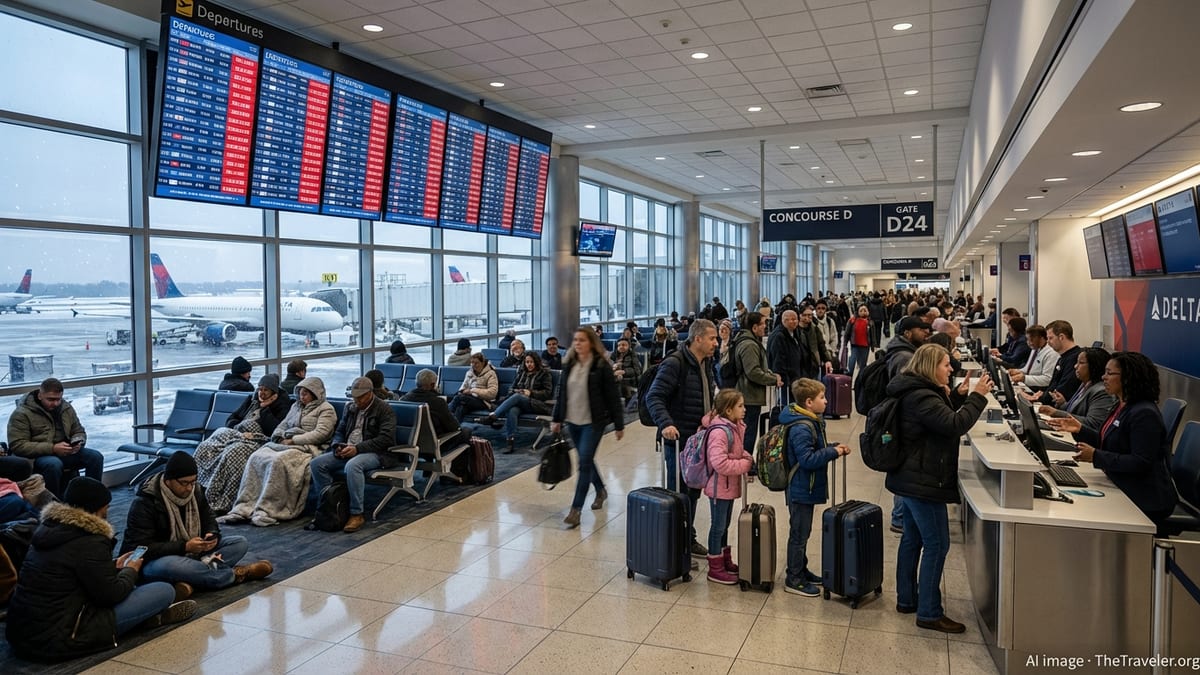
Storm Line Stretches From Mid-Atlantic to New England
Weather forecasts describe a fast-moving corridor of severe thunderstorms tracking from the Mid-Atlantic through New England, producing heavy rain, lightning and low cloud ceilings over several of the country’s busiest air corridors. Radar imagery and regional forecasts indicate that the most intense cells developed through the morning and early afternoon, coinciding with peak departure banks at major hubs.
Publicly available aviation data show that New York City’s three main airports, along with Boston, Philadelphia and Washington, D.C., have all faced periodic ground-delay programs and flow restrictions as controllers space aircraft more widely for safety. Those measures sharply reduce the number of takeoffs and landings that can be handled each hour, creating long queues both in the air and on the ground.
While storms are typical in the Northeast during late July, today’s pattern has been especially disruptive because of its timing and breadth. As the line of storms repeatedly rebuilds along the coast, conditions can improve briefly before quickly deteriorating again, complicating efforts by aviation planners to restore normal schedules.
New York and Boston Airports Bear the Brunt
Data from airline trackers and federal aviation dashboards point to New York area airports as the epicenter of today’s disruption. Newark Liberty, LaGuardia and John F. Kennedy International have reported extensive arrival and departure delays as thunderstorms repeatedly move across approach and departure paths, forcing controllers to meter traffic and, at times, hold flights on the ground before takeoff.
Boston Logan has also seen mounting delays as storms advance northeast through New England, affecting both transcontinental services and shorter regional hops. With New York and Boston serving as critical connection points for domestic and transatlantic travel, ripple effects have extended well beyond the storm zone, affecting flights across the country as aircraft and crews fall out of position.
Travel industry coverage notes that some airlines have been using longer routings to skirt the worst weather bands, adding flight time and further tightening schedules. Even when skies appear relatively calm at individual airports, lingering storm cells along en route corridors can force additional spacing between flights, extending backups that start hundreds of miles away.
Airlines Activate Weather Waivers and Rebooking Options
Several major U.S. carriers have issued flexible travel policies in response to the storms, allowing affected passengers to shift travel dates or rebook seats without standard change fees. Public bulletins indicate that many of these waivers cover travel through at least Wednesday for flights touching key East Coast airports, reflecting expectations that disruptions could persist as storms exit slowly and operations recover.
In some cases, airlines are encouraging customers with nonessential trips to move travel to later in the week to reduce congestion at overstretched hubs. Industry statements and customer advisories emphasize that available seats on remaining flights are increasingly limited, particularly on popular business routes between the Northeast and major Midwestern and Southern cities.
Operationally, airlines are also facing constraints related to crew duty-time limits and aircraft positioning after multiple days of unsettled weather. Once storms force extended ground stops or lengthy diversions, planes and crews may end up in locations that do not match the following day’s schedules, leading to additional cancellations even after skies begin to clear.
Travelers Face Long Lines and Tight Connections
Passenger accounts shared through social media and aviation forums describe crowded terminals, long security and customer-service lines, and mounting concern over missed connections, weddings, cruises and international departures. Some travelers report multiple rolling delays before flights are finally canceled, leaving fewer rebooking options as the day progresses.
For those already in the air, airborne holding patterns near major hubs have added to flight times as pilots wait for clearance to land. Published flight-tracking data show aircraft circling in stacks around New York and Boston during the busiest periods, a common feature of severe-weather days in the congested Northeast corridor.
Consumer advocates routinely advise affected travelers to monitor airline apps closely, check flight status before leaving for the airport, and consider proactive rebooking when storms are forecast. Travel insurance and credit-card protections can also play a role in recouping some costs from hotel stays and missed connections when weather causes significant disruption.
Outlook for the Remainder of the Week
Meteorological outlooks suggest that the most intense thunderstorms will gradually shift offshore late Tuesday into Wednesday, but lingering showers, low clouds and residual congestion in the air traffic system could extend delays into midweek. Airlines are expected to focus on restoring aircraft and crews to their regular rotations, which may require targeted cancellations on certain routes even after weather improves.
Analysts note that mid- to late July is already one of the busiest periods of the summer travel season, leaving little spare capacity to absorb large-scale disruptions. When thousands of flights are affected in a single day, it can take multiple schedule cycles before network operations fully normalize, especially at complex East Coast hubs.
For travelers planning to fly through the Northeast over the next several days, industry guidance remains cautious. Flexible itineraries, early-morning departures where possible, and readiness for last-minute changes remain the best strategies to navigate a system still recovering from today’s wave of more than 5,600 storm-disrupted flights.