


More news on this day
Europe’s new Entry/Exit System, recording biometric data for non-EU nationals at Schengen borders, is now fully enforced, and transport operators across the continent are warning travellers to expect longer queues and uneven processing times.
Get the latest news straight to your inbox!
From phased rollout to full enforcement
The European Union’s Entry/Exit System (EES) is an automated database that logs the entry and exit of non-EU nationals making short stays of up to 90 days in any 180-day period. Instead of passport stamps, the system stores biometric data, including facial images and fingerprints, alongside passport details and travel history.
The system entered into operation in October 2025 with a progressive rollout across 29 participating European countries, then became fully operational at all external Schengen border crossing points on 10 April 2026, according to publicly available information from EU institutions. Reports indicate that this milestone formally ended the reliance on manual passport stamping for most third-country visitors at air, land and sea borders.
EU documentation on the Smart Borders package describes EES as central to the bloc’s border-management strategy, with objectives that include tightening enforcement of the 90/180‑day rule, improving the detection of overstays, and strengthening security by giving border and law-enforcement authorities faster access to traveller records.
Since its launch, the system has processed tens of millions of border crossings. Recent updates from the European Commission and eu‑LISA, the EU agency managing large-scale IT systems, indicate that EES has now been deployed at all external Schengen borders and is operating continuously, even as some countries rely on temporary derogations or contingency measures at particularly congested crossing points.
Queues build as airlines and airports flag disruption
While EES is intended to speed up border checks in the long term, reports from European media outlets, aviation associations and traveller forums suggest that the early months of full enforcement have produced a sharp increase in waiting times at some major gateways.
A joint statement from European airport and airline groups in late March 2026, published ahead of the Easter travel peak, warned that queues at several Schengen entry points were already stretching to two hours or more at busy times, with some hubs citing even longer delays. Industry bodies highlighted a combination of factors, including the one-off biometric enrolment required for every non-EU traveller and space constraints in existing border-control halls.
Coverage from European travel media in June and July 2026 describes ongoing congestion at popular tourist destinations in Spain, Portugal, France and Germany, especially at peak summer departure and arrival waves. In some cases, local authorities have reportedly opened additional manual booths or redirected passengers between queues to relieve pressure when the biometric equipment or software has struggled to keep pace with demand.
There are also reports that, in exceptional circumstances, some airports and ferry ports have temporarily deactivated EES processing or relied on fallback procedures permitted under EU rules, particularly when large volumes of passengers arrived simultaneously. According to this coverage, operators argue that these short-term suspensions are needed to prevent missed connections and cascading disruption across flight and ferry schedules.
Why the new checks take longer
Under EES, non-EU nationals entering the Schengen Area for the first time since the system went live must complete a full biometric registration, which includes capturing four fingerprints and a facial image, along with passport details. EU institutions note that, in theory, this is a one-off process valid for multiple trips over a period of three years, after which a simpler verification can be used.
In practice, travel-industry reports indicate that the initial enrolment can take significantly longer than a traditional passport stamp, especially when passengers are unfamiliar with the technology or when hardware issues arise. Airport associations have previously warned that each first-time registration can add several minutes per passenger at the border booth, multiplying waiting times when entire aircraft or coach loads of travellers reach control points at once.
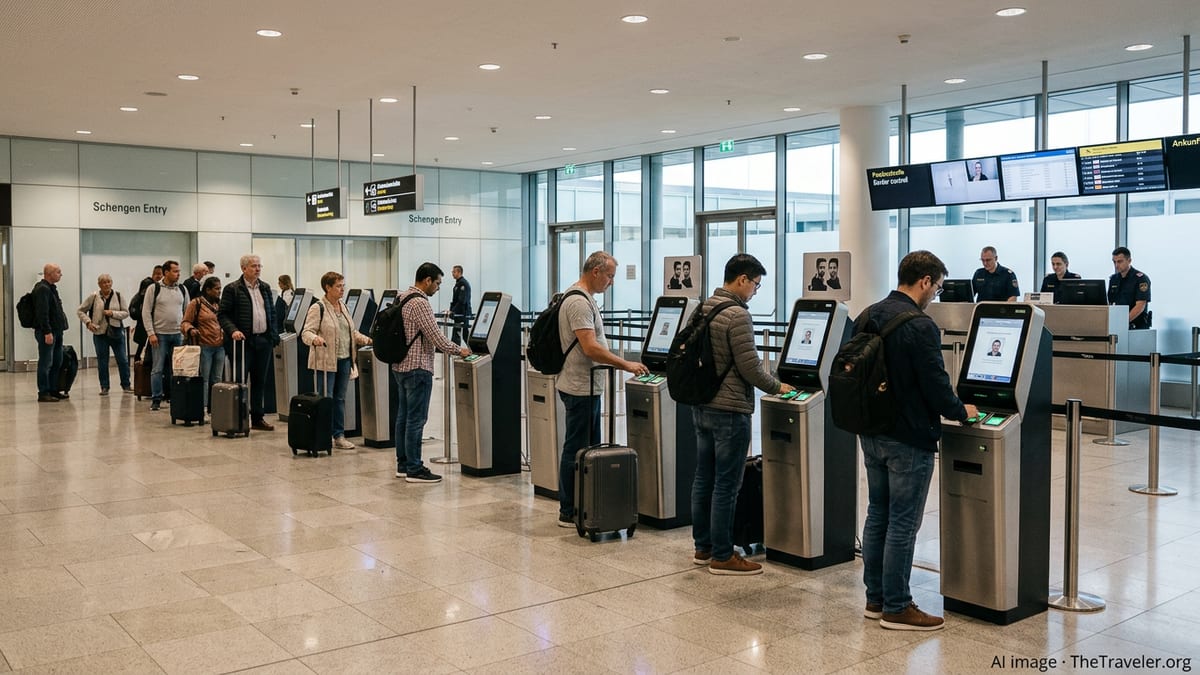
Where self-service kiosks and e‑gates are fully deployed and functioning, some travellers describe relatively smooth experiences, with facial recognition used to match passengers against their stored records and reduce the need for repeat fingerprint scans. However, publicly available accounts from several European airports suggest that this level of automation is not yet universal, and that layouts designed for manual passport checks can struggle to accommodate lines of passengers waiting for biometric capture at kiosks or single points of entry.
Reports also highlight teething problems with data matching and system reliability. Travel coverage and user testimonials mention instances in which passengers have been asked to repeat enrolment on subsequent trips, or where technical glitches have temporarily forced officers to fall back on manual checks, adding to uncertainty over how long border formalities will take.
Transport operators push for flexibility
The aviation sector has been among the most vocal in calling for a flexible approach to enforcement as EES bedding-in continues. Statements from European airline and airport associations argue that, while they support the security objectives of the new system, current bottlenecks risk undermining punctuality and the passenger experience at some of the continent’s busiest hubs.
Industry groups point to EU provisions for a progressive launch and temporary derogations, which allow member states, in exceptional circumstances, to suspend or limit EES operations at a particular border crossing point for short periods when queues escalate. According to available policy documents, these measures were designed to safeguard the resilience of the IT infrastructure and avoid gridlock while staff and passengers adapt to the new procedures.
At the same time, transport operators are investing in additional staff training, reconfigured terminal layouts and expanded self-service capacity. Some airports have introduced dedicated EES information campaigns, online guidance and signage in departure halls to encourage travellers to prepare passports in advance, remove face coverings before biometric capture and move quickly through kiosks, all in an effort to improve throughput.
Ferry and rail operators serving land borders report similar concerns. Longer processing times per vehicle and passenger can reduce the number of cars or coaches that can be cleared between departures, and published accounts describe instances in which border checks have become the primary constraint on the capacity of popular cross-Channel and cross-border routes.
What non-EU travellers should expect now
With EES now fully enforced across the Schengen Area, non-EU nationals travelling for short stays can expect their journeys to be recorded digitally every time they enter and leave the bloc. For those who have not yet been registered since the system went live, the first trip is likely to involve a more time-consuming set of checks, including fingerprinting and facial imaging at the border.
EU communications on the system emphasise that, once this initial enrolment has been completed, later visits should require only a verification of the traveller’s stored biometric and biographical data, using either automated gates or a border officer’s workstation. Over time, as more passengers complete the first registration and as infrastructure upgrades are rolled out, officials anticipate that average processing times should fall.
In the short term, however, travellers are being urged by transport providers and travel advisers to build in extra time at departure and arrival airports, seaports and high-speed rail hubs, particularly during holiday peaks. Publicly available guidance suggests arriving earlier than usual for long-haul flights into major Schengen hubs, checking airport websites for specific EES instructions, and ensuring that passports and any required documentation are readily accessible in the queue.
According to recent state-of-Schengen reporting and commentary from EU institutions, the coming months will be critical in determining how quickly EES stabilises. Some analyses estimate that it could take up to two years for procedures, staffing and technology to fully adapt, suggesting that elevated waiting times and occasional disruption may remain a feature of trips into and out of the Schengen Area for the near future.
European Commission: Entry/Exit System fully operational
Euronews travel coverage of EES queues and disruption
ACI Europe & A4E briefing on disruption risks from EES rollout