


More news on this day
Europe’s new Entry/Exit System is now fully enforced at Schengen external borders, and travel organizations and government data indicate that passengers should prepare for longer queues as biometric checks are applied to every non-EU arrival and departure.
Get the latest news straight to your inbox!
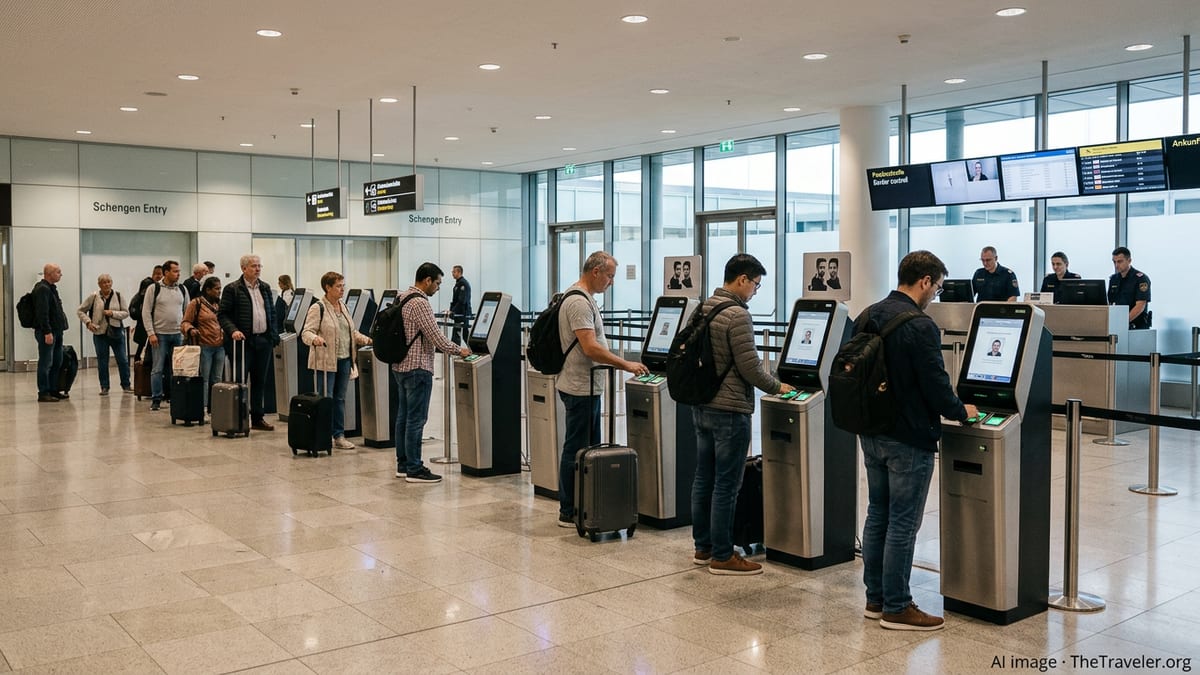
From phased rollout to full enforcement
The European Union’s Entry/Exit System (EES) launched in a progressive phase on 12 October 2025 across 29 European countries that apply the Schengen rules at their external borders. During that initial period, countries could introduce the new checks gradually and, in some cases, limit the share of travelers who had to complete full biometric registration at peak times.
According to publicly available EU legislation and technical documentation, this transition window formally ended on 10 April 2026. From that date, EES has been fully deployed at air, land and sea borders, meaning that the system must now be used systematically for all short-stay, non-EU nationals arriving at or departing from the Schengen area.
The end of the rollout phase coincides with increasingly strict application of the rules at many busy border crossing points. Border agencies are moving from trial operation to routine use of biometric capture and database checks for every eligible traveler, leaving less flexibility to switch back to faster, stamp-only processing when queues build.
For visitors from countries such as the United States, United Kingdom, Canada, Australia and many others whose citizens do not need a visa for short stays, the first trip to the Schengen area since EES went live now typically involves a set of one-off biometric enrolment steps in addition to a standard passport check.
What EES changes at the border for travelers
EES replaces manual passport stamping with an automated system that records the time and place of every entry and exit for non-EU nationals staying in the Schengen area for up to 90 days in any 180-day period. The system stores biographic details from the passport and biometric identifiers such as facial images and, in most cases, fingerprints.
On a first trip after the system’s introduction, travelers are directed either to staffed counters or to self-service kiosks where their passport is scanned, a live facial image is captured and, depending on the setup at the border crossing, fingerprints are taken. These details are checked against watchlists and stored in a central database managed by eu-LISA, the EU agency responsible for large-scale IT systems in justice and home affairs.
Once the initial record exists, later crossings are generally quicker but still involve verification against EES rather than a simple visual inspection and ink stamp. Border officers or automated gates must confirm that the traveler’s biometric data matches, and that there is remaining time available under the 90/180-day rule before allowing entry.
EU information campaigns stress that EES does not introduce a new pre-travel authorization or visa requirement. For visa-exempt travelers, all steps take place at the border rather than online in advance. However, this design concentrates additional procedures at the point of arrival, with the potential to create bottlenecks at busy airports, seaports and land crossings if staffing and infrastructure are not sufficient.
Evidence of longer queues at key gateways
Reports from airlines, airports and passenger advocacy groups indicate that the shift to full EES enforcement has already lengthened waiting times at several major gateways, particularly where large numbers of non-EU passengers arrive in short bursts. Industry associations representing European airports and carriers have publicly warned that, without further adjustments, peak-season queues for third-country nationals at some border control points could reach several hours.
Recent travel-season data cited in European and international media coverage shows that maximum waiting times at passport control in certain hubs have at least doubled compared with the summers before EES became operational. Particular pressure has been reported at major connection points between the United Kingdom and the Schengen area, such as busy airports and cross-Channel terminals where high volumes of biometric-first-timers are processed in relatively confined spaces.
Individual traveler accounts collected in public forums since April 2026 paint a varied picture. At some airports, non-EU arrivals describe waits of 60 to 120 minutes at peak times while officers complete biometric registration for each person in line. At other border crossings, especially where new kiosks and e-gates have been installed in sufficient numbers, reported waiting times are closer to 20 to 30 minutes even at busy periods.
EU-level statistics published since the launch also show that millions of EES records have already been created for third-country nationals, confirming the scale of throughput and the extent to which the system has replaced traditional stamping at external borders.
Why queues are expected to persist in the near term
The structure of EES means that border checks are front-loaded for travelers who have not yet enrolled, which is currently a large share of visitors from outside the EU. First-time EES registration requires additional steps, including collecting biometrics and verifying the accuracy of the new record, which adds time to each transaction compared with a visual stamp.
Travel-industry analyses note that this effect is amplified at airports and ports where non-EU leisure traffic is heavily concentrated into short waves linked to holiday departures and arrivals. When several long-haul flights land within a tight window, the cumulative impact of slower processing can translate into visible, sometimes very long lines.
During the progressive rollout, special rules allowed countries to temporarily suspend or limit EES registration to keep border traffic flowing when queues became excessive. With full enforcement now in place, the scope for such derogations is much narrower, leaving border management authorities more reliant on physical expansion, staffing increases and passenger-flow redesign to prevent extended delays.
At the same time, EES is designed to deliver efficiency gains once the majority of frequent travelers have completed their first registration and as more self-service systems come online. EU information materials highlight the eventual removal of passport stamps and greater use of automated gates as long-term benefits that should make crossings faster and more predictable, especially for repeat visitors.
How travelers can prepare for EES checks
Public guidance from EU institutions and national border agencies emphasizes that travelers can reduce their own risk of delays by preparing documentation in advance and allowing extra time at departure and arrival. Passports should be valid for the required period, undamaged and ready for inspection before reaching the front of the line. Families are urged to keep members together during processing to avoid duplicated checks and confusion.
Some border points now encourage passengers to use dedicated EES kiosks before reaching staffed counters. Travelers who carefully follow on-screen instructions for facial capture and fingerprint scans can sometimes move more quickly through the subsequent officer check, freeing capacity for others in the queue.
Industry bodies recommend that airlines, cruise companies and long-distance coach operators continue to provide clear pre-departure information about the new procedures, especially to customers embarking on their first trip to the Schengen area since EES began. Simple explanations of what to expect at the border and realistic guidance on likely waiting times may help reduce stress at peak travel periods.
Looking ahead to upcoming holiday seasons, travelers should expect that EES checks will remain a visible feature of the border experience and that queues may be longer than they were before October 2025. As infrastructure expands and frontline staff gain more experience with the system, reports suggest that processing times are gradually improving in some locations, but the adjustment period is still ongoing in others.
European Commission: New Entry/Exit System went live on 12 October 2025
Council of the EU: How the Entry/Exit System works
eu-LISA: Entry/Exit System fully deployed across the EU
IATA / ACI Europe / A4E: Call for review of Schengen EES ahead of peak months