


Brisbane Airport is one of Australia’s busiest international gateways, and for many travellers the simplest way into the city is still a taxi. This guide walks you through where to find the ranks at both terminals, what you can expect to pay, how things work late at night, and when a cab is more practical than the Airtrain or buses.
Get the latest updates straight to your inbox!
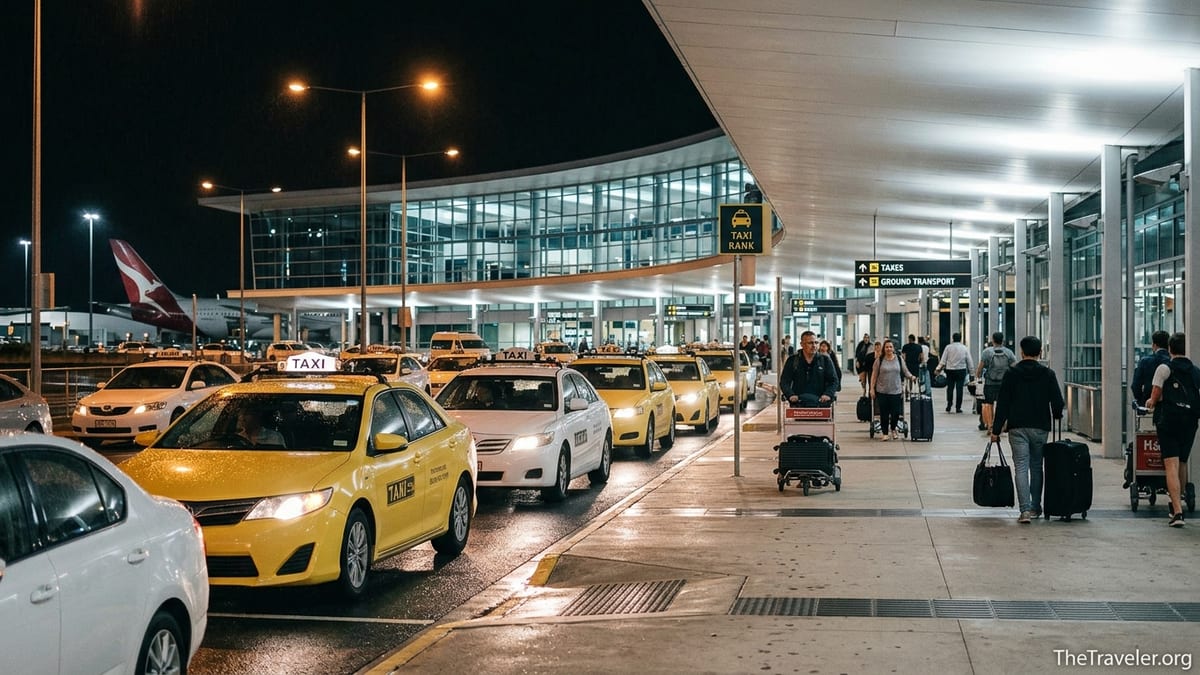
Taxi ranks at Brisbane Airport’s Domestic Terminal
Brisbane Airport’s Domestic Terminal has a clearly signed, dedicated taxi rank directly in front of the building. After you collect your bags, follow the “Taxis” signs toward the front forecourt; you will exit onto the arrivals-level roadway and see the official rank with a queuing area and taxi marshals during busier periods. The rank is located in the central forecourt area, so you do not need to cross any major roads. It is designed for quick turnover, with taxis constantly arriving to pick up passengers.
In practice, walking time from the baggage carousel to the domestic rank is usually under five minutes, even with luggage. If you land on a typical weekday around 10:00, you will often find a line of yellow and white sedans and MAXI taxis already waiting. During peak hours around morning and evening banked departures, airport staff may help direct passengers into cabs, especially larger groups or those with accessibility needs.
The domestic rank operates 24 hours, but the feel changes with the clock. Early afternoon, you may see families heading to the Sunshine Coast or Gold Coast resorts. After 22:00, the crowd is more likely to be business travellers and FIFO workers going to inner-city hotels and suburbs like Fortitude Valley, South Bank or Hamilton. Whatever the time, you should only board taxis that are waiting at the official rank or that you have booked directly through a recognised operator, not unofficial touts.
If you are connecting between domestic and international flights, remember that the terminals are about 4 kilometres apart. A taxi between them typically costs around 9 to 15 Australian dollars depending on traffic and time of day, and the ride usually takes less than 10 minutes. This can be a sensible backup if you just miss the free terminal transfer bus or are travelling with heavy bags.
Finding the taxi rank at the International Terminal
At Brisbane’s International Terminal, the taxi rank sits on the arrivals level outside the main exit doors. Once you clear immigration, customs and quarantine and step into the public arrivals hall, follow the “Taxis” and “Ground Transport” signs. Glass sliding doors open to an undercover roadway where the official taxi queue begins; this is the only place where taxis are permitted to wait for arriving passengers.
The international rank is well lit and has sheltered waiting areas, which matters during summer storms or heavy rain. For late-night arrivals from Asia, the Middle East or North America that often land between midnight and 05:00, airport management ensures cabs are on hand because large aircraft can easily unload several hundred passengers at once. Even at 02:30, you can normally step outside and find a line of taxis moving steadily through the rank.
One practical difference at the International Terminal is the mix of trip lengths. Many passengers are heading into Brisbane CBD or nearby suburbs such as Newstead, Kangaroo Point or West End, but there is also a significant number travelling to the Gold Coast, Sunshine Coast or inland to Ipswich or Toowoomba. If you know you are travelling a long distance, it is worth telling the dispatcher at the front of the queue; they may direct you to a larger MAXI or a driver comfortable with intercity trips.
As with the domestic side, only use the official rank or a pre-booked service. Do not accept rides from anyone approaching you inside the terminal or near the doors offering a “cheap taxi” or cash deal. Queensland taxi regulations require meters and visible fare stickers inside the cab, and licensed airport pickups are subject to airport access fees that are added automatically to the meter.
Official taxi companies, vehicles and payments
Brisbane’s taxi market is dominated by a handful of major operators that are authorised to serve the airport. The two names most visitors will recognise are 13cabs and Yellow-branded fleets, both of which provide standard sedans as well as larger MAXI taxis and wheelchair-accessible vehicles. When you step into a cab at Brisbane Airport, you are almost certainly riding with one of these or another accredited South East Queensland operator.
Vehicles are typically modern Toyota Camry or similar sedans, hybrid models, and larger Toyota HiAce-style MAXIs that can handle groups of up to 10 passengers, depending on luggage. Inside the cab you should see the driver’s photo ID card, the company name, and a fare schedule sticker showing the Queensland-regulated maximum fares. The meter must be clearly visible to passengers, usually mounted on the dash.
Payment options are flexible. While cash is still accepted, almost all airport taxis are set up for card and digital wallet payments. You can usually pay with major credit and debit cards, Cabcharge, and phone wallets such as Apple Pay and Google Pay. Card payments may attract a small service fee, commonly around a couple of percent, which should be displayed on signage in the vehicle. If you are travelling on business, ask for a tax invoice; drivers can print or text you a receipt at the end of the trip.
For families or groups, MAXI taxis are worth considering. If you are four adults with three large suitcases and smaller bags going from the International Terminal to a CBD hotel, a MAXI or station wagon can be more comfortable than trying to wedge everything into a sedan’s boot and back seat. MAXIs can be requested at the rank; let the marshal know you need a larger vehicle, and they will direct you to the correct lane or radio one forward.
Typical taxi fares from Brisbane Airport
Taxi fares in Brisbane are regulated by the Queensland government, with a standard flagfall plus a per-kilometre rate and waiting time. On top of that, airport pickups incur an access fee that the driver pays electronically and passes through to the passenger. Because of traffic, toll roads and time of day, actual costs vary, but there are clear patterns that most visitors can use as a guide.
For a standard sedan from Brisbane Airport to the CBD, most recent estimates put the typical fare in the range of about 55 to 75 Australian dollars, depending on whether you are travelling in light traffic or at a busy afternoon peak. Some fare calculators and local travel writers suggest an average around the low-60s for a weekday daytime trip between the airport and central city hotels. If your driver uses the Airportlink tunnel to avoid congestion, you will see the toll passed through on top of the metered distance.
Shorter rides to nearby suburbs such as Hamilton, Ascot or Hendra can be significantly cheaper, often landing in the 30 to 45 dollar range. On the other hand, longer intercity journeys add up quickly. A late-night ride to Surfers Paradise on the Gold Coast can easily reach well over 200 dollars in a standard taxi, while a run to Ipswich might sit somewhere around 120 to 160 dollars, depending on the exact destination and traffic. In these cases, it is worth comparing a taxi against pre-booked shuttle services or rideshare quotes.
If you are simply moving between the Domestic and International Terminals by taxi, recent guides suggest a fare around 9 dollars in light traffic if the driver takes the most direct route. This can creep higher at peaks or if you add waiting time, but it is still a very short and relatively inexpensive trip and can save your connection when the free terminal bus is crowded or you are tight on time.
Late-night and early-morning arrivals: what to expect
Brisbane Airport handles a wave of long-haul arrivals that land in the small hours of the morning, particularly flights from Singapore, Hong Kong, Doha and Los Angeles that can touch down between midnight and 05:00. During these hours, the Airtrain does not run; the last evening service is typically around 22:00, with the first morning trains starting around 05:00 to 05:30. If your flight lands after the trains stop, you will be relying on taxis, rideshares or pre-booked private transfers.
The taxi ranks at both terminals operate 24 hours, and airport transport guides consistently report that cabs are usually available even at 03:00 or 04:00. After you collect your luggage, simply follow the signs to the rank as you would during the day. Queues can form if several widebody flights arrive within a short window, but staff generally manage the flow so the line moves steadily. In many cases you will be in a cab within 10 to 20 minutes of exiting customs.
At very late hours, demand patterns change. You may find that rideshare availability drops and surge pricing increases, particularly on Friday and Saturday nights when drivers gravitate to nightlife districts in the city. In these situations, the fixed, regulated taxi tariff can actually be more predictable than a rideshare quote. Travellers posting online frequently mention choosing the taxi rank when they see rideshare prices spiking to double or triple the usual level, especially after midnight.
If you are arriving with children or are anxious about late-night connections, consider pre-booking a taxi or private transfer with a reputable company for peace of mind. Pre-booked services can meet you in the arrivals hall with a sign or at a designated point just outside, and will track your flight in case of delays. While this may cost a little more than simply joining the rank, it can be reassuring after a 14-hour flight when all you want is a guaranteed ride to your hotel.
Luggage, accessibility and travelling with families
Brisbane Airport’s taxi ranks are built to handle travellers with all sorts of luggage, from carry-on only to families with surfboards, prams and multiple suitcases. Standard sedans can usually fit two large hard-shell suitcases plus carry-ons in the boot, with additional bags on laps if needed, but anything more than that is better in a wagon or MAXI. If you are carrying bulky items such as golf clubs or a stroller, tell the rank marshal, who can direct you toward an appropriate vehicle.
For passengers with mobility needs, Brisbane’s taxi fleets include wheelchair-accessible vehicles equipped with ramps or lifts. These are part of the standard rotation at the airport but may require a short wait if one is not already in the queue. Let the marshal know as soon as you reach the rank that you need a wheelchair-accessible taxi; in most cases, they can radio for one to pull forward. The vehicles are designed so that the wheelchair can be securely fastened in the passenger area, and the driver should be trained in safe boarding procedures.
Families with young children should be aware that Queensland law places responsibility for child restraints differently in taxis than in private cars. Although many airport taxis can supply child seats if pre-booked through their app or phone service, seats are not automatically available at the rank. If travelling with a baby or toddler and you prefer a dedicated child seat, arranging a pre-booked taxi or private transfer that confirms the seat type is a safer choice than relying on what is on hand.
If you are juggling several suitcases, backpacks and tired kids, a taxi can save a lot of hassle compared with lugging everything onto the Airtrain, especially if your hotel is not directly opposite a city station. A concrete example: a family of four landing from Auckland late in the evening may find that a single MAXI taxi to a South Bank apartment, even at 70 or 80 dollars, is worth it to avoid changing trains and walking 10 to 15 minutes with baggage.
When a taxi beats the Airtrain
During the day, the Airtrain is usually the cheapest straightforward way into central Brisbane, with adult fares to most city stations sitting in the low-20s for a one-way journey at current prices. For solo travellers or couples staying within walking distance of Central, Roma Street or South Brisbane stations, it is hard to beat on pure cost. However, there are several scenarios where a taxi is genuinely easier or better value despite the higher fare.
The most obvious case is outside train operating hours. If your flight is scheduled to arrive after about 21:30, you should not count on catching the Airtrain. A delay of even 30 minutes could push you past the last departure, leaving you with few options other than a taxi or rideshare. Travellers arriving on a 23:00 domestic or a 00:30 international flight often find that going straight to the taxi rank is the only realistic way to reach hotels in the CBD or suburbs without staying overnight at the airport.
Group size also matters. Consider four adults landing at the Domestic Terminal at 17:00 and heading to a hotel in Fortitude Valley. Four Airtrain tickets might come to around 90 dollars or more at standard prices. A taxi for the same group, even at 60 to 70 dollars in peak traffic, becomes competitive once you spread the cost across all passengers and factor in the convenience of being delivered directly to your hotel door. If you are carrying heavy luggage or it is raining, that door-to-door aspect becomes even more compelling.
Finally, think about your ultimate destination. If you are bound for suburbs not well served by the Airport line, such as inner-west areas like Toowong or outlying districts without direct rail connections, taking the train into the city and then transferring to a bus or another train can be cumbersome. In those cases, a taxi can cut your total travel time in half, particularly outside rush hour when road traffic is lighter and the driver can use toll tunnels to bypass congestion.
Tips to avoid problems and save money
A few simple habits can make your Brisbane Airport taxi rides smoother and better value. First, always check that the meter is on as you depart the terminal. Queensland regulations require metered fares within the metropolitan area, and you should be wary of any driver who suggests a cash-only, off-meter deal unless you have a clear, mutually agreed fixed fare to a distant destination. For most airport-to-city journeys, running the meter is the fairest approach.
Second, confirm with the driver whether they intend to use toll roads. Using tunnels like Airportlink can save 10 to 15 minutes during busy periods, but the tolls will appear on your final fare. If you prefer the cheaper, toll-free route and are not in a rush, say so at the start. Conversely, if you are racing to make a last train or tour departure, giving the driver permission to use tunnels can be a wise investment.
Third, keep an eye on your luggage and ensure everything is loaded before you hop into the back seat. At busy times when multiple groups are boarding simultaneously, bags can get mixed up. Make a mental note of how many pieces you have and do a quick count when you arrive at your destination, before the taxi pulls away. If you do leave something behind, the receipt will list the taxi number and company, which greatly improves your chances of recovery.
Finally, if you have any concerns about the trip, fare or driver behaviour, note the cab number and company and raise the issue later through the taxi operator or relevant transport authority. Complaints about serious misconduct or systematic overcharging are taken seriously, and the presence of regulated fares and licensing is one of the advantages of using official airport taxis rather than informal or unlicensed services.
The Takeaway
Taxis remain one of the most straightforward ways to get from Brisbane Airport to the city or surrounding regions. With 24-hour ranks at both Domestic and International Terminals, regulated fares, and a steady supply of vehicles ranging from standard sedans to MAXI cabs and wheelchair-accessible vans, they offer a dependable option regardless of when your flight lands.
For daytime arrivals when the Airtrain is running and your destination is close to a city station, the train will usually be cheaper, particularly for solo travellers. Yet if you are arriving late, travelling with a group, carrying lots of luggage or heading somewhere not well connected by rail, a taxi can be faster, more convenient and sometimes even competitive on price per person.
The key is to know where to find the ranks, what a realistic fare looks like, and how to communicate your needs to the driver or rank marshal. With that knowledge, stepping into a Brisbane Airport taxi becomes a routine part of the journey rather than a source of stress, letting you focus on enjoying your time in Queensland’s capital and beyond.
FAQ
Q1. Are taxis available 24 hours a day at Brisbane Airport?
Taxis operate at both the Domestic and International Terminal ranks 24 hours a day, so you can usually find a cab even in the early hours of the morning.
Q2. How much does a taxi from Brisbane Airport to the CBD usually cost?
Most recent estimates suggest a typical fare of about 55 to 75 Australian dollars for a standard sedan between the airport and central Brisbane, depending on traffic and routing.
Q3. Where exactly are the taxi ranks at Brisbane Airport?
At the Domestic Terminal, the rank is directly in front of the terminal in the central forecourt area. At the International Terminal, it is on the arrivals level just outside the main exit doors.
Q4. Is it cheaper to take the Airtrain or a taxi?
For solo travellers or couples staying near a city train station, the Airtrain is usually cheaper. For groups, late-night arrivals or destinations away from the rail line, a taxi can be more practical and sometimes similar in cost per person.
Q5. Can I pay for a Brisbane Airport taxi by card or phone?
Yes. Most airport taxis accept major credit and debit cards, Cabcharge and mobile wallets such as Apple Pay and Google Pay, although a small card surcharge may apply.
Q6. Are MAXI taxis and wheelchair-accessible vehicles available at the airport?
Yes. Larger MAXI taxis and wheelchair-accessible vehicles are part of the regular airport fleet. You may need to tell the rank marshal if you require one so they can direct or call an appropriate vehicle.
Q7. How long does a taxi from the airport to the city take?
In light to moderate traffic, a taxi from Brisbane Airport to the CBD typically takes around 20 to 30 minutes. At peak times or during incidents, it can take longer, especially without using toll tunnels.
Q8. Should I pre-book a taxi for a very late or very early flight?
It is not essential because the ranks operate 24 hours, but pre-booking with a reputable company can be reassuring for arrivals or departures in the middle of the night or if you need a specific vehicle type or child seat.
Q9. Can I negotiate a fixed fare from Brisbane Airport?
Within the metropolitan area, taxis normally use the meter. For very long journeys outside the city, some drivers may agree a fixed fare before departure, but this should be clear and mutually agreed before you leave the rank.
Q10. Is it safe to take a taxi from Brisbane Airport at night?
Licensed airport taxis are regulated and generally considered safe at all hours. Use the official ranks, check that the meter is on and keep your belongings close, just as you would in any major city.