


More news on this day
Egypt is advancing one of the most ambitious rail overhauls in the Middle East, pairing a new 2,000‑kilometre high-speed electric network with sweeping upgrades to its historic railway in a bid to shift millions of daily journeys from roads to rails.
Get the latest news straight to your inbox!
High-Speed Electric Network Enters Trial Phase
Publicly available information shows that Egypt’s first high-speed electric rail line, running from Ain Sokhna on the Red Sea to Alamein and Marsa Matrouh on the Mediterranean, is moving into trial operation. Government summaries indicate that trial running on sections of the first line is scheduled to begin in September 2026 and continue for around six months, a key step toward full commercial service on the 660 kilometre corridor linking coastal resorts, new cities and industrial hubs.
Reports from recent inspections of the line describe track laying, overhead electrification and signaling systems progressing along multiple sections between Ain Sokhna, the New Administrative Capital and 6 October City. The route is designed for trains operating at up to 250 km/h, with initial services expected to run at slightly lower speeds as systems are tested and drivers trained.
According to published coverage of the project framework, the high-speed network is being delivered by a consortium led by Siemens Mobility alongside Egyptian contractors Orascom Construction and Arab Contractors, under contracts that envisage more than 2,000 kilometres of new electrified main line. The first line alone is planned to include around 21 stations, combining high-speed stops with regional stations to serve both long-distance and intermediate passengers.
Technical updates shared in recent months point to a growing fleet as well. Industry briefings note that Siemens Velaro high-speed trainsets and Vectron electric locomotives dedicated to the Egyptian network are already in production, with several units completed and initial trains delivered to Egypt for static and dynamic testing on the new line.
From Three Lines to a 2,000 km Express Web
The high-speed vision extends well beyond the first Red Sea–Mediterranean corridor. Official project descriptions and international tenders outline three main passenger-focused express lines totaling about 2,000 kilometres, forming a backbone that aims to connect roughly 90 percent of Egypt’s population through fast rail links.
Based on these plans, the first line connects Ain Sokhna, the New Administrative Capital, 6 October City, Alamein and Marsa Matrouh, effectively tying together Egypt’s emerging new capital, Greater Cairo’s western suburbs, and Mediterranean coastal destinations. A second north–south axis is mapped from the Cairo region toward Upper Egypt and Abu Simbel, while a third line is proposed between Qena and the Red Sea ports of Safaga and Hurghada, supporting both tourism and freight flows.
Project documentation and company announcements show that the Siemens-Orascom-Arab Contractors consortium signed successive contracts expanding its role from the initial 660 kilometre line to the broader network. The scope covers civil works, track, electrification, signaling and long-term maintenance, positioning the system as a fully integrated, electrified alternative to conventional diesel rail on Egypt’s busiest intercity corridors.
Planning material highlights that the network is being designed for mixed operations, carrying both passengers and containerized freight at higher speeds. Proponents argue that combining passenger and cargo flows on electrified lines could relieve pressure on highways, cut journey times between ports and inland logistics zones, and reduce emissions compared with long-distance trucking.
Light Rail and Metro Links Create a New Urban Spine
Egypt’s high-speed rail build-out is closely intertwined with a broader set of urban rail projects, notably the Light Rail Transit (LRT) system east of Cairo and new monorail lines on both banks of the Nile. Publicly available route maps show that the LRT from Adly Mansour interchange station through 10th of Ramadan City to the New Administrative Capital has already opened in stages, with multiple surface and elevated stations now carrying passengers.
Information published by the Cairo governorate indicates that successive LRT extensions are designed to tie directly into the high-speed network at the Central Capital Station, where passengers will be able to change between suburban LRT services and long-distance high-speed trains. Additional phases are planned to reach deeper into the Administrative Capital and nearby industrial zones, reinforcing the area’s role as a multimodal hub.
National summaries of the transport program describe a similar approach on the western side of Greater Cairo, where the West Nile monorail and 6 October City links are planned to intersect with both the high-speed system and existing conventional rail. Future connections to Cairo Metro Line 6 are also configured to create interchange points between legacy metro tunnels, new elevated monorails and the express network, forming a layered urban rail spine across the metropolitan region.
Analysts following the sector note that this degree of integration is intended to simplify end-to-end journeys. Rather than relying on road transfers between central Cairo and outlying new towns, passengers could move from metro to monorail or LRT and then onto high-speed trains using unified stations, potentially cutting overall travel times on cross-country trips.
Modernizing a Historic Network Serving Hundreds of Millions
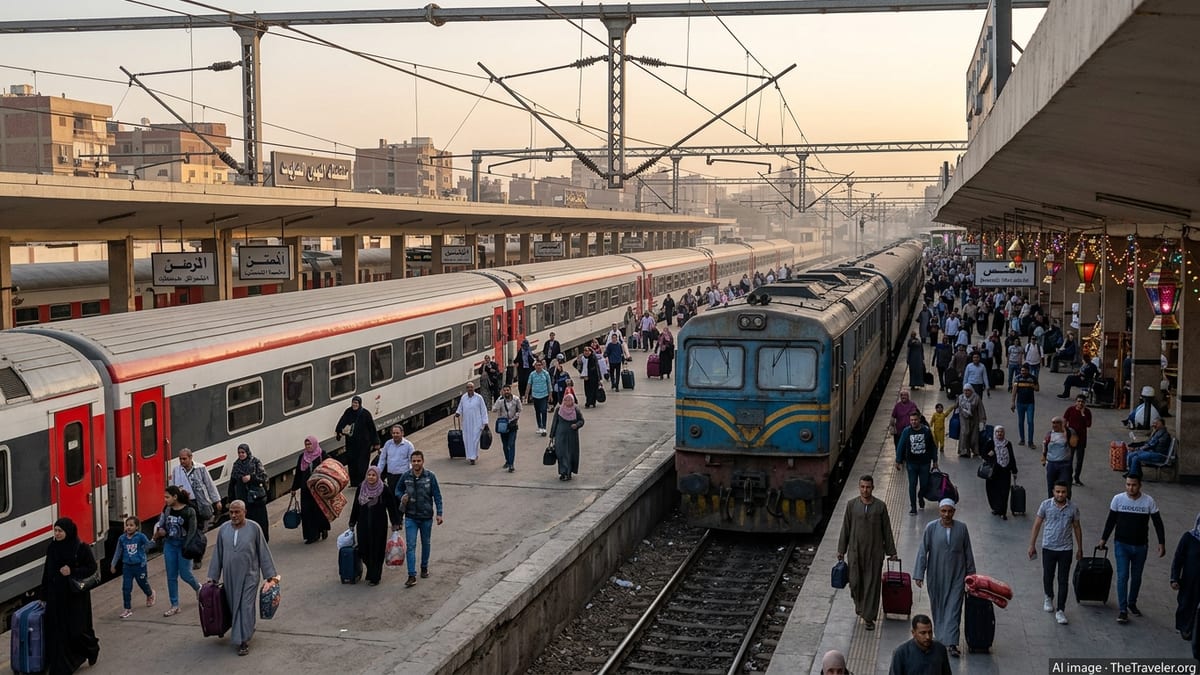
While the high-speed project captures much of the attention, published economic and transport reports emphasize that Egypt is simultaneously investing heavily in its conventional rail network, which remains the backbone of daily mobility for lower- and middle-income passengers. Background studies describe the Egyptian railway system as one of the world’s oldest and the largest in the Middle East and Africa, with roughly 10,500 kilometres of track connecting more than 80 stations from Alexandria to Aswan.
Recent analyses of passenger flows estimate that the national railway carries in the range of 300 million passengers a year, equivalent to more than 800,000 daily journeys, primarily on conventional intercity and commuter trains. With new services and network extensions under way, national planning documents set more ambitious targets that would see rail’s daily role expand further as new capacity comes online.
Supporting this growth, international project documentation points to ongoing modernization of signaling, track and stations on key sections such as the Cairo–Beni Suef corridor and segments in Upper Egypt. These works are intended to shorten journey times, increase line capacity and improve safety, laying the groundwork for more frequent and reliable services on routes that will continue to use upgraded diesel and electric rolling stock alongside future high-speed links.
Gradual fleet renewal is also under way, according to publicly accessible procurement records and manufacturer statements. New locomotives and passenger coaches are being supplied under multi-year contracts, with a view to replacing aging rolling stock and raising service standards on routes that will not be immediately shifted to the express electric network.
Economic, Social and Tourism Impacts Ahead
Supporters of Egypt’s rail transformation point to a wide range of anticipated economic and social impacts. Project briefs and official summaries argue that connecting industrial zones such as Helwan, Borg El Arab and New Minya to high-speed and upgraded conventional rail could lower logistics costs, attract new investment and support export-focused manufacturing.
Tourism is another core focus. The planned second high-speed line toward Upper Egypt is expected, according to planning material, to improve access to heritage destinations including Luxor, Aswan and Abu Simbel, while the first line will shorten trips to Mediterranean resorts at Alamein and Marsa Matrouh as well as Red Sea hubs near Ain Sokhna. Sector observers suggest that faster, more predictable rail journeys could encourage more domestic tourism and diversify options for international visitors.
Environmental and safety considerations are also prominent in published justifications for the program. Electrified high-speed and urban rail systems are framed as tools to cut road congestion, reduce greenhouse gas emissions per passenger-kilometre and shift both people and freight from long-distance trucking and private cars onto mass transit. Parallel upgrades to signaling and grade-crossing protection on legacy lines are aimed at improving safety performance over time.
With early trial runs on the first express corridor about to start and a pipeline of modernization projects unfolding across the conventional network, Egypt’s railway revolution is shifting from concept to reality. The coming years are set to test how far high-speed trains and upgraded classic services can reshape daily travel patterns for millions of passengers across the country.
Al-Masry Al-Youm: High-speed electric train network details
State Information Service: Trial operation of first high-speed line