


Bogotá’s El Dorado International Airport is one of Latin America’s busiest hubs and, for many travelers, their first experience of Colombia. Whether you are connecting from New York to Lima on Avianca, flying LATAM from Medellín and switching to Air France, or landing from Europe and continuing to Cartagena, the way you handle immigration, baggage, and terminal transfers at El Dorado often determines whether your connection feels effortless or stressful. This guide explains, in practical detail, how connections work at El Dorado today and what realistic connection times look like for different scenarios.
Get the latest updates straight to your inbox!
Understanding El Dorado’s Layout and Terminals
El Dorado International Airport (IATA code BOG) serves Bogotá and is Colombia’s main aviation hub, handling tens of millions of passengers each year. The airport is centered around Terminal 1, a large, modern building that handles all international flights and the vast majority of domestic flights. Avianca, Colombia’s flag carrier and a major Star Alliance hub airline at Bogotá, operates all of its routes from Terminal 1, including both domestic and international services. This means that many connections, especially “Avianca-to-Avianca,” happen entirely within the same terminal, which greatly simplifies transfers.
In addition to Terminal 1, there is a smaller Terminal 2, often called Puente Aéreo. Terminal 2 is used for a subset of domestic flights on regional and low-cost carriers such as Clic, Satena, and JetSmart. It is a separate building on the airfield but functionally part of El Dorado. Travelers connecting between a flight in T2 and a flight in T1 have to transfer between the two, typically using the free airport shuttle bus or a short taxi or ride-hail journey, which can take around 10 to 20 minutes of travel time once you are outside.
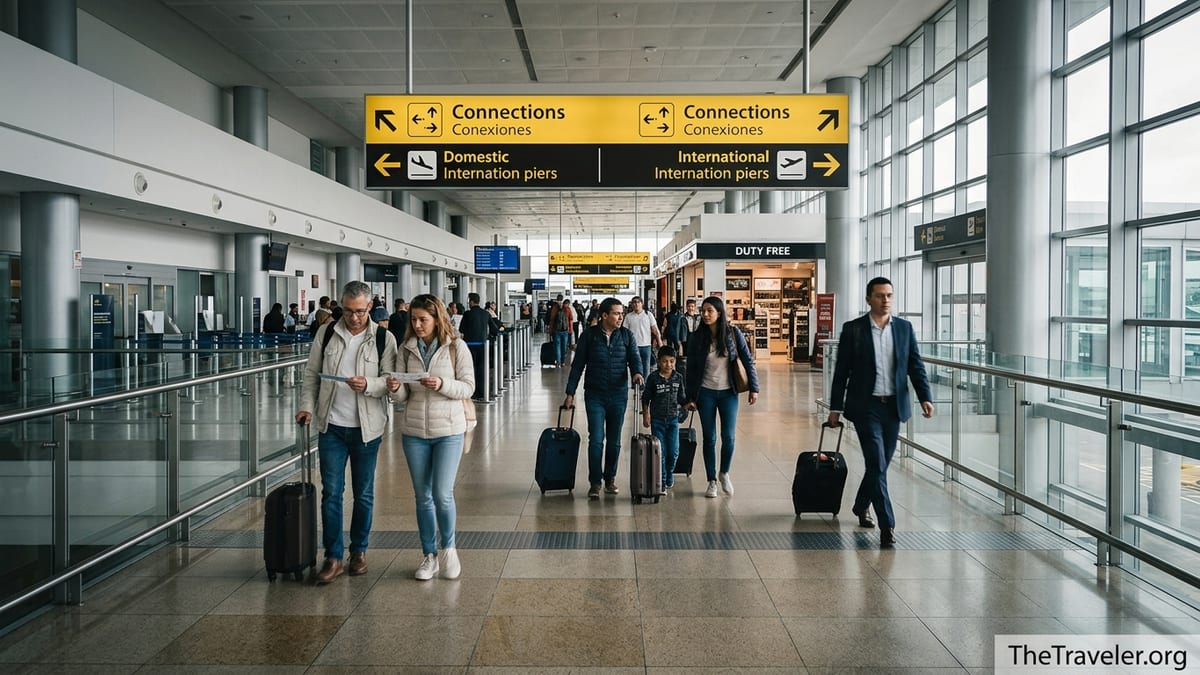
Inside Terminal 1, the airport is divided into domestic and international concourses. Domestic gates are grouped in color-coded concourses (for example, C in orange and D in green, where airlines such as LATAM, Avianca and Wingo usually operate), while the international gates occupy a different pier with their own security checkpoints. Clear, bright yellow signs, floor stickers and overhead boards guide connecting passengers from arrivals to departures. As a rule of thumb, if you are staying within Terminal 1 for your connection, you will be walking indoors and simply following bilingual Spanish-English signage marked “Conexiones” or “Connections.”
For many travelers, the most important distinction is not the terminal number but whether their connection is domestic-to-domestic, domestic-to-international, international-to-domestic, or international-to-international. Each of these involves a slightly different path through the airport, especially regarding immigration and baggage. The sections that follow break down each scenario and show how they typically work in real life, with examples.
Baggage Rules on Different Types of Connections
How your checked baggage is handled at El Dorado depends on whether your flights are on one ticket and whether you are changing airlines. If you fly, for example, Miami to Bogotá to Quito entirely on Avianca on a single reservation, your checked bag is usually tagged all the way to Quito at your origin. In this case you do not need to collect your baggage in Bogotá on an international-to-international connection, even though you are passing through Avianca’s hub. You simply walk from your arriving gate to the international connections area and go through security before your next flight.
On the other hand, if you fly Madrid to Bogotá on Iberia and then continue to Cartagena on a separate domestic ticket with Avianca or LATAM, your baggage will almost always be tagged only as far as Bogotá. In that scenario, after landing from Madrid you must clear Colombian immigration, pick up your bag at the baggage carousel, walk through customs, and then recheck your bag at the domestic airline’s check in area in Terminal 1. Only after dropping your bag again and receiving your new boarding pass do you proceed upstairs to the domestic security checkpoint and on to your gate.
Domestic connections within Colombia are simpler but still depend on tickets. If you book a through ticket like Cali to Bogotá to Santa Marta on Avianca, and both flights are domestic on the same reservation, your luggage is usually checked straight through to Santa Marta. You stay in the domestic side of Terminal 1 and do not see your bag until your final destination. In contrast, if you bought two separate domestic tickets, such as a low-cost carrier into Bogotá and a full-service airline onward, you may be required to collect and recheck your baggage. It is essential to ask the check in staff at your origin whether your bag is checked through to your final destination or only to Bogotá.
Cabin baggage rules are more consistent. Security at El Dorado follows familiar international standards, with liquid restrictions on international flights and standard X-ray screening for all cabin bags. However, many regional carriers, particularly low-cost ones, enforce strict size and weight limits on carry on bags. It is common, for example, for a domestic Colombian low-cost airline to limit cabin bags to around 10 kilograms and a single personal item. If your rolling suitcase was accepted in Europe or North America but looks borderline large or heavy at the Bogotá gate, build in extra time in case you are asked to gate-check it and pay a fee.
Immigration, Customs and Security: What to Expect
Whether you deal with immigration in Bogotá depends on your exact routing and ticket type. If you are simply transiting through El Dorado on an international-to-international connection on a single ticket, you normally do not go through Colombian immigration or customs at all. After disembarking, you follow the yellow signs for international connections, pass a boarding pass check, and re-clear security in a dedicated transit area. In this case, Bogotá functions as a sterile transfer hub, similar to how many travelers connect through airports like Panama City or Lima without formally entering the country.
By contrast, if Bogotá is your first point of entry into Colombia and you are ending your trip here or connecting to a domestic flight, you must pass through immigration. Arriving passengers funnel toward the immigration hall, where there are different lines for Colombian citizens and foreign visitors. El Dorado has installed e-gates and biometric machines for eligible passports, which can significantly speed up processing during busy periods, and airlines such as Avianca may direct passengers with very tight connections to special “short connection” lanes at immigration when available. After immigration, you retrieve checked luggage, walk through customs screening, and emerge into the public arrivals area.
When connecting from an international flight to a domestic one on a single ticket, you will always have to clear immigration and customs in Bogotá, since you are entering Colombia before continuing to another Colombian city. Even if your luggage is tagged through to your final domestic destination, you may still be asked to collect it at Bogotá for customs inspection and then drop it onto a special transfer belt. Procedures can vary by airline and by the agreements they have in place, so always listen carefully to the announcements on board and check the information screens after landing. Most travelers should plan for at least 45 to 60 minutes from aircraft door to exiting customs in typical conditions, longer at busy evening peaks.
Security screening at El Dorado is handled separately for domestic and international departures. If you are remaining within the domestic concourses, you will use the domestic security lanes, which generally have shorter queues during the day but can get crowded at early morning and late evening peaks. For international departures, there is a larger security zone feeding the international pier. When you are connecting from domestic to international within Terminal 1, you will usually exit the domestic zone, ride an escalator or elevator toward the main departures level, and then enter the international security checkpoint. Liquids and duty free restrictions are enforced at this point, so plan accordingly if you purchased beverages or toiletries during your domestic leg.
Moving Between Terminals and Inside Terminal 1
Most connections at El Dorado do not require changing terminals, because almost all international flights and most domestic flights share Terminal 1. Within Terminal 1, walking times are moderate. A fit traveler with light carry on can usually walk from a domestic gate at the far end of concourse D to a mid-range international gate in around 10 to 15 minutes at a normal pace, not including time spent in security or at boarding pass checks. Overhead signs indicate not only gate numbers but also estimated walking times, which helps you judge whether you can stop for a coffee or need to head straight to your gate.
Transfers between Terminal 1 and Terminal 2 (Puente Aéreo) matter mainly for passengers connecting between regional carriers such as Satena or Clic and larger airlines in T1. The airport operates a free shuttle bus, often referred to as a satellite bus, that circulates between Terminal 1, cargo areas, nearby hotels, and Terminal 2. Typical ride time between T1 and T2 is around 10 to 15 minutes, but you should allow additional buffer for waiting, boarding, and walking from the bus stop into the terminal building. In practice, most travelers should budget at least 30 to 40 minutes purely for the inter-terminal transfer, especially at peak times or if traveling with luggage.
As an example, consider a traveler arriving from Leticia on Satena into Terminal 2 and onward to New York on Avianca from Terminal 1. After collecting checked baggage at T2, they would exit the building, locate the airport shuttle stop, ride the bus to Terminal 1, and then enter the departures hall to check in for the Avianca flight and drop their bag. If everything runs smoothly and queues are short, this entire process might take as little as 60 to 75 minutes from aircraft door to completion of check in, but a more realistic buffer is 2 to 3 hours to account for delays, shuttle waiting time, and security screening before the transatlantic departure.
Inside Terminal 1, services such as lounges, restaurants, currency exchange, and duty free are concentrated along the main spine of the building and in the international pier. If you have a longer layover, say 4 to 6 hours, it can be comfortable to clear security early and wait airside where soft seating, power outlets, and lounges are available. Many travelers on Avianca premium cabins or Star Alliance Gold status, for example, head straight to the Avianca lounges near the international and domestic gates once they are through security, using their lounge access as a base during layovers.
Avianca-Style Connections: How Hub Transfers Typically Work
Avianca is by far the dominant airline at Bogotá, using El Dorado as its main hub for connections within Colombia and across the Americas. Many itineraries sold by Avianca involve a connection in Bogotá, such as Los Angeles to Bogotá to São Paulo, or Medellín to Bogotá to Madrid. When both flights are on Avianca and booked on a single ticket, connections are designed to be as seamless as possible, and minimum connection times are set with typical airport flows in mind.
For international-to-international connections on Avianca, such as Miami to Bogotá to Lima, passengers normally stay airside throughout. After landing from Miami, you follow signs for international connections, undergo a quick security check, and proceed directly to your departing gate to Lima. Your checked baggage is transferred automatically in the background. Under normal conditions, a connection of around 1 hour 30 minutes is generally workable, and many itineraries are sold with layovers as short as about 1 hour to 1 hour 15 minutes. However, such tight connections leave little margin if the inbound flight is delayed, if boarding starts early, or if you have to switch from one end of the international pier to the other.
Domestic-to-international connections on Avianca, like Cali to Bogotá to New York, are only slightly more complex. You arrive in the domestic concourse, follow signs to international departures, clear the international security checkpoint, and then walk to your long haul gate. There is no immigration check when leaving Colombia, but exit control may involve document verification at the gate or just before boarding. Assuming both flights are on one ticket, your luggage is checked through to New York, and you do not need to visit baggage claim at El Dorado. Here, too, connections of around 1 hour 30 minutes may be sold and are usually possible in practice, but 2 hours or more provides a more comfortable buffer, especially for families or less mobile travelers.
International-to-domestic Avianca connections, such as Toronto to Bogotá to Pereira, are where immigration and customs enter the picture. After landing from Toronto, you must pass through immigration, collect any checked baggage as instructed, clear customs, and then proceed to the domestic departures zone. Avianca sometimes offers short-connection assistance, guiding passengers with tight layovers through faster lanes where available, but these measures cannot fully compensate for very short buffers. While some itineraries may legally operate with connections of around 1 hour 15 minutes to 1 hour 30 minutes, planning for at least 2 hours is more comfortable, and 2 hours 30 minutes or more provides extra assurance, particularly at busy midday and evening banks of arrivals.
Realistic Connection Times for Common Scenarios
El Dorado’s official minimum connection times are designed to be achievable under normal conditions, but real-world travelers often experience variability due to late arrivals, long immigration queues, or busy security lines. For international-to-international connections on a single ticket within Terminal 1, such as a Bogotá hub connection with Avianca or other partners, many seasoned travelers consider 1 hour 30 minutes acceptable in typical circumstances. Accounts from recent passengers suggest that when flights are on time and queues are average, they can walk off an Avianca flight from the United States, clear transit security, and reach their onward South American gate in 30 to 45 minutes. That leaves a modest buffer before boarding.
For domestic-to-international connections within Terminal 1, 1 hour 30 minutes might still work, but it is more sensitive to delays. Imagine arriving from Medellín at 07:00 with a flight to Orlando at 08:30: if the Medellín flight is 20 minutes late and you sit toward the back of the aircraft, you may find yourself rushing through the domestic concourse and up to international security with little time to spare. Adding just 30 to 60 extra minutes to that layover dramatically reduces stress, giving you time for a restroom break, a quick snack, and a less pressured security experience.
The most time-consuming connection type is international-to-domestic, especially when changing airlines or traveling on separate tickets. For example, a passenger arriving from Madrid at 15:40 on a European airline and connecting to an early evening domestic flight to Cartagena could, in theory, complete immigration, baggage claim, customs, domestic check in, and security in under 90 minutes if everything runs very smoothly. In practice, though, many travelers report that 2 hours 30 minutes to 3 hours feels far safer. This accounts for longer immigration lines at afternoon peaks, potential baggage delays, the time required to queue and check in again, and security wait times before entering the domestic concourse.
Whenever your connection requires an inter-terminal transfer between Terminal 1 and Terminal 2, you should be even more conservative. A same-day connection between a regional carrier in T2 and a major international airline in T1 is feasible, but only if you allow plenty of time. A layover of 3 hours might be technically possible if queues are short and the shuttle bus arrives promptly, but 4 hours or more is a more comfortable benchmark, especially if you do not know the airport. This is particularly true during Bogotá’s common afternoon and evening thunderstorms, which can cause inbound delays and tighten connection windows.
Planning Layovers, Overnight Stops and Long Waits
Because Bogotá serves as a major hub, many long haul flights from North America and Europe arrive very early in the morning, often between 04:00 and 07:00. Domestic banks then depart from around 06:00 onward to cities like Medellín, Cali, Barranquilla and Cartagena. If you are planning your own itinerary, it can be tempting to choose the shortest possible layover, but for first-time visitors or those unsure about their Spanish, choosing a connection around 2 hours for domestic-to-international or international-to-international, and around 2 hours 30 minutes to 3 hours for international-to-domestic, usually leads to a calmer experience.
For very long layovers, such as 6 to 10 hours, you can decide whether to stay airside or briefly enter Bogotá. El Dorado is linked to the city by official taxi stands, ride-hail services, and public buses. Travel times to central neighborhoods like Chapinero or La Candelaria can range from about 30 minutes off peak to 60 to 90 minutes during rush hour. If you have at least 7 to 8 hours between flights, are eligible to enter Colombia without a visa, and are comfortable managing urban traffic, a quick trip into the city for coffee, a meal, or sightseeing is possible. However, those unfamiliar with Bogotá’s traffic patterns are often wise to stay at or near the airport on layovers under about 6 hours.
Overnight connections are common on itineraries linking North America or Europe with smaller Colombian cities. Some travelers choose to book an evening arrival in Bogotá and a domestic flight the next morning, staying at an airport hotel in between. Several hotels operate within a short shuttle or taxi ride of the terminals, including mid-range international brands and local properties. This strategy can be especially attractive for families with children or older travelers who prefer a proper night’s sleep to an ultra-tight connection late at night. When doing this, be sure to confirm whether your checked bags are tagged only to Bogotá or all the way to your final destination, as you may need them overnight.
Inside the terminal, El Dorado offers a mix of cafes, bakeries, fast food, and sit-down restaurants, with more options on the airside of Terminal 1. Prices are generally higher than in Bogotá’s city restaurants but comparable to other large international airports. If you have three or more hours on a daytime layover, many travelers use part of that time to have a proper meal, recharge devices at charging points, or visit a lounge. For travelers without lounge access through their ticket or status, paid-entry lounges are sometimes available and can provide showers and quieter seating, which is particularly welcome on overnight or multi-leg journeys.
The Takeaway
Transiting through Bogotá’s El Dorado International Airport is generally straightforward once you understand how the terminals, immigration, security, and baggage procedures fit together. Most connections take place entirely within Terminal 1, especially on Avianca, which simplifies the process to a sequence of clear signage, moderate walking distances, and standard security checks. Only a minority of itineraries, particularly those involving regional carriers in Terminal 2, require inter-terminal shuttles and more generous time buffers.
The key variables that determine how much time you should allow are your ticket type, whether you need to clear immigration and customs, and whether your baggage is checked through. International-to-international and domestic-to-international transfers on a single airline and ticket can be comfortable at around 1 hour 30 minutes, while international-to-domestic connections typically require 2 hours or more to feel unhurried. Any connection that involves changing terminals or rechecking baggage on a separate ticket should be planned at 3 hours or longer.
By thinking through your specific routing in advance, confirming how your baggage is handled, and giving yourself a realistic buffer based on the connection type, you can treat El Dorado not as a source of anxiety but as a well-organized hub on your journey through Colombia or the wider Americas. Whether your goal is to sprint from gate to gate on a precisely timed Avianca connection or to enjoy a relaxed coffee while watching the Andean sunrise over the runway, a little preparation goes a long way at Bogotá’s main airport.
FAQ
Q1. Do I need to collect my checked bag in Bogotá on an international-to-international connection?
In most cases, no, if both flights are on a single ticket and the bag is tagged to your final destination. You follow international connection signs, clear security, and your bag transfers automatically. Always confirm with check in staff at your departure airport.
Q2. How much time should I allow for an international-to-domestic connection at El Dorado?
A practical target is at least 2 hours, since you must clear immigration, possibly collect your bag, go through customs, and then pass domestic security. At busy afternoon or evening peaks, 2 hours 30 minutes or more is more comfortable.
Q3. Are 60 to 75 minutes enough for an Avianca domestic-to-international connection?
It can be enough when both flights are on Avianca in Terminal 1 and on time, but it leaves little room for delay. Travelers who prefer less stress often choose 90 minutes to 2 hours for this type of connection.
Q4. Do I have to go through immigration if I am only transiting Bogotá between two international flights?
Usually not, if the connection is on a single ticket and your luggage is checked through. You remain airside, go through a transit security checkpoint, and proceed to your next gate without entering Colombia formally.
Q5. How do I transfer between Terminal 1 and Terminal 2 at El Dorado?
You can use the free airport shuttle bus that circulates between the terminals and nearby facilities or take a short licensed taxi or ride-hail trip. In normal conditions, plan at least 30 to 40 minutes for the terminal transfer plus extra time for check in and security.
Q6. Is it possible to leave the airport during a long layover in Bogotá?
Yes, if you are eligible to enter Colombia and have a layover of at least 7 to 8 hours, you can clear immigration, store or take your luggage, and visit the city. However, Bogotá traffic can be heavy, so build in a generous buffer to return to the airport and clear security before your next flight.
Q7. What happens if my inbound flight is delayed and I miss my connection?
If all flights are on a single ticket, your operating airline is usually responsible for rebooking you on the next available service. Approach the airline’s transfer desk or customer service immediately. If your flights are on separate tickets, you may have to buy a new ticket, so longer buffers are advisable.
Q8. Are there lounges I can use during a layover at El Dorado?
Yes. Terminal 1 has several airline-operated and independent lounges, including options used by Avianca, LATAM and Star Alliance partners. Access depends on your ticket class, frequent flyer status or paid admission. Lounges typically offer Wi Fi, snacks, drinks and sometimes showers.
Q9. How long does it usually take to clear immigration in Bogotá?
Times vary by time of day and flight banks. In moderate conditions, many travelers take around 30 to 45 minutes from aircraft door to clearing immigration. During peak periods, queues can be longer, which is why at least 2 hours are recommended for international-to-domestic connections.
Q10. Is El Dorado Airport easy to navigate for non Spanish speakers?
Yes. Signage throughout the terminals is in Spanish and English, using clear symbols and color coding for domestic and international areas. Most frontline staff in airlines and security have at least basic English, and information screens clearly show gate numbers, boarding times and terminal details.