


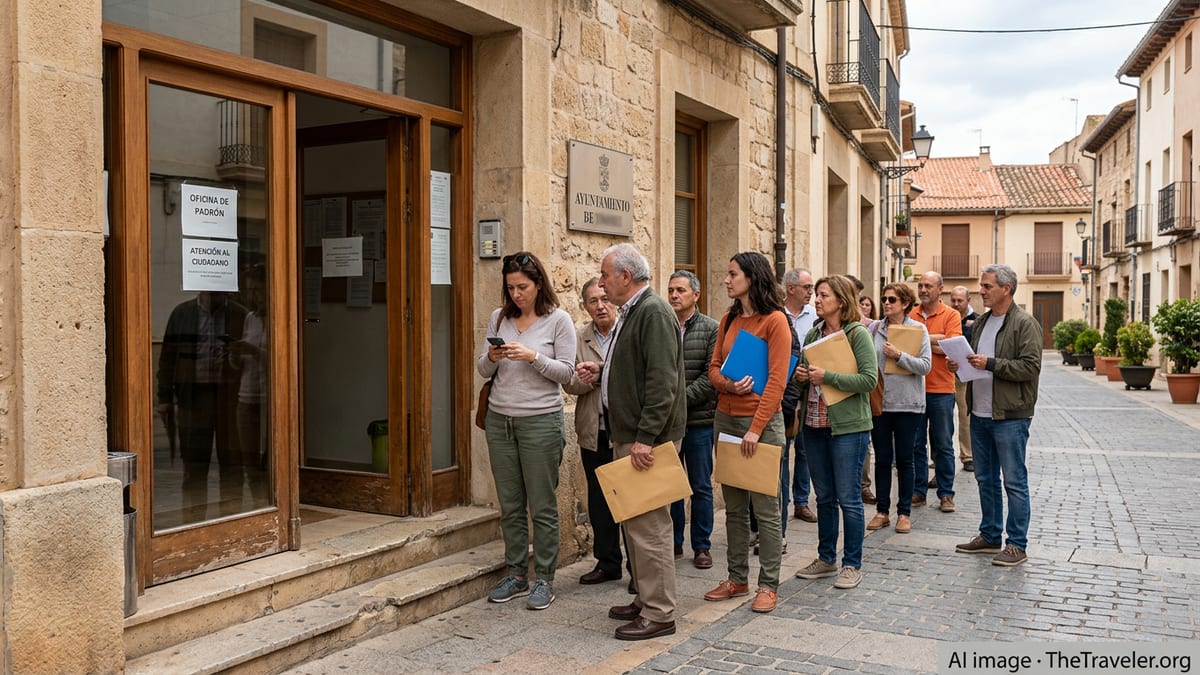
Empadronamiento is the process of registering in the local municipal census (padrón municipal) in Spain, and it is a foundational administrative step for anyone planning to live in the country beyond a short stay. For relocation planning, understanding what empadronamiento is, when it is mandatory, and how the process works is essential, as this registration underpins access to many public services and is frequently requested in later procedures.
Definition and Legal Role of Empadronamiento
Empadronamiento refers to registration in the padrón municipal, the local population register held by each Spanish municipality. The padrón records the habitual residence of every person living in that municipal territory, regardless of nationality or immigration status. It is the official basis for Spain’s population statistics and for allocating resources such as local budgets and public services.
Spanish legislation makes registration on the municipal padrón compulsory for anyone who habitually resides in Spain. Municipal registers are coordinated nationally by the National Statistics Institute (INE), and updated figures are approved by the central government as the country’s official population data. The padrón entry includes basic data such as full name, sex, habitual address, nationality, place and date of birth, and a national ID or foreign identity reference.
It is important to distinguish empadronamiento from immigration status. Registration on the padrón does not in itself legalize a person’s stay in Spain and is not proof of lawful residence. It is an administrative declaration of where a person lives for municipal and statistical purposes. However, in practice, the resulting certificate of empadronamiento is frequently used as supporting evidence of residence and length of stay in a wide range of other procedures.
For relocation decision making, this means that empadronamiento is both a legal obligation and a practical prerequisite: it does not grant immigration rights, but it is often required in later steps that do.
Who Must Register and When
All persons who reside in Spain are expected to be registered in the padrón of the municipality where they usually live. This obligation applies to Spanish citizens, EU/EEA and Swiss nationals, and non-EU nationals alike, including those without a current residence permit. The key criterion is habitual residence, typically interpreted as spending most of the year in that municipality and treating it as the main home address.
Practice varies slightly by municipality, but many town halls indicate that individuals planning to live in Spain for more than several months in a year should register once they have a stable address. Some local guidance frames the obligation as applicable to those residing more than six months per year in Spain, while other guidance highlights the need to register as soon as one has established residence and has proof of an address. In most cities, registration is expected soon after moving into the property rather than at a specific nationwide deadline.
It is not permissible to be concurrently registered as habitually resident in more than one municipality in Spain. When a person moves between municipalities, they should register in the new location; the new town hall will normally notify the previous municipality so that the old registration is cancelled. Within the same municipality, a change of address usually requires an update to the padrón record but not a new registration file.
For people considering part-year residence, such as digital nomads or retirees splitting time between countries, it is important to understand that the padrón reflects habitual residence in Spain rather than short visits. Registering while also appearing resident elsewhere can create inconsistencies with other authorities, including tax administrations, so the decision about whether and when to empadronarse should align with broader residency planning.
Core Steps in the Empadronamiento Process
The empadronamiento process is managed by each ayuntamiento (town or city hall), and procedures vary by locality, but the general workflow is similar nationwide. Prospective residents first identify the competent office, which might be the central town hall, district councils in larger cities, or dedicated citizen service offices. Many municipalities now offer online pre-registration systems or appointment booking portals, alongside traditional in-person registration.
In most cities the standard process has three stages. First, an appointment is booked, especially in major urban areas where walk-in service is limited. Second, the individual submits an application form with identity and address documents, either online or at the appointment. Third, once the registration is processed, the municipality issues either an immediate print-out confirming registration or allows the resident to request a certificate (certificado or volante de empadronamiento) as needed.
Processing times differ. Some municipalities issue confirmation and a basic certificate on the same day, particularly where the appointment includes document verification at the counter. Others may take several days or weeks to validate documents and update the register before enabling the resident to download or collect a certificate. Appointment availability can be a practical constraint in large cities and should be factored into relocation timelines.
The table below summarizes typical elements of the process; specific municipalities can deviate from this pattern, so local confirmation is always necessary.
| Step | Typical practice |
| Appointment | Online booking strongly recommended in large cities; smaller towns may allow walk-ins. |
| Application form | Municipal padrón form, usually one per household; often downloadable in advance. |
| Submission channel | In person; increasingly online or by electronic office for those with digital certificates. |
| Processing time | Same day to several weeks depending on city workload and verification. |
| Output | Padrón entry plus option to request certificate or simple “volante” when needed. |
Documentation Requirements and Common Variations
Documentation for empadronamiento is standardized in broad terms but applied with local nuances. Typically, each adult must provide valid identification and evidence of occupation of the dwelling. Identity documents usually mean a Spanish national ID card for citizens, an EU national passport or identity card for EU citizens, and a passport or foreigner identity card (such as a TIE) for non-EU nationals. Where a foreigner identity card is not yet available, the passport number is normally recorded.
Proof of address is the most variable element. When the applicant is the property owner, this often takes the form of a property deed or recent property tax bill. Tenants usually present a rental contract, sometimes with additional requirements such as a recent utility bill in the same name. Where the applicant is not on the lease or deeds, municipalities often require a signed authorization from an adult already registered at the address, accompanied by that person’s ID and, in some cases, proof of their title to the property.
For families, municipalities typically allow one representative to register multiple members of the household, though original documents and birth certificates for minors may be requested. In shared accommodation or informal arrangements, the practical challenge is often obtaining the owner’s authorization, not the legal right to register. Spanish guidance emphasizes that irregular immigration status is not a lawful reason to deny empadronamiento; the decisive factor is residence at the address, but proving that residence can still be administratively demanding.
Relocating professionals should anticipate that some municipalities request additional documents not explicitly listed in national rules, particularly in large urban areas. Examples include recent utility bills, bank statements showing the address, or translations and legalizations of foreign documents. It is therefore advisable to review the specific instructions of the destination city council before arrival and gather as broad an evidence set as feasible.
Validity, Renewal and Deregistration Rules
Once registered, the permanence of the empadronamiento entry depends on nationality and residency status. Spanish citizens and EU/EEA or Swiss citizens with stable residence rights generally retain their padrón registration indefinitely, as long as they continue to live in the municipality. They are usually only removed if they are known to have moved away or after specific municipal review procedures.
For non-EU nationals without long-term or permanent residence, national rules provide for periodic confirmation of registration. In practice, many town halls require these residents to renew or confirm their padrón entry every two years from the date of registration, unless they hold a recognized long-term status. Failure to confirm may result in automatic removal from the padrón after a period, meaning that certificates requested later would show no current registration.
When a person moves within Spain, registering in the new municipality normally triggers a communication to cancel the previous registration. However, practical delays and data mismatches can occur, so it is possible for records to be temporarily duplicated or for an old registration to remain active. This can affect statistics and, in some cases, access to services linked to local residency. Some municipalities therefore encourage residents to request explicit deregistration (baja) when leaving, especially if moving abroad.
Certificates of empadronamiento themselves also have a limited validity period for use in other procedures. Many authorities and consulates stipulate that certificates must be “recent,” often defined as issued within 90 days, but certain processes require even more recent documents, such as certificates not older than 30 days or, occasionally, one week. As a result, residents rarely obtain a certificate only once; they request new copies repeatedly when specific procedures demand up-to-date proof.
Practical Functions and Interactions with Other Procedures
Although empadronamiento is a municipal census, the resulting record and certificate play a central role in a wide range of administrative procedures that impact relocated individuals. Access to local services is a primary function. Municipalities use padrón data to plan education, social services, and infrastructure and often condition eligibility for local benefits or subsidies on registration. For example, school enrolment in a given catchment area commonly requires proof that the child is registered at an address within that area.
Health systems and social security interfaces often treat empadronamiento as factual proof of residence in a particular autonomous community. In many regions, registering with the public health system or obtaining a local health card requires presentation of a recent padrón certificate. Likewise, certain welfare benefits administered at municipal or regional level examine padrón records to verify residence duration and household composition.
Empadronamiento also interacts indirectly with immigration and residency procedures. While being registered does not in itself confer lawful status, authorities frequently request a recent certificate of empadronamiento to prove address when applying for residence cards, renewing foreigner identity documents, or demonstrating continuity of residence for long-term status. Several police stations and immigration offices include the padrón certificate among standard document lists, particularly for non-EU nationals.
Private entities increasingly use the padrón certificate as accepted address proof. Banks, telecom providers, and some landlords may request either a certificate or a recent padrón print-out when opening accounts, signing contracts, or verifying identity. For mobile professionals, this creates an additional incentive to complete empadronamiento swiftly after securing housing, as delays can cascade into difficulty accessing financial and communication services.
Strategic Considerations for Relocating Households
From a relocation planning perspective, empadronamiento should be considered an early-stage administrative milestone. Because many subsequent procedures rely on a padrón certificate as address evidence, delays in booking an appointment or securing the necessary housing documents can slow down residence card applications, school registration, or even basic tasks like opening a bank account.
Households moving to major cities where appointment bottlenecks are common should assess local booking conditions in advance. In some municipalities, obtaining a padrón appointment can take several weeks, while in others same-week slots are available. Corporate relocations and international schools sometimes provide guidance or assistance with scheduling, recognizing that timely empadronamiento is often a gatekeeper for other services.
Where accommodation is temporary, such as serviced apartments or short-term rentals, it is important to verify whether the provider allows empadronamiento. Some landlords are reluctant to authorize municipal registration at their properties, although legal guidance emphasizes that actual residence, not property status, is the relevant criterion. Prospective tenants may wish to address this point explicitly in rental negotiations and contracts to avoid a situation where they live in Spain but cannot register.
Finally, individuals planning only intermittent presence in Spain need to weigh the benefits of empadronamiento against potential inconsistencies it may create with residence and tax status in other countries. While the padrón is not a tax register, multiple authorities can use it as an indicator of where a person usually lives. For highly mobile professionals, coordinated advice that considers immigration, tax, and social security implications alongside empadronamiento rules is advisable.
The Takeaway
Empadronamiento is a core component of Spain’s administrative system, functioning as a municipal population register that is mandatory for habitual residents but distinct from immigration status. The process is handled locally by town halls, involves relatively basic documentation of identity and address, and yields a padrón entry that underpins a wide range of public and private procedures.
For relocating individuals and families, successful empadronamiento is both an obligation and a practical enabler. It is often required for access to local services, health coverage registration, school enrolment, and, indirectly, for supporting many residence and permit applications. Differences between municipalities in appointments, documentation details, and renewal practices mean that local verification is essential, but the structural role of the padrón is the same across Spain.
In relocation planning, empadronamiento should be treated as an early, high-priority administrative step once accommodation is secured. Understanding who must register, how renewals work for different categories of foreigners, and how recent certificates need to be for specific procedures helps avoid delays and ensures that Spain’s municipal systems recognize the new household as part of the local community from the outset.
FAQ
Q1. Does registering through empadronamiento make my stay in Spain legal?
Empadronamiento records where you habitually live but does not in itself legalize your immigration status or grant residence rights; those depend on separate immigration rules and permits.
Q2. How soon after arriving in Spain should I complete empadronamiento?
Once you have a stable address and supporting documents, most municipalities expect you to register promptly as a habitual resident; in practice this is commonly done within the first weeks after moving into the property.
Q3. Can I empadronarme if I do not yet have a residence permit or foreigner ID card?
In many municipalities you can register using your passport as identification and suitable proof of address; lack of a residence permit alone is not generally a valid reason to refuse empadronamiento.
Q4. What happens if I move to another city in Spain?
You should register on the padrón in the new municipality; this normally triggers deregistration from the previous one, although requesting an explicit baja when leaving can help prevent duplicated or outdated records.
Q5. How often must non-EU nationals renew their padrón registration?
Non-EU nationals without long-term or permanent residence status are typically required to confirm or renew their registration every two years; failing to do so can lead to automatic removal from the register.
Q6. Is empadronamiento necessary to access public healthcare?
In many regions a recent empadronamiento certificate is one of the standard documents used to prove residence when registering for public health services, although additional insurance or eligibility criteria may still apply.
Q7. Can I be registered on the padrón at more than one address?
No, the padrón is intended to record your main habitual residence in a single municipality; you are expected to be registered only where you genuinely live most of the time.
Q8. How long is a certificado de empadronamiento valid for other procedures?
The underlying registration continues until it is changed or removed, but institutions often require that the certificate itself be recently issued, frequently within the past three months and sometimes within a shorter period.
Q9. What is the difference between a volante and a certificado de empadronamiento?
Both are documents derived from the padrón; in practice, some authorities accept a simple volante while others insist on a formal certificado, so it is important to follow the specification given in each procedure.
Q10. Can a landlord refuse to allow empadronamiento at their property?
Municipal guidance focuses on the fact of actual residence rather than the landlord’s preference, but in practice you often need the owner’s documentation or authorization, so clarifying this point before signing a lease is advisable.