


Administrative efficiency is a critical factor when evaluating Spain as a relocation destination. While Spain performs relatively well in international benchmarks on government effectiveness and digital public services, day-to-day experiences with bureaucracy can vary considerably between regions and individual offices. This briefing assesses Spain’s administrative efficiency from a relocation perspective, focusing on the performance of public administration, degree of digitalisation, procedural complexity, and predictability of interactions for foreign residents.
Macro Indicators of Administrative Efficiency in Spain
Spain’s overall public sector performance compares favorably with many countries, though it does not reach the very top tier of the most efficient administrations globally. According to World Bank governance indicators, Spain’s government effectiveness percentile rank is in the mid to high 70s out of 100, indicating it performs clearly above the global average in the quality of public services, civil service and policy implementation. This places Spain broadly on par with many Western European peers, though still behind the most efficient northern European systems.
In composite public sector performance studies that benchmark economic and social policy implementation across advanced economies, Spain tends to score in the intermediate to upper range. Its administrative systems are generally able to deliver core services and implement reforms, but often with slower timelines, higher procedural complexity and more interpersonal variation than the most efficient OECD countries. Relocating professionals can therefore expect reasonably functional administration, but not a fully frictionless environment.
For individuals and businesses, these macro indicators translate into a system where official procedures are usually completed successfully, but may involve additional steps, in-person visits, and follow-up compared with more digitally streamlined jurisdictions. Administrative reliability is broadly adequate, though predictability and speed can be inconsistent, especially for foreign residents unfamiliar with local practices.
Overall, macro data suggests Spain offers a workable administrative environment for relocation, but not an exceptionally lean or uniformly high-performing one. The differences between formal indicators and lived experience often emerge at the level of municipal offices and specific immigration or registration procedures, which matter greatly for new arrivals.
Digital Public Services and E‑Government Performance
Spain is a European frontrunner in digitalisation of public services. In the former European Commission Digital Economy and Society Index, Spain consistently ranked near the top of the EU for digital public services, with recent data placing it among the top five member states and significantly above the EU average in indicators such as online service availability and e‑government use. In related national digital strategy documents, Spain is frequently cited as second among EU countries for the development of digital public services.
Recent EU reporting under the Digital Decade framework shows that a high proportion of key public services for citizens and businesses can be completed online, and Spain scores particularly well on the provision of digital services for companies. E‑government user rates for citizens are also higher than the EU average, with a large majority of internet users engaging with online government portals for at least some procedures in a given year.
From a relocation standpoint, the advanced state of e‑government means many interactions, such as tax filings, social security queries, and appointments with central administration, can theoretically be handled digitally. However, practical access to these tools depends heavily on obtaining a digital certificate or electronic ID, which itself often requires in‑person verification, and on navigating Spanish-language interfaces. Once these prerequisites are met, digital channels can substantially reduce the number of required physical visits for ongoing administrative life.
The key nuance is that Spain’s strong digital rankings coexist with persistent pockets of analogue practice and local variation. Certain procedures remain paper-based or partially digital only, and some offices insist on printed copies even when online submission is available. Newcomers should therefore view digital public services as an important efficiency booster, but not as a full substitute for traditional bureaucratic steps.
Structure of Public Administration and Regional Variations
Spain’s decentralized administrative structure has a significant impact on perceived efficiency. Competences are distributed across the central government, 17 autonomous communities, and thousands of municipalities, each with its own administrative culture, resources, and technological maturity. While central-level services tend to be more standardized, regional and local administrations can differ widely in responsiveness, digital adoption, and procedural flexibility.
Large urban areas such as Madrid, Barcelona and Valencia often have more developed citizen service centres and online systems for municipal procedures, including registration at the municipal register and local permits. Smaller cities and rural municipalities may rely more heavily on in‑person visits, limited appointment slots, and manual processing, which can lengthen timelines and require more persistence from new residents.
This territorial diversity means that administrative efficiency in Spain is not uniform. Two individuals following ostensibly the same procedure can experience substantially different processing times depending on province, city, and even specific office. Reports from expatriates and local practitioners frequently highlight that in some provinces appointments for certain residence or registration procedures can be obtained within days, while in others, waiting lists extend to several months.
Relocation planning should therefore factor in not only national rules but also regional administrative capacity. High-demand regions with significant immigration flows often experience bottlenecks, particularly for residence card appointments, whereas mid-size cities can sometimes offer faster and more predictable service due to lower caseloads.
Process Complexity, Documentation and Predictability
Spain’s administrative framework is characterised by detailed legal requirements and extensive documentation, which contribute both to procedural rigor and to perceived complexity. Many key interactions, such as residence-related procedures, municipal registration, social security enrolment and professional licensing, require multiple supporting documents that must be correctly formatted, translated where necessary, and often legalised or apostilled.
Legal time limits exist for many administrative decisions, typically measured in weeks or a few months. In practice, however, unofficial evidence from practitioners and applicants indicates that these timelines are often exceeded, especially in high-volume immigration and civil registry offices. Delays of several months beyond the nominal deadline are not uncommon for certain residency and family reunification procedures in busy provinces, even though simpler actions such as municipal registration can still be processed on the same day in some municipalities.
An additional challenge is procedural consistency. While regulations are national, local offices interpret and enforce them with some discretion. Requirements that are optional in one office may be applied rigidly in another. This can result in repeated visits when an official requests a document not mentioned in standard guidance, or rejects a submission for a minor formatting issue. For relocating professionals used to more harmonised and fully codified systems, this discretion can feel unpredictable.
At the same time, Spain’s civil servants often show a problem-solving attitude once an applicant understands the required steps, and errors can sometimes be corrected without restarting entire processes. Administrative inertia tends to manifest more in slow appointment systems and case backlogs than in outright refusal to process legitimate applications, although persistence and careful preparation are generally required to achieve efficient results.
Appointment Systems, Waiting Times and Front-Office Experience
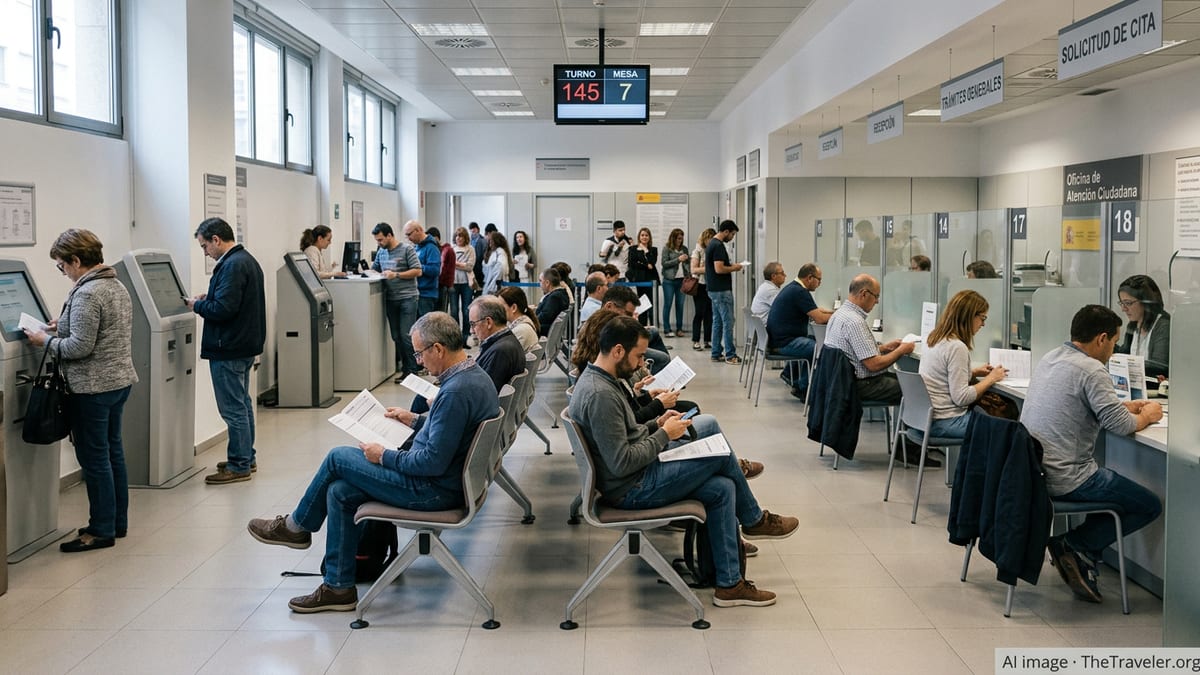
The appointment system, commonly referred to as “cita previa,” is a central feature of Spain’s administrative interface with the public. Most interactions that matter to new residents, including residence card applications, fingerprinting appointments, and many municipal services, require a pre-booked appointment. This system is intended to improve efficiency by managing flows and reducing queues.
In practice, appointment availability is one of the main bottlenecks affecting perceived administrative efficiency. Unofficial reports from affected users across different regions highlight considerable variation: in some cities, appointments for key procedures can be secured within a few days, while in others, slots appear only sporadically and are booked within minutes, forcing applicants to check the system repeatedly over weeks. For certain residency categories in high-demand areas, delays of several months between application submission and the first available appointment have been reported.
Once an appointment is secured and documentation is complete, many front-office interactions are relatively efficient, with staff processing standard procedures within a short in-person visit. However, the binary nature of the appointment system means that individuals unable to obtain a slot have limited alternatives, and walk-in options are often unavailable, even in urgent cases. This can be particularly challenging for newcomers who need to complete specific steps within legal deadlines.
From a relocation intelligence standpoint, the appointment mechanism should be viewed as a critical operational variable. Successful navigation often depends on monitoring online systems at specific times, using different devices or browsers, and in some cases engaging local professionals familiar with patterns of appointment releases in a given province. The appointment bottleneck can be a larger source of inefficiency than the substantive processing of the application itself.
Digital Identity, Certificates and Practical Use of E‑Administration
Spain’s advanced digital public services rely heavily on secure digital identity mechanisms. The main tools are the electronic national identity document for citizens, the foreigner identification number and card for foreign residents, the Cl@ve system for unified access, and various digital certificates issued by accredited providers. These credentials allow individuals to sign documents electronically, submit forms, and access personal records online.
For foreign professionals, obtaining and activating these digital credentials is a key threshold for unlocking administrative efficiency. Many procedures that are time-consuming when handled in person, such as obtaining certain social security documents, checking tax records, or requesting certificates, become significantly faster once digital access is in place. However, initial registration for digital certificates usually requires at least one in-person identity verification, which brings applicants back into the appointment system and local office variability.
Language is another practical factor. Interfaces for e‑administration are predominantly in Spanish, with partial support in co-official languages in certain regions and limited English. Relocating individuals who do not speak Spanish may find it difficult to use digital platforms without assistance, which can negate some of the theoretical efficiency gains. Professional intermediaries such as administrative agents or “gestores” commonly bridge this gap and are widely used by both locals and expatriates for complex procedures.
Once established, Spain’s digital identity ecosystem can support a relatively high degree of administrative self-service compared with many countries. For long-term residents and companies, the combination of secure digital signatures and mature online portals can substantially reduce the friction of routine interactions with public bodies.
Reforms, Modernisation Efforts and Future Outlook
Spain has pursued an active agenda of administrative digitalisation and simplification in recent years, anchored in national strategies such as the Digital Spain initiatives and reforms to public administration law. These programmes aim to expand fully electronic procedures, promote interoperability between different public bodies, and reduce paperwork through data sharing and “once-only” principles.
National digital strategy documents highlight goals to consolidate platforms, standardise user experience across administrations, and strengthen back-office integration so that citizens and residents no longer need to supply information already held by another authority. Spain’s strong performance in European digital public service rankings reflects progress in implementing these reforms, especially for business-facing services and selected priority procedures.
At the same time, practical evidence from applicants and practitioners suggests that legacy processes and capacity constraints continue to generate bottlenecks, particularly in areas such as immigration processing, civil registries and some municipal services. Formal simplification measures sometimes add new digital layers on top of existing rules rather than fully replacing them, which can temporarily increase complexity for users.
Looking forward, the policy trajectory points toward gradual improvement in administrative efficiency, especially as more procedures move to unified digital portals and inter-agency data sharing matures. However, given Spain’s decentralised system and the diversity of local administrations, improvements will likely remain uneven across regions and sectors. Relocating professionals should therefore anticipate incremental gains rather than a sudden transition to a frictionless system.
The Takeaway
Spain combines relatively strong international scores for government effectiveness and digital public services with a day-to-day bureaucratic reality that can feel complex, time-consuming and variable for newcomers. On a structural level, the country has built a modern framework for e‑government and launched sustained administrative reform efforts, and many routine interactions are now manageable online once digital credentials are in place.
However, decentralisation, appointment bottlenecks, extensive documentation requirements and inconsistent local implementation all limit practical efficiency. For relocation decisions, this means Spain’s administrative environment is workable but demands preparation, patience and often professional support, especially during the first year. Individuals and organisations that invest early in understanding procedures, obtaining digital identity tools and selecting locations with stronger administrative capacity will experience a smoother transition.
In comparative terms, Spain is generally more efficient and digitalised than many non-European destinations, and broadly aligned with the middle of the Western European group. It is not, however, among the very easiest countries in Europe in which to navigate public administration as a foreign newcomer. Factoring realistic administrative timelines and potential delays into relocation planning is advisable for any professional considering a move.
FAQ
Q1. How efficient is Spain’s public administration compared with other countries?
Spain’s public administration scores above the global average and in the upper-middle range among OECD countries, but it is not among the very top performers in administrative efficiency.
Q2. Are most government procedures in Spain available online?
A large share of central government and many regional procedures are available online, especially for tax, social security and business services, but some key processes still require in-person steps.
Q3. How much do administrative procedures vary between Spanish regions?
Variation is significant. Rules are national, but appointment availability, processing times and local practices can differ widely between autonomous communities and even between cities.
Q4. Are appointment systems a major bottleneck for new residents?
Yes. Securing appointments for certain residence and registration procedures can be one of the main constraints, with waiting times ranging from days to several months depending on location.
Q5. Does speaking Spanish substantially improve the administrative experience?
In most cases it does. Digital platforms, forms and front-office interactions are primarily in Spanish, so language skills or local assistance can significantly improve speed and accuracy.
Q6. How reliable are official processing time limits in practice?
Legal time limits exist for many procedures, but practical experience shows they are often exceeded for complex or high-volume processes, particularly in immigration and civil registry matters.
Q7. Can digital identity tools really reduce bureaucracy for residents?
Once obtained, digital certificates and access credentials allow many procedures to be handled online, reducing visits and paperwork, though they do not eliminate all bureaucratic complexity.
Q8. Is it common to use professional intermediaries for Spanish bureaucracy?
Yes. Many residents and businesses use administrative agents or consultants to navigate complex procedures, prepare documentation and secure appointments more efficiently.
Q9. Are there ongoing reforms to improve Spain’s administrative efficiency?
Spain is implementing national digitalisation and simplification strategies aimed at expanding e‑government, consolidating platforms and improving data sharing between public bodies.
Q10. What should relocating professionals expect during their first year in Spain?
They should expect a functional but sometimes slow and complex administrative environment, with initial set-up requiring multiple steps, careful documentation and proactive management of appointments.