


Picture your ship gliding silently between steep granite walls streaked with waterfalls as icebergs drift past and the blue face of Dawes Glacier grows on the horizon. For many Alaska itineraries, that is the standard scenic day in Endicott Arm. Increasingly, though, cruise lines and Juneau operators are offering a more intimate way to experience this fjord: transferring to a smaller vessel that can push deeper into the ice and linger longer at the glacier itself. Deciding whether that small-boat tour is worth the extra time and money is one of the key calls Alaska travelers now face.
Get the latest updates straight to your inbox!
Understanding the Baseline: What Your Cruise Already Includes
On most mainstream Alaska routes, Endicott Arm and Dawes Glacier appear on the itinerary as a “scenic cruising” day rather than a port call. Large ships sail up the fjord for several hours, maneuver as ice allows within view of Dawes Glacier, then slowly turn and retrace their route. Guests stay onboard and watch from outer decks, lounges, or private balconies. Cruise lines such as Royal Caribbean and Princess highlight this as a marquee glacier experience, comparable in feel, if not in scale, to cruising Glacier Bay or Hubbard Glacier.
The shipboard experience can be impressive in its own right. Modern Alaska vessels are designed with abundant outdoor viewing areas and indoor lounges with floor to ceiling windows. Commentary from the bridge or a naturalist is often piped over the public address system while the ship threads through Endicott Arm’s narrow channel, where cliffs can rise more than 1,000 feet from sea level and icebergs drift past. On clear days, guests may see Dawes Glacier calve even from a distance, and wildlife such as harbor seals on ice floes or mountain goats high on the walls sometimes appears without leaving the ship.
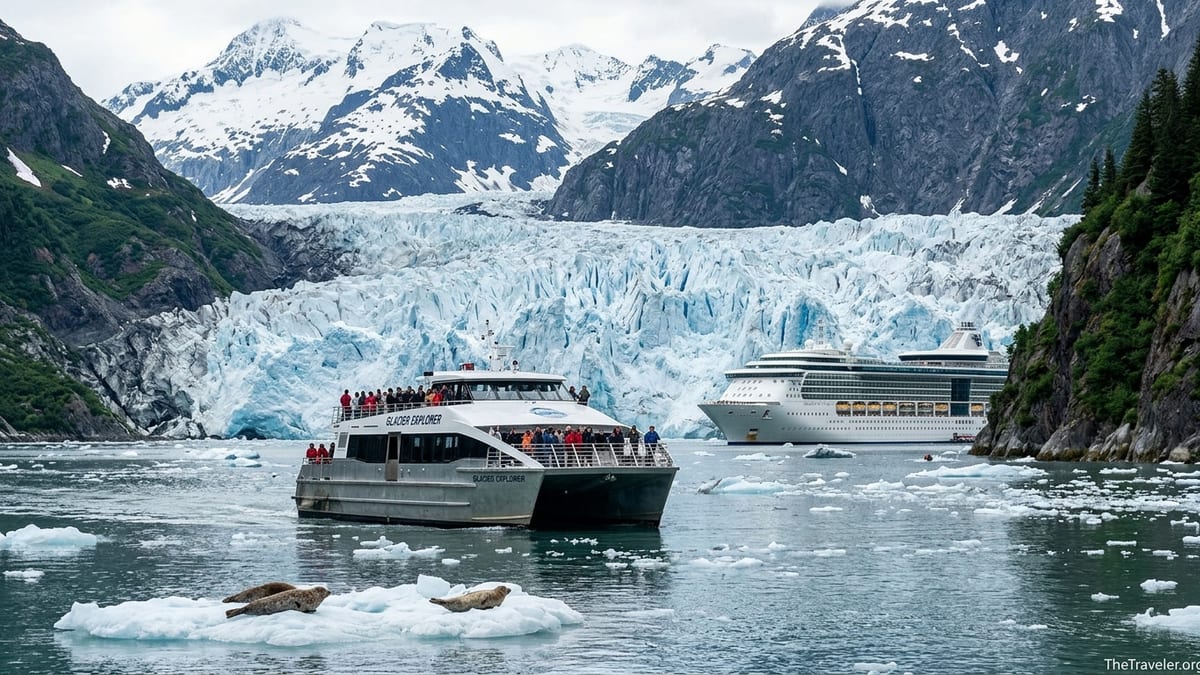
However, a big-ship visit must balance scenery with safety and schedule. Captains keep a wide margin between their vessel and heavy ice, and they have firm windows for entering and exiting the fjord to meet tidal and port timing. That is where the dedicated glacier excursions come in. On some sailings, cruise lines and independent operators position high speed catamarans or expedition style boats in Endicott Arm to take a much smaller group even closer to the ice where conditions allow.
Understanding this baseline matters because you are not choosing between “Dawes Glacier or nothing.” You are choosing between viewing from a large ship with hundreds or thousands of fellow guests versus joining a far smaller group that can maneuver closer to the glacier face and focus more intensely on wildlife and photography.
Main Excursion Types: From Ship Transfers to Juneau Day Cruises
The most common add on is a ship to small boat excursion that begins with a transfer directly from your cruise ship while it is already inside Endicott Arm. Lines including Princess, Royal Caribbean, MSC Cruises and others sell versions of this under names such as “Endicott Arm Fjord and Dawes Glacier Explorer” or “Endicott Arm Fjord & Glacier Explorer.” Guests step from a lower tender platform onto a dedicated catamaran or expedition vessel that shadows and then passes the ship, continuing deeper into the fjord than a large hull can safely travel.
These ship to small boat tours typically last around four to five and a half hours, according to current 2026 season descriptions. Princess, for example, lists its Endicott Arm Fjord & Dawes Glacier Exploration Cruise at about four and a half hours, including the initial transfer from the ship to the tour vessel and the return later in the day. MSC similarly describes a multi hour voyage that boards alongside the cruise ship and travels toward Dawes Glacier, with adjustments if ice blocks the inner fjord. Exact timings vary by itinerary and season, so any article should date stamp the examples given.
A second category comprises Juneau based round trip day cruises that focus on Endicott Arm and Dawes Glacier and may not involve a big ship at all. Juneau operator Allen Marine Tours, for instance, advertises high speed expedition vessels that depart from Juneau’s harbor to explore either Tracy Arm or Endicott Arm, including Dawes Glacier, as a full or very full day outing. These boats resemble the ship based catamarans but run as independent day cruises, sometimes packaged through cruise lines and sometimes sold directly to independent travelers or pre and post cruise guests.
Finally, there are expedition style or charter options. A handful of small ship cruise companies and adventure outfitters offer multi day itineraries where Endicott Arm is just one among many fjords, with the vessel anchoring overnight and deploying kayaks or skiffs to approach ice and shorelines. In addition, private charters aboard smaller yachts or custom expedition boats can sometimes be arranged from Juneau. These are generally the most expensive and least widely available options and tend to appeal to repeat visitors or travelers building a custom Alaska program.
What the Small Boats Actually Add Over Staying on the Ship
The selling point of the small boat excursions is proximity and flexibility. Large cruise ships tend to halt several miles from Dawes Glacier, depending on ice conditions. Tour descriptions and traveler reports indicate that the smaller vessels can, in favorable conditions, work through brash ice to roughly half a mile or less from the glacier face. That extra distance can make a dramatic difference to how much detail you see in the blue ice and how vividly you experience any calving that happens while you are there.
These boats also have the freedom to linger. While a big ship might only pause for 30 to 60 minutes before needing to turn around and keep to schedule, small boat itineraries often plan to spend an hour or more near the glacier if conditions allow. With fewer people on board, there is more room to move between inside seating and outside viewing decks, and it becomes easier to find a front rail for photos or video without competing with hundreds of other guests.
Wildlife viewing is another major draw. Operators frame these trips as a combined glacier and wildlife safari. Narrated by onboard naturalists, the vessels can slow or stop to watch harbor seals resting on ice, scan shorelines for bears, or detour slightly for whales or porpoises spotted by the crew. Some boats carry hydrophones to let guests hear whale vocalizations when marine mammals are encountered. Because group sizes are typically in the low hundreds or fewer rather than thousands, guests often report more time to ask questions and receive detailed interpretation of the landscape and ecology.
It is important to note that every reputable operator emphasizes that wildlife and glacier activity are never guaranteed. Princess, MSC and Juneau based companies all include language that ice conditions, tides and weather can limit how close they approach Dawes Glacier and that calving, bear sightings or whales may not occur on any given departure. Any coverage of these trips should summarize those disclaimers clearly, underlining that the premium is paid for increased chances and a more immersive platform, not for promised animal encounters or dramatic glacier collapses.
Comfort, Inclusions and What a Day on the Water Feels Like
Physically, the small boat experience differs from remaining on a large cruise ship. The dedicated fjord catamarans in use today typically seat a few dozen to a few hundred guests in enclosed cabins with large viewing windows and climate control. They also provide multiple outdoor observation decks. Current descriptions for Princess’s and MSC’s glacier explorer style tours specify heated indoor seating, restrooms on board and complimentary coffee, tea and sometimes light snacks. Some independent Juneau operators offer additional refreshments or cafeteria style food for purchase. Very few day boats provide full meal service on standard departures, so travelers should check whether they will miss a shipboard mealtime and plan accordingly.
Boats of this size can move and vibrate more than a mega ship. Seas inside the fjord are usually relatively protected, but the ride can still feel bouncy over wakes or in windy conditions, particularly when standing on open decks. Guests prone to motion sickness may want to bring medication and choose lower level seating toward the middle of the vessel. On chillier days, the contrast between warm interiors and exposed outer decks can be stark, and most operators recommend layered clothing, waterproof outer shells, hats and gloves even in high summer.
Group sizes differ by operator and itinerary. Some cruise line contracted boats in Endicott Arm appear, from deck plans and photographs, to accommodate roughly 100 to 150 guests, while certain independent Juneau day cruises advertise capacities in the same broad range. Expedition ships and charters may carry far fewer. Because operators rarely publish a fixed number for every departure and can adjust loads by season, any article should describe capacities in approximate terms and direct readers to confirm expected group size before booking if that matters to them.
The overall feel is more like a focused nature cruise than a traditional ship tour. The smaller scale makes it easier to hear the glacier’s creaks and booms when engines idle, and to appreciate the intricate ice patterns at Dawes’ face. On the other hand, the environment is less luxurious than a big ship’s lounges and suites, and guests should be prepared for basic seating, shared restrooms and a more utilitarian atmosphere designed around viewing and maneuverability rather than amenities.
Time, Cost and Trade offs With Other Juneau Experiences
The central question for many travelers is not whether the small boat trip would be memorable but what it displaces. Endicott Arm small boat excursions from cruise ships commonly run four to five and a half hours. Because they begin while the ship is in transit, part of that time overlaps with scenic cruising you would otherwise view from the decks. However, if the boat continues on to Juneau and arrives later than the ship, it will eat directly into your port day.
Sample 2026 itineraries from major lines show Juneau calls of roughly eight to ten hours. If, for example, your Endicott Arm day involves disembarking onto a catamaran that then takes you to Dawes Glacier and onward to Juneau, you might arrive at the dock several hours after fellow passengers who remained aboard the ship. That can significantly compress or even crowd out other marquee activities from Juneau, such as whale watching, Mendenhall Glacier visits, helicopter or floatplane flightseeing and rainforest hikes. Writers comparing options should look at specific port arrival and departure times for representative sailings and map how much onshore time would remain after the small boat returns.
Cost is another major trade off. Publicly visible 2026 pricing for cruise line sold Endicott Arm and Dawes Glacier explorer tours shows approximate ranges from the high hundreds of dollars per person upward, depending on operator, duration and whether transportation to or from Juneau is included. Independent Juneau based day cruises can be somewhat less or similar, especially once transportation from the cruise pier and any bundled add ons are factored in. Exact fares fluctuate by date and demand, so any figures in print should be labeled as approximate and tied to a specific season.
Weather risk adds another dimension. The fjord’s beauty is not diminished by drizzle and low clouds, but photography can be more challenging and standing outside for extended periods feels harsher. Travelers who are sensitive to cold or who dislike being out in inclement weather may get more overall enjoyment from sampling the views on a large ship, where they can alternate between indoor comfort and short forays onto deck. Those who are happy to endure several hours of chill and spray in exchange for more visceral glacier time are better candidates for the small boat.
Ultimately, deciding whether the excursion is “worth it” means considering both the absolute cost and the opportunity cost in your personal context. Travelers who have only one Alaska cruise planned, whose itinerary does not include other major glaciers and who are passionate about photography or wildlife may justifiably allocate a significant portion of their excursion budget to Endicott Arm. Others might decide that combining whale watching, Mendenhall Glacier and a shorter city tour in Juneau provides more variety for a similar total spend.
Booking, Availability and What Happens When Plans Change
In practice, most cruise lines treat Endicott Arm and Dawes Glacier small boat experiences as premium, capacity limited excursions that can sell out. Based on current booking patterns and guest reports, Alaska excursions for a given sailing often appear in the cruise line’s planner system between roughly 12 and 6 months before departure, with some specialty or early season offerings loaded closer to the sailing date. Demand is strongest for midseason departures in June, July and August. Travelers who know they want a glacier explorer style tour are generally best advised to book as soon as they see it available.
Independent Juneau operators may open their own bookings on a similar timeline, sometimes a season at a time. When those same operators run boats under contract for cruise lines, however, inventory control and pricing usually sit with the line, and independent slots on similar itineraries may or may not be offered on the exact day your ship visits Endicott Arm. Because this is highly itinerary specific, travelers should verify whether a given Juneau day cruise is realistically compatible with their ship’s schedule before booking directly.
Cruise line cancellation and refund policies are especially important for Endicott Arm excursions because conditions sometimes prevent safe entry into the fjord or limit progress toward Dawes Glacier. Current descriptions from major operators specify that if a ship cannot enter Endicott Arm at all, or if the tour cannot operate safely due to weather or ice, the excursion will be cancelled and guests will receive a full refund of the excursion price. If Endicott Arm is inaccessible but nearby Tracy Arm or another fjord is safe, some operators reserve the right to substitute an alternate route of comparable scenic value instead of cancelling altogether.
Travelers should also note the difference between excursion cancellation policies and individual change penalties. Cruise lines often allow guests to cancel ship booked excursions without penalty up until a cutoff, commonly 24 to 48 hours before the port call. Closer to that time, voluntarily cancelling may incur a fee or forfeit the full excursion cost, even if the sailing itself proceeds as planned. Independent operators around Juneau typically have their own cancellation windows, sometimes longer because they are not protected by cruise line volume. Any current article should reference specific, date checked examples of these policies and remind readers that individual terms are operator specific and subject to change.
Accessibility, Mobility and Who These Trips Suit
Accessibility is a critical but often overlooked dimension in deciding about a Dawes Glacier small boat tour. Ship contracted operators such as those used by Princess, Royal Caribbean or MSC outline explicit mobility requirements in their shore excursion descriptions. Common conditions include being able to navigate a series of steps between decks on the excursion vessel, manage a potentially moving gangway between the cruise ship and the catamaran and stand or walk unaided on outer decks. Wheelchair and scooter access is frequently limited or not guaranteed, especially when boarding from a tender platform that can rise and fall with the swell.
Some tours are labeled as “accessible” or note that collapsible wheelchairs can be accommodated with assistance, but even in these cases guests often must transfer to a standard seat and be comfortable with short walks and a few steps. Restrooms on board are usually marine style and may be compact, which can pose challenges for some travelers. Writers covering accessibility should quote operator language precisely, highlight any age minimums or health advisories and urge readers to discuss individual needs directly with the cruise line’s access desk or the independent operator well before sailing.
Cold sensitivity and stamina also matter. Even though the small boats provide heated indoor cabins, much of the appeal lies in stepping outside repeatedly to capture photos or simply feel the scale of the fjord. Guests who find it difficult to tolerate wind and low temperatures for more than a few minutes at a time might find the experience frustrating, especially if they feel compelled to push their comfort zone to justify the cost. Conversely, those who can remain on deck for long stretches tend to extract the most value from the closer vantage point.
Families with young children should check for age restrictions. Some operators set minimum ages, often around 5 or 7 years, due to safety considerations and the length of the outing. For older travelers or anyone with cardiovascular or balance issues, the main concerns are the potential motion of the boat, the need to move around on sometimes wet decks and the limited ability to sit in one place with a perfect view for the entire duration. In borderline cases, remaining on the large ship, where elevators, wide corridors and sheltered viewing lounges are readily available, may be the more comfortable and still very scenic choice.
Is the Dawes Glacier Small Boat Tour Worth It? A Decision Guide
For travelers on a tight budget or those already investing heavily in marquee excursions such as helicopter landings on Mendenhall Glacier or full day wildlife trips in other ports, the Dawes Glacier small boat tour is often best viewed as a high value, high cost enhancement rather than an essential. If paying for it would require sacrificing multiple other experiences you are excited about, or if you are already visiting another major tidewater glacier like Hubbard or Glacier Bay on the same trip, then simply enjoying Endicott Arm from the ship can still deliver a powerful glacier day without extra expense.
If you have moderate to strong mobility, enjoy photography and wildlife, and are not particularly prone to seasickness, the calculus shifts. For many such travelers, especially those whose itinerary includes only this one major glacier day, the small boat outing is frequently described as a highlight that brings the fjord down to a human scale. The ability to frame Dawes Glacier without telephoto lenses, to hear ice crack and to watch seals on nearby floes can justify the time and money, provided you accept the inherent uncertainties of weather and wildlife.
Those who know they dislike long, chilly hours outdoors, who are anxious about smaller vessels or who place a higher priority on maximizing their time exploring Juneau’s onshore attractions may reasonably decide that the excursion is not worth the trade offs. In that case, staking out a good spot on the ship’s bow or aft decks with binoculars and a hot drink, and then focusing your budget on whale watching, Mendenhall or a flightseeing trip from Juneau, can deliver a more varied and personally satisfying Alaska experience.
In the end, there is no single right answer. The Dawes Glacier small boat tours exist precisely because travelers value different things. By comparing up to date durations, prices, accessibility notes and cancellation policies across at least two cruise lines and one Juneau operator, and by weighing those against your own budget, mobility, tolerance for motion and passion for glaciers, you can decide whether to say yes to the catamaran or to let Endicott Arm unfold from the comfort of your ship. Either way, the fjord itself, with its waterfalls, icebergs and steep walls, is likely to become one of the defining memories of your Alaska journey.