


In spring 2027, the bulb fields southwest of Amsterdam will once again turn into a patchwork of tulips, hyacinths and daffodils. If you are staying in Amsterdam and do not want to rent a car, it is still entirely possible to see both the famous Keukenhof gardens and the surrounding Bollenstreek flower-growing region. This guide explains how to reach the area by public transport, how to add cycling without overdoing it, and what to expect in different weeks of the short tulip season.
Get the latest updates straight to your inbox!
Key 2027 dates and understanding gardens versus fields
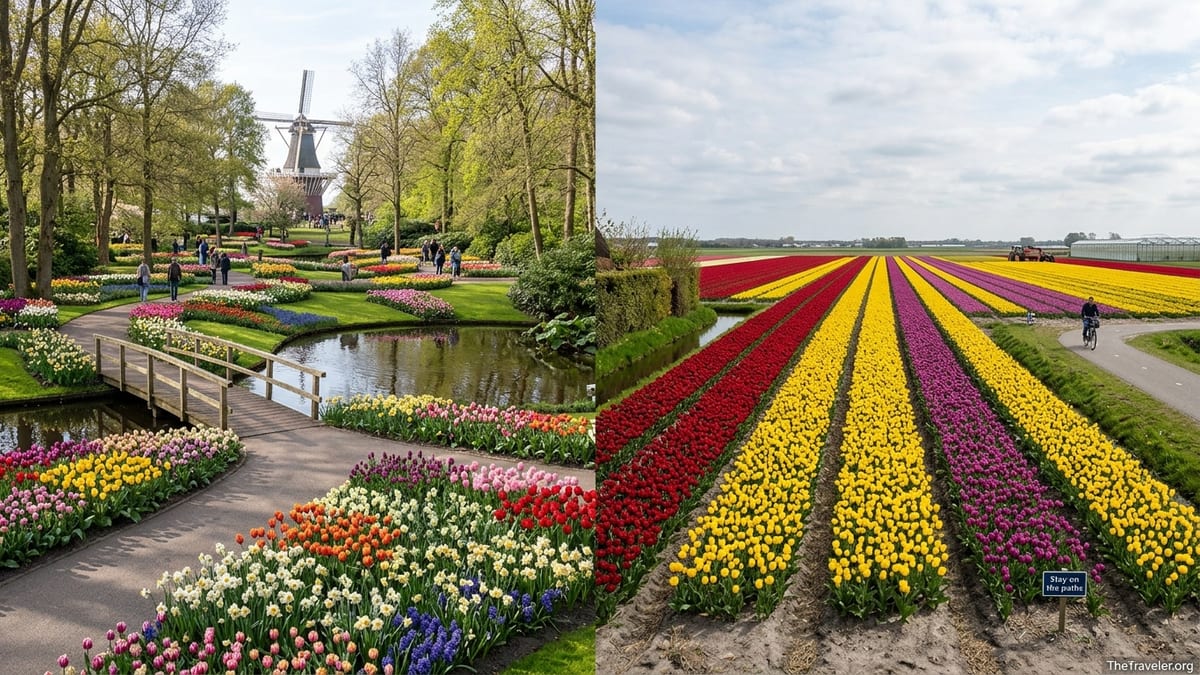
Keukenhof, the landscaped spring garden on the edge of Lisse, is officially scheduled to open from 18 March to 9 May 2027. The park is a designed flower show, with around seven million bulbs planted in planned beds, pavilions, wooded areas and lakes. You need a dated ticket with time slot to enter these gardens. Keukenhof is not a farm and the bulbs here are primarily for display rather than commercial production.
The surrounding Bollenstreek region is a different world. Between towns such as Lisse, Hillegom, Voorhout, Sassenheim and Noordwijkerhout you will find large fields of tulips, daffodils and hyacinths grown as agricultural crops. These fields belong to individual growers and most are not open to the public. The famous photographs of visitors standing between long rows of flowers are usually taken on private land with the farmer’s permission or at ticketed attractions that recreate field settings.
When planning your trip it helps to decide what matters most. If you want guaranteed flowers regardless of weather, Keukenhof is the safest choice because the plantings are staggered and include many varieties. If your dream is wide open tulip fields, you must accept more uncertainty, because bloom and harvest dates depend heavily on temperature and rainfall. A realistic plan combines both: a timed Keukenhof visit, plus time on local roads and cycle paths that pass working bulb farms.
Public authorities and tourism boards in the Bollenstreek stress that the flower fields are working farmland. Visitors are asked to stay on roadsides and paths, not to walk into the fields, and never to pick flowers or bulbs without permission. Grocers and export companies rely on these crops and compaction or disease from trampling can ruin a harvest. Throughout this guide, any field access mentioned refers only to places where the grower has created paths or a paid attraction.
Reaching Keukenhof and the Bollenstreek by public transport
For 2027, the main backbone for car-free visitors will again be the Keukenhof Express buses operated by Qbuzz. Information published for the 2027 tulip season confirms dedicated routes from Amsterdam RAI (line 852), Haarlem (line 850), Leiden Centraal (line 854) and Schiphol Airport area via Hoofddorp (lines 858 and 859). These seasonal lines run only while Keukenhof is open and depart from train or metro stations so that you can easily connect from Amsterdam and other Dutch cities.
From Amsterdam, the most straightforward route is metro line 52 to Europaplein / RAI, then Keukenhof Express bus 852. The metro ride from Amsterdam Centraal to Europaplein usually takes around eight minutes, and the express bus to Keukenhof takes roughly 35 minutes in light traffic. On peak days in April, Qbuzz typically schedules very frequent departures, often every few minutes rather than a strict hourly pattern, and staff manage queues at the stop. Combination tickets that include Keukenhof entry plus return bus transport from Amsterdam RAI have in recent seasons cost in the high 30 euro range per adult, with discounts for children.
Schiphol Airport is another major gateway. Intercity trains from Amsterdam Centraal reach Schiphol in about 15 to 20 minutes. Outside the terminal, seasonal bus 858 runs directly to Keukenhof during opening weeks, with journey times usually advertised at around 30 to 35 minutes. For travellers staying near the airport or landing in the morning and heading straight to the gardens, this can be faster and less crowded than going via central Amsterdam. Combination tickets from Schiphol plus Keukenhof entry are slightly cheaper than the Amsterdam packages because of the shorter bus journey.
Haarlem and Leiden provide access from both sides of the bulb region. Regular trains from Amsterdam Centraal reach Haarlem in around 15 minutes and Leiden Centraal in about 35 minutes. In 2027 Keukenhof Express buses 850 and 854 will run from these stations toward the gardens and pass close to extensive bulb fields on the way. Travellers based in Haarlem or Leiden can combine a shorter bus ride with local cycling in the Bollenstreek, as described below. For all of these express buses, the most reliable place to check exact 2027 route numbers, first and last departures and any required time slots is the Keukenhof and Qbuzz official information closer to your travel date.
Keukenhof tickets, combination deals and tours
Because capacity at Keukenhof is limited and tulip season weekends sell out, advance booking is important. Timed-entry tickets for specific days between 18 March and 9 May 2027 are usually released months ahead. Independent visitors can buy either a simple entrance ticket and arrange their own transport by regular train and bus, or a combination ticket that bundles Keukenhof admission with travel on a particular Keukenhof Express line. Prices for 2026 adult combi tickets from Amsterdam RAI have been around 38 to 40 euros, which gives a useful benchmark for 2027 budgeting, though final prices can change.
Organized tours from Amsterdam add another layer. Many operators sell half-day or full-day trips that include coach transport, a Keukenhof entrance ticket, and sometimes a short visit to a bulb farm or a canal cruise back in Amsterdam. These tours usually cost more than independent travel with a combi ticket but can be simpler if you dislike navigating public transport. Typical adult prices for small-group tours with farm visits have been in the 70 to 100 euro range, whereas basic large-coach Keukenhof trips may be priced closer to 50 to 60 euros. Travellers who enjoy flexibility and want to linger longer at Keukenhof or explore by bike often prefer the combi-ticket-and-cycle approach instead.
One middle ground is the “Tulip Festival Card” style product promoted by local tourism partners, which in recent years has combined Keukenhof entry, a shuttle or Keukenhof Express bus, and a canal cruise in Amsterdam. In 2027 similar bundles are expected to be marketed again during the 18 March to 9 May season. These passes can be cost-effective if you plan to take a canal cruise anyway, but you should still compare the individual prices of tickets and transport before buying. Also check whether the card locks you into a particular time slot for Keukenhof, which might reduce your flexibility if the weather forecast shifts.
Whatever option you choose, try to book at least several weeks ahead for visits in early to mid April, which is traditionally the busiest period. Weekends, public holidays and the weekend of the Bloemencorso Bollenstreek flower parade in late April attract the heaviest crowds and can lead to long queues for buses in both directions. If you have flexibility, a Tuesday or Wednesday visit with an early-morning time slot at Keukenhof will usually feel more relaxed while still offering abundant flowers in the park and the surrounding fields.
Adding cycling: rentals, routes and taking bikes on transport
Bikes are an excellent way to see the Bollenstreek beyond Keukenhof, but you do not need to be a serious cyclist. Several rental points in and around Lisse, Hillegom and Noordwijkerhout offer straightforward Dutch city bikes and sometimes e-bikes on a day basis. Near Keukenhof’s main entrance, a long-running rental concession provides standard bicycles during park opening months, with day rates in recent springs starting around 15 to 20 euros for a basic bike and higher rates for e-bikes or tandems. These rental stands often also hand out maps with suggested tulip routes of about 10 or 25 kilometres.
Lisse itself has additional bike rental options, including shops linked to local tourism offices and a large garden centre on the northern edge of town used as a starting point for the “Tulip Bike Tour” through the fields. In Noordwijkerhout and Noordwijk, rentals are often associated with beach hotels and tourist businesses, though some outlets allow visitors to pick up bikes for a few hours to ride inland among the fields. Daily prices for city bikes across the region commonly sit between 15 and 25 euros, with e-bikes starting higher, sometimes around 35 euros or more per day.
Several signposted cycling routes thread through the Bollenstreek. One well known spring itinerary is a free 10 or 25 kilometre “Tulip Bike Tour” loop that runs around Lisse and adjacent villages, passing bulb fields, farms and attractions such as De Tulperij, Tulip Experience Amsterdam, The Tulip Barn and local castles. Another is a longer flower and dunes route connecting Lisse with Noordwijkerhout and the North Sea coast. For more detailed planning, regional tourist boards publish downloadable route maps showing numbered junctions that allow you to shorten or extend your ride depending on your energy and the weather.
If you are based in Amsterdam and want to bring a bike, be aware of restrictions. Regular Dutch trains allow bikes outside peak commuter hours, but you must buy a bike supplement ticket and avoid the busiest carriages. The Keukenhof Express buses from Amsterdam RAI, Schiphol, Haarlem and Leiden are not set up for carrying bicycles and generally will not take them, so the usual approach is to travel by public transport to a town close to the fields, then rent a bike locally. For example, you can take a train from Amsterdam to Leiden or Haarlem, then transfer to a regional bus or cycle from a nearby station such as Hillegom or Voorhout, where independent rentals or Dutch public bike schemes are sometimes available.
Respecting working fields and finding legitimate photo spots
The colourful stripes you see in photos are commercial fields owned by bulb growers. Tourists who enter between the rows can spread plant diseases and damage bulbs by compacting the soil. Local campaigns in recent years have asked visitors explicitly to stay out of the fields unless a farmer has opened a path or attraction. In practice this means you should remain on farm tracks, paved roads, cycle paths and verges when taking pictures, and never cross a ditch or fence into the fields without permission.
There are still many legitimate places to take memorable photos. Quiet country roads such as Loosterweg and the lanes north of Lisse have viewpoints where you can safely step onto a grass verge or a small lay-by and photograph the rows from the edge. Some growers have built paid experiences like Tulip Experience Amsterdam, De Tulperij or The Tulip Barn, which offer access to show fields designed for photography, often with props and information boards. Tickets for these attractions are separate from Keukenhof and usually cost a modest amount compared with the main park, providing an ethical way to walk among flowers.
Keukenhof itself also offers iconic images. Within the gardens you can photograph dense beds of tulips, winding paths under blossoming trees, and reflections in ponds, all without stepping on soil. A popular spot is the historic windmill at the back of the park, which overlooks neighbouring bulb fields. From its viewing platform and adjacent paths you can frame both landscaped gardens and commercial fields in a single image while staying behind fences. Early morning entry slots give the best chance of soft light and smaller crowds for photography inside the park.
If you want images with fewer people, consider basing yourself in Haarlem, Leiden or smaller villages and cycling early or late in the day, when tour groups are absent. Respect any signs deployed by growers asking you to keep out, and treat ditches and wire as absolute boundaries. Local authorities sometimes place boards along popular roads explaining why entering fields is not allowed; reading these offers useful context about how long bulbs take to cultivate and how sensitive they are to infection.
When to go: bloom timing from late March to early May
While Keukenhof is guaranteed to have flowers throughout its 18 March to 9 May 2027 opening, the surrounding fields are much more weather-dependent. In a typical season, late March sees early-blooming crocuses, daffodils and some hyacinths, with only a few early tulip varieties beginning to colour. By the first days of April more fields around Lisse and Hillegom usually show strong bands of hyacinths and early tulips, though large areas of green leaves remain.
In early to mid April, especially between roughly 5 and 20 April in an average year, tulips dominate the landscape. This is the period when many promotional images are taken, because fields of red, yellow, pink and purple tulips line the roads on both sides. However, the exact peak can shift by more than a week depending on the winter and early spring. A cold March can delay bloom well into April, while an unusually warm late March can lead to full bloom by early April and earlier harvesting.
By late April and into early May, growers begin to “head” the tulips by cutting off the flowers so more energy goes to the bulbs. This means you might find green fields with no flowers even while Keukenhof is still colourful inside its gates. Around the May holiday period, remaining outdoor colour tends to be in late varieties, ornamental plantings and city displays rather than endless commercial strips. Visitors coming in early May should set expectations accordingly and focus on Keukenhof itself, nearby show gardens, and the urban tulip displays in Amsterdam.
Weather also affects how enjoyable your visit feels. Spring in the Netherlands is changeable, with chilly mornings, frequent showers and occasional windy days. Temperatures can sit in the single digits Celsius in late March and climb to the mid-teens or higher on sunny April afternoons. When planning, build in flexibility to swap your tulip day to a brighter forecast where possible, and pack layers, waterproofs and closed shoes that can cope with wet verges and puddles along farm tracks.
Amsterdam Tulip Festival: urban alternatives and add-ons
If your dates do not align with perfect fields, or if you prefer to avoid the crush around Lisse, the Amsterdam Tulip Festival offers a strong urban alternative. For 2027, official announcements confirm that the Tulp Festival will run from 1 to 30 April across various locations in the city. During this month tens of thousands of tulips are planted in public squares, museum gardens, shopping streets and residential areas, turning ordinary corners of Amsterdam into photogenic spots.
The city festival is not a single enclosed event. Instead, tulip displays are scattered among places you might already plan to visit, such as cultural venues, canalside streets and parks. Maps and brochures produced shortly before April usually highlight concentrations of plantings and suggested walking routes. Many of the displays are free to enjoy because they sit in public space, making this a budget-friendly way to see tulips if Keukenhof tickets have sold out or if you want to spread your flower viewing over several days.
Urban tulips will not replace the feeling of standing beside hectares of fields, but they do provide more reliable colour throughout April and work well for travellers with limited time or mobility. You can easily combine a relaxed city walk among festival plantings with a café stop, canal view or museum visit. For photographers, Amsterdam’s brick facades, bridges and houseboats offer pleasing backdrops that differ from the wide open polder horizon of the Bollenstreek.
Because the Tulp Festival overlaps completely with Keukenhof’s busiest period, consider pacing yourself. One option is to dedicate a weekday to Keukenhof and the fields using the express buses, then spend another morning later in the week following an Amsterdam tulip walking route. This spreads your exposure to crowds and bad weather and increases the chance that at least one of your flower days will enjoy good light.
A realistic car-free day trip itinerary and budgets
A practical 2027 car-free tulip day from Amsterdam might start with an early metro line 52 from Amsterdam Centraal to Europaplein, arriving before 9:00. From there you join the queue for Keukenhof Express bus 852, having prebooked a Keukenhof ticket with a morning arrival slot around 9:30 or 10:00. The bus ride typically takes about 35 minutes, but on busy April weekends you should allow extra time for boarding and traffic. Once at Keukenhof you spend three to four hours exploring the gardens, pavilions and windmill area, with a simple lunch at one of the park restaurants.
In early afternoon you can either remain in the park longer, or walk to the bike rental outside Keukenhof’s main gate and hire a bicycle for a 10 or 25 kilometre loop through the surrounding fields along signposted routes. A gentle ride with photo stops will take two to three hours. You then return the bike, re-enter Keukenhof briefly if your ticket still allows access, or head straight to the bus stop by late afternoon. Allow a generous buffer for the return bus, as queues from mid-afternoon can be long, and consider leaving the park before closing time to avoid the last rush. From Europaplein, a short metro ride brings you back to the city centre well before evening.
For budgeting, consider three example visitor profiles using current price ranges as a guide. A solo traveller buying a Keukenhof combi ticket from Amsterdam for around 40 euros, renting a basic bike near the gardens for about 20 euros, and spending roughly 20 euros on simple meals and drinks would be looking at a total day cost of about 80 euros, not counting extras like souvenirs. A couple sharing the same pattern might spend around 160 euros in total, with some savings if they share snacks or choose a supermarket picnic.
For a family of two adults and two children, costs add up differently. Child combi tickets are usually significantly cheaper than adult ones, sometimes around half price up to a certain age. If we assume adult combi tickets around 40 euros and child tickets in the low 20s, transport and entry for the family might land near 120 to 130 euros. Adding two rental bikes with child seats or a cargo bike for a few hours could cost another 30 to 50 euros depending on configuration, while meals and treats in the park might run to 40 or 50 euros. A realistic all-in budget for such a family tulip day in 2027 is likely to sit between 200 and 240 euros, depending on choices.
Travellers on tighter budgets can reduce costs by skipping bike rental and focusing on Keukenhof plus free walks along nearby roads, bringing a picnic instead of eating full meals in the park, and choosing regular public transport tickets instead of combi products if they already hold discount cards or rail passes. Urban tulip viewing in Amsterdam during the April festival, combined with a standard off-peak train to Haarlem or Leiden for a short local walk, can also provide a strong flower experience for considerably less than a full Keukenhof outing.
Crowds, accessibility, booking tips and who should choose what
Weekends, especially in early and mid April, are extremely popular at Keukenhof and on the Keukenhof Express buses. Expect queues at Amsterdam RAI, Schiphol and the park bus stops, plus busy paths inside the gardens from mid-morning onwards. To reduce stress, book the earliest feasible entry slot, travel on a weekday if possible, and arrive at the bus stops well before the time printed on your Keukenhof ticket. Having a contactless bank card or Dutch transport card ready speeds up any separate metro or train segments.
Accessibility at Keukenhof is generally good. Paths are flat and paved, wheelchairs and mobility scooters can be rented at the entrance with advance reservation, and accessible toilets are available. However, the sheer number of visitors can make navigation slower, and some bridges and narrow alleys become crowded at peak times. For visitors with limited mobility, it can be wise to skip external cycling and instead spend more time in quieter corners of the park and the cafés. Urban tulip viewing in Amsterdam often works even better because public trams and buses are accessible, and you can choose shorter, more flexible walks.
For travellers whose priority is iconic field photographs, a combination of Keukenhof and an organised or self-guided visit to a ticketed tulip farm is usually the most reliable route. These attractions are designed for photography and allow you to move between rows without damaging crops. Pairing a morning at Keukenhof with an afternoon photo session at a place such as De Tulperij or Tulip Experience Amsterdam, reached by bike or local taxi from Lisse, can yield varied images in a single day. Always check opening hours and prebook tickets where required.
If your main concern is cost, or if you are visiting outside the highest bloom window, focus on the Amsterdam Tulip Festival and regional walks instead of Keukenhof. City tulip plantings are free to enjoy, and a simple train ride to a smaller station near the fields followed by a walk or short rental bike can reveal plenty of colour without major expenses. Whichever approach you choose, planning ahead for 18 March to 9 May 2027, keeping expectations flexible about exact bloom dates, and respecting the working fields of the Bollenstreek will help you enjoy a memorable, car-free spring day out from Amsterdam.