


Airport lounges used to be the domain of road warriors and premium-cabin flyers. Today, though, networks like Escape Lounges have opened the door to far more travelers, promising quieter spaces, free food and strong Wi-Fi in airports that often lack other premium options. But are Escape Lounges actually worth using for airport lounge access, especially when you factor in day-pass prices and credit card annual fees? This guide breaks down how they work in 2026, what you really get inside, and when Escape Lounges deliver genuine value versus when you are better off saving your money.
Get the latest updates straight to your inbox!
What Exactly Is an Escape Lounge?
Escape Lounges are a small but growing network of independent airport lounges in the United States and the United Kingdom. Rather than being tied to one airline, they operate as common-use spaces that any eligible traveler can pay to enter or access with the right credit card or invitation. In the U.S., many locations are branded as “Escape Lounge – The Centurion Studio Partner,” reflecting a partnership with American Express that folds these lounges into the Amex Global Lounge Collection.
Unlike big networks such as Delta Sky Club or United Club, Escape Lounges focus heavily on secondary airports or specific terminals that might otherwise have no lounge at all. For example, you will find Escape Lounges at airports like Oakland (OAK), Columbus (CMH), Syracuse (SYR), Greenville-Spartanburg (GSP) and Kansas City (MCI), as well as at larger hubs such as Minneapolis–St. Paul (MSP) and Phoenix (PHX). The company’s own site highlights new lounges at Tulsa and San Juan, underlining that the footprint is still expanding rather than static.
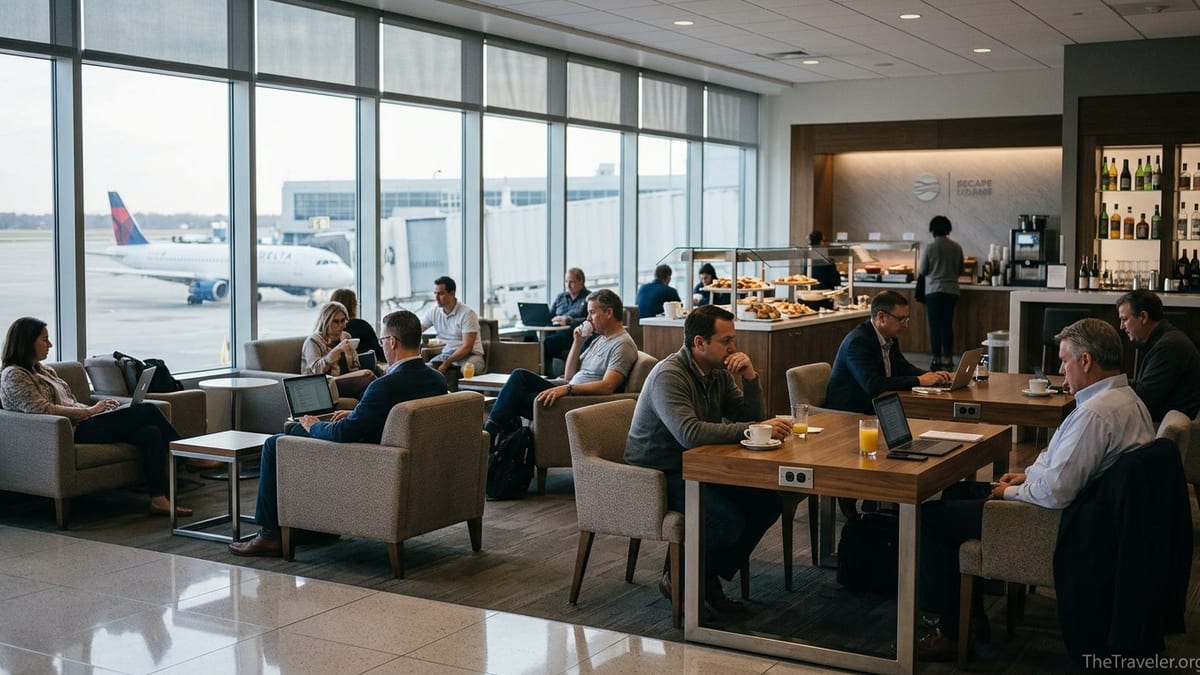
Inside, the lounges follow a broadly similar template: self-serve buffets with hot and cold items, a staffed bar, plenty of power outlets, reasonably fast Wi-Fi and a mix of dining tables, armchairs and bar seating. While they do not usually match the most elaborate Centurion Lounges or top-tier airline clubs, frequent flyers often rank Escape Lounges above many standard Priority Pass options in the U.S., particularly when it comes to the range of food and the overall cleanliness.
Operationally, each Escape Lounge is tailored slightly to its local airport, which means details like opening hours, menu variety and crowding patterns vary by location. For example, the MSP lounge has long been known for a more substantial buffet and good runway views, while some smaller locations like OAK offer a compact space that is still a welcome step up from the general gate area. That local variation is important when deciding whether an Escape Lounge at your specific airport is worth the effort.
Where You Find Escape Lounges and Typical Entry Prices
As of mid‑2026, Escape Lounges operate in roughly two dozen U.S. airports, including Minneapolis–St. Paul, Oakland, Sacramento, Fort Lauderdale, Greenville-Spartanburg, Columbus, Syracuse, Phoenix (separate lounges in Terminals 3 and 4), Reno-Tahoe, Kansas City, Hartford, Providence, Tulsa and San Juan, among others. The biggest practical takeaway is that they often appear exactly where traditional airline clubs are thin on the ground, giving travelers who do not fly a single airline enough a valuable alternative.
For travelers without eligible credit cards, the most straightforward way to get into an Escape Lounge is to buy a day pass. At many U.S. locations, advance online purchase starts at around 40 to 45 dollars per person, with same-day walk-up pricing commonly a bit higher. For instance, the Kansas City lounge advertises entry “from 45 dollars per person,” and similar pricing bands are visible across multiple U.S. locations. Children are usually discounted, though specifics depend on each lounge’s local policy.
Those entry fees are important when you compare Escape Lounges with competing options. A typical domestic airport meal with a drink can easily cost 25 to 35 dollars per person in 2026, especially at sit-down restaurants in hub airports. If you are likely to buy a main course, a coffee and a glass of wine or beer during a longer layover, a 45 dollar lounge visit that covers substantial food, soft drinks and many alcoholic beverages can pencil out as a better deal. On the other hand, if you tend to grab a quick sandwich and tap the airport water fountain, paying full freight for a day pass may feel steep.
It is also worth noting that Escape Lounges sometimes run promotions in partnership with airports or local tourism boards, offering discounted or bundled entry, particularly during off-peak seasons. These specials are not guaranteed and change frequently, so you should always check current details for the specific lounge you plan to use rather than relying on a single price point you have seen elsewhere.
How to Access Escape Lounges With Credit Cards
The biggest story for Escape Lounges in 2026 is credit card access. Many travelers never pay cash at the door because select American Express cards and some airline-invited premium passengers can enter for no additional fee beyond what they already pay in annual card charges or airfare. This is where Escape Lounges become genuinely compelling for frequent travelers and even for occasional flyers with the right card in their wallet.
From the Amex side, the American Express Platinum Card and the Centurion Card provide complimentary access to Escape Lounges as part of the Amex Global Lounge Collection. Updated 2026 guidance notes that cardholders can simply present their valid physical card, same-day boarding pass on any airline and a government-issued ID to enter. There is no separate per-visit fee for the primary cardholder, and Escape Lounges are explicitly listed as part of the network alongside Centurion, Priority Pass, Plaza Premium and certain airline lounges.
A second major group of travelers getting free Escape Lounge access comes via Delta’s top-end co-branded cards. Holders of the Delta SkyMiles Reserve American Express Card and the Delta SkyMiles Reserve Business American Express Card receive complimentary entrance to Escape Lounges, including those branded as Centurion Studio Partner locations, when they are flying on a same-day Delta-marketed or Delta-operated flight and paid for the ticket with an eligible Amex card. American Express’ own benefit descriptions emphasize that the name on the boarding pass must match the name on the card, and that guest fees match each lounge’s posted guest rate.
Guest policies are a crucial part of the value calculation. With the Platinum Card, guest access to Centurion Lounges has tightened in recent years, often requiring a fee unless the cardholder meets high annual spending thresholds. At Escape Lounges, though, policies are generally simpler: the cardholder enters for free, and guests pay the same rate posted for that lounge unless there is a special promotion. For a family of four with one Amex Platinum holder, the card covers the primary traveler, but paying three separate guest fees could wipe out the perceived “free” value of the benefit on a short trip.
What You Actually Get Inside: Food, Drinks and Space
Evaluating whether Escape Lounges are worth it requires a close look at what you genuinely receive once you check in. On the food front, travelers commonly find a rotating buffet with a handful of hot dishes, salads, snacks and desserts. At breakfast, that might mean scrambled eggs, breakfast potatoes, oatmeal and pastries; midday spreads often include soups, pasta or grain salads, and light hot entrees. While some reviews compare the quality as slightly below the very best Centurion Lounges, many still describe Escape Lounges as a noticeable upgrade over the typical Priority Pass-branded space at a similar airport.
The bar is another key feature. Most Escape Lounges offer a well-stocked selection of complimentary house wines, beers and basic spirits, with a menu of premium cocktails or top-shelf pours available for an extra charge. At the Escape Lounge in Minneapolis, for example, visitors report decent house wines and regional craft beers included at no extra cost, with higher-end liquors offered for a small surcharge. For travelers who would otherwise order two drinks at an airport bar, the included beverages alone can make a 40 to 45 dollar entry fee look reasonable.
Comfort and layout also matter. Escape Lounges typically provide a mix of restaurant-style two-top tables, soft seating clusters and bar-height workstations near power outlets. Many locations feature natural light and tarmac views, particularly at MSP and some of the newer lounges like Kansas City, where the design leans into wood textures and neutral tones instead of glossy branding. Wi-Fi is generally reliable and fast enough for video calls, though at peak times speeds can slow as more travelers log on.
The main downside is crowding. Because Escape Lounges sit at the intersection of Amex Platinum, Delta Reserve, occasionally Priority Pass, and day-pass traffic, popular locations can fill up during the morning and evening rush. When that happens, staff may limit entry even to eligible cardholders until space frees up, similar to policies at Centurion Lounges and airline clubs. If you are banking on a guaranteed quiet workspace before a meeting, you should treat access as “very likely” rather than absolutely certain, especially at mid-sized hubs.
Comparing Escape Lounges With Priority Pass and Airline Clubs
For many travelers, the real question is not simply “Are Escape Lounges good?” but rather “Are they better than my alternatives?” The answer depends heavily on your home airport, airline loyalties and which credit cards you already carry. At some airports, Escape Lounges are effectively the only high-quality option. At others, they compete directly with airline clubs and other independent spaces.
In the U.S., Escape Lounges often outperform the average Priority Pass lounge in terms of food variety and ambiance. Travelers active on frequent flyer forums regularly describe Escape locations like CMH, PHX Terminal 3 and SYR as “the best part of Priority Pass in the U.S.,” noting that while they may not match Centurion in sophistication, they are clearly superior to bare-bones lounges that offer little more than soft drinks and packaged snacks. This reputation helps explain why Escape Lounges are frequently cited as a major reason some travelers keep a Priority Pass membership at all.
When compared with airline-branded lounges, the picture is more nuanced. At a Delta hub like Minneapolis, for instance, a frequent flyer with both a Delta Sky Club membership and Amex Platinum might choose between a Sky Club and the Escape Lounge depending on crowding and location within the terminal. Some travelers prefer the Sky Club for its larger footprint and broader bar program, while others like the more relaxed vibe in the Escape Lounge, particularly during off-peak hours. In airports where Escape is the only lounge, such as Greenville-Spartanburg, the comparison is simply between “Escape or gate area,” and in those cases the lounge almost always comes out ahead for anyone facing a delay or long layover.
One more comparison point is reliability of access. Airline clubs sometimes restrict entry during severe crowding, especially when storm systems snarl operations. Escape Lounges can and do hit capacity as well, but because their membership is more diffuse, some travelers find that these spaces remain a bit more accessible at secondary airports even during irregular operations. That said, access rules continue to tighten across the industry, and travelers should not assume any lounge is guaranteed during peak holiday periods.
When Escape Lounges Are Worth It: Real-World Scenarios
The value of Escape Lounges emerges most clearly when you run through specific, real-world travel days. Imagine a solo business traveler flying from Kansas City to New York with a two-and-a-half-hour layover due to schedule changes. Without lounge access, they might spend 30 to 40 dollars on a sit-down lunch, coffee and maybe a glass of wine, while trying to take Zoom calls from a noisy gate. Buying a 45 dollar Escape Lounge day pass yields a quieter work environment, reliable Wi-Fi, a proper meal, coffee and house wine, plus easy access to power outlets. In that scenario, the incremental cost over normal airport spending might be only 5 to 15 dollars, which many travelers would happily pay.
Now consider a family of four traveling through Phoenix on vacation. One parent holds an Amex Platinum card. Entry for the primary cardholder is complimentary, but the lounge charges around 40 to 45 dollars per guest. If the family uses the lounge twice on a round-trip, they could easily spend more than 300 dollars in guest fees alone. If the kids are picky eaters and more excited about fast food in the terminal than a buffet, the value proposition becomes less clear. In that scenario, the Amex Platinum’s Escape benefit is nice to have, but it might not be the smartest way to extract value from the card unless the family has an unusually long delay.
Another common scenario involves irregular operations. Picture arriving in Hartford on a delayed evening flight with a misconnection that pushes your onward departure three hours later. The airport’s restaurants are closing, but the Escape Lounge remains open with hot food, snacks and a relatively quiet environment to regroup, rebook and rest. Many travelers who have found themselves unexpectedly stranded at a smaller airport report that the ability to retreat into an Escape Lounge can transform a stressful delay into a manageable, even productive interval.
Finally, there is the “work-from-airport” traveler who intentionally schedules a longer layover to clear email or take calls between cities. For a remote worker flying from Oakland to Denver with a four-hour buffer at OAK, a 45 dollar Escape Lounge visit can replace the cost of renting a day office, buying multiple coffees and scouring the terminal for quiet corners. When you view the lounge as a temporary coworking space with food, Wi-Fi and drinks included, the math often tips strongly in its favor.
Key Limitations and Fine Print to Watch
Despite their appeal, Escape Lounges come with a few important caveats. The first is that not all locations participate equally in every access program. Some Escape Lounges work with Priority Pass or airline invitations in addition to Amex and Delta access; others do not. The Phoenix Terminal 3 lounge, for instance, has confirmed Priority Pass participation in recent communications, while the Terminal 4 location has not. If you are counting on a third-party membership for entry, you should always verify that your particular card is accepted at that specific lounge and terminal.
Second, many of the premium credit card access rules are tightening. American Express has gradually introduced visit caps, spending thresholds and time limits across several parts of its lounge portfolio. While Escape Lounge access for Platinum and Centurion cardholders is still relatively straightforward in mid‑2026, related rules for Centurion Lounges and Delta Sky Club visits have become more restrictive, and guest fees at various lounges have increased. It is reasonable to expect that Escape Lounge policies could continue to evolve, which means travelers should treat current terms as subject to change rather than permanent guarantees.
Third, entry requirements can extend beyond simply holding the right card. Delta Reserve cardholders, for example, must generally be flying on a same-day Delta-marketed or Delta-operated flight booked with an Amex card to access Escape Lounges under their complimentary benefit. Similarly, some locations may only admit travelers within a fixed window before departure, typically around three hours, particularly during busy periods. Showing up at 8 a.m. for a 3 p.m. flight is unlikely to be allowed even if the lounge is nearly empty.
Lastly, not every traveler values the same amenities. If you rarely drink alcohol, travel mostly on very short hops, or prefer to spend layovers walking the terminal instead of sitting, the core lounge benefits might hold less appeal. In those cases, the headline notion of “free lounge access” tied to a premium credit card can be more psychological than practical. The real measure is how often you would have used a lounge in the absence of any benefit, and whether Escape specifically improves those trips enough to justify the costs of access.
The Takeaway
Escape Lounges occupy a useful niche in the current airport lounge ecosystem: better food and ambiance than many generic Priority Pass locations, more accessible than some airline clubs, and physically present in airports where you might otherwise have no lounge at all. For travelers with the right American Express or Delta Reserve cards, that combination can turn a frustrating layover into a much more comfortable experience, effectively for no incremental cost beyond existing annual fees.
Whether they are “worth it” comes down to how you travel. If you hold an Amex Platinum or Delta Reserve card and frequently pass through airports like MSP, PHX, OAK, CMH or GSP, Escape Lounges are almost certainly worth using whenever time allows. The included food, drinks, Wi-Fi and relative calm can easily match or exceed what you would otherwise spend in the terminal. On the other hand, if you only travel once a year, do not hold a qualifying card and would need to pay 40 to 50 dollars per visit out of pocket, an Escape Lounge will feel like a luxury splurge rather than a clear-cut value play.
The smartest approach is to treat Escape Lounges as a flexible tool in your travel toolkit rather than a must-use benefit. Check whether your specific airport has one, verify current access rules for your cards, and weigh the day’s circumstances: length of layover, need for quiet work time, hunger level and likely airport spending. When those factors align, walking through the door of an Escape Lounge can be one of the best ways to turn airport time from a chore into a perk.
FAQ
Q1. What is an Escape Lounge and who operates it?
Escape Lounges are independently operated airport lounges, often branded as “Escape Lounge – The Centurion Studio Partner” in the U.S. through a partnership with American Express. They are not owned by a specific airline and instead serve travelers from any carrier who meet the access criteria.
Q2. How much does it cost to enter an Escape Lounge without a credit card?
Most U.S. Escape Lounges charge around 40 to 45 dollars per person when you book in advance online, with walk-up prices sometimes slightly higher. Children may be discounted depending on the specific lounge, so you should always check the current pricing for the exact airport you plan to use.
Q3. Which credit cards give free access to Escape Lounges?
The American Express Platinum Card and Centurion Card provide complimentary access to Escape Lounges as part of the Amex Global Lounge Collection. In addition, Delta SkyMiles Reserve and Delta SkyMiles Reserve Business cardholders receive complimentary access when flying on a same-day Delta-marketed or Delta-operated flight booked with an eligible Amex card.
Q4. Can I bring guests into an Escape Lounge with my Amex Platinum or Delta Reserve card?
Yes, but guests are not usually free. With Amex Platinum or Delta Reserve, the primary cardholder enters Escape Lounges at no extra charge, while guests typically pay the posted guest fee for that location. Exact guest pricing and any promotions vary by lounge and can change over time.
Q5. Are Escape Lounges better than Priority Pass lounges?
Many travelers report that Escape Lounges offer better food, drink selection and ambiance than the average Priority Pass-branded lounge in the U.S., especially at airports like Columbus, Phoenix Terminal 3 and Syracuse. However, quality can vary by location, and some full-service airline clubs and top-end independent lounges may still provide a more premium experience.
Q6. Do Escape Lounges accept Priority Pass for entry?
Some, but not all, Escape Lounges have relationships with Priority Pass or similar memberships. For example, the Phoenix Terminal 3 Escape Lounge has confirmed Priority Pass participation, while the Terminal 4 lounge has not. Because participation differs by location and can change, you should verify current acceptance for your specific lounge before relying on Priority Pass for entry.
Q7. What food and drink can I expect inside an Escape Lounge?
Most Escape Lounges offer a buffet with hot and cold dishes, such as breakfast eggs and pastries in the morning or soups, salads and hot entrees later in the day. Soft drinks, coffee and tea are complimentary, along with a selection of house wines, beers and basic spirits. Premium cocktails or top-shelf liquors are often available for an additional charge.
Q8. How early can I enter an Escape Lounge before my flight?
Policies vary, but a common rule is that travelers may enter within about three hours of their scheduled departure, especially at busier locations. During peak periods staff may enforce these time limits more strictly, so arriving extremely early for a flight may not guarantee lounge access even if you hold an eligible card.
Q9. Are Escape Lounges usually crowded?
Crowding levels depend on the airport and time of day. At mid-sized hubs such as MSP or PHX, Escape Lounges can become busy during morning and evening peaks and may temporarily restrict entry when they reach capacity. At smaller airports or off-peak hours, they are more likely to feel calm and spacious.
Q10. How do I decide if using an Escape Lounge is worth it for my trip?
Start by comparing the entry cost or effective cost of your credit card to what you would otherwise spend in the terminal on food, drinks and workspace. Factor in the length of your layover, your need for a quiet place to work or relax, and whether the lounge is conveniently located for your gates. If you have a long wait, expect to buy a meal and value a calmer environment, an Escape Lounge visit often makes financial and practical sense.