


More news on this day
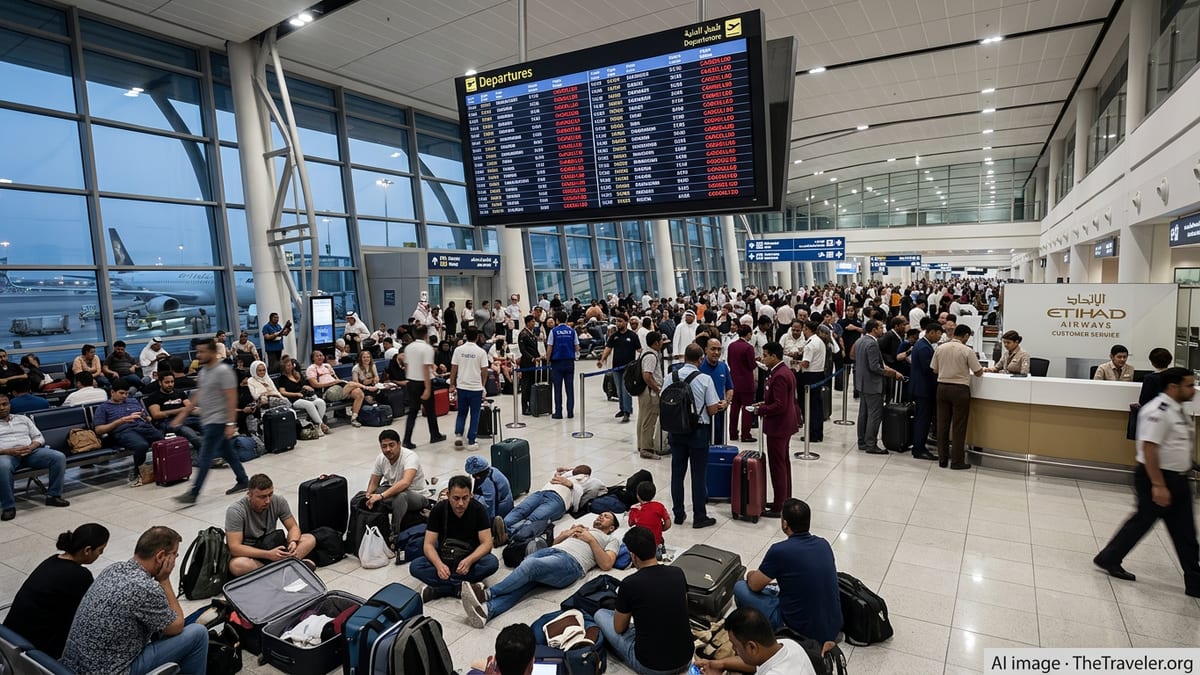
About 200 passengers were left stranded at Delhi’s Indira Gandhi International Airport after Etihad Airways cancelled a late-evening flight to Abu Dhabi, with reports indicating travelers had already boarded before being asked to disembark as the delay stretched into a cancellation.
Get the latest news straight to your inbox!
What happened at Delhi airport
Published coverage indicates the disruption involved Etihad flight EY217, scheduled to depart Delhi for Abu Dhabi late Saturday night. Travelers reported that boarding began as usual, but the departure did not proceed as planned and the aircraft remained on the ground for an extended period.
Reports describe passengers being informed of a technical issue after boarding and then being asked to deplane. After additional waiting at the terminal, the flight was ultimately cancelled, leaving many passengers to seek alternate options at the airport during late-night hours.
Multiple outlets identified the aircraft type as a Boeing 787, and flight-tracking data published online lists the route as a regular Etihad service between Delhi (DEL) and Abu Dhabi (AUH). While the specific fault has not been publicly detailed, the incident underscores how last-minute technical problems can quickly cascade into missed onward connections and overnight disruption for travelers.
Immediate impact: missed connections and limited rebooking options
For passengers traveling onward via Abu Dhabi, a cancellation at the origin can be particularly disruptive because it can collapse an entire itinerary. Abu Dhabi is a major transfer hub for Etihad’s network to destinations across the Gulf, Europe, and North America, and many travelers on Delhi to Abu Dhabi services use the flight as a short first leg in a longer journey.
When a cancellation happens close to departure, seats on the next available services can be scarce, especially on high-demand trunk routes between India and the UAE. Even when an airline offers rebooking, capacity constraints can mean long waits for confirmed alternatives, with some travelers opting to buy last-minute tickets on other carriers if urgent travel is required.
Separate from immediate seat availability, published coverage of other recent disruption periods in the region has highlighted that irregular operations can trigger ripple effects, including congestion at airport service desks, long call-center queues, and uncertainty about whether travelers should stay at the airport or return home or to a hotel while awaiting new arrangements.
Passenger rights and what travelers may be entitled to
In India, airline obligations during cancellations and long delays are shaped by the Directorate General of Civil Aviation’s passenger-protection framework, which outlines responsibilities around refunds, alternate arrangements, and certain forms of assistance when passengers are affected by disruptions. Publicly available government guidance notes that carriers are expected to provide support in line with these requirements in cancellation and delay scenarios.
Etihad also publishes passenger-rights information and conditions of carriage that describe how it handles flight disruption and what assistance may apply depending on circumstances. The airline’s published legal notices indicate that certain care or reimbursement may be available in specific situations, while also noting limitations and conditions that can apply, including distinctions between airline-controlled disruptions and those beyond an airline’s control.
For affected travelers, practical next steps typically include confirming whether the airline has rebooked the passenger automatically, requesting a refund if travel is no longer needed, and retaining receipts if the traveler incurs eligible out-of-pocket expenses that may be considered for reimbursement under applicable policies. Because eligibility can depend on ticket type, routing, and the reason for cancellation, travelers often need to review the rules that apply to their specific booking and departure point.
Broader context: operational reliability, aircraft swaps, and regional disruptions
The Delhi to Abu Dhabi market is served by multiple airlines and operates at high frequency, making it competitive but also sensitive to sudden operational shocks. A technical fault discovered near departure can lead to a lengthy ground delay while checks are performed, and if a replacement aircraft or required parts are not immediately available, a cancellation may be the outcome.
In parallel, travelers in the Gulf region have also seen periodic spikes in delays and cancellations tied to wider operational disruptions. Recent published travel advisories and reporting have pointed to episodes where multiple services were impacted over short windows, adding strain to already busy schedules and increasing the knock-on impact when a single flight is cancelled.
For passengers, the takeaway is that even when the cause is localized to one aircraft, the outcome can be amplified by broader constraints such as aircraft rotations, crew duty limits, airport curfews, and the availability of spare aircraft positioned at the right airport at the right time.
What to do if your flight is cancelled after you arrive at the airport
Travelers faced with a last-minute cancellation generally benefit from acting quickly across multiple channels: checking the booking in the airline’s app or website for automated rebooking, joining the service-desk queue while also calling customer support, and documenting the disruption with screenshots of flight status and booking changes. Where travel is time-sensitive, comparing alternate routings on the same day can be important before remaining seats sell out.
For those who must travel urgently, an option can be rebooking on another carrier if the airline’s next available flight is too far out, although this can be expensive at short notice. In those cases, passengers may still pursue refunds for the unused portion of the original ticket under the fare rules and applicable passenger-protection requirements.
Travelers with onward international connections should also review whether their travel insurance or credit card travel coverage includes trip interruption or delay benefits. Coverage terms vary widely, and many policies require evidence such as cancellation notifications, proof of additional expenses, and confirmation that the disruption caused a missed connection or extended delay.