


More news on this day
Etihad Airways, in partnership with Abu Dhabi tourism and insurance providers, has introduced complimentary medical travel insurance for eligible international visitors, positioning the UAE capital as a safer hub choice amid continuing global flight disruption.
Get the latest news straight to your inbox!
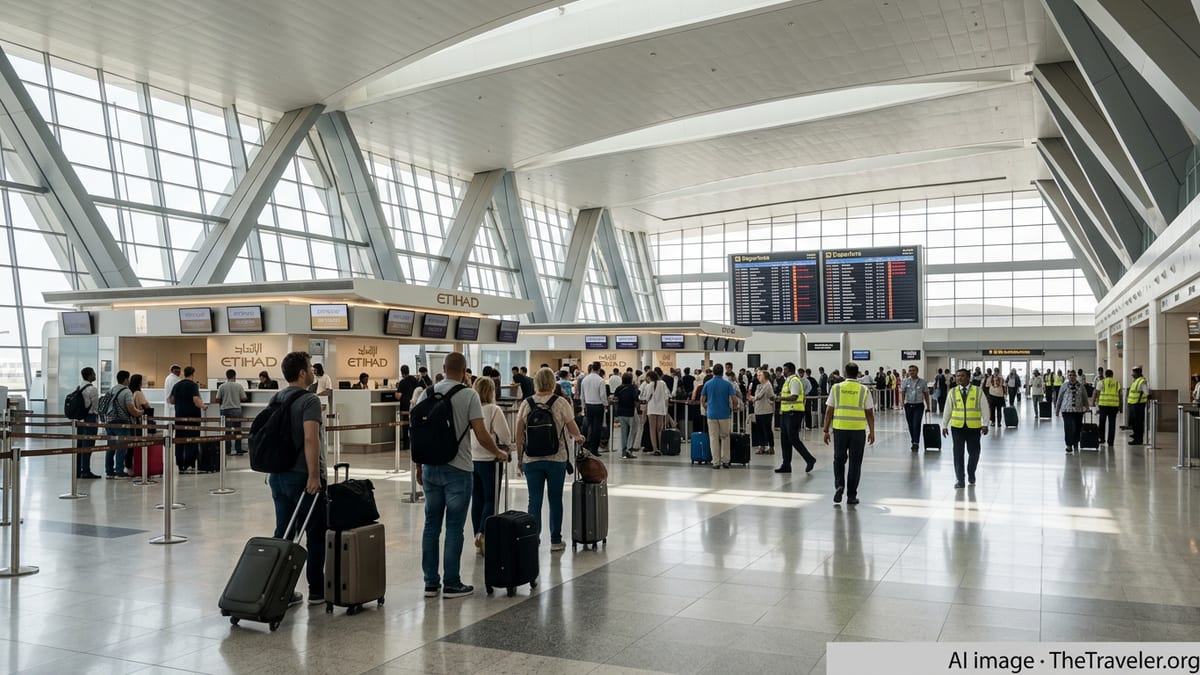
A New Medical Safety Net for Abu Dhabi Arrivals
Publicly available information indicates that from July 2026, international visitors flying into Abu Dhabi on Etihad-operated services will receive automatic medical travel insurance for a limited stay, at no extra cost embedded in the ticket. Coverage is described in regional media and industry reporting as focused on emergency healthcare during a visitor’s time in the emirate, effectively acting as a medical safety net for travelers worried about falling ill away from home.
Reports from Gulf-based outlets describe the initiative as a joint effort between Etihad Airways, Abu Dhabi’s culture and tourism authorities, and a domestic insurer. The product is framed as a city welcome measure rather than a traditional add-on upsell, with the explicit aim of encouraging travel to Abu Dhabi at a time when many passengers remain wary of medical risks and logistical turmoil on international routes.
While exact benefit limits vary by report, coverage is characterized as including emergency medical expenses for a defined period, typically up to around two weeks from arrival in Abu Dhabi. The insurance is not advertised as a replacement for comprehensive travel policies, but as an additional layer of reassurance for inbound visitors whose plans may already be strained by cancellations and rerouting across multiple carriers.
For Etihad, the free cover supplements its existing paid travel insurance products, which continue to be offered through global providers such as AXA under the FlySafe and FlySafe Plus branding. Those optional policies, according to Etihad’s own documentation, include broader protections such as trip cancellation, delays, medical evacuation and, in some versions, limited dental and legal assistance.
Responding to Months of Severe Network Disruption
The new medical insurance initiative comes after several months in which Etihad’s Abu Dhabi hub has been heavily affected by regional airspace restrictions and security concerns. From early March 2026, multiple reports from aviation outlets and passenger forums documented widespread cancellations, shortened route lists and temporary suspensions on services into and out of Zayed International Airport.
Schedule data and specialist aviation coverage show that Etihad has been gradually rebuilding its network, restoring dozens of daily flights and reopening routes from Abu Dhabi to Europe, Asia and the Americas. Flexible rebooking options, extended change windows and fee waivers have featured prominently in public announcements, reflecting a continuing effort to manage disrupted itineraries while keeping bookings on the books.
Travel advisories and independent analyses describe the broader situation as volatile, with some passengers facing last-minute changes, longer layovers or rerouting via alternative hubs. Online accounts from travelers detail experiences ranging from smooth rebooking to multi-day delays and out-of-pocket accommodation costs, underscoring the uneven impact of disruption across the passenger base.
Within this context, the decision to underwrite complimentary inbound medical cover for Abu Dhabi visitors is being interpreted by travel industry commentators as part risk-management tool, part confidence-building signal. It aligns the emirate with a wider regional pattern in which tourism-driven destinations deploy targeted insurance measures to offset traveler anxiety during periods of geopolitical uncertainty.
How the Complimentary Cover Fits With Etihad’s Existing Insurance Suite
Etihad’s own travel insurance pages outline a tiered portfolio of paid products that remain available alongside the new free cover. The airline’s long-standing arrangements, offered in partnership with international insurers, typically allow customers in selected countries to purchase protection against emergency medical costs, evacuation, personal liability and travel inconvenience such as cancellations, delays and baggage issues.
These FlySafe-branded policies are sold as optional extras at booking or via the airline’s manage-booking channels. Policy documents highlight 24-hour assistance services, defined medical expense limits, and specified triggers for compensation when flights are delayed or itineraries are cut short for covered reasons. Separate wording was introduced in the past to address pandemic-era medical risks, indicating that certain infectious disease scenarios can be included if they occur during the trip.
By contrast, the new complimentary medical travel insurance for Abu Dhabi-bound visitors is reported to be narrower in scope and geographically confined. The focus is on emergency treatment and related medical support while the traveler is in the emirate, rather than covering the full arc of a multi-country journey. Analysts note that passengers who want protection for trip cancellations, missed connections or nonrefundable hotels on other legs of their itinerary are still likely to need private travel insurance purchased independently.
Nonetheless, industry commentary suggests that the free medical cover meaningfully reduces the perceived downside of routing through Abu Dhabi at a time when some travelers are re-evaluating their choice of hub. The combination of a gradually normalizing schedule, flexible rebooking policies and medical cost protection on arrival is being described as a three-part strategy to shore up Etihad’s competitive position against other Gulf carriers.
Implications for Travelers Navigating Global Flight Chaos
For passengers, the most immediate implication of the new scheme is a shift in how risk is distributed. Instead of relying solely on their own insurance arrangements, eligible visitors to Abu Dhabi now benefit from a locally supported layer of medical protection for a defined period, without additional paperwork beyond holding an Etihad ticket into the city.
Travel advisors and consumer advocates examining the move point out that the offer may be particularly valuable for those who have found comprehensive policies more expensive or harder to obtain amid changing risk assessments by global insurers. Younger travelers, visitors on short city breaks and those connecting through Abu Dhabi on complex itineraries are seen as likely beneficiaries, especially where underlying medical systems at origin are costly or difficult to access from abroad.
At the same time, publicly available guidance stresses that passengers should read the fine print carefully. Complimentary schemes generally come with eligibility criteria, territorial limits, exclusions for pre-existing conditions and defined maximum payouts. They also may not address non-medical losses that have become common during recent disruption, such as last-minute schedule changes, missed onward flights or denied boarding caused by capacity constraints.
Observers note that the launch also signals how airlines and destination authorities are responding to what some analysts describe as a “new normal” of chronic disruption. Rather than relying solely on schedule reliability, carriers and tourism boards are increasingly turning to financial instruments like insurance and guarantees to reassure nervous travelers who have watched conflict zones, weather extremes and staffing shortages repeatedly spill over into global air travel.
Abu Dhabi’s Bid to Reassure and Attract Visitors
Within the United Arab Emirates, the initiative is being interpreted as part of Abu Dhabi’s wider push to distinguish itself as a secure, well-managed gateway during a turbulent period for long-haul flying. Tourism-focused coverage emphasizes that the emirate is competing not only with neighboring Dubai but also with other major hubs that have sought to highlight safety protocols, health infrastructure and traveler protection mechanisms in their marketing.
Abu Dhabi has invested for years in hospital capacity, emergency response systems and tourism infrastructure, and the new medical insurance layer is being presented in regional media as the latest expression of that strategy. The scheme allows local authorities and partners to frame the city as a destination where health risks are actively managed rather than passively accepted, a message that resonates strongly with risk-conscious travelers and corporate travel managers.
Aviation analysts suggest that if the program proves popular, it could become a template for similar collaborations elsewhere, with airlines, insurers and destination marketing bodies sharing the cost of such guarantees. The move could also place competitive pressure on rival carriers to enhance their own disruption and medical support offerings, particularly on routes where Abu Dhabi is positioned as an alternative to other Gulf or European hubs.
For now, the free medical cover serves as a prominent signal at a moment when traveler confidence remains fragile. As global networks continue to stabilize only gradually, measures that directly address passenger fears about falling ill abroad may carry as much weight as loyalty points or onboard amenities in shaping how and where people choose to fly.