


More news on this day
Air travel between Europe, the Gulf and wider Middle East is facing renewed disruption as Ireland aligns with Sweden, Germany, France, Italy, Spain and other European Union members in enforcing an extended conflict zone advisory covering Bahrain, the United Arab Emirates, Saudi Arabia, Oman and seven additional regional states, prompting widespread rerouting, delays and flight suspensions for travelers across the globe.
Get the latest news straight to your inbox!
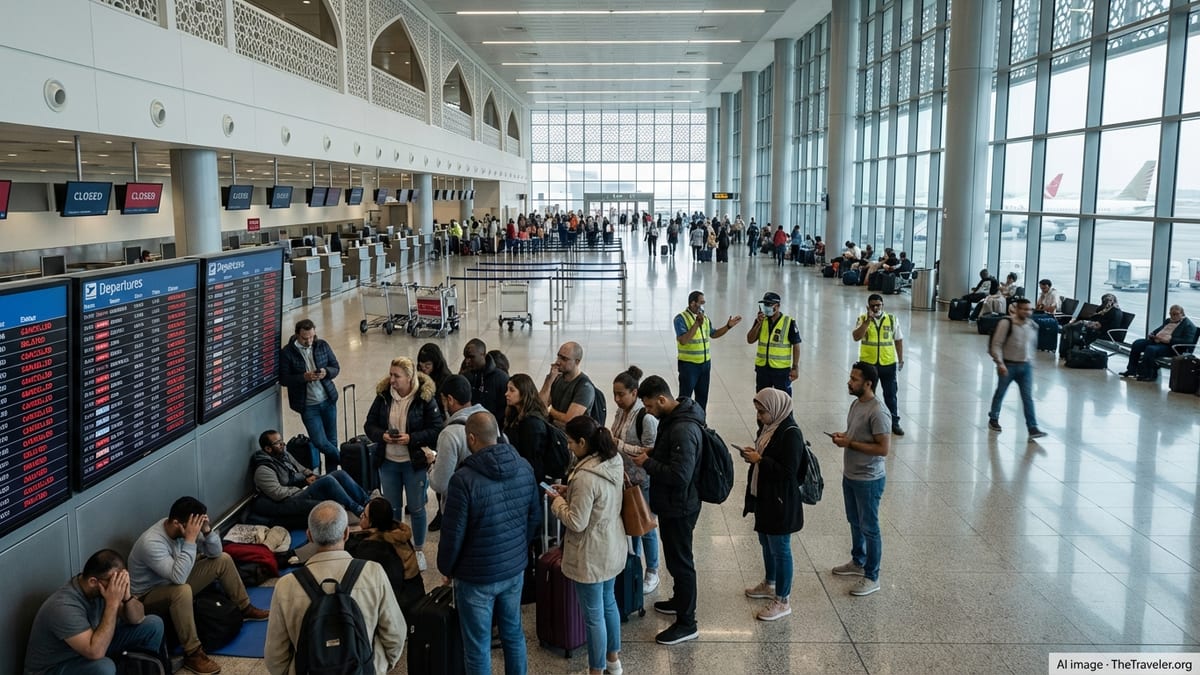
EU Extends Middle East Conflict Zone Advisory
Publicly available information shows that the European Union Aviation Safety Agency has prolonged its Conflict Zone Information Bulletin over a broad swathe of Middle Eastern and Gulf airspace, including Bahrain, the UAE, Saudi Arabia, Oman, Qatar, Kuwait, Iran, Iraq, Israel, Jordan and Lebanon. The advisory, which currently runs until at least 24 April 2026, urges European carriers to avoid or severely restrict operations in the affected flight information regions due to elevated military activity and risks to civil aviation.
Reports indicate that this latest revision of the bulletin, referenced as CZIB 2026-03-R6, reflects a complex security picture following missile and drone attacks across the Gulf and Levant, as well as recent incidents affecting major hubs and fuel infrastructure. The guidance highlights that modern weapons systems can operate at all flight levels, making overflight exposure a central concern rather than only departures and arrivals in the region.
Travel and aviation industry coverage notes that, while some Gulf states have partially reopened their airspace under tightly controlled corridors, the EU advisory still treats large areas as high-risk. Airlines under European jurisdiction are required to demonstrate compliance through route planning and operational risk assessments, which in practice means avoiding many of the shortest paths between Europe and Asia.
Specialist aviation risk platforms mirror this assessment, listing Bahrain, the UAE, Saudi Arabia, Oman and several neighbouring countries as airspace to be avoided wherever possible. This layered caution, combining national and EU-level directives, is now driving a second wave of schedule changes just as some carriers had begun cautiously rebuilding their Gulf networks.
Ireland Aligns with Sweden, Germany, France, Italy and Spain
In the wake of the extended EU bulletin, Ireland has formally joined Sweden, Germany, France, Italy, Spain and other member states in applying uniform conflict zone protocols to its registered airlines. According to published coverage, this means Irish carriers are now bound by the same restrictions as their continental counterparts when planning routes across the Gulf region and wider Middle East.
Ireland’s move comes alongside broader travel advice updates from Dublin that warn against non-essential trips to parts of the Gulf, citing volatile security conditions and ongoing missile and drone activity. Earlier government advisories had already urged citizens to reconsider journeys to countries such as Kuwait, Bahrain, the UAE, Qatar, Jordan and Saudi Arabia, and the EU-wide aviation stance now reinforces those cautions in the airspace domain.
For major European aviation markets such as Germany, France, Italy and Spain, the advisory effectively standardises the response across national regulators. Reports from European travel media describe coordinated enforcement, with carriers in these countries obliged to reroute around sensitive airspace and to avoid specified flight levels or entire flight information regions when risk thresholds are exceeded.
Nordic states including Sweden have also aligned with the EU framework, giving the bulletin a pan-European scope that reaches from Ireland’s Atlantic gateways to Scandinavia’s hubs. This collective stance amplifies the impact on global connectivity, as a critical mass of European airlines recalibrate their schedules away from the most direct Gulf crossings.
Rerouting, Longer Flight Times and Network Strain
With large portions of Gulf and Middle East airspace now constrained, airlines are increasingly funnelling long-haul traffic through alternative corridors over Central Asia, the Caucasus, North Africa and the eastern Mediterranean. Aviation advisories and consultancy analyses describe heavy congestion in the remaining open east–west routes, particularly those traversing Saudi Arabia or skirting the conflict zone via Egypt and Türkiye.
The immediate effect for passengers is longer flight times on many Europe–Asia and Europe–Australasia services, as aircraft detour hundreds of kilometres around sensitive zones. Travel industry reports highlight additional fuel stops on some ultra-long-haul sectors and a tightening of payload limits to accommodate extra fuel, which can in turn reduce available seats or cargo capacity.
Airport disruption is also mounting. Major hubs such as Dubai, Doha, Abu Dhabi and Kuwait City have experienced rolling schedule changes as local authorities balance partial reopenings with precautionary closures and slot restrictions. Case studies of recent drone and missile incidents around fuel and airport infrastructure have underscored the fragility of operations in the region, with closures at short notice forcing wide-body diversions and last-minute crew and aircraft repositioning.
Industry updates indicate that several European carriers have suspended or sharply reduced flights to certain Gulf destinations while maintaining limited operations to others under carefully defined corridors. This patchwork approach is designed to preserve some connectivity while remaining compliant with the EU’s conflict zone guidance and internal airline risk models.
Global Ripple Effects for Leisure and Business Travel
The airspace constraints are not only a regional issue. Because Gulf hubs traditionally function as key bridges between Europe, Asia, Africa and Oceania, restrictions on Bahrain, the UAE, Saudi Arabia, Oman and neighbouring states are echoing across global itineraries. Travel advisories from markets as far away as Australia and New Zealand warn of potential disruption on routes transiting the Gulf, even where airlines continue to operate under modified flight plans.
Tour operators and corporate travel managers are reporting a rise in itinerary changes, with passengers being rebooked through alternative hubs in Europe, North Africa or Southeast Asia. Trade press coverage notes that some travellers have been shifted from Gulf-based carriers to European or Asian airlines using more northerly or southerly routings, often involving additional connections or overnight layovers.
The uncertainty has prompted flexible booking policies from several major airlines, allowing passengers to change dates or routes without standard penalties on affected services. Nonetheless, travelers are still encountering full flights, limited rebooking options during peak periods and increased journey times, particularly on short-notice bookings in and out of the Middle East.
Air cargo flows are also being reshaped, with freight operators diverting around closed or constrained airspace and, in some cases, shifting high-value shipments to maritime or multimodal routes. Analysts suggest that these changes could add cost and complexity to global supply chains, especially for industries reliant on rapid Middle East–Europe or Asia–Europe transport.
What Travellers Should Expect in the Coming Weeks
With the current EU conflict zone advisory in place until at least 24 April 2026, publicly available forecasts from aviation risk specialists suggest that operational disruption is likely to persist into the early summer season. Even if security conditions continue to ease under recent ceasefire arrangements, regulators and airlines are expected to take a cautious approach to restoring pre-crisis routings.
Travel organisations advise passengers planning trips involving Bahrain, the UAE, Saudi Arabia, Oman or neighbouring countries to monitor airline notifications closely and to expect potential last-minute adjustments. Routing changes, aircraft swaps and revised departure times may occur even on the day of travel as carriers respond to shifting risk assessments and evolving airspace notices.
For journeys that simply overfly the region en route between Europe and Asia, itineraries may continue to show longer scheduled flight times than before the current crisis. Ticket prices on some city pairs could remain elevated where demand is being funnelled through a limited number of safe corridors and alternative hubs, while seat availability may tighten on routes that bypass the Gulf entirely.
Industry observers note that the coordinated stance taken by Ireland, Sweden, Germany, France, Italy, Spain and other EU members signals a sustained period of heightened caution rather than a short-lived response. Until there is a durable improvement in the regional security environment, the Gulf’s role as a seamless crossroads in global aviation is likely to remain constrained, and travelers worldwide will need to factor additional time and flexibility into their plans.