


Driving or taking a bus between Croatia and Bosnia and Herzegovina has always meant crossing an external border of the European Union. Since the EU’s new Entry/Exit System (EES) became fully operational in April 2026, those checks look and feel different for many non‑EU travelers. This guide explains in plain language what is happening at the Croatia–Bosnia border, who is affected, and how to plan your trip with realistic expectations.
Get the latest updates straight to your inbox!
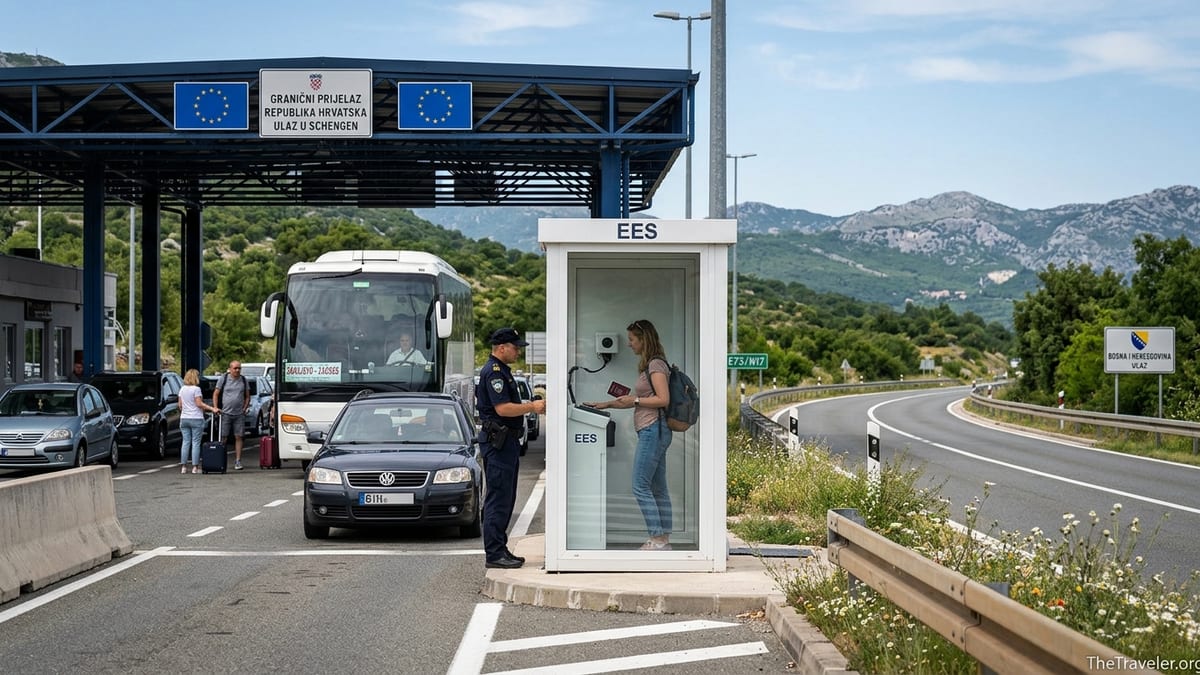
What the EU Entry/Exit System Actually Is
The Entry/Exit System is a large EU‑wide digital database that records when non‑EU nationals enter and leave the Schengen Area for short stays. Instead of relying on manual passport stamps, border guards now scan passports and capture biometric data to create an electronic record of your movements at external Schengen borders, including those between Croatia and Bosnia and Herzegovina.
The EU began phasing in the system in October 2025 and it became fully operational on 10 April 2026 at all external Schengen border crossing points. From that point, EES has gradually replaced routine stamping of passports for travelers who fall under the system. Croatia, a Schengen member since 2023, applies EES at its land borders with Bosnia and Herzegovina as part of this EU‑wide roll‑out.
EES is not a new visa category and it does not change the basic rule that most non‑EU visitors can spend up to 90 days in any 180‑day period in the Schengen Area. Instead, it enforces that rule more precisely by tracking entries, exits and any refusals of entry in a central system that border officers can consult each time you cross.
The system is operated on behalf of all participating states by the EU agency eu‑LISA. It is in use at air, sea and land borders throughout the Schengen Area, which currently includes Croatia and most other EU and some non‑EU countries, but not Bosnia and Herzegovina.
Who EES Applies To at the Croatia–Bosnia Border
EES applies to non‑EU, non‑EEA and non‑Swiss nationals entering the Schengen Area for short stays, either with a short‑stay visa or as visa‑exempt visitors. In practice, this means that most tourists from countries such as the United States, United Kingdom, Canada, Australia, as well as many travelers from Asia, Africa and the Americas, are registered in EES when they cross from Bosnia into Croatia.
By contrast, EU citizens, EEA nationals and Swiss citizens are not registered in EES when they cross the external border. Certain other categories are also exempt, such as long‑stay residence permit holders in a Schengen country who cross using their residence card and passport. Because legal categories can change and some exemptions are quite technical, travelers with residence rights in an EU or Schengen state should always check up‑to‑date guidance from their national authorities before travel.
Croatia treats Bosnia and Herzegovina as a neighboring non‑EU country at its external Schengen border. Bosnian citizens who do not hold residence in an EU state are third‑country nationals for the purposes of EES, even though they may have close daily ties across the border. When such travelers enter Croatia for a short stay, they are generally subject to EES registration and verification like any other non‑EU visitor.
If you are unsure which category you fall into, the practical rule of thumb is simple. If your passport is not from an EU, EEA or Swiss country and you are entering Croatia for a stay of up to 90 days, you should assume that EES will apply to you when you cross from Bosnia and Herzegovina into Croatia.
What Data EES Collects and What Happens at First Registration
At your first crossing where EES applies, border officials create an individual file for you in the system. According to official EU explanations, this file includes your basic passport details (such as name, nationality, document number and expiry date), information about your entry (date, border crossing point and the country that admitted you), and biometric data. Biometrics are currently a live facial image and fingerprints collected at the border.
The facial image is usually taken on the spot, similar to a mug‑shot style photo at a kiosk or camera next to the passport booth. Fingerprints are captured by asking you to place some or all fingers on an electronic scanner. These steps are in addition to the routine passport scan that already happens at modern borders. If a traveler refuses to provide the required biometric data for EES without falling into an exempt category, the EU rules state that entry to the Schengen Area can be refused.
Once your data is stored, it is kept for a limited period that is defined in EU law, typically counting from your last exit from the Schengen Area. On later trips, you do not usually go through a full registration again. Instead, the system verifies your identity and travel history against the existing record, which can make repeat crossings somewhat faster than the first time, provided there are no complications with your stay length or documents.
For privacy reasons, only authorized border and migration authorities can access EES, and only for restricted purposes such as border checks, return procedures and certain law‑enforcement investigations. Ordinary commercial companies, hotels and transport operators do not have access to the database, although they may still check your passport independently for their own requirements.
Crossing from Croatia into Bosnia: Exit Checks and What to Expect
When you leave Croatia for Bosnia and Herzegovina by road, you pass through a Croatian exit checkpoint and then a Bosnian entry checkpoint. At the Croatian booth, border police carry out systematic checks for all travelers because this is an external Schengen border. For travelers subject to EES, your exit is recorded electronically, and in many cases your passport will no longer be stamped.
In practice, non‑EU travelers often experience a mix of digital and manual procedures. On bus routes and at busy car crossings, officers may briefly take all passports for scanning, then return them. If your first EES registration happened at an earlier entry to the Schengen Area, the Croatian officer will usually only verify your identity and record the exit in the system. Additional biometric steps at exit are possible but are not always applied systematically, particularly if your data is already in EES and there are no alerts.
After clearing Croatian exit controls, you continue to the Bosnian side. Bosnia and Herzegovina is not part of Schengen or the EU, so its border police apply their own national entry rules. This typically means a passport check and, depending on your nationality, possibly a visa or proof of sufficient funds and onward travel. EES is not used by Bosnian authorities, so the data capture on that side remains separate from the EU system.
At many smaller Croatia–Bosnia crossings, local traffic between border communities is frequent and facilities can be modest. As EES roll‑out at land borders is still being fine‑tuned in some places, travelers may occasionally find that biometric equipment is only operated during certain hours or that staff are adapting to new procedures. These patterns can change quickly, so it is wise to allow extra time, especially during weekends and holidays.
Crossing from Bosnia into Croatia: Entry Checks and EES in Action
When you return from Bosnia and Herzegovina to Croatia, you first encounter Bosnian exit controls and then Croatian entry checks. The Bosnian exit is generally straightforward, involving a passport scan and any national procedures that apply to you. There is no EES step at this stage, because the system operates only on the Schengen side of the border.
The critical part for EES is the Croatian entry checkpoint. Non‑EU travelers should expect their passports to be scanned and, if it is their first EES registration, to provide fingerprints and a facial image. On bus and coach routes, everyone typically has to disembark with their luggage on the Croatian side so that border guards can conduct checks and any necessary biometric capture inside the terminal or at dedicated kiosks.
On later entries, the process may be faster. If your details and biometrics are already stored, the officer will normally verify your identity and confirm you still have days left under the 90/180‑day rule, then record your new entry electronically. Many travelers report that since full EES roll‑out in April 2026, Croatian officers are more reluctant to stamp passports and instead rely on the digital record, although occasional stamps may still be issued in exceptional cases, for example if there is a technical issue.
Because EES has added steps at busy external borders, queues can be longer than travelers were used to before 2026, particularly at major crossings used by holiday traffic and long‑distance buses. Reports from the 2026 summer season mention multi‑hour waits at some Balkan land borders during peak weekends. While not all Croatia–Bosnia posts experience such extremes, you should plan on extra time compared with pre‑EES years, especially if your journey to Croatia continues directly to a flight or ferry.
Restricted Minor Crossings and Why They Matter for Bosnian Citizens
One very practical consequence of EES at the Croatia–Bosnia border concerns which crossings third‑country nationals may use. In June 2026, the Border Police of Bosnia and Herzegovina published a formal information notice about the application of EES at certain border crossing points with Croatia. The notice explains that some minor crossings lack appropriate infrastructure to perform full EES procedures.
Because of this, the Bosnian authorities have stated that third‑country nationals who are subject to EES, including Bosnian citizens without residence in an EU member state, cannot use those particular minor crossings to enter Croatia and thus the EU until further notice. The notice lists several specific local border posts where only categories exempt from EES, such as certain local border traffic permit holders, may still cross into Croatia.
The exact list of affected crossings, and the categories still allowed to use them, can change as Croatia upgrades facilities and as the two countries revise their bilateral arrangements. Travelers should therefore not rely on older word‑of‑mouth advice about “small local shortcuts” across the border. If you are a Bosnian citizen without EU residence planning to enter Croatia, check the latest information from the Bosnian Border Police and Croatian authorities shortly before departure, paying attention to the publication date of any notice.
For most international tourists driving hire cars or taking intercity buses between major cities such as Sarajevo, Mostar, Split, Dubrovnik and Zagreb, routes normally use larger international border crossings that are equipped for EES. The restrictions around minor local posts matter most for people living in border regions or using lesser‑known rural routes, but they are still important for visitors who like to rely on navigation apps that sometimes suggest small back‑road crossings without indicating their status.
Typical Itineraries Affected: Day Trips, Transit Routes and Buses
EES has the biggest impact on non‑EU travelers following a few common patterns along the Croatia–Bosnia border. The classic example is a day trip from Dubrovnik to Mostar and back or an organized tour from the Croatian coast to sights such as the Kravica waterfalls and Međugorje. On these excursions, you will normally exit and re‑enter Croatia on the same day, which means two full Schengen border crossings with EES verification for non‑EU participants.
Another frequent scenario is transiting through Bosnia as the most direct road route between two parts of Croatia. This happens, for example, when driving from southern Dalmatia northwards via the Neum corridor or when certain bus routes dip in and out of Bosnian territory to link Croatian cities. Each time you cross the border, your EES record is updated for exit or entry, so a multi‑hop itinerary can involve several digital logs even if you consider the trip as one continuous journey.
Long‑distance road travel between Sarajevo and Zagreb is also directly affected. These routes cross the external Schengen border once in each direction, and non‑EU bus passengers can expect to leave the vehicle twice at each crossing for the respective exit and entry procedures. Reports since 2026 from various Balkan borders indicate that drivers and operators have adjusted their schedules by adding buffer time to account for slower processing during peak seasons.
All of this means that travelers should build in realistic margins. While an off‑season weekday crossing at a smaller, fully equipped post might feel smooth, the same route at the height of summer or during public holidays can take substantially longer. Do not assume that a quick morning hop into Bosnia and a lunchtime return to Croatia will always go exactly to schedule, especially if you have a plane or pre‑booked ferry waiting.
Passports, Stamps, the 90/180‑Day Rule and Short Hops
One of the most common questions is whether passports are still stamped at the Croatia–Bosnia border. For travelers covered by EES, EU policy is to replace routine stamping with digital registration of entry, exit and any refusal of entry. In practice, many non‑EU visitors now find that they receive few or no stamps when crossing into or out of Croatia by land, unless there is a system problem or a specific reason for manual annotation.
The underlying 90/180‑day rule for short stays in the Schengen Area has not changed. Non‑EU visitors may generally spend up to 90 days in any rolling 180‑day period within Schengen, regardless of how many times they exit and re‑enter during that window. EES simply provides a more accurate electronic way to count those days and to alert border guards if someone appears to have overstayed or is at risk of doing so.
A very important consequence is that a short trip into Bosnia and Herzegovina does not “reset” your Schengen clock. Leaving Croatia for a few hours or a few days and then coming back does not give you a new 90‑day allowance if you have already used most or all of your permitted days. The system logs each exit and entry and calculates your presence over the previous 180 days, so attempts to gain extra time by border‑hopping are now much less likely to go unnoticed.
Because the calculation can be complex for frequent travelers, many people still keep their own records or use unofficial day‑counting tools. However, the definitive record for border checks is now the EES database. If you know you will be close to your 90‑day limit when traveling via Bosnia and Herzegovina, factor in that Croatian officers at the border can see your full recent movement history within Schengen, even if there are few passport stamps.
EES, ETIAS and Pre‑Registration: How They Differ
EES often gets confused with ETIAS, another EU border initiative. They are separate systems with different purposes. EES is the database that records your entries and exits at the border and stores your biometric data for future checks. You do not apply for EES and there is no pre‑registration; it happens automatically at the external border when you travel.
ETIAS, by contrast, is a planned electronic travel authorization for visa‑exempt nationals visiting the Schengen Area for short stays. When ETIAS becomes fully operational, affected travelers will have to apply online before travel, pay a small fee and receive an approval linked to their passport. The EU has signaled that ETIAS will follow EES, but as of late November 2026, ETIAS has not yet been rolled out. Travelers should monitor official EU communications for the latest launch timetable and requirements once it comes into force.
At the practical level, this means that, for now, non‑EU visitors driving or taking the bus between Bosnia and Croatia only need to think about EES at the border itself, alongside regular visa rules. There is no separate online registration to complete specifically for crossing this land border, unless your nationality already requires a short‑stay Schengen visa or other document that you must obtain in advance.
When ETIAS does start, it will add a pre‑travel step for many visa‑exempt visitors, but the physical experience at the Croatia–Bosnia border will still involve EES for biometric checks and movement recording. ETIAS approval will not remove the need for border controls; it will simply be one of the documents officers check alongside your passport and, if relevant, your visa or residence permit.
Border Queues, Waiting Times and How to Plan
The introduction of EES has noticeably changed waiting patterns at some external Schengen borders, especially during the initial roll‑out and in peak holiday periods. Capturing biometrics and consulting the new database takes more time per passenger than a simple stamp. Media reports from 2026 describe hours‑long queues at certain Balkan crossings on busy summer weekends, in part due to the new system and in part due to heavy seasonal traffic.
At the Croatia–Bosnia border, the longest waits tend to occur at major international crossings that carry large volumes of tourist traffic and commercial vehicles. Smaller crossings can sometimes be quicker, but this is not guaranteed, particularly where facilities are still being upgraded or where staffing levels are limited. Weather, holidays and local events can all make a significant difference from one day to the next.
For travelers, the safest strategy is to think in patterns rather than precise minutes. Expect longer processing times during midday and afternoon peaks, on Fridays and Sundays, and during school holidays and summer months. Very early morning or late‑evening crossings may be quieter at some posts, but confirm opening hours, as not all minor crossings operate around the clock.
If you have a flight, international train or long‑distance ferry departing from Croatia after a road trip via Bosnia and Herzegovina, allow generous buffer time before check‑in or boarding. What used to feel like a quick border hop in pre‑EES years can now take significantly longer if several buses arrive at once or if there is a technical slowdown. Tour operators are gradually adapting itineraries, but independent travelers need to take this into account when planning self‑drive routes.
Key Takeaways and Planning Checklist
For most non‑EU visitors, EES at the Croatia–Bosnia border is less about new restrictions and more about stricter recording of movements that were already regulated. The core rules remain familiar: you still need valid travel documents, you still must respect the 90/180‑day limit on short stays in Schengen, and you still pass through two national border checks each time you cross between Croatia and Bosnia and Herzegovina.
What has changed since April 2026 is the method. Your entries and exits are now logged digitally, your biometrics are captured at least once, and some small local crossings have become unavailable for travelers who are subject to EES. For common itineraries such as Dubrovnik–Mostar day trips, coast‑to‑coast transits via Bosnia, and Sarajevo–Zagreb road journeys, this translates into more structured procedures at the border and, at busy times, potentially longer queues.
Before you travel, make sure your passport is valid for the required period, carry any vehicle documents and insurance papers needed for both Croatia and Bosnia and Herzegovina, and check official sources from Croatian and Bosnian authorities for the latest updates. Pay particular attention to any recent notices about EES implementation, restricted minor crossings and reported delays. Because operational details continue to evolve, especially at land borders, advice from previous seasons may no longer be reliable.
Above all, build flexibility into your schedule. Leave extra time before flights or fixed onward connections in Croatia, be prepared to leave buses for checks and biometric capture, and keep a calm, patient attitude at the border. With realistic planning and up‑to‑date information, EES should become simply another background part of your journey between Croatia and Bosnia and Herzegovina rather than an unwelcome surprise.