


More news on this day
Europe’s long-planned biometric border overhaul is colliding with peak holiday demand in the summer of 2026, as the European Union races to contain mounting delays and passenger frustration linked to its new digital Entry/Exit System at major airport hubs.
Get the latest news straight to your inbox!
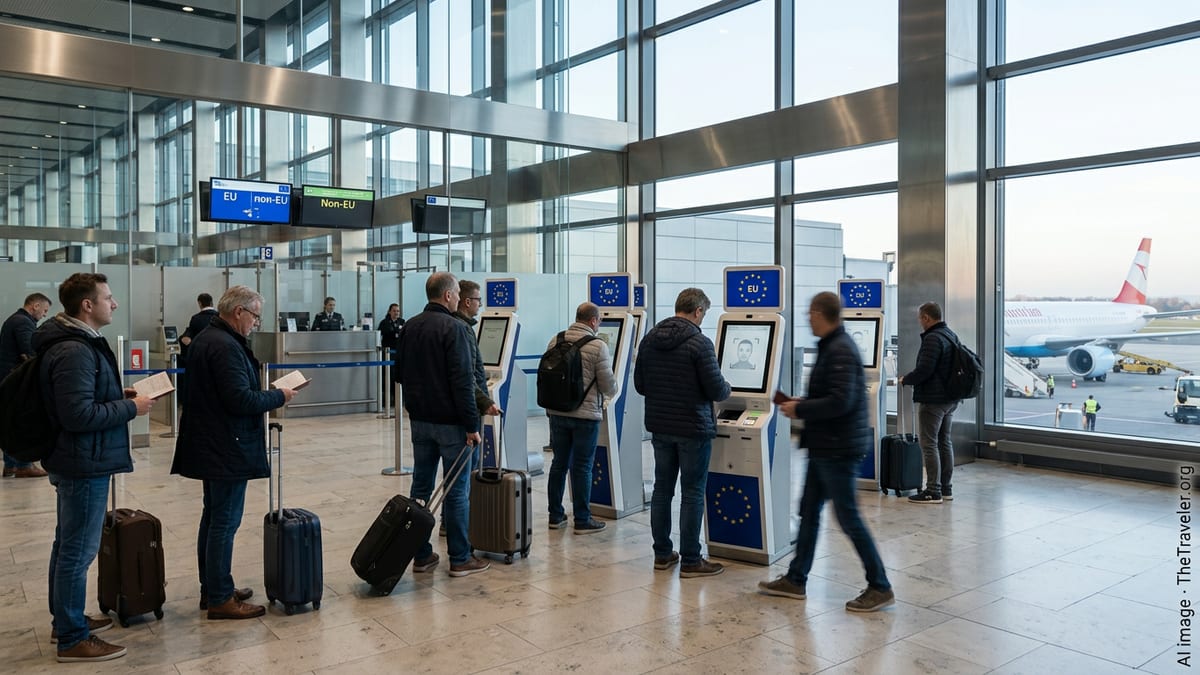
Biometric border system meets its first peak summer test
The Entry/Exit System, known as EES, is the EU’s new digital register for non-EU nationals crossing the external borders of the Schengen area. Instead of passport stamps, travellers are now enrolled with facial images and fingerprints on first entry, and each subsequent crossing is recorded in a central database. Publicly available EU communications describe the scheme as a key tool to tighten border security and track overstays.
The system became fully operational at all Schengen external border points on 10 April 2026, after a phased rollout that started in October 2025. In its first half-year of progressive use, European Commission reporting indicated tens of millions of entries recorded and a sharp rise in biometric checks against security databases, underlining how quickly EES has become embedded in day-to-day border management.
Those same months, however, exposed structural weaknesses. Industry summaries and technical assessments pointed to longer processing times at manual counters, uneven deployment of automated gates and complex procedures for mixed traveller groups such as families, which together set the stage for stress once summer volumes began to rise.
Travel organisations and aviation analysts had warned that peak holiday traffic in July and August would be the first full-scale test of whether EES could function without paralyzing queues. Forecasts published by airline and airport associations described a risk of multi-hour waits at the busiest gateways if biometric registration was not carefully managed and staffing levels failed to keep pace.
Queues stretch into hours as hubs struggle with first-time registrations
In early July, that stress test is now playing out at airports including Paris Charles de Gaulle, Amsterdam Schiphol, Rome Fiumicino and several major Spanish gateways, according to travel trade publications and local media coverage. Reports from these hubs describe lines for non-EU arrivals that regularly spill into overflow areas, with waits of two to five hours during peak evening waves.
The core challenge is the first-time enrolment process for travellers who have never been captured in EES before. Public guidance explains that these passengers must provide fingerprints and a facial image in addition to standard passport checks, a sequence that can take several minutes per person at a staffed booth if automated kiosks are unavailable or malfunctioning. When multiplied across thousands of passengers arriving within narrow time windows, the result is rapid saturation of border-control areas.
Airline and airport groups have repeatedly flagged this bottleneck. An open letter from leading European aviation associations at the end of June warned that EES-related delays were already becoming systemic, pointing to instances of passengers held outside terminal buildings and on airport aprons while queues cleared inside. Their modelling suggested that, unless mitigated, waiting times could rise further as July departures ramp up toward traditional summer peaks.
For travellers, the impact is immediate and highly visible. Consumer-rights organisations and travel media have documented missed connections, disrupted cruise departures and long waits for families with young children at key holiday gateways. Advisories from individual carriers now commonly urge non-EU passengers to arrive at departure airports at least three hours in advance, and in some cases earlier, to account for slower outbound border checks.
Brussels shifts tactics with emergency flexibility and national leeway
Facing mounting evidence of disruption, EU institutions and national governments are adjusting how EES is applied during the busiest weeks. Recent public statements from the European Commission highlight that border authorities have the option to temporarily suspend biometric capture at checkpoints experiencing exceptional pressure, while still recording basic entry or exit data in the system.
This flexibility effectively creates a safety valve, allowing officers to revert to faster document checks alone when queues pass certain thresholds. Member states retain discretion over when and how to activate such measures, and practices are already diverging. Media coverage from Italy, Spain and France indicates that some airports are preparing contingency plans to streamline procedures at defined peak times, while others are focusing on redeploying staff and opening additional booths to maintain full biometric capture wherever possible.
In parallel, European bodies are engaging more closely with industry. Aviation representatives have called for clearer communication, temporary suspension of EES checks at the most congested airports during July and August, and a structured review of bottlenecks before the autumn travel season. EU-level briefings, in turn, have emphasised ongoing technical work with member states and the agency operating the system to improve reliability and throughput.
Despite these steps, there is no single, bloc-wide pause. Publicly available information shows that EES remains in force as a legal requirement at external borders, and that any easing measures are calibrated to be temporary and targeted. This balancing act underscores the political sensitivity of weakening new security tools, even in the face of visible queues and vocal complaints from both industry and travellers.
Where the impact is being felt most by summer travellers
The disruption is far from uniform across Europe. Travel intelligence platforms, airline briefings and national transport updates indicate that long waits are concentrated at large hub airports handling substantial intercontinental traffic, particularly in countries with high inbound tourism. These gateways serve large numbers of non-EU travellers who must be enrolled into EES for the first time, magnifying pressure on their border facilities.
By contrast, some smaller regional airports and those with a predominately intra-Schengen or domestic profile appear to be coping better, with shorter queues and more consistent processing times. Differences in staffing levels, the availability and reliability of automated biometric gates, and the physical design of border-control zones are all shaping how the system performs in practice.
Land and sea borders present another layer of complexity. Ferry ports linking the United Kingdom and Ireland to continental Europe, and certain high-volume road crossings, have reported intermittent slowdowns as new procedures are embedded. However, publicly available reporting suggests that the longest waits are still concentrated at aviation hubs, where large aircraft can deliver several hundred passengers into a single border hall within minutes.
For travellers, the variability means that experience can differ sharply even within a single itinerary. A passenger might clear EES quickly at one entry point but face an extended queue at another on their return or when transiting. Travel advocates are therefore encouraging passengers to monitor airport-specific updates and allow generous connection times when booking itineraries that involve an external Schengen border crossing.
Security goals versus passenger experience: the debate ahead
The EU continues to present EES as a cornerstone of its border-management strategy, designed to improve security, prevent unlawful overstays and replace an outdated manual passport-stamping regime with more accurate data. Technical reporting from recent months indicates that the system has already flagged tens of thousands of attempted entries that did not meet legal requirements, providing a tangible argument for its effectiveness from a control perspective.
At the same time, the summer 2026 travel season is exposing the trade-offs inherent in such a large transformation of front-line procedures. Airlines and airports argue that the current configuration was not adequately stress-tested at full peak volumes, pointing to earlier warnings about capacity constraints and the need for additional resources well before EES became fully operational.
Public debate is now shifting from whether to have a digital border system to how it should function in practice. Proposals being discussed in industry and policy circles include expanding the use of pre-enrolment kiosks away from the immediate border area, redesigning passenger flows inside terminals to separate first-time registrants from those already in the database, and refining rules that govern how families and tour groups are processed together.
For the remainder of the summer, the immediate priority across the EU is damage control: keeping queues within manageable limits, protecting critical connections at hub airports and maintaining traveller confidence in journeys to and from Europe. The experience of summer 2026 is likely to shape not only how EES operates in the years ahead, but also how future digital schemes are introduced at Europe’s borders.