


More news on this day
Peak summer travel across Europe has been hit by a fresh wave of disruption, with publicly available data showing more than 1,500 delayed flights and at least 70 cancellations in a single day across major hubs including Milan, Geneva and Paris, affecting low-cost carriers such as Ryanair and easyJet as well as network airlines like Austrian Airlines.
Get the latest news straight to your inbox!
Ripple Effects Across Europe’s Busiest Summer Corridors
Operational data compiled from airport and aviation-tracking platforms indicates that at least 1,513 flights were delayed and 73 cancelled across Europe within a 24-hour window, creating widespread knock-on effects for passengers connecting through Italy, France, Switzerland and Spain. The pattern reflects how even localized disruptions at a handful of airports can rapidly cascade across a tightly scheduled summer network.
Major hubs and regional gateways in these countries, including Milan’s airports, Geneva, and the Paris system, all reported clusters of delayed departures and arrivals. As aircraft and crews rotated late through the system, delays began to propagate to secondary cities and leisure destinations around the Mediterranean, extending the impact far beyond the original problem airports.
Low-cost carriers with dense short-haul schedules, such as Ryanair and easyJet, were particularly exposed because rapid aircraft turnarounds leave little margin to absorb disruption. Network operators, including Austrian Airlines and others connecting via key European hubs, also experienced schedule pressures as late incoming flights forced retimings or cancellations of onward services.
The disruption has come at a time when European air traffic is running close to or above pre-pandemic levels in several markets, making it more difficult for airlines and airports to recover quickly once operations begin to fray.
Heat, Congestion and Capacity Constraints Combine
Reports from France describe how extreme heat and congestion at Paris Charles de Gaulle and Nice Côte d’Azur at the start of the week triggered hundreds of delays and a number of cancellations, with late-running flights then spreading disruption to airports in Italy, Switzerland, Spain and beyond. When aircraft depart late from Paris or the Riviera, return legs to cities such as Milan, Geneva, Barcelona and Vienna often leave behind their scheduled departure slots, worsening congestion at the next airport in the chain.
Elsewhere in the network, staffing constraints and airport infrastructure bottlenecks have continued to weigh on punctuality. Industry analyses published in recent weeks highlight persistent staffing and fleet availability issues at several European carriers, as well as runway or terminal works at a number of airports, all of which reduce operational flexibility during peak hours.
In Italy, separate coverage has drawn attention to concerns over jet fuel logistics at certain airports, illustrating how ground-side factors can also threaten to curtail schedules or force carriers to limit operations temporarily. While such issues may be localized, they add to the overall fragility of Europe’s tightly coordinated summer timetable.
In Switzerland, earlier reports of flight reductions by local operators due to staff shortages and aircraft maintenance demands underline how slender the margin for error has become. Each lost aircraft rotation can mean multiple cancellations or delays, particularly at slot-constrained hubs where replacement capacity is difficult to deploy on short notice.
Low-Cost Giants Under Pressure in Milan, Geneva and Paris
Ryanair and easyJet, Europe’s largest low-cost groups by passenger numbers, have taken a visible share of the latest disruption, in part because they dominate short-haul traffic at key hubs and regional airports in Italy, France, Switzerland and Spain. Publicly available timetables show these carriers operating dense banks of flights in and out of Milan’s airports, Geneva and Paris, linking them with dozens of city pairs across the continent.
When such high-frequency operators encounter air-traffic restrictions, heat-related performance limits or temporary ground delays, their schedules can unravel quickly. A single late arrival into Milan Malpensa or Geneva can delay its onward departure to destinations such as Madrid, Barcelona or Vienna, and subsequent rotations may then miss their assigned air-traffic slots, compounding the delay.
Austrian Airlines and other network carriers have also been drawn into the turbulence via shared hubs and codeshare operations. Late departures from Paris or Milan can force last-minute changes to banked connections at central European hubs, where regional feeders and long-haul services are carefully timed to minimize connection times. Even when cancellations are limited in number, the resulting misconnects can strand passengers far from their planned routes.
Although some carriers have been able to maintain relatively strong on-time performance on select routes, industry dashboards continue to show elevated levels of “reactionary delays,” where one late flight triggers schedule disruptions across several subsequent sectors.
Impact on Travellers and What Passengers Can Expect
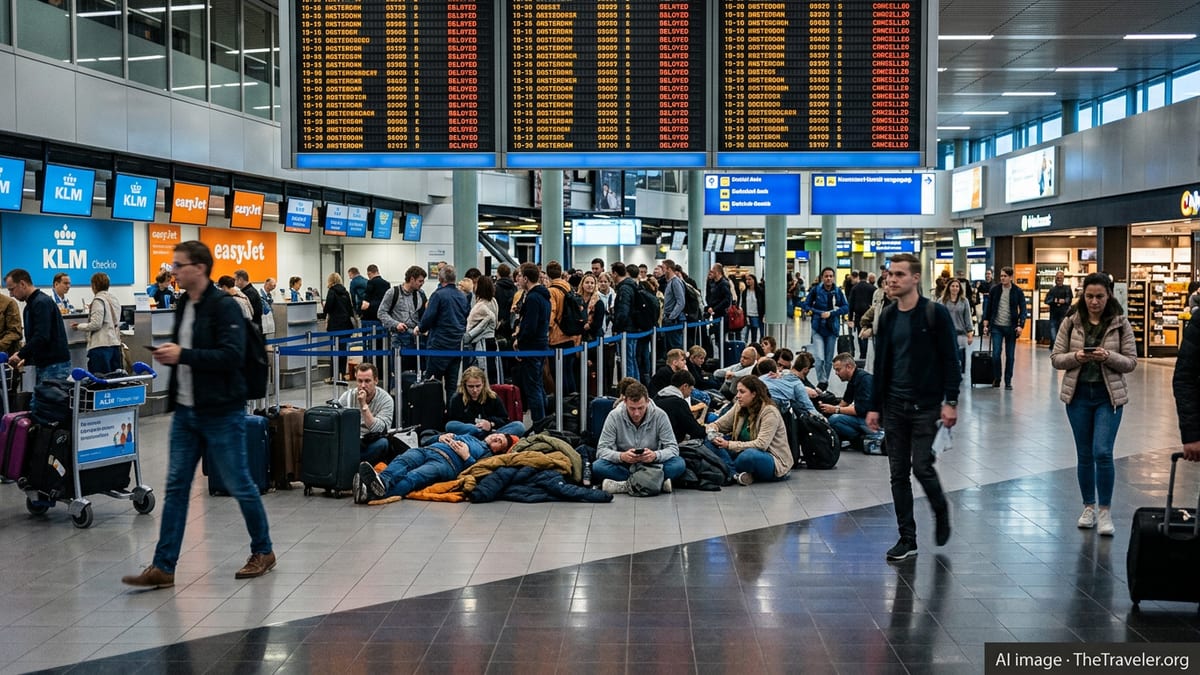
For passengers, the most visible outcome has been long departure boards of delayed flights, crowded terminals and a scramble to rebook itineraries after last-minute cancellations. Travellers heading to or from Milan, Geneva and Paris for business or summer holidays have reported extended waits in security and check-in lines, as ground staff attempt to process simultaneous waves of re-accommodated customers.
Consumer-rights organisations and travel advisories are urging passengers to monitor their flight status closely in the 24 hours before departure and to check in as early as possible in case of last-minute gate or schedule changes. Publicly available guidance also stresses the importance of understanding compensation and care provisions under European passenger-rights rules, particularly for delays or cancellations that are within an airline’s control.
With the latest disruption striking at the height of the holiday season, some travellers have opted to adjust itineraries proactively, including by avoiding tight connections through the busiest hubs or choosing early-morning departures, which are less exposed to knock-on delays accumulated over the course of the day.
Travel industry analysts note that while airlines have added extra capacity for summer 2026, many are operating with leaner operational buffers than before the pandemic, making them more vulnerable to sudden spikes in air-traffic restrictions, weather disruptions or ground-handling constraints.
Outlook for the Remainder of the Summer Season
Forecasts from European aviation bodies suggest that traffic will remain intense across the continent through at least late August, particularly in southern markets such as Italy and Spain and on key connecting routes via France and Switzerland. With minimal spare capacity available, even modest disruptions could again translate into large numbers of delayed or cancelled flights.
Industry reporting indicates that airlines and airports are continuing to recruit staff and streamline processes, but these measures may only gradually ease the pressure as the summer progresses. Several airports are also pushing digital tools and improved passenger information in an effort to smooth peak-hour flows and reduce congestion in terminals.
For now, travellers planning trips through Milan, Geneva, Paris, Barcelona, Madrid or other major hubs are being advised by travel information services to build additional time into their journeys and to remain flexible about routing and departure times. While the current wave of 1,513 delays and 73 cancellations may ease as schedules are rebalanced, the underlying combination of high demand, capacity constraints and climate-related stresses suggests that Europe’s skies are likely to remain busy and, at times, unpredictable throughout the summer.