


More news on this day
Major Gulf airlines are keeping large parts of their networks in the air despite a renewed flare-up in the Iran conflict, relying on rapid rerouting, evolving safety advisories and flexible schedules to sustain operations at some of the world’s busiest aviation hubs.
Get the latest news straight to your inbox!
Airlines press on as missiles and drones test Gulf skies
The latest cycle of hostilities between Iran, the United States and regional states has brought fresh missile and drone attacks across the Gulf, but commercial flight activity in the United Arab Emirates and Qatar remains largely intact. Publicly available flight-tracking data and regional media coverage indicate that Dubai, Abu Dhabi and Doha are still handling arrivals and departures, even as air defence systems respond to incoming threats.
Reports over recent days describe interceptions over Qatar, Kuwait and other Gulf states, with residents urged to follow official safety guidance as airspace conditions change. Despite this backdrop, Hamad International Airport in Doha and Dubai International Airport continue to function as long-haul hubs, with major Gulf carriers maintaining schedules to Europe, Asia and Africa, albeit with some reductions compared with pre-conflict traffic.
Travel risk assessments published by private security and aviation consultancies highlight an unusual picture in which airports are operational and runways open, yet regional skies are periodically disrupted by military activity. Analysts describe a patchwork environment where civil aviation is still moving significant passenger volumes while responding to sudden escalations that can trigger diversions or temporary closures.
Rerouting around Iran as safety advisories tighten
A key factor enabling Gulf airlines to keep flying has been their willingness to avoid Iran’s airspace in response to regulatory and industry guidance. The European Union Aviation Safety Agency has issued advisories urging carriers to steer clear of Iranian, Iraqi and Lebanese skies, citing heightened risks to civil aircraft from military operations and air defence activity.
In practice, this has pushed airlines to take longer routes over Saudi Arabia, Turkey and the eastern Mediterranean, or south via Oman and the Arabian Sea, adding flight time and fuel costs but reducing exposure to the most volatile corridors. Regional travel outlets report that Emirates, Etihad Airways, Qatar Airways, flydubai and Air Arabia are operating with modified routings, accepting increased operating expenses in exchange for a higher safety margin.
Industry data compiled since the initial outbreak of the Iran war in early 2026 shows how quickly route maps have been redrawn. During previous peak phases of the conflict, widespread airspace closures forced large-scale suspensions across the Gulf, bringing daily movements at major hubs close to zero. The current phase, by contrast, is characterised by selective overflight bans and dynamic reroutes, allowing airlines to restore a substantial proportion of their networks while still complying with evolving advisories.
Capacity still below pre-war levels as demand wavers
Even with aircraft back in the sky, scheduled capacity across the Middle East remains below pre-war levels. Aviation industry reports tracking seat supply and frequencies indicate that flights across the region are still several percentage points lower than in mid-2025, reflecting both lingering operational constraints and a cautious recovery in demand.
Analysts note that Gulf carriers have progressively rebuilt operations since the total shutdowns seen during the earliest weeks of the Iran conflict, when airspace closures over the UAE, Qatar, Kuwait and Bahrain forced mass cancellations and left airports deserted. Today’s environment is more nuanced, with airlines trimming frequencies on certain routes, deploying smaller aircraft and leaning on connecting traffic to fill long-haul flights.
For travellers, this translates into fewer daily options on some city pairs, tighter connections, and occasional last-minute schedule changes as airlines respond to shifting risk calculations. Travel advisories from governments and private security firms continue to flag the potential for sudden disruption, urging passengers to monitor airline notifications closely and allow additional time for itinerary changes.
Balancing safety, commercial pressures and hub status
The decision by Gulf airlines to keep planes flying is shaped partly by the central role their hubs play in global aviation. Dubai, Doha and Abu Dhabi are built around connecting traffic, with business models that depend on funnelling passengers between continents. Prolonged shutdowns risk eroding that position as travelers and partner airlines divert to alternative hubs in Europe and Asia.
Publicly available statements and schedules suggest that carriers are relying on established risk-management frameworks, including continuous monitoring of conflict zones, consultation of safety advisories and coordination with aviation authorities, to determine where and when to operate. When missile or drone activity spikes near a particular airport, airlines have shown a willingness to cancel or divert specific flights, but they have stopped short of the wholesale suspensions seen earlier in the war.
Commercial pressures also play a role. After months of disrupted operations, regional airlines face higher fuel bills, increased insurance costs and the need to restore revenue. Maintaining at least a reduced level of flying allows them to keep aircraft and crews active, protect market share and demonstrate resilience to investors and passengers, even as they leave flexibility in schedules to adjust to new flare-ups.
What travelers should expect in the coming weeks
For passengers planning trips through Gulf hubs, the renewed Iran conflict means a travel environment that is functioning but fragile. Industry trackers show that airlines continue to sell seats across their networks, yet caution that future surges in hostilities could trigger fresh waves of cancellations or rerouting.
Travel experts recommend that passengers build flexibility into their plans where possible, including allowing longer connection windows, maintaining up-to-date contact details with airlines and considering travel insurance that covers disruption linked to conflict. Experience from earlier phases of the Iran war suggests that when airspace restrictions or attacks force temporary closures, airlines typically prioritise safety by suspending operations, then work through backlogs as soon as conditions allow.
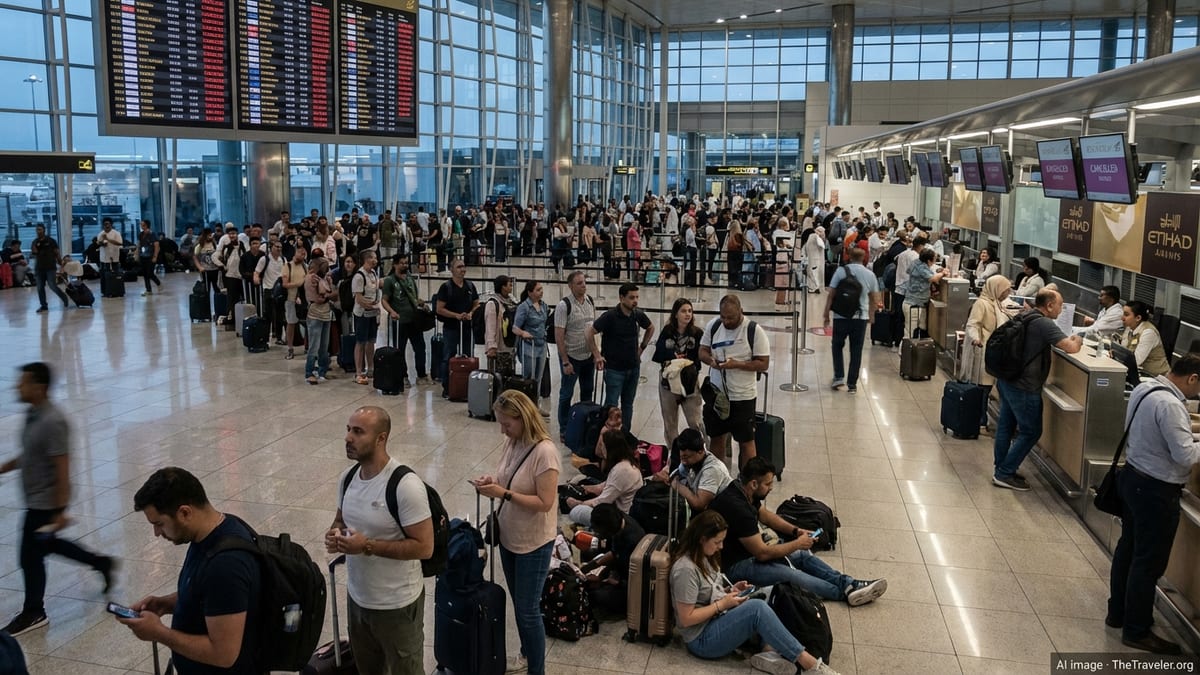
In the meantime, images of busy departure halls in Dubai and Doha, contrasted with reports of missile interceptions over the same region, underscore the unusual reality facing Gulf aviation. The main carriers are determined to keep their networks alive, threading a narrow path between geopolitical tensions and the practical necessity of moving people and goods across one of the world’s most strategically important air corridors.