


More news on this day
Thunderstorms linked to Typhoon Bavi have triggered thousands of flight cancellations and delays across China in recent days, disrupting travel at some of the country’s busiest airports and stranding passengers at the height of the summer holiday period.
Get the latest news straight to your inbox!
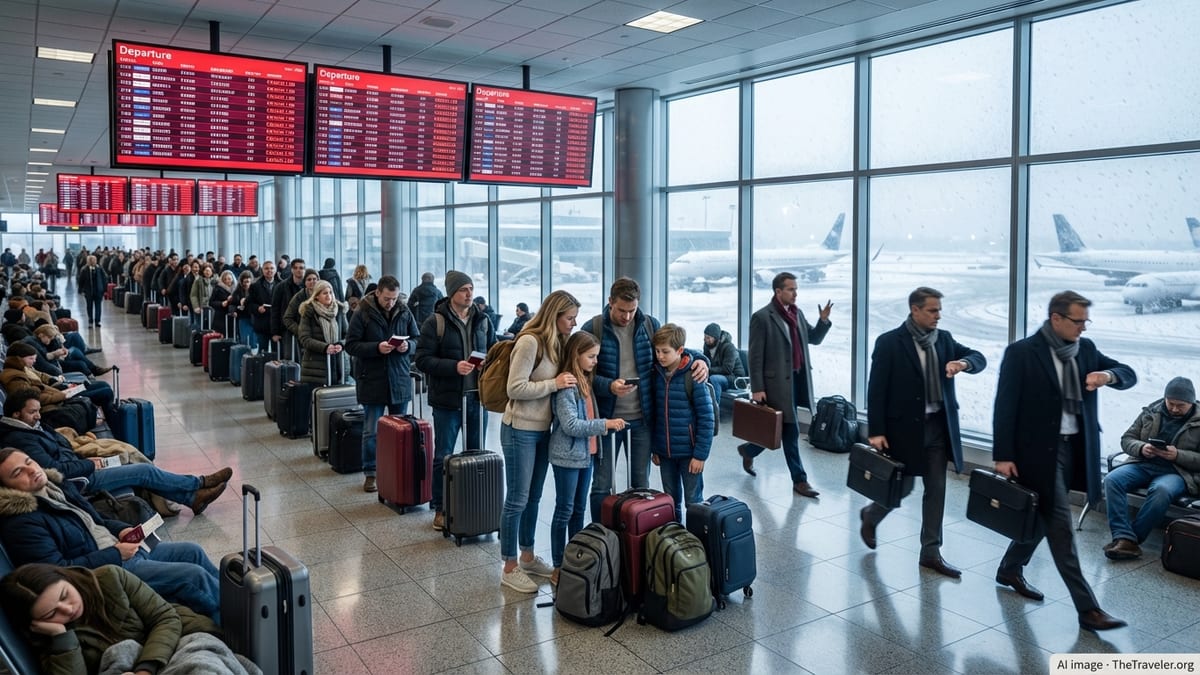
Widespread disruptions across major Chinese aviation hubs
Published coverage indicates that air travel in eastern and southern China has been hit particularly hard, with Shanghai, Hangzhou, Nanjing and Ningbo among the cities reporting large numbers of grounded or delayed services. Data compiled by domestic travel platforms showed that airlines planned to cancel more than 2,800 inbound and outbound flights on Sunday alone as the storm system continued to generate severe thunderstorms over a broad swathe of the country.
Shanghai Pudong and Shanghai Hongqiao, two of China’s primary international gateways, were expected to see sharply reduced operating capacity, with nearly one third of scheduled flights forecast to be canceled or significantly delayed at the peak of the disruption. Additional cancellations were reported at airports in the coastal provinces of Fujian and Zhejiang, as well as in the Guangxi Zhuang autonomous region and Hainan, where outer rainbands from Bavi produced intense downpours and lightning.
According to publicly available flight tracking information, the impact was not limited to domestic routes. Services linking mainland China with regional hubs such as Taipei, Hong Kong and several Southeast Asian cities were also suspended or rescheduled, as carriers adjusted operations to avoid the most active storm cells and comply with local safety protocols.
The scale of the disruptions built over several days as Bavi approached the mainland. Earlier, as the system tracked across the East China Sea and skirted Taiwan, carriers had already begun trimming schedules and issuing waivers for itinerary changes on routes into eastern China, anticipating that conditions would worsen as the storm made landfall.
Thunderstorm alerts at dozens of airports
Chinese meteorological bulletins cited in local media reports show that at least 45 airports issued thunderstorm alerts as Bavi’s circulation pushed inland. These warnings, which flag heightened risks of lightning, wind shear and heavy precipitation in airport terminal areas, typically trigger tighter restrictions on takeoffs and landings and can force controllers to temporarily close sections of airspace.
Storm-related alerts were concentrated in a belt stretching from the southeastern province of Fujian through Zhejiang and Jiangsu to parts of central and southern China. Airports in cities such as Hangzhou and Changzhou were reported to have implemented extended ground holds while intense convective cells passed overhead, leading to knock-on delays that rippled through the national aviation network.
China’s national weather services noted that, although Bavi quickly weakened from a super typhoon to a severe typhoon and later a tropical storm after landfall, its vast size allowed it to continue producing powerful thunderstorms well inland. That combination of a broad circulation and slow forward motion prolonged the period of adverse flying conditions over some of the country’s most densely trafficked air corridors.
Airlines operating in the region responded by consolidating services, rerouting some aircraft around the most active weather and temporarily suspending others. Published advisories from several carriers urged passengers to monitor flight status closely and allowed fee-free changes on affected dates, reflecting the uncertain and fast-evolving nature of the thunderstorm risk.
Evacuations, infrastructure strain and limited rail alternatives
Beyond its impact on aviation, Typhoon Bavi has placed broader strain on eastern China’s transport infrastructure. National and regional media report that more than two million people were evacuated from low-lying and coastal areas ahead of landfall, part of a large-scale precautionary effort that also included the temporary suspension of some ferry routes and port activities.
Heavy rain associated with the system added to already saturated ground in parts of southern and central China, which have endured weeks of above-average rainfall linked to earlier tropical systems. In some provinces, localized flooding and landslides have affected roads and railways, limiting the ability of stranded airline passengers to switch to ground transport during the worst of the flight disruptions.
High-speed rail services along parts of the eastern seaboard also faced interruptions as Bavi approached, with operators adjusting timetables and in some cases suspending trains on sections of line most exposed to high winds and potential debris. For travelers, this meant that alternative routes were not always available, particularly on peak travel days when remaining services quickly reached capacity.
Urban transport systems in several coastal cities nevertheless remained largely functional, allowing many passengers to reach hotels or stay with friends and relatives while they waited for rebooked flights. Local coverage highlighted busy scenes at major stations and airports as travelers queued to change tickets or seek information about revised schedules.
Airlines and passengers navigate days of uncertainty
As with previous major storms affecting the western Pacific, the operational response to Typhoon Bavi has involved a balance between safety considerations and efforts to minimize disruption. Airlines serving Chinese airports have relied on a mix of advance cancellations, rolling delays and route adjustments, guided by evolving meteorological guidance and air traffic control constraints.
Some carriers operating routes into Shanghai and other eastern hubs announced the suspension of specific flights on July 11 and 12, citing the deteriorating weather associated with Bavi. Others offered flexible rebooking policies for travel over the weekend period, encouraging passengers with nonessential trips to postpone journeys until after the most intense thunderstorms passed.
For travelers already en route, the situation has produced extended waits aboard aircraft on the ground, diversions to alternate airports and last minute changes in routing to circumnavigate active storm cells. Travel forums and social media posts from affected passengers describe missed connections, unexpected overnight stays and challenges obtaining updated information during the busiest hours of the disruption.
Industry observers note that China’s aviation sector has faced similar tests during previous typhoon seasons, but the scale of Bavi’s thunderstorm footprint and its timing during a peak holiday period have amplified the effects. The experience is likely to feed into ongoing discussions about capacity management, passenger communication and contingency planning at major hubs.
Gradual normalization as Bavi weakens inland
By late Sunday, meteorological assessments indicated that Bavi had weakened to a tropical storm as it moved further inland across eastern China, reducing the intensity of the thunderstorms affecting coastal airports. Reports from Shanghai and several neighboring cities noted that flight and rail operations were gradually resuming, although residual delays and scattered cancellations were expected to continue while backlogs were cleared.
Airlines have begun restoring regular schedules on key domestic and international routes, while maintaining advisories about potential weather related adjustments in areas still experiencing heavy rain. Flight data platforms show a steady increase in departures and arrivals compared with the peak of the disruption, but the overall network remains busier than usual as carriers reposition aircraft and crews.
For travelers planning to transit eastern China in the coming days, publicly available guidance from aviation and meteorological agencies continues to emphasize the importance of checking real time information before heading to the airport. Even as Bavi’s winds diminish, lingering showers, low clouds and air traffic congestion may still affect punctuality on some routes.
The experience of Typhoon Bavi underscores how rapidly changing storm dynamics in the western Pacific can cascade through complex transport systems. For China’s airlines, airports and passengers, the episode has provided another reminder that even a weakening tropical system can generate severe local thunderstorms capable of grounding thousands of flights across one of the world’s busiest aviation markets.