


More news on this day
Europe’s new biometric Entry/Exit System is now fully enforced at Schengen external borders, and travel hubs are warning that first-time enrolment checks will slow queues for many non-EU visitors in the coming months.
Get the latest news straight to your inbox!
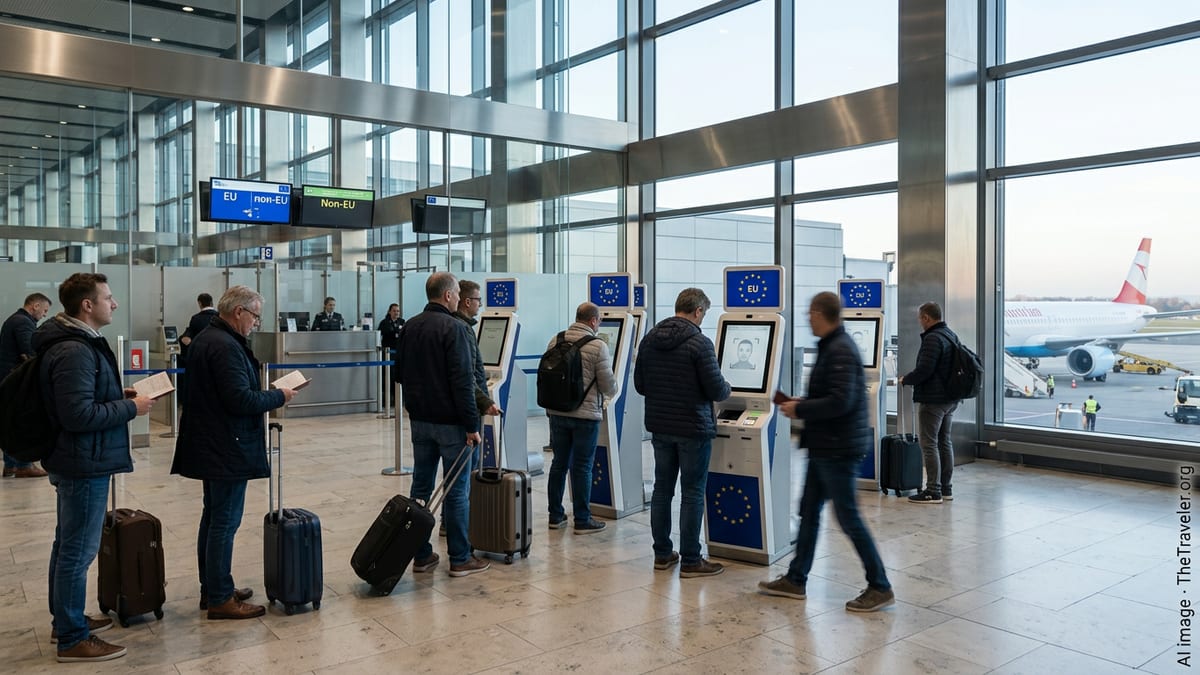
What the fully enforced EES actually changes at the border
The European Union’s Entry/Exit System, or EES, is a large-scale database that records the entry and exit of non-EU nationals at the external borders of the Schengen area. It replaces manual passport stamping with automated registration of personal details, travel documents and biometric data such as fingerprints and facial images. According to information published by EU institutions, the system began operations in October 2025 and reached full deployment at all Schengen border crossing points on 10 April 2026.
The system applies to most non-EU and non-EFTA travellers entering Schengen for short stays, including visitors from the United States, the United Kingdom, Canada, Australia and many Asian countries. Each time a traveller crosses an external Schengen border, their data is checked and updated in the central system. Overstays can be detected more easily, and border authorities gain a clearer picture of traffic flows, but the new checks introduce extra steps at the point of entry.
Under the fully enforced regime, air, sea and international coach operators are also required to verify that certain categories of passengers have been properly registered in the system before boarding. Publicly available guidance from the EU’s IT agency describes how carriers must consult an online service hosted by eu-LISA to confirm that travellers holding single or double-entry visas are eligible to travel. This additional verification layer can add time at check-in or boarding if systems are slow or passengers are unfamiliar with the requirements.
The EU’s separate European Travel Information and Authorisation System (ETIAS), scheduled to follow EES in late 2026, will not replace EES but sit alongside it. ETIAS will function more like a digital travel authorisation, while EES continues to handle border-time checks and the recording of entries and exits.
Why longer queues are being reported at airports and ports
In the months since the system became fully operational, travel industry coverage has described longer waits at some of Europe’s busiest border points, particularly during peak holiday periods. Reports from airports in countries such as Spain, Portugal and France highlight queues forming where large numbers of non-EU passengers must complete first-time biometric enrolment before entering the Schengen area.
First-time registration is the main cause of delays. The initial capture of facial images and fingerprints, along with verification of passport data, typically takes several minutes per passenger. Once a traveller is enrolled, subsequent trips should move more quickly, but the first wave of visitors after full enforcement includes many people encountering the system for the first time. At major hubs with high volumes of long-haul flights, even small per-passenger delays can translate into sizeable queues.
Land and sea crossings are experiencing similar pressures. At juxtaposed border controls serving routes between the United Kingdom and France, for example, cars and coaches must pass through check booths where travellers complete EES procedures before boarding ferries or trains. UK government statements ahead of the 2026 summer season referenced investment in additional passport booths and infrastructure at Dover, Eurotunnel Folkestone and London St Pancras, reflecting expectations that the new procedures would otherwise risk significant congestion.
Some travel commentary also points to uneven implementation between states and individual border posts. While many airports have installed banks of self-service kiosks and automated gates to streamline EES checks, others rely more heavily on manual processing. Where equipment is limited or technical issues arise, travellers can experience waits significantly longer than before the system’s introduction.
How the EES process works for travellers
At a typical Schengen airport, non-EU travellers subject to EES are directed first to a self-service kiosk or manned desk. At the kiosk, they scan their passport, have a facial image taken and, where required, provide fingerprints. The system cross-checks this information against central records and border databases, and issues a token or confirmation that is used at the subsequent control point.
Travellers then proceed to an automated gate or a staffed border booth, where the token and passport are verified. If the data matches and no alerts arise, the traveller is allowed to enter, and the system records the date, time and location of entry. Similar checks occur on exit, although in most cases no fresh biometrics are needed unless the system indicates a problem.
EU guidance allows for the use of fully automated self-service systems in certain circumstances, reducing the need for face-to-face interaction with border officers. However, the rules also provide for travellers to be redirected for manual inspection whenever the supervising officer deems it necessary or when technical issues occur. For families, passengers with reduced mobility or travellers unfamiliar with digital processes, this can add steps and slow the overall flow.
Because first registration takes the longest, airports and ports are encouraging passengers to arrive earlier than before, particularly during busy periods. Some national authorities and travel hubs have launched public information campaigns explaining the new procedures, but awareness remains inconsistent, and many travellers encounter EES for the first time at the border itself.
Measures to manage queues and reduce disruption
European and national authorities have been working with airports, ports and transport operators to smooth the transition to EES and reduce the risk of sustained disruption. EU-level reports and the 2026 State of Schengen assessment highlight investment in pre-registration kiosks, additional e-gates and the development of a “Travel to Europe” mobile application intended to simplify data collection before arrival.
In the United Kingdom, which hosts several juxtaposed border controls for Schengen destinations, the government has announced multiple rounds of funding aimed at expanding border infrastructure. Earlier support packages focused on installing EES-compatible equipment at Dover, Eurotunnel and Eurostar terminals, while more recent commitments included money for additional passport booths and traffic management measures in Kent. Public statements emphasise the goal of keeping freight and passenger flows moving despite the more complex border regime.
Elsewhere in Europe, airports have been adding staff, redesigning queuing areas and adjusting flight schedules to allow more time for outbound and inbound processing. Some carriers are advising passengers to arrive significantly earlier than they would have done pre-EES and to pay close attention to airline and airport guidance, especially when connecting between non-Schengen and Schengen flights.
Despite these efforts, industry reporting and traveller accounts indicate that performance remains uneven. Some border points are clearing passengers with minimal disruption, particularly where infrastructure upgrades were completed early and staff are experienced with the new tools. Others continue to see extended queues at peak times, and EU officials have suggested that it could take an extended period before the system operates smoothly across all frontiers.
What non-EU travellers should expect in the coming months
For visitors from the United States and other visa-exempt countries, the immediate impact of full EES enforcement is likely to be most visible at the first Schengen border crossed on each trip. Travellers should be prepared for extra time at immigration on their initial journey under the new system, and for the possibility of longer lines at busy hubs during holiday peaks.
Published guidance recommends checking the latest information from airports, ports and carriers before departure, paying attention to any advice on early arrival times, dedicated EES lanes or specific procedures for families and travellers needing assistance. Because first-time biometric capture is the main bottleneck, repeat trips should generally be quicker, although queues will still depend on local staffing levels and infrastructure.
Later in 2026, ETIAS is expected to add an additional layer of pre-travel formalities for many non-EU visitors. Once active, eligible travellers will be required to obtain online travel authorisation before boarding transport to most Schengen countries. Combined with EES, this will create a two-step process, with ETIAS handling advance risk assessment and EES managing border-time checks and overstay monitoring.
For now, the most immediate concern is adjusting to the new border checks and planning for possible delays. As the system beds in and more travellers become enrolled, industry observers expect queue lengths to moderate, but the experience will vary by route and season. Anyone planning trips into or out of the Schengen area over the next year is advised to factor the new procedures into their timings and to stay alert to evolving local guidance.
European Commission: EES operational and fully enforced timeline
eu-LISA: Entry/Exit System fully deployed across the EU
European Commission: EES vs ETIAS explained for travellers
UK government: preparations for EES border checks at juxtaposed controls