


Perched on the green slopes of Montjuïc, the Fundació Joan Miró is one of Barcelona’s most rewarding art experiences, combining an exceptional collection of Miró’s work with luminous Mediterranean architecture and broad city views. Before you add it to your itinerary, it is worth understanding how the museum is laid out, what you can expect to see, and the practical details that will make your visit smooth and memorable.
Get the latest updates straight to your inbox!
Why the Fundació Joan Miró Matters
The Fundació Joan Miró is not just another modern art museum. Conceived by the artist himself and opened in 1975, it was created as a living center for contemporary art, a place where Miró’s own work would sit alongside new voices and experimental practices. Today the foundation holds one of the most important public collections of his paintings, sculptures, drawings and prints, spanning from early figurative pieces to the bold, pared-back works of his later years.
For travelers, visiting the foundation offers a different angle on Barcelona than the familiar Gaudí circuit. Miró was also a son of the city, and his playful language of stars, birds and women has become part of Barcelona’s visual identity. Seeing his works together on Montjuïc, just a short ride from the city center, helps you connect the dots between the street mosaics you may have crossed on La Rambla and the large Miró sculptures scattered around Catalonia.
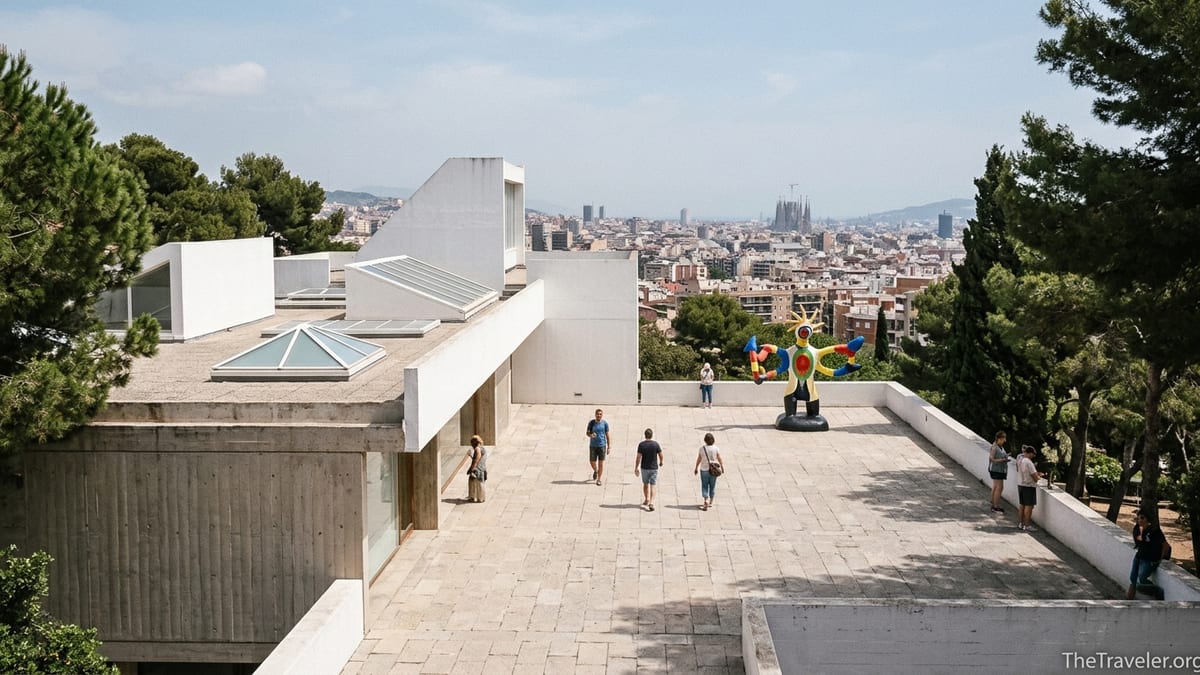
The setting amplifies the experience. The building, designed by architect and Miró’s close friend Josep Lluís Sert, is a masterclass in Mediterranean modernism: white walls, skylights, terraces and courtyards that open to pine trees and clean air. Even travelers who are only mildly interested in art often come away talking as much about the atmosphere, the light and the views as about individual canvases.
Unlike some blockbuster museums, the Fundació Joan Miró usually feels manageable in scale. Most visitors spend between two and three hours exploring the permanent collection and at least one temporary exhibition, leaving enough energy to enjoy Montjuïc’s parks, the Olympic Ring or nearby museums later the same day.
The Collection and Current Exhibitions
The permanent collection occupies more than 1,500 square meters and brings together several hundred works by Miró, including paintings, sculptures, textiles and graphic art. You will see early pieces where he experimented with Fauvism and Cubism, works influenced by his time in Paris, and iconic large-scale canvases full of saturated blues, reds and blacks that many associate with his mature style. A typical path leads you chronologically, so it is easy to follow the evolution from rural Catalan landscapes to the radical simplification of form in his later years.
In recent seasons the foundation has been rethinking how it presents this collection. A newly arranged display structured around materials and processes rather than strict chronology highlights Miró’s use of unconventional supports, collage and found objects. Expect to encounter vitrines with sketchbooks, maquettes for public sculptures and works that show paint scraped, burned or punctured, underscoring how experimental he remained into old age.
The museum is also known for its temporary exhibitions, which can be major solo shows of international artists or thematic projects connecting Miró to contemporary practice. In 2026, programming continues in spaces such as Espai 13, which for decades has hosted emerging artists and curators. Checking the foundation’s official website shortly before your trip will give you the latest on what is on during your dates, from focused Miró studies to ambitious group exhibitions.
Do not overlook the outdoor works. On the terraces and in adjacent gardens you may encounter pieces like the vibrant sculpture "Luna, sol y una estrella," or other large bronzes that gain a different presence against the Barcelona skyline. These areas are being opened up and integrated more fully into visitor routes, so allow time to step outside and see how Miró’s work lives in the open air.
The Building, Architecture and Views
Josep Lluís Sert’s building is a destination in its own right. Designed specifically for Miró’s work, it uses white concrete, modular forms and generous skylights to bring in Mediterranean light without overwhelming the art. Long ramps, open staircases and interior patios create a sense of slow, continuous movement, almost like walking through a village of interlinked terraces. Many travelers who have visited other Sert buildings, such as the Fundació Miró in Mallorca or university projects abroad, recognize a similar rhythm of space and light here.
The layout feels human in scale. Galleries are never oppressively high or grand, and the frequent courtyards give you breathing space between dense sequences of paintings. In summer, these outdoor pockets offer shade and glimpses of pine trees and stone, while in cooler months the pale surfaces and reflected light keep interiors bright. Photographers will appreciate how the architecture frames views out to the city and down into the gardens.
The foundation’s position on Montjuïc gives it some of Barcelona’s most underrated vistas. The North Patio in particular functions as a belvedere, opening toward the city with sweeping views that stretch from the Eixample grid to the sea. On clear days you can pick out landmarks like the Sagrada Família and the coastal towers of the Vila Olímpica. Many visitors pause here after touring the collection to rest on a bench, take photos and absorb the sense of distance from the busy center below.
Because of these spatial qualities, the museum rarely feels cramped, even at peak times. Natural light is carefully controlled to protect the works, so you will not be squinting in glaring sun, but you will notice subtle changes in atmosphere as clouds pass or as you move from skylit rooms to lower, more intimate spaces. It is a good idea to wear layers, as air conditioning works efficiently in summer and some concrete areas can feel cool out of season.
Ticket Options, Prices and Passes
Ticket prices at the Fundació Joan Miró are comparable to other major museums in Barcelona. As of mid 2026, standard adult admission to the permanent collection and main temporary exhibition is typically in the mid to high teens in euros, with reductions for students, seniors and young visitors. Children below a certain age threshold, often under 14 or 15, are usually admitted free of charge, and teenagers and young adults up to around 25 can expect a discounted rate on presentation of valid ID.
The foundation sometimes offers combined tickets for special exhibitions or evening events, as well as free or reduced entry during citywide cultural initiatives such as museum nights. If your dates fall on a major festival or on the first Sunday of the month, check the official website or contact the museum directly, as there may be time slots with reduced or free entry that require advance booking.
For travelers planning to visit several art institutions, the Articket Barcelona museum pass is worth considering. Costing around the high 30s in euros for an adult, Articket grants skip-the-line access to six major museums over a 12-month period, including the Fundació Joan Miró, the Picasso Museum, the National Art Museum of Catalonia, MACBA, CCCB and the Fundació Antoni Tàpies. If you visit even three of these, such as Picasso, Miró and MACBA, you generally save money compared to buying individual tickets and reduce your time waiting at ticket desks.
Other city passes, such as the Barcelona Card, sometimes include discounts or free access to the foundation, as well as public transport. If you are staying in the city for four or five days and plan to use transit heavily, comparing the cost of a transport-only card with a combined card that also offers museum benefits can help optimize your budget. Always verify the latest inclusions and conditions, since partnered attractions and prices can shift from year to year.
Getting There and Navigating Montjuïc
The Fundació Joan Miró sits in Parc de Montjuïc, on the southern side of Barcelona. Although it is on a hill, it is relatively easy to reach on public transport. A common route is to take the metro to Paral·lel station and connect with the Montjuïc funicular or its replacement shuttle bus, which climbs partway up the hill. From there, it is a short, signposted walk through green spaces toward the museum. The funicular operates as part of the integrated metro system, so if you have a Hola Barcelona travel card or a multi-trip ticket, the ride is included.
Bus options are also convenient. Several local lines, such as the 55 or 150 when in service, serve Montjuïc and stop within walking distance of the foundation. Travelers staying near Plaça d’Espanya can often catch a direct bus up the hill and get off close to other attractions like the Olympic Stadium, then walk ten to fifteen minutes through the park to the museum. This route is popular with visitors who want to combine Miró with a stroll past the Palau Nacional and the Magic Fountain area.
Walking up from the city is feasible if you are reasonably fit and the weather is mild. From Poble-sec or Paral·lel, allow 25 to 35 minutes on foot, following stairways, ramps and park paths through Jardins de Laribal and other landscaped areas. Many travelers enjoy this climb because it feels like a gradual transition from urban bustle to greenery, with occasional viewpoints over the port. Wear comfortable shoes, as some paths are steep and can be slippery after rain.
Taxis and ride-hailing services are widely available and convenient, particularly if you are visiting with children, carrying luggage or have limited mobility. A taxi from central neighborhoods like the Gothic Quarter or Passeig de Gràcia to the Fundació Joan Miró normally costs in the range of 10 to 15 euros, depending on traffic and time of day. Drivers are usually familiar with the museum; simply stating the name and "Montjuïc" is enough. There is limited parking in the area, and the foundation itself encourages visitors to arrive by public transport or on foot.
Accessibility, Services and Visitor Experience
The Fundació Joan Miró has made noticeable efforts to be accessible and welcoming to a wide range of visitors. The building includes ramps, elevators and adapted restrooms, and most public spaces are reachable without using stairs. An accessibility guide in easy-to-read format with pictograms is available, and the museum participates in initiatives aimed at improving the experience for people with sensory, cognitive or mobility challenges. If you have specific needs, contacting the museum ahead of time can help staff advise on the best entrances and routes.
For interpretation, the foundation offers labels in multiple languages and increasingly relies on digital tools. The free Bloomberg Connects app provides audio content, background texts and thematic routes that you can explore on your own smartphone. Many travelers prefer this to renting a separate audio guide, as it allows them to move at their own pace and access additional material later. Be sure to bring headphones and have your phone charged if you plan to use the app extensively.
On-site services include a bookshop and a café. The shop is particularly strong on Miró-related material, from exhibition catalogues and scholarly monographs to postcards, posters and design objects inspired by his motifs. Prices range from a few euros for small souvenirs to higher sums for large-format books and limited-edition prints. The café, usually with indoor seating and sometimes access to outdoor terraces, serves light meals, coffee and drinks at prices in line with other museum cafés in Barcelona. It can be a pleasant place to pause between galleries or to regroup before heading back down the hill.
Families with children generally find the foundation manageable. The open spaces, occasional interactive elements and colorful works provide visual stimulation, and staff are accustomed to visitors of all ages. That said, galleries are still museum environments, so supervision and respect for the artworks are expected. Strollers are typically allowed in most areas, though you may be asked to leave large backpacks or bulky items in the cloakroom for safety reasons.
Planning Your Visit: Timing and Suggested Combinations
Opening hours at the Fundació Joan Miró vary slightly by season but usually cover late morning to early evening, with extended hours on some days and potential closures on Mondays or selected holidays. As schedules can change for refurbishment, special events or public holidays, it is important to check the official calendar for the specific date of your visit. Arriving within an hour of opening or after mid-afternoon often results in a calmer experience than the peak late-morning window when group tours sometimes arrive.
If you are visiting in high season, such as late spring, summer or major holiday periods, pre-booking your ticket online is advisable, especially when there is a headline temporary exhibition. Timed entry slots help regulate flow and reduce queues at the entrance. Travelers using the Articket Barcelona pass or similar products typically have a separate priority entrance, which can save time at busier moments of the day.
Because the museum is on Montjuïc, it combines naturally with other sights on the hill. Many itineraries pair a morning at the Fundació Joan Miró with an afternoon at the National Art Museum of Catalonia, enjoying its Romanesque and Gothic collections along with terrace views over Plaça d’Espanya. Others spend time at the Olympic Stadium, the Mies van der Rohe Pavilion or the botanical gardens. On long summer days you might visit Miró in the late afternoon, then walk down toward the Magic Fountain area for its evening light and water show.
Weather is a factor to consider. In the height of summer, Barcelona afternoons can be hot and humid, and although the museum is air-conditioned, the approach on foot involves some uphill sections with limited shade. In those months, try to schedule your visit for early morning or early evening, and carry water. In cooler seasons, the hill can be breezy, so a light jacket is useful if you plan to linger on the terraces or continue exploring Montjuïc after your museum visit.
The Takeaway
Fundació Joan Miró offers a concentrated, atmospheric encounter with one of the 20th century’s most distinctive artists in a building and setting shaped by his own vision. Rather than being an encyclopedic museum that overwhelms you with information, it invites you to slow down, follow the rhythm of light-filled galleries and courtyards, and notice how Miró’s language of signs and symbols remains vivid decades after his death.
For travelers to Barcelona, especially those already attracted by the city’s architecture and design, the foundation is a natural complement to visits to Gaudí’s buildings and contemporary art spaces in the center. With thoughtful planning around tickets, timing and transport, a visit here can anchor a rewarding day on Montjuïc that balances culture, landscape and some of the city’s best open-air views.
Whether you spend an hour with just a few favorite works or an entire afternoon exploring every corner, the experience is likely to stay with you, colored by the memory of bright terraces, shifting sky and Miró’s playful constellations of shapes and lines.
FAQ
Q1. How long should I plan to spend at the Fundació Joan Miró?
Most visitors find that two to three hours is enough time to see the permanent collection, at least one temporary exhibition and the terraces without rushing. If you like to read wall texts carefully or use the digital guide in depth, consider allowing closer to three hours.
Q2. Do I need to book tickets in advance?
Advance booking is strongly recommended in high season, on weekends and when there is a major temporary exhibition. Buying tickets online or using a museum pass with priority access can reduce waiting times and ensure you get your preferred entry slot.
Q3. Is the Articket Barcelona museum pass worth it if I only want to see a few museums?
If you plan to visit at least three of the included museums, such as the Fundació Joan Miró, the Picasso Museum and MACBA, Articket usually works out cheaper than separate tickets and offers faster access. For one or two museums only, buying individual tickets is generally more economical.
Q4. What is the best way to get to the museum by public transport?
A common route is to take the metro to Paral·lel and then use the Montjuïc funicular or replacement shuttle bus, which is included in standard transport passes. Several city buses also stop near the museum, and from Plaça d’Espanya the journey usually takes around 20 minutes.
Q5. Is the Fundació Joan Miró suitable for children?
Yes, many families visit with children and find the colorful artworks, open spaces and short sequences of rooms manageable. While there are not playground-style areas, the environment is relaxed, and staff are used to younger visitors, provided children are supervised and respect the artworks.
Q6. Are there good views from the museum?
Yes, one of the highlights of the foundation is its position on Montjuïc, which offers broad views of Barcelona. Terraces and courtyards, especially on the north side of the building, provide excellent vantage points over the city and are popular spots for photos.
Q7. What facilities are available on-site?
The museum offers a bookshop, café, cloakroom and restrooms, as well as elevators and ramps for accessibility. The shop is particularly strong on Miró publications and design objects, while the café serves light meals and drinks at prices similar to other museum cafés in the city.
Q8. Is the museum fully accessible for visitors with reduced mobility?
The building includes ramps, lifts and adapted facilities, and most galleries and public spaces are accessible without using stairs. If you have specific mobility needs, it is advisable to contact the museum in advance so staff can suggest the easiest routes and entrances for your visit.
Q9. Can I take photos inside the Fundació Joan Miró?
Non-flash photography for personal use is often allowed in many areas of the museum, though restrictions may apply in temporary exhibitions or for specific works. Signs and staff will indicate where photography is not permitted, so it is important to check and follow local rules during your visit.
Q10. What other attractions can I combine with a visit to the Fundació Joan Miró?
Because the museum is on Montjuïc, it pairs well with the National Art Museum of Catalonia, the Olympic Stadium, the botanical gardens or a walk down toward the Magic Fountain area. Many visitors plan a half-day on the hill that blends art, gardens and panoramic viewpoints.