


Perched high on Montjuïc hill with sweeping views over Barcelona, Fundació Joan Miró feels very different from the city’s more traditional museums. Part artist sanctuary, part light-filled modernist icon and part contemporary art lab, it is one of the few places where visitors can walk inside a world carefully designed around a single artist’s vision. For travelers trying to choose between the Picasso Museum, MNAC, MACBA and others, understanding what makes the Miró foundation special can help shape an unforgettable day of art in Barcelona.
Get the latest updates straight to your inbox!
A Museum Born From the Artist’s Own Vision
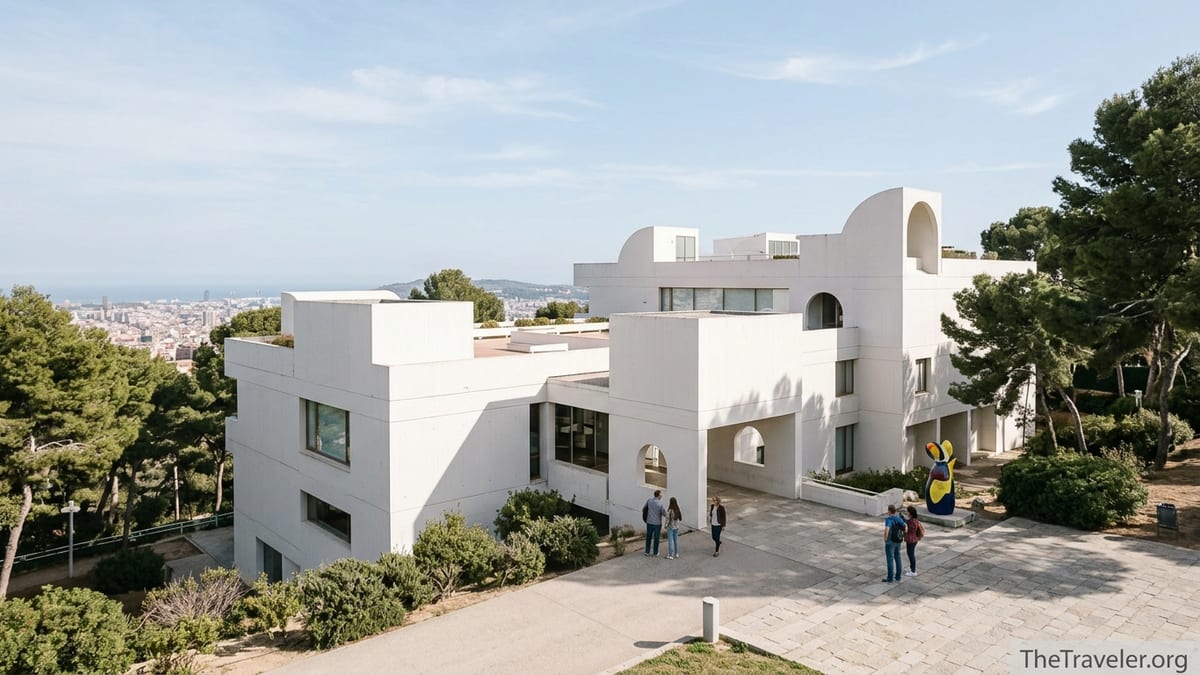
Many of Barcelona’s museums are housed in historic palaces that were later adapted to hold art. Fundació Joan Miró is different. It was conceived from the beginning as an artist’s space, created by Joan Miró himself with his friend, architect Josep Lluís Sert. Opened in 1975 on Montjuïc, the building, the terraces and even the patios were designed to fit Miró’s work, not the other way around. This makes the experience feel more like entering an artist’s universe than walking through a standard gallery.
Where the Picasso Museum occupies a series of medieval palaces in the Gothic Quarter, complete with narrow corridors and stone courtyards, the Miró foundation offers white walls, clean lines and generous skylights that filter Catalan sun into the rooms. The architecture uses courtyards, arcades and roof terraces to create a rhythm between interior and exterior spaces, mirroring Miró’s interest in nature and the Mediterranean landscape. Visitors often comment that they remember the building and its light just as strongly as the artworks themselves.
Compared with MNAC, housed in the grand Palau Nacional with monumental staircases and domes, Fundació Joan Miró feels intimate and human-scaled. Even its entrance, set inside the greenery of Parc de Montjuïc, signals that this is not a palace of state but an artist’s refuge. For travelers who find some big museums overwhelming, this more personal, purpose-built environment can be a welcome change of pace.
The museum’s setting on Montjuïc also shapes the visit. Reaching it usually involves riding the Montjuïc funicular from Paral·lel metro station and then walking through parkland, or taking the red route of the hop-on hop-off bus which stops at “Fundació Joan Miró.” This slow transition from city streets to hillside park quietly prepares visitors for Miró’s world of color, sky and symbols before they even enter the galleries.
The World’s Most Complete Miró Collection
Fundació Joan Miró holds the most important public collection of Miró’s work anywhere. The foundation’s own figures speak of thousands of pieces in different media, from early drawings to late sculptures. For visitors, the practical impact is clear: you can trace an almost complete arc of Miró’s life, which is something no other museum in Barcelona offers for a single artist except perhaps the Picasso Museum.
While the Picasso Museum focuses heavily on Picasso’s formative and early Barcelona years, the Miró foundation presents a wider lifetime panorama. You see figurative early works that show Miró learning traditional techniques, then the gradual abstraction into his signature constellations of signs, stars and biomorphic forms. There are key paintings from the 1920s and 1930s, poetic works from his exile years, and bold, large-scale canvases from the 1960s and 1970s that explode with primary colors and calligraphic brushstrokes.
Crucially, the collection moves beyond painting. Visitors encounter Miró’s ceramics, tapestries and sculptures, many of which are difficult to see elsewhere. A striking example is the playful, brightly colored sculptures on the foundation’s terraces, which interact directly with the Barcelona skyline. This sculptural presence is not something you typically find at the Picasso Museum, where the focus is overwhelmingly on paintings and works on paper, or at MACBA, where sculpture is part of a broader contemporary mix rather than the voice of a single artist.
Because the foundation holds such depth, the curators can rotate works and build thematic displays that go beyond a simple chronological path. On a practical level, this means that a repeat visitor a year or two later is likely to encounter new combinations of paintings, drawings and objects, even if they have already visited the permanent collection once.
Light, Space and the Mediterranean Atmosphere
One of the most distinctive aspects of Fundació Joan Miró, especially when compared with Barcelona’s more traditional museums, is how it uses natural light. Sert’s building incorporates rooflights, large windows and interior courtyards, but the design keeps direct sunlight off the works while allowing a soft, even brightness to fill many galleries. The result is a sense of calm clarity that suits Miró’s vivid palette and helps visitors focus on subtle details of brushwork and texture.
Other major museums in the city offer very different atmospheres. MNAC, in the Palau Nacional, often feels dimmer in its older sections, where preserved church frescoes and medieval altarpieces require lower light levels. The Picasso Museum’s Gothic palaces have charming stone corridors and inner patios, but the flow between rooms can feel more labyrinthine. MACBA, by contrast, leans into white-cube minimalism with large glass façades overlooking Plaça dels Àngels, where skaters perform outside, giving the museum a distinctly urban edge.
At the Miró foundation, the Mediterranean character is more explicit. Many visitors notice how the white concrete, pine trees and bright blue sky recall the landscapes that inspired Miró in Catalonia and on Mallorca. On clear days you can step onto a terrace and see down to the city and the port, then turn back to view a painting that seems to compress that same sky and sea into symbols and color fields. For travelers, it is one of the places in Barcelona where art and place feel most directly connected.
This integration of architecture, setting and art also shapes how long visitors tend to stay. Instead of pushing through rooms to see a few famous works, people often slow down, sitting on benches near the windows or stepping outside between galleries. That relaxed rhythm contrasts sharply with the dense crowds that commonly form in the Picasso Museum’s narrow rooms during peak season, where it can be hard to pause without blocking someone’s view.
Beyond a Shrine: A Living Contemporary Art Center
Although it holds a major historical collection, Fundació Joan Miró is also committed to contemporary art and experimentation. Its Espai 13 program, for example, has long supported emerging artists with site-specific projects. Temporary exhibitions frequently bring in international contemporary work that dialogues with Miró’s legacy, from abstract painting to installation and performance. This dual identity as both historical museum and living laboratory sets it apart from several of Barcelona’s other single-artist foundations.
Museu Picasso, for instance, does host temporary exhibitions, but its core mission remains focused on Picasso’s work and period. The Museu Tàpies explores the work of Antoni Tàpies and broader contemporary themes, yet its building and collection operate on a smaller scale. MACBA and CCCB, on the other hand, are contemporary from top to bottom, but they lack the intimate link to a single artist that gives the Miró foundation such a strong personality.
For visitors, this means a day at the Miró foundation can cover both a deep dive into 20th‑century modernism and a look at cutting-edge practices. In recent seasons, shows have ranged from surveys of Miró’s relationship with poetry to group exhibitions of younger artists responding to political and environmental questions. Travelers who enjoy connecting historical art to current debates often find this mix especially rewarding.
The museum’s role in citywide cultural events also underlines its contemporary energy. During Barcelona’s annual Night of the Museums in May, for example, Fundació Joan Miró participates alongside institutions like MACBA, CCCB, MNAC, the Picasso Museum and Museu Tàpies, opening late into the night and drawing in local audiences that might not otherwise climb up to Montjuïc. For a visitor who times their trip accordingly, experiencing Miró’s work in this festive, open-door context can be particularly memorable.
Practical Visiting Experience: Crowds, Prices and Passes
When comparing museums, the on-the-ground experience matters as much as the art. In recent years, standard adult tickets for Fundació Joan Miró’s collection plus temporary exhibition have typically been in the mid-teens in euros, with a small discount for buying online versus at the ticket office, and reduced rates for students, seniors and certain concession cards. By contrast, the Picasso Museum’s general ticket is usually a little higher, especially when there is a major temporary show, while MNAC’s standard admission is in a similar range but sometimes bundled with special offers or time-limited discounts.
One key advantage of the Miró foundation is crowding. The Picasso Museum, tucked into the narrow streets of El Born and Gothic Quarter, is almost always busy and often sold out in advance for popular time slots. Long lines can form even for those with timed tickets. MNAC is larger and can absorb more people, but certain blockbuster shows bring dense crowds to specific rooms. Fundació Joan Miró, located on Montjuïc with a bit more travel friction, tends to feel calmer on most days outside peak holiday weekends, especially in the morning when the museum first opens.
For travelers planning to see several museums, the Articket Barcelona pass can make a substantial difference. This pass typically includes six major art institutions: Fundació Joan Miró, the Picasso Museum, MNAC, MACBA, CCCB and Fundació Antoni Tàpies, with a single payment that is often cheaper than buying individual tickets to three or more of them. The pass also offers skip-the-line access at many sites, which can be particularly valuable at the Picasso Museum. Choosing the Miró foundation as part of an Articket route lets visitors combine a calm, contemplative Montjuïc visit with more urban museums later in their stay.
Access is straightforward once you understand the options. The Montjuïc funicular from Paral·lel metro station connects directly to the hillside in just a couple of minutes, using the same tickets and passes as the regular metro. From the upper funicular station, it is about a 10 to 15 minute walk through the park to the museum. City buses and tourist hop-on hop-off buses also stop nearby. Visitors with limited mobility may prefer a taxi up the hill, which is usually still reasonably priced given the short distance from central neighborhoods like Poble-sec or El Raval.
Montjuïc: Combining Miró With Other Cultural Sites
Another feature that makes Fundació Joan Miró special is its location within a dense cluster of attractions on Montjuïc. A visitor can easily combine the foundation with MNAC, the Olympic Stadium, the Montjuïc Castle cable car, Caixaforum or the hillside gardens in a single day, creating a varied program that mixes art, history and city views.
One common itinerary is to ride the funicular up in the morning, walk to the Miró foundation for a two to three hour visit, then continue uphill or across the park to MNAC. There, travelers encounter a sweeping survey of Catalan art from Romanesque church frescoes to modern painting. While MNAC’s collection is broader and more historical, seeing it directly after the focused intensity of Miró helps highlight the diversity of Catalan creativity over the centuries.
Others might pair Fundació Joan Miró with MACBA and CCCB in El Raval, creating a cross-city contemporary art day. Some travelers choose to start the morning at the Miró foundation when it is quieter, then ride public transport back down to the city center for an afternoon in MACBA’s bright galleries and CCCB’s thematic exhibitions on cinema, urbanism or digital culture. For visitors comparing which museums to visit in limited time, understanding how easily Miró fits into these wider art routes can be a deciding factor.
There is also a qualitative advantage to Montjuïc itself. Unlike the dense alleyways around the Picasso Museum or the busy avenues near MACBA, the hill’s parks and viewpoints allow for breaks between museum visits. Having a coffee on a terrace overlooking the harbor after walking through Miró’s colors gives travelers time to let the experience sink in, something that can be harder to achieve when shuttling between downtown attractions.
Who Will Appreciate Fundació Joan Miró Most
Every Barcelona museum has a slightly different ideal visitor. The Picasso Museum is crucial for those deeply interested in Picasso’s early years and in seeing how a teenage prodigy developed his skills. MNAC is ideal for travelers who want a sweeping story of Catalan art, especially lovers of medieval frescoes and ornate altarpieces. MACBA appeals strongly to fans of conceptual and experimental contemporary work, while CCCB attracts those interested in culture, film and ideas as much as in traditional art objects.
Fundació Joan Miró tends to resonate with visitors who value color, imagination and a mix of seriousness and play. Travelers who might feel intimidated by very academic museums often find Miró’s language of stars, birds, moons and fantastical shapes easy to connect with, even if they are not seasoned museum-goers. The presence of large sculptures, tapestries and outdoor pieces also makes it engaging for families and for anyone who prefers art they can walk around rather than only view on walls.
The foundation is also a strong choice for people who like architecture. Sert’s building is considered a key work of modern design in Barcelona, distinct from Gaudí’s organic curves yet equally rooted in Mediterranean light and space. Architecture students and photography enthusiasts often spend considerable time capturing the play of shadow in the courtyards or the way the building frames the city views. Compared to the Gothic palaces of the Picasso Museum or the neoclassical grandeur of MNAC, Miró offers a subtler but very coherent architectural experience.
Finally, the museum suits travelers who prefer a slower pace. Because it is slightly removed from the busiest tourist routes, even in high season it often feels more reflective than rushed. Those planning several packed days of sightseeing might schedule the Miró foundation toward the middle of their trip as a kind of artistic retreat, pairing it with a quiet walk through the Montjuïc gardens rather than another crowded downtown attraction.
The Takeaway
What makes Fundació Joan Miró special compared with other Barcelona museums is not a single feature but a combination of factors that are hard to replicate elsewhere. It is a museum designed hand in hand with the artist, filled with the world’s most complete public collection of his work, and set in a building that turns light and space into partners for the art.
When measured against the Picasso Museum, MNAC, MACBA or Museu Tàpies, the Miró foundation stands out for its balance of focus and openness: focused in its dedication to one artist’s universe, open in its role as a contemporary art laboratory and its invitation to wander between gallery and garden. Its location on Montjuïc, its manageable crowd levels and its role in citywide cultural life make it both a destination in itself and a flexible anchor for broader art itineraries.
For travelers deciding how to spend limited time in Barcelona, this means that Fundació Joan Miró is more than just another museum on a checklist. It is a place where the city’s sky, its modern architecture and one of its greatest artists come together in a way that feels uniquely Barcelona. If you want an art experience that is both deeply rooted in the city and pleasantly removed from its busiest streets, it deserves a firm place on your list.
FAQ
Q1. How long should I plan for a visit to Fundació Joan Miró?
Most visitors are comfortable with about two to three hours inside the museum, including time for the permanent collection, any temporary exhibitions and a short break on the terraces or in the café. Art enthusiasts who like to read wall texts carefully or sketch may want closer to three hours.
Q2. Is Fundació Joan Miró a better choice than the Picasso Museum if I only have time for one?
It depends on your interests. Choose the Picasso Museum if you are specifically passionate about Picasso or want to see his early Barcelona years. Pick Fundació Joan Miró if you prefer a calmer experience in a modern building, with more space, outdoor terraces and a very complete view of one artist’s mature work alongside contemporary projects.
Q3. How does the ticket price compare with other major Barcelona museums?
Standard adult tickets for Fundació Joan Miró’s collection plus temporary exhibitions are usually in the mid-teens in euros, broadly comparable to MNAC and a little below or similar to the Picasso Museum when special shows are running. Prices can change, and there are reduced rates for students, young people and some concession cards, so it is worth checking the latest information before visiting.
Q4. Is Fundació Joan Miró suitable for children and families?
Yes. The colorful artworks, large sculptures and outdoor spaces tend to appeal to children more than some very traditional museums. Families often appreciate that the building is bright and not overwhelmingly large. Depending on the season, the museum may offer family-friendly activities or educational materials that help younger visitors engage with Miró’s symbols and stories.
Q5. What is the best way to get to the museum using public transport?
The most straightforward route is to take the metro to Paral·lel station and then transfer to the Montjuïc funicular, which is included in standard public transport tickets. From the upper funicular station it is about a 10 to 15 minute walk through the park to the museum. Several city buses and tourist hop-on hop-off buses also stop near the entrance, and taxis from central neighborhoods are usually quick and reasonably priced.
Q6. Can I visit Fundació Joan Miró and MNAC on the same day?
Yes, combining the two makes an excellent Montjuïc art day. Many visitors spend the late morning at the Miró foundation, have lunch nearby or at a viewpoint café, then continue to MNAC in the afternoon. The walk between the two takes around 15 to 20 minutes through park paths, with good views of the city.
Q7. Is the museum very crowded, and do I need to book in advance?
Fundació Joan Miró is generally less crowded than the Picasso Museum, especially outside peak summer weekends and holidays. It can still be busy at popular times, but the building handles visitors well. Booking in advance is helpful during high season or if you are on a tight schedule, while in quieter periods you can often buy a ticket on arrival without long waits.
Q8. How does Fundació Joan Miró compare with MACBA for contemporary art lovers?
MACBA is a dedicated contemporary art museum with a broad international collection and frequently changing exhibitions. Fundació Joan Miró combines a deep historical focus on Miró with a robust program for contemporary artists. If you are very interested in current global trends, MACBA is essential, but the Miró foundation offers a compelling bridge between 20th‑century modernism and today’s practices.
Q9. Are there good views of Barcelona from the museum?
Yes. One of the highlights of Fundació Joan Miró is its position on Montjuïc, which offers sweeping views over the city and the port from terraces and nearby viewpoints. Many visitors take a few minutes between galleries to step outside, enjoy the scenery and photograph the skyline framed by Miró’s outdoor sculptures.
Q10. Is Fundació Joan Miró accessible for visitors with reduced mobility?
The museum building itself has lifts and ramps to help visitors move between levels, but its hillside location means that reaching the entrance can involve some slopes. Travelers with reduced mobility often find it easiest to arrive by taxi or a vehicle that can stop close to the door, rather than walking up from the funicular or bus stops. It is advisable to check current accessibility details in advance and allow a little extra time for the approach.