


Landing at Ezeiza International Airport for the first time can feel overwhelming. You step off a long-haul flight, face immigration lines, a new currency, aggressive taxi offers, and the challenge of reaching central Buenos Aires, which lies roughly 30 to 40 minutes away by car depending on traffic. This guide walks you, step by step, through Ezeiza (officially Ministro Pistarini International Airport) and your first hours in Argentina’s capital, with concrete examples on transport, money, SIM cards, and essential city tips so you can arrive confident and prepared.
Get the latest updates straight to your inbox!
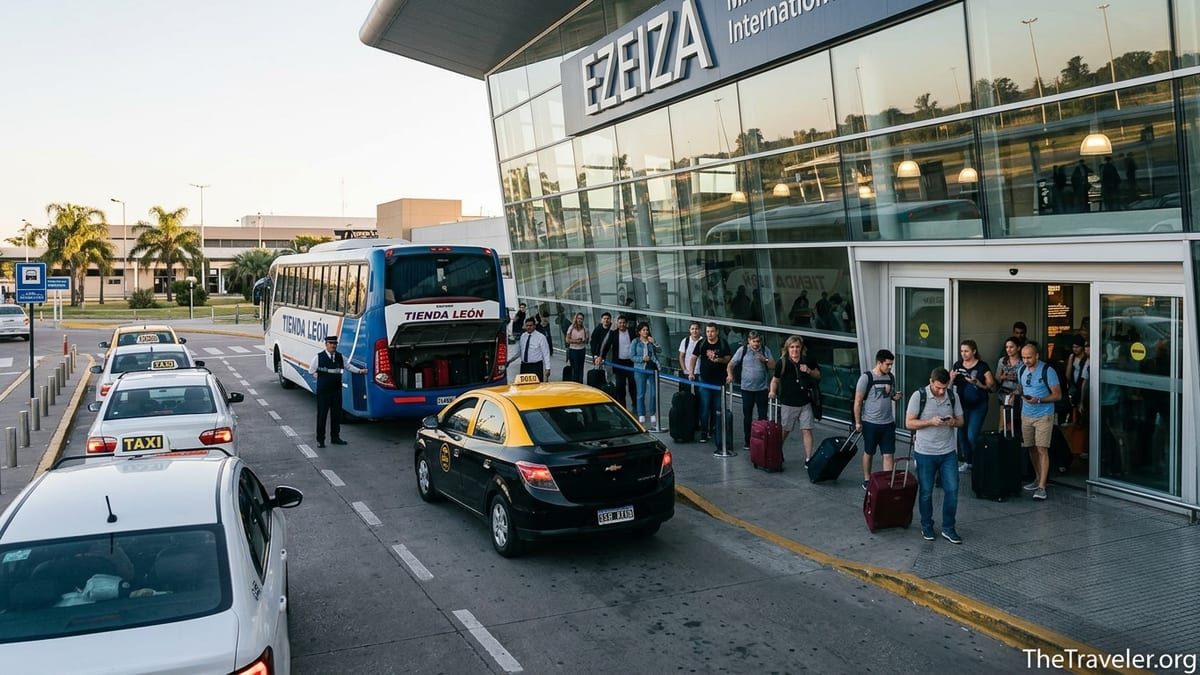
Understanding Ezeiza Airport’s Layout and Arrival Flow
Ezeiza is Argentina’s main international gateway, located in the suburb of Ezeiza south-southwest of the city. The airport complex today effectively works as a unified terminal system for most travelers, but it is still helpful to think in terms of three passenger terminals historically known as A, B, and C, plus a newer departures building that has been opened in stages since 2023. In practice, your experience will be straightforward: international flights arrive into a common arrivals area, and you will follow standard signage for immigration, baggage claim, and customs before entering the public arrivals hall.
After disembarking, you first reach immigration. Lines can range from 10 minutes to over an hour depending on how many widebody flights land at the same time, particularly in the early morning when several overnight flights from North America and Europe arrive. For example, if you land at 7:30 a.m. on a busy day from New York, you might encounter passengers from Madrid, Paris, and São Paulo in front of you. There is usually a separate line for Argentine citizens and residents and another for foreign passport holders. Have your passport, completed arrival card if provided on the plane, and any required visa details ready.
Once stamped in, you proceed to baggage claim. Carousels are clearly numbered by flight. Trolleys are available and useful if you have multiple large suitcases, though you may need small change or a credit card depending on the machine in use when you arrive. Customs screening is normally light, but random bag checks are possible. You will place your luggage through an x-ray scanner or walk through a green corridor if directed, then emerge into the main public arrivals hall where you will find ATMs, currency exchange booths, mobile phone counters, transport desks, and waiting friends and family.
The public arrivals hall is where most important services cluster. You will see official taxi and remis counters, the Tienda León shuttle desk, currency exchange with bright signage, and often representatives handing out flyers or trying to sell transfers. This is also where you should slow down, ignore any pushy touts, and take a few minutes to organize your money, phone connectivity, and transfer before heading toward the city.
Immigration, Safety, and What to Expect in the Arrivals Hall
For most nationalities arriving as tourists, immigration at Ezeiza is a standard process: the officer checks your passport, may ask for proof of onward travel or accommodation, and records your entry digitally. It is wise to have a printed or easily accessible confirmation of your first hotel or apartment booking and your return or onward flight, especially if you are on a long multi-country trip. Keep your passport in a zippered pocket or money belt as you move from the aircraft to the immigration lines to avoid fumbling with bags at the last moment.
Security in the arrivals area is generally good, with visible police and airport staff. That said, like in any large Latin American gateway, petty theft is a risk wherever tired travelers juggle luggage and phones. As soon as you collect your bags, close all zippers, keep valuables in front pockets or interior compartments, and avoid leaving items unattended on trolleys. If someone you did not request insists on helping with your bags or guides you assertively toward a particular taxi, you can simply say “No, gracias” and walk to an official counter instead.
In the arrivals hall, you will immediately notice a mix of services: ATMs lining the walls, exchange counters with large digital rate boards, a few cafes and snack stands, convenience shops, and telecom company desks or kiosks. The atmosphere can be noisy and crowded during peak times. Give yourself permission to pause, sit at a cafe with a coffee and bottled water, and decide on your next steps. Rushing directly out to the curb often leads first-time visitors into overpriced or unofficial taxis.
If you are being met by a prearranged driver or a hotel representative, they will typically wait just beyond the sliding doors in the public area holding a sign with your name. Confirm your name and the hotel or agency before following anyone. Many legitimate transfer companies also send the driver’s name and vehicle plate in advance by email or message, which provides an extra safety check in case of confusion.
Getting from Ezeiza to Buenos Aires: Taxis, Uber, Cabify, and Tienda León
Reaching central Buenos Aires from Ezeiza typically takes 30 to 50 minutes by car, depending on traffic and your exact neighborhood. You have four main options: official airport taxis or remises, app-based rides such as Uber and Cabify, shared or semi-private airport shuttles like Manuel Tienda León, and in some cases public buses. For most first-time visitors, a pre-paid official taxi, a Cabify ride, or Tienda León will be the most straightforward and secure choices.
The simplest option for many travelers is an official taxi booked inside the terminal. Look for the official taxi or remis desks just after you exit customs into the public hall. You tell the clerk your destination, for example “Recoleta” or “Palermo,” pay in pesos or by card at the counter, and receive a printed receipt. A mid-range fare into central neighborhoods may be in the ballpark of 30 to 45 US dollars equivalent for up to three passengers, but inflation and exchange rates change frequently, so think in terms of relative price rather than a fixed number. The key advantage is safety and clarity: the fare is set, the taxi is registered, and you do not negotiate at the curb.
Ride-hailing services operate in a gray legal area but are widely used by locals and visitors. Many travelers use Uber or, increasingly, Cabify from Ezeiza to the city. The typical process is to connect to airport Wi-Fi or your new SIM, request a ride, and follow the app’s instructions to a pickup point, usually at a designated curb or parking area. In practice, Cabify often has better availability and slightly more professional drivers in Buenos Aires, while Uber may show more cars at off-peak hours. An app ride from Ezeiza to a central area can often be cheaper than an official taxi, for example roughly equivalent to 20 to 35 US dollars at recent price levels, though surge pricing and peso volatility make exact quotes unreliable in print.
Manuel Tienda León is the iconic shuttle bus linking Ezeiza with downtown. Its counters are located in the arrivals hall; staff can sell you a ticket on the spot. Buses run to the company’s Terminal Madero in central Buenos Aires, near the Retiro transport hub and Puerto Madero district. From there you can connect to metered taxis, rideshare apps, or simply walk if your hotel is close. The shuttle is attractive for solo travelers or couples on a budget who prefer a predictable price. As a rough orientation, a one-way adult ticket is often less than half the price of a private taxi, and you can sometimes add a hotel drop-off supplement to be transferred from the bus terminal directly to your accommodation in a smaller vehicle.
Public bus line 8 technically connects Ezeiza with central Buenos Aires and is very inexpensive, typically a fraction of a US dollar equivalent when paid with a rechargeable SUBE transit card. However, the ride can take two hours or more with frequent stops, and you must handle luggage on a standard city bus. For a first-time visitor arriving from an overnight flight, this is generally not recommended unless you are on a shoestring budget, speak some Spanish, and are comfortable with local bus systems. For most travelers, a taxi, Cabify, Uber, or the Tienda León shuttle provides a better balance of comfort, safety, and simplicity.
Money at Ezeiza: ATMs, Currency Exchange, and Practical Strategies
Argentina’s currency environment is complex, with multiple exchange rates and high inflation. This means that any single peso amount printed today can be outdated quickly. Instead of chasing an exact number, think in terms of strategy. At Ezeiza, you will find ATMs from major Argentine banks and at least one official exchange house in the arrivals area. These services are convenient but often come with higher fees or less favorable exchange rates than you might obtain later in the city.
A common tactic among frequent travelers is to use Ezeiza only for a small starter amount of cash. For example, exchange or withdraw enough pesos to cover your taxi or Tienda León ticket plus a bit of extra for small purchases, then wait to handle larger currency needs at reputable cambios in central Buenos Aires. At the airport, you might exchange the equivalent of 50 to 100 US dollars to get through the first 24 hours, while paying for larger items like accommodation and restaurant meals with a credit or debit card that offers a competitive rate.
ATMs at Ezeiza are convenient but can charge substantial fixed fees per withdrawal, and they may have relatively low per-transaction limits. If your home bank refunds foreign ATM fees, withdrawing pesos at the machine can still be reasonable, but expect that the rate and total cost may not be optimal. Some travelers report occasional technical issues, such as a machine being out of service or declining foreign cards, so do not wait until you are down to your last dollar before trying. It is smart to carry a backup card and a small reserve of US dollars or euros as a safety net.
For card payments inside Argentina, recent regulations have often made foreign card purchases convert at a more favorable “tourist” or “digital” rate compared with the official rate used for government exchange counters. This can make paying by card in shops and restaurants in Buenos Aires surprisingly good value compared with exchanging large amounts of cash at the airport. Your exact experience will depend on your card issuer and the rules in effect at the time of your visit, but as a first-time traveler you will usually be better off limiting airport currency exchanges to essentials rather than converting your full holiday budget on arrival.
Staying Connected: SIM Cards, eSIMs, and Airport Wi-Fi
Reliable mobile data makes the arrival process at Ezeiza far easier, especially if you plan to use ride-hailing apps or navigate public transport. The main mobile operators in Argentina are Claro, Personal, and Movistar. In the arrivals hall you may find branded counters or small shops for at least one of these companies, most commonly Claro or Personal, as well as multi-brand convenience kiosks selling prepaid SIMs. Opening hours can vary, and some travelers arriving in the very early morning have found telecom desks closed and only expensive third-party SIM offers available.
If you plan to buy a physical SIM at the airport, have your passport handy. Registration may be required, and staff will often ask to see your passport information page. Tourist data packs commonly include a set amount of high-speed data plus unlimited use of messaging apps like WhatsApp for about one to four weeks. Due to inflation, it is better to think of pricing in relative terms: a one-week or ten-day tourist data package is typically inexpensive compared with your flight, often in the range of a few to perhaps twenty US dollars equivalent depending on promotions. Be cautious if a kiosk quotes a price that seems wildly out of step with local costs, for instance asking for the equivalent of 30 or 40 US dollars for only a couple of gigabytes with no clear justification.
Many visitors now arrive with an eSIM already purchased from an international provider that works in Argentina. This can be activated before landing or as soon as you connect to airport Wi-Fi. An eSIM avoids hunting for a counter and works well for phones that support it. However, a local SIM from Claro, Personal, or Movistar may provide better local coverage or value if you are staying longer than a couple of weeks or traveling into rural areas. For a short first-time stay focused on Buenos Aires, any of the three major networks should be adequate, with Personal and Claro often cited as slightly stronger in urban neighborhoods.
Ezeiza offers free Wi-Fi in the terminal buildings, which is usually sufficient to order a rideshare or send arrival messages. Connection speeds and reliability can vary when the terminal is crowded. It is wise to take screenshots of your accommodation address and any important contact numbers before you travel, so you can show them to taxi drivers even if your connection drops. Once you reach your hotel or apartment, you can always fine-tune your mobile setup by visiting an official carrier shop in neighborhoods like Microcentro, Palermo, or Recoleta, where staff can explain current tourist packages in detail.
First-Time Tips for Navigating Buenos Aires After Ezeiza
Once you leave Ezeiza behind and approach the city, the scale of Buenos Aires becomes clear. This is a vast urban area with a European-influenced center, historic neighborhoods, and a busy modern transport network of buses, suburban trains, and six metro lines. For your first day, keep logistics simple: plan to check in, shower, and have a light meal before trying to sightsee aggressively, especially if you have crossed several time zones. Many visitors choose central districts such as Recoleta, Palermo, San Telmo, or Microcentro for their first stay because they balance walkability, dining options, and access to transport.
For getting around the city, the SUBE rechargeable transit card is essential if you plan to use buses or the subway. You can buy or top up a SUBE card at kiosks, subway stations, and some lottery stands. Occasionally they are also available at or near the airport, but stock can be inconsistent, so assume you will purchase one in town. Fares in Buenos Aires are relatively low by international standards, but they have been rising, so check the current rate at your hotel or a station. Even if you mostly use taxis and ride-hailing apps, having a SUBE card makes it easy to hop on the subway during rush hour when traffic is heavy.
Safety in Buenos Aires is similar to other major Latin American capitals. Violent crime against tourists is relatively rare in central neighborhoods, but opportunistic theft occurs, especially in crowded streets, on the subway, and in busy pedestrian areas. As a first-time visitor, basic precautions go a long way: keep your phone out of sight when standing near the curb, avoid wearing flashy jewelry, use cross-body bags with zippers, and do not leave bags hanging on the back of cafe chairs. At night, use taxis, Cabify, or Uber rather than walking long distances in unfamiliar areas.
Culturally, expect late dinners, strong coffee, and a social rhythm that starts later than in many North American or European cities. Most restaurants in central areas begin to fill after 9:00 p.m., and many bars are quiet until well after 11:00 p.m. On your first night, you might choose an early dinner by local standards in a neighborhood like Palermo Soho, then take a short taxi back to your hotel before midnight while your body clock adjusts. Plan calmer activities for the first day such as a stroll through Recoleta Cemetery and its surrounding plazas rather than a packed itinerary that has you crossing the city multiple times.
Practical Examples: A Smooth First 24 Hours from Plane to Plaza
To make the information more concrete, imagine a typical first-time visitor arriving from the United States. Your flight lands at Ezeiza at 8:15 a.m. After disembarking, you spend about 40 minutes in immigration and another 20 waiting for luggage. By roughly 9:30 a.m., you walk into the arrivals hall. You withdraw a modest amount of pesos from an ATM, enough to cover a taxi and incidental expenses, then walk to the official taxi desk and tell them you are going to a hotel in Recoleta. You pay with your card, receive a printed voucher with the fare and vehicle number, and follow the staff member guiding you to the corresponding taxi outside.
The drive into the city takes about 40 minutes in mid-morning traffic. Your driver may offer basic conversation in Spanish; if you do not speak the language, a simple “Buenos días” and showing the hotel address on your phone is sufficient. You arrive at your hotel around 10:15 or 10:30 a.m., drop your bags, and perhaps leave them at reception if your room is not ready yet. The front desk clerk suggests a nearby cafe where you can have your first medialunas and café con leche. On the way, you stop at a local kiosk to buy and load a SUBE transit card, following the clerk’s instructions to load a small amount of credit for your first few rides.
In the afternoon, you take a short taxi to Recoleta Cemetery, paying by card or in pesos, and then wander through the leafy streets of the neighborhood, getting a feel for the city’s pace. You use your hotel’s Wi-Fi to download an offline map and confirm the location of a Claro or Personal store nearby where you can compare data plans the next day if you did not sort a SIM at the airport. That evening, you have dinner at a parrilla within walking distance and return to your hotel by 11:00 p.m., using a Cabify or Uber booked over Wi-Fi if you are not comfortable hailing a street taxi.
For a second scenario, imagine a budget-conscious solo traveler arriving at 5:30 p.m. from Europe. After immigration and baggage claim, you reach the Tienda León counter at around 7:00 p.m. and buy a shuttle ticket to Terminal Madero. You pay with a credit card, then wait in the seating area until your bus boarding is called. The ride into town takes about an hour in evening traffic. At Terminal Madero, you connect to a pre-booked small transfer van or call a rideshare to your hostel in San Telmo, which is a short drive away. This layered approach costs less than a direct taxi from Ezeiza while still keeping navigation manageable on your first evening.
FAQ
Q1. How long does it usually take to get from Ezeiza Airport to central Buenos Aires?
In normal traffic, expect about 30 to 50 minutes by car from Ezeiza to central neighborhoods like Recoleta, Palermo, San Telmo, or Microcentro. During rush hours or when there are accidents on the main highway, the trip can stretch toward an hour.
Q2. Is it better to take a taxi, Uber, Cabify, or Tienda León from Ezeiza?
For first-time visitors, official taxis or remises booked inside the terminal and the Tienda León shuttle are the simplest and most predictable. Uber and Cabify can be cheaper and are widely used, but require mobile data or Wi-Fi and a bit more confidence finding the pickup point. Solo travelers and couples on a budget often choose Tienda León, while families or those with heavy luggage tend to prefer a private taxi or rideshare.
Q3. Can I pay for my taxi from Ezeiza with a credit card?
Yes, if you book through an official taxi or remis desk inside the arrivals hall, you can usually pay at the counter by credit or debit card in pesos. Street taxis outside may not accept cards reliably, so for your first ride it is safer to pay at the official desk or use an app-based service linked to your card.
Q4. Should I exchange a lot of money at Ezeiza Airport?
Generally no. Exchange counters at the airport tend to offer less favorable rates than reputable cambios in the city, and Argentina’s exchange system changes often. A practical approach is to exchange or withdraw only enough pesos to cover transport and small first-day expenses, then handle larger currency needs in Buenos Aires once you have more time to compare options.
Q5. Are there ATMs at Ezeiza, and do they work with foreign cards?
Yes, there are multiple ATMs operated by major Argentine banks in the arrivals area and elsewhere in the terminal. Many foreign cards work, but fees can be high and per-withdrawal limits relatively low. It is wise to bring at least two different bank cards, notify your bank of your travel plans in advance, and not rely on a single machine or card for all your cash needs.
Q6. Can I easily buy a local SIM card on arrival at Ezeiza?
Often yes, but not always on the best terms. Depending on your arrival time, you may find official Claro or Personal counters offering tourist SIM packs, or third-party kiosks selling prepaid SIMs. Some travelers report high prices or limited data at certain airport kiosks, especially late at night or early in the morning. If prices at the terminal seem unreasonable, you can rely on airport Wi-Fi to reach your hotel and then visit an official carrier shop in the city to buy and activate a SIM at local rates.
Q7. Is it safe to arrive at Ezeiza late at night?
Arriving late at night is common on intercontinental flights, and the airport remains active around the clock. Inside the terminal, security presence is visible and the environment is generally safe. For transfers, use official taxi desks, pre-booked hotel transfers, or established ride-hailing apps. Avoid following unsolicited drivers or accepting rides from people approaching you aggressively in the arrivals hall or outside.
Q8. What is the best neighborhood in Buenos Aires for first-time visitors arriving via Ezeiza?
There is no single best neighborhood, but Recoleta, Palermo, San Telmo, and parts of Microcentro are popular choices for first-timers. Recoleta and Palermo are known for their leafy streets, restaurants, and cafes; San Telmo has more colonial charm and cobblestone streets; Microcentro offers proximity to landmarks but can be quieter and more business-focused at night. All are reachable from Ezeiza by taxi or shuttle in similar travel times.
Q9. Do I need to speak Spanish to navigate Ezeiza and reach my hotel?
No, but a few basic Spanish phrases help. Airport signage uses international symbols and English alongside Spanish, and many staff at official taxi desks, shuttle counters, and major hotels speak at least some English. Have your hotel name and address written down or saved on your phone to show drivers, and learn simple phrases like “Por favor, lléveme a esta dirección” to make interactions smoother.
Q10. Can I connect from Ezeiza to a domestic flight within Argentina?
Yes, but pay close attention to which airport your onward flight uses. Many domestic and regional flights depart from Aeroparque Jorge Newbery, a separate airport closer to the city center. If you are landing at Ezeiza and connecting to a domestic flight from Aeroparque, you will need to transfer between airports by taxi, shuttle, or private transfer, which can take around an hour or more depending on traffic. If both flights use Ezeiza, follow the internal transfer signage or ask ground staff for guidance, and allow extra time for check-in and security.