


More news on this day
Formula 1 is pressing ahead with this week’s Azerbaijan Grand Prix in Baku, even as governments highlight heightened security risks in the wider region and advise travelers to avoid areas close to the Iranian border.
Get the latest news straight to your inbox!
Race weekend proceeds on compressed Thursday to Saturday schedule
The 2026 Azerbaijan Grand Prix remains on the official Formula 1 calendar as Round 15 of the season, with the event scheduled in Baku from Thursday 24 to Saturday 26 September. The Baku City Circuit will once again host the street race, which has become one of the championship’s most distinctive venues, combining tight turns around the Old City with long, high-speed straights on the Caspian Sea waterfront.
According to the latest timetable published by Formula 1, practice and qualifying sessions have been shifted forward to accommodate a rare Saturday grand prix. The calendar was updated earlier this year after organizers requested that the race be moved from Sunday 27 September to Saturday 26 September to avoid clashing with a national day of mourning. As a result, the Azerbaijan Grand Prix opens a late-season stretch of long-haul events that continues with races in Bahrain, Singapore, the United States, Mexico, Brazil, Las Vegas, Qatar and Abu Dhabi.
The Baku weekend also marks ten years since the inaugural Azerbaijan Grand Prix joined the championship. Over that decade the circuit has developed a reputation for unpredictable racing and frequent safety car interruptions, with narrow walls, variable wind conditions and slipstream-heavy straights contributing to incidents and surprise podium finishers.
Race organizers and local tourism bodies are continuing to promote Baku as a showcase destination despite regional instability. Public materials emphasize the city’s modern waterfront, hotel capacity and public transport links, as well as the compact nature of the street circuit, which allows spectators to stay within the urban core without traveling near sensitive border areas.
Heightened regional risk shapes official travel advisories
While the race itself takes place in Baku on the Caspian coast, several governments are flagging broader security concerns across the South Caucasus and around Iran. The latest public advisory from the United States for Azerbaijan cites an ongoing risk of drone and missile attacks linked to the conflict between Iran and a U.S.-led coalition and notes that U.S. personnel are barred from non-official travel near the country’s southern border.
That advisory classifies travel to Azerbaijan at an intermediate warning level and includes a specific instruction to avoid areas within roughly 5 kilometers of the frontiers with Iran and Armenia. It also states that the U.S. government has limited ability to provide emergency assistance in border regions and that movements of official staff outside Baku are restricted during periods of elevated tension.
Separate security alerts covering Iran describe limitations and periodic closures at land crossings into neighboring states, including Azerbaijan. One recent notice highlights that access for U.S. citizens from Iran into Azerbaijan has been curtailed during spikes in regional tension, referencing previous episodes when fighting in the Gulf prompted tighter controls at shared borders.
European governments carry similar warnings, advising against travel near the conflict-affected border areas and highlighting the risk of sudden changes in entry rules. However, most current advisories stop short of discouraging travel to Baku itself, instead drawing a clear distinction between the capital and southern or western frontier zones that are geographically distant from the race venue.
Border restrictions and route changes for fans approaching from Iran
The complex security environment along Iran’s borders is directly affecting overland travel plans for some race-going fans. Publicly available U.S. and European notices on Iran stress that land crossings can close with little warning and that foreign nationals may face heightened scrutiny when attempting to leave Iran via neighboring states, including Azerbaijan. Travelers are advised to have alternative exit routes and to avoid assuming that a particular checkpoint will be open on a given day.
Recent security communications focused on Iran underline that, in times of heightened tension, border authorities may restrict crossings for certain nationalities altogether. One January 2026 alert noted that entry from Iran into Azerbaijan had previously been restricted for U.S. passport holders during regional crises, warning that similar measures could reappear without advance public notice if the security situation deteriorates.
For spectators considering combining an overland trip through Iran with attendance at the grand prix, these advisories effectively narrow the viable options. Travel experts and regional policy briefs point out that the South Caucasus sits at the intersection of multiple conflicts, including the ongoing confrontation involving Iran to the south and the war in Ukraine to the north, increasing the likelihood of sudden policy shifts at border posts.
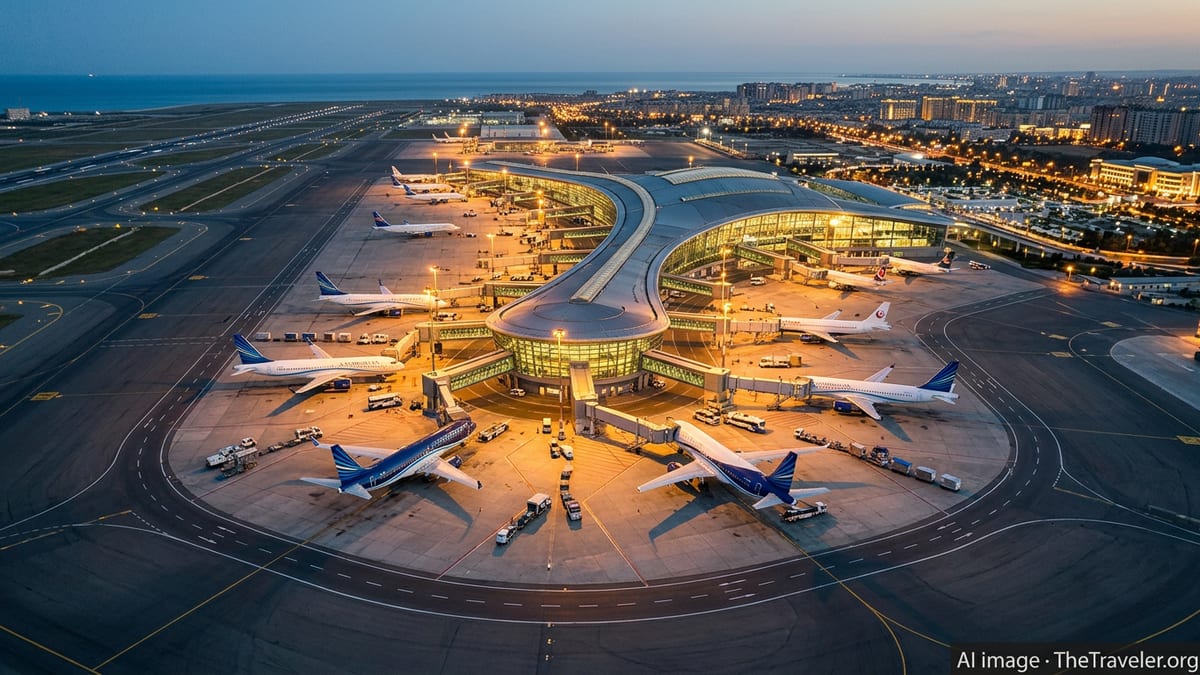
As a result, many travel agencies that cater to motorsport fans are currently steering customers toward air routes directly into Baku rather than transiting via Iran or other neighboring states. Published itineraries emphasize flights through hubs such as Istanbul, Doha and Dubai, with onward connections to Heydar Aliyev International Airport, allowing visitors to bypass overland segments near sensitive borders.
Local security posture in Baku and implications for visitors
Within Azerbaijan, public information from security analysts and regional think tanks indicates that the government has strengthened its domestic security posture during the Iran crisis, particularly around major infrastructure and high-profile events. Previous editions of the Azerbaijan Grand Prix have already involved extensive road closures, layered access checks and visible policing along the circuit and in fan zones, and analysts expect those measures to remain in place or intensify for the 2026 race.
For visitors, the main practical effect is likely to be longer transit times between the airport, hotels and grandstand areas, especially around session start and finish times. Fan guides produced in previous years highlight that Baku’s narrow streets can quickly become congested when roads are closed for Formula 1 and recommend walking or using public transport wherever possible within the central zone. With additional security screening anticipated this year, spectators are being encouraged through media coverage to arrive early for each session.
Despite regional concerns, there have been no publicly reported decisions by Formula 1 or the governing body to relocate or postpone the event. The race remains listed unchanged on the official sporting calendar approved by the World Motor Sport Council, and ticketing outlets continue to sell three-day passes and grandstand seats for the late-September dates.
Risk assessments published by academic and policy institutions note that, while Azerbaijan’s southern border area is exposed to spillover from the Iran crisis, Baku itself lies several hundred kilometers to the north and has not been a direct theater of hostilities. These analyses generally characterize the capital as more stable than frontier regions but stress that any significant escalation in regional conflict could alter the threat picture and trigger rapid changes in event planning or travel policy.
What international visitors should monitor in the days before departure
With the grand prix taking place only days away, prospective travelers are being urged in open-source guidance to monitor multiple information channels rather than relying solely on initial booking assumptions. Key items to track include government travel advisories for Azerbaijan and neighboring states, updates from airlines on routing or schedule changes through the Gulf and the South Caucasus, and official F1 communications regarding the race weekend timetable.
In recent months, volatility around the Iran conflict has led airlines to periodically alter flight paths and, in some cases, suspend services over or near Iranian airspace. Travelers booked on connecting flights through impacted hubs may face last-minute time changes or reroutings, even if Baku itself remains open as a destination. Industry coverage recommends confirming flight status repeatedly in the 48 hours before departure and allowing extra transfer time at intermediate airports.
Insurance considerations are also receiving greater attention this season. Policy documents and consumer advisories stress that many standard travel insurance products exclude coverage for disruptions linked to declared conflicts, missile attacks or government-imposed airspace closures. Fans planning costly long-haul trips to Azerbaijan are therefore being encouraged by consumer watchdogs to check the fine print of their policies and to consider specialist coverage that explicitly addresses war-related disruptions if they view the risk as material.
For now, with Baku’s streets being prepared for another high-speed weekend and the championship entering a critical phase, the Azerbaijan Grand Prix is set to proceed under a spotlight that extends well beyond lap times. The event has become a focal point in the conversation about how global sports navigate tournaments in regions touched by geopolitical confrontation, and the 2026 edition will test how comfortable fans and organizers are with that balance.